
For one straightforward Ottawa rental, DIY landlord apps usually mean lower direct management costs, while full-service management trades a fee for professional oversight and less day-to-day work. Choosing between DIY landlord apps and full-service management in Ottawa depends on more than the monthly bill: your time, tenant turnover, maintenance coordination and rent collection all affect the value.
It’s understandable to want to keep costs down when you own a single property, especially if rent arrives regularly and there are few issues to manage. But an app can organize tasks without taking responsibility for the work behind them. A quiet tenancy can look very different from a turnover or repair-heavy year.
This comparison explains how to assess annual costs, setup and maintenance charges, vacancy and tenant-placement scenarios, and the practical differences in rent collection. You’ll come away with a clearer way to decide whether managing the property yourself makes sense or professional support better fits your time and circumstances.
Key Takeaways
- Compare the annual management cost with the time and administrative work you would take on yourself, not just the monthly fee.
- Include tenant placement and other turnover-related charges when estimating costs for a year with a vacancy.
- Look beyond rent collection automation to consider who handles follow-up, tenant communication and payment records.
- Use your property’s complexity, turnover likelihood and available time to decide whether professional management is worth considering.
Is property management worth it for one property?
For one Ottawa rental, the decision depends on the management agreement, the tasks covered and your available time. A landlord app can organize records, but the owner remains responsible for managing the tenancy.
DIY Landlord Apps Compared with Full-Service Management
A useful way to compare DIY landlord apps versus full-service management in Ottawa is to list who handles each recurring task. An app can support payment tracking and record organization, while the owner manages tenant communication and decisions.
Full-service management typically coordinates tenant screening, rent collection, maintenance and financial reporting. For a single property, weigh those responsibilities against the time you can give the rental and your comfort handling tenant issues directly.
Ottawa Management Fee Structures
Ottawa managers commonly calculate ongoing fees as a percentage of rent collected; flat monthly fees are less common. Tenant-placement charges may be separate, and the agreement determines whether management fees apply during vacancy.
Compare annual costs by separating recurring management charges from services billed only when needed. The same monthly rate can produce different totals if a tenant leaves or the agreement treats vacant periods differently.
Management Packages and Included Services
Packages differ in scope. Full-service arrangements typically include rent collection, maintenance coordination, tenant communication and financial reporting, while a narrower package can leave more administration with the owner.
For tenant screening, lease documents, repairs and payment follow-up, identify who handles each task. The choice between DIY landlord apps and full-service management in Ottawa becomes clearer when you map responsibilities alongside charges.
| Option | Owner’s role | Typical scope |
|---|---|---|
| DIY app | Handles decisions and follow-up | Digital organization |
| Full-service management | Delegates agreed tasks | Coordinated rental management |
Ottawa’s Rental Housing Property Management By-law requires landlords and property managers to respond to urgent tenant service requests within 24 hours, and non-urgent requests within seven (7) days. A rental’s documentation and response process are practical factors when comparing the options.
Choose the arrangement that matches the responsibilities you want to keep and the work you’d rather delegate.
Are there hidden fees like setup or maintenance mark-ups?
Yes. A monthly percentage may not cover every charge during a tenancy. Ottawa management agreements can list separate setup, tenant-placement, inspection, notice-preparation, after-hours emergency or maintenance-coordination charges. The agreement also determines whether fees apply while the property is vacant. These items can change the annual total, particularly when a tenant leaves and the unit needs preparation and leasing work.
Tenant placement is a key turnover cost to clarify. It may be billed separately from ongoing management, so a year with a new tenant can cost more than a stable tenancy. Look at what placement covers: advertising, screening, lease documents and move-in coordination are distinct tasks. A tenant placement service can help organize that transition, while the agreement should make any charges and included work clear.
Ontario landlords must follow the Residential Tenancies Act and applicable rules for forms, timing, notices and records. For non-payment, a tenant receiving an N4 notice has 14 days to pay or move. If the matter proceeds to the Landlord and Tenant Board, organized rent records, notices and communication help document the case. Management support can coordinate records and procedural tasks, but should not be confused with legal representation.
Ottawa’s Rental Housing Property Management By-law also sets tenant-information requirements. Landlords must provide two copies with the lease, one for the tenant and one signed copy retained by the landlord. If information changes, a revised copy is due within 30 days of modification. A replacement copy must be provided within 15 days of a tenant’s request, and records retained for six (6) months following termination of occupancy.
Accommodation requests and tenant support require careful, consistent records. Keep the request, response and relevant communications together, and record any resulting change in arrangements. Inspections or maintenance coordination may also carry separate charges under an agreement, so distinguish the service itself from its fee.
Before comparing options, group charges by monthly management, annual administration and tenant-turnover events. That breakdown reveals which costs recur and which arise only when a tenant changes.
Annual management costs and turnover scenarios
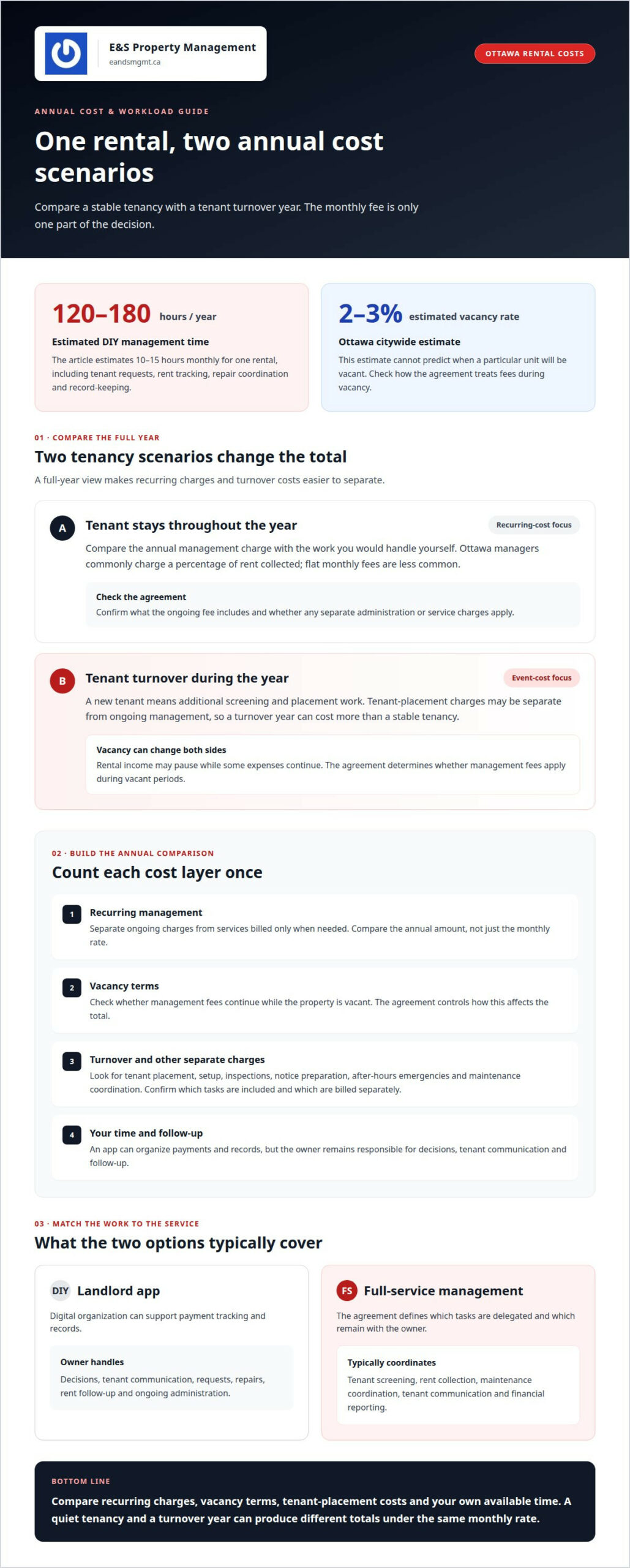
Compare options across a full year, not one rent payment. DIY landlords spend an estimated 10-15 hours monthly managing one rental, or 120-180 hours annually. That time includes coordinating tenant requests, tracking rent collected, arranging repairs and maintaining records. An app can organize these tasks, but the owner still handles decisions and follow-up.
For a managed property, annual costs depend on the agreement’s pricing model and the rent collected. A useful comparison separates recurring management charges from vacancy and tenant-placement costs. Consider two scenarios: a tenant stays throughout the year, or the rental turns over and requires new screening and placement. The second scenario adds work and may add a separate charge.
Vacancy changes the calculation because income may pause while some expenses continue. Ottawa’s estimated vacancy rate is around 2-3%, but a citywide estimate cannot predict the timing of a particular unit’s vacancy. A turnover can also involve advertising, screening, lease preparation and coordination before rent resumes. Include those steps in the annual scenario rather than assuming the monthly management fee covers them.
Use a consistent comparison: list expected annual rent, management charges on collected rent, any placement fee and costs excluded from the agreement. Then account for your time and responsibilities in the DIY column. Financial reporting can make collected rent and property expenses easier to review throughout the year, while screening and tenant placement shape how a turnover is handled. For urgent requests, consider who coordinates the response and keeps a record.
Finally, compare a stable tenancy with a turnover year, using the same rent assumptions for both options. If the agreement charges only on rent collected, vacancy may reduce the management charge; separate service charges can affect the total. The better fit depends on which responsibilities you want to retain and how much variability you can manage.
Automated rent collection and payment records
Automated collection can make a rental’s payment history easier to follow, but it doesn’t remove the need for oversight. An app-based process can help record payment dates, amounts and outstanding balances. Full-service management adds a person to coordinate collection and reporting, so a missed payment can be followed up rather than simply appearing as an unpaid entry.
For a useful record, connect each payment to the rental period and tenant. A clear ledger distinguishes rent received from a partial payment, a late payment or an amount still owing. Keep the payment date, amount, reference and follow-up notes together. That record supports accurate reporting and helps clarify payment questions without relying on memory or scattered messages.
Compare the full management cost with the work an app leaves behind. A lower monthly charge may still require you to review the ledger, contact tenants about balances and reconcile payment records. Full-service management typically includes rent collection and financial reporting, but the agreement defines the scope. Confirm how it treats payment follow-up, reporting periods and separate charges.
Consistency matters during a tenant change, too. Close the outgoing tenant’s record, preserve its payment history and open a separate ledger for the next tenancy. During vacancy, note that no rent was collected for that period. This keeps annual totals understandable and helps distinguish vacancy from missed payment when reviewing income.
Ask one practical question when comparing options: who notices and acts when an expected payment hasn’t arrived? An app can organize entries, while a manager can coordinate collection and maintain financial records. The right arrangement depends on whether you want to handle that response yourself or delegate it.
For support coordinating collection and reporting, discuss full-service rent management.
E&S Property Management: Full-Service Property Management
E&S Property Management can take on the recurring work that makes a rental demanding, from rent collection and tenant communication to maintenance coordination and financial reporting. Full-Service Property Management may suit you if you want one point of oversight instead of managing each task yourself.
When a tenant changes, Tenant Placement Service supports the transition, while Regular Property Inspections help keep the property’s condition under review. Financial Reporting and Accounting helps organize rental income and expenses, giving you a clearer view of the property’s financial activity.
If you’re weighing a digital tool against delegated support, consider which responsibilities you want handled throughout the tenancy, not only at move-in. To discuss management for your Ottawa rental, contact E&S Property Management.
Choose the level of support that fits your next chapter
Choosing between DIY landlord apps and full-service management in Ottawa is also a decision about how you want your rental to fit into daily life. Consider what you want to handle personally, what you’d rather delegate and how much attention you can give the property as circumstances change. The right arrangement should support your priorities, not add another source of uncertainty.
Before deciding, think beyond the next rent payment. Changes in work, travel or personal responsibilities can affect how manageable tenant communication and property decisions feel. If you value direct involvement, an app may suit your approach. If you want a professional to coordinate the ongoing workload, a management conversation can clarify the next step.
When you’re ready to explore professional support for your rental, contact E&S Property Management. A thoughtful decision now can help you move forward with greater clarity and confidence.
Frequently Asked Questions
Do I have to use full management, or can I pick individual services?
You can consider individual services as well as full management. For example, E&S Property Management offers Tenant Placement Service and Regular Property Inspections alongside Full-Service Property Management. Individual support may suit an owner who wants help with a defined task but will handle the ongoing tenancy. Match the agreement’s scope to the work you want to delegate.
Is there a fee to find a tenant?
Tenant placement can involve a separate fee rather than being included in ongoing management. The charge depends on the agreement and the work covered, such as marketing the vacancy, screening applicants and preparing lease documents. For a fair comparison, check whether the placement service includes each step you need. A one-time leasing charge affects a turnover year differently from a tenancy that continues.
What do full-service property managers charge in Ottawa, including management and leasing fees?
Ottawa managers commonly charge an ongoing percentage of rent collected, while tenant placement may be billed separately. The total depends on the agreement’s scope, the rent collected and whether a new tenant is needed. Compare a stable-tenancy year with a turnover year, and distinguish recurring charges from one-time leasing costs. Also note how the agreement treats vacancies and additional services, since those terms affect the total.
What services do Ottawa landlord apps provide compared with full-service managers?
Apps can help organize rental information and payment records, while a full-service manager takes on operational coordination. A digital record may show that rent is outstanding, for example, but you still need to decide how to follow up unless management handles collection. The practical difference is responsibility: an app supports your process, while a manager coordinates agreed tasks with tenants and service providers.
What are the benefits and drawbacks of self-managing a rental property in Ottawa?
Self-management gives you direct control over tenant communication, decisions and the timing of expenses. It also means personally coordinating each issue, from arranging a repair appointment to keeping communications organized. If you live nearby and have time for those tasks, you may prefer that involvement. Travel, a demanding work schedule or a tenant change can make the same responsibilities harder to manage consistently.
What are the risks and responsibilities of DIY rental management under Ontario law?
Self-managing owners remain responsible for handling the tenancy in line with Ontario’s Residential Tenancies Act and applicable Ottawa requirements. That includes using appropriate forms, meeting relevant timelines and keeping organized documentation. A practical safeguard is to maintain consistent records of lease documents, notices, maintenance requests and tenant communications. If a dispute develops, clear records help establish what was sent, when it was sent and how the issue was handled.


