Self-managing a rental can take more than occasional admin. In Ottawa, the time commitment of self-managing a rental property averages 5-10 hours per month per property. Tenant screening, rent collection, property checks, and coordinating repairs can all add to that workload.
Managing a rental may feel manageable when everything runs smoothly, but tenant requests and maintenance still need attention alongside your other responsibilities. The right choice depends on how much time you can consistently set aside and whether you’re comfortable overseeing each part of the tenancy.
This article breaks the decision into four practical considerations: the tasks involved, the time and resources they require, how self-management compares with professional management, and what delegating could change. You’ll be better placed to decide whether managing the property yourself fits your schedule or whether professional support would free up time for other priorities.
Key Takeaways
- Assess whether you can respond consistently to tenant concerns and coordinate repairs, including when an issue needs prompt attention.
- Factor in the administrative work and interruptions that can make landlord duties harder to fit around your regular schedule.
- Compare the direct control of self-management with the convenience of delegating day-to-day responsibilities to a professional manager.
- Consider whether tenant placement, inspections, and financial reporting support would ease the parts of property management that take the most effort.
1. Do You Really Need a Property Manager in Ottawa?
In Ontario, landlords are responsible for keeping rental properties in good repair and fit for habitation. That responsibility continues even if a tenant knew about a problem before signing the tenancy agreement. A property manager can handle tenant reports, arrange repairs, and coordinate contractors, but hiring one doesn’t remove the landlord’s responsibility for the property.
Ottawa’s Rental Housing Property Management By-law No. 2020-255 requires landlords or property managers to maintain a system and record for tenant service requests. The procedure must accept written, verbal, and electronic text requests. Urgent requests require a response within 24 hours; non-urgent requests require a response within seven (7) days. A clear log helps track when a tenant reported an issue, what action followed, and whether further work remains outstanding.
Access also takes coordination. In Ontario, landlords generally must give tenants 24 hours’ notice before entering for repairs, except in emergencies such as a fire or gas leak. That means a repair plan may involve acknowledging the report, arranging a suitable visit, and following up if a contractor needs another appointment. A burst pipe, for example, calls for prompt emergency coordination rather than routine scheduling.
Owners of apartment buildings in Ottawa must maintain a capital maintenance plan. It must record the date of the last inspection for each applicable listed capital element. This is separate from responding to a tenant’s immediate repair request: the plan documents the condition and inspection history of building components over time.
Seasonal upkeep adds another layer. Before winter, arrange checks for heating issues and address snow or ice that could affect access. In spring, look for water entering around the foundation or damage to exterior surfaces. Planning inspections and repairs can help prevent small concerns from growing. If you’re weighing the time commitment of self-managing a rental property in Ottawa, consider whether you can handle both scheduled upkeep and unexpected calls.
Time and resources needed for landlord duties
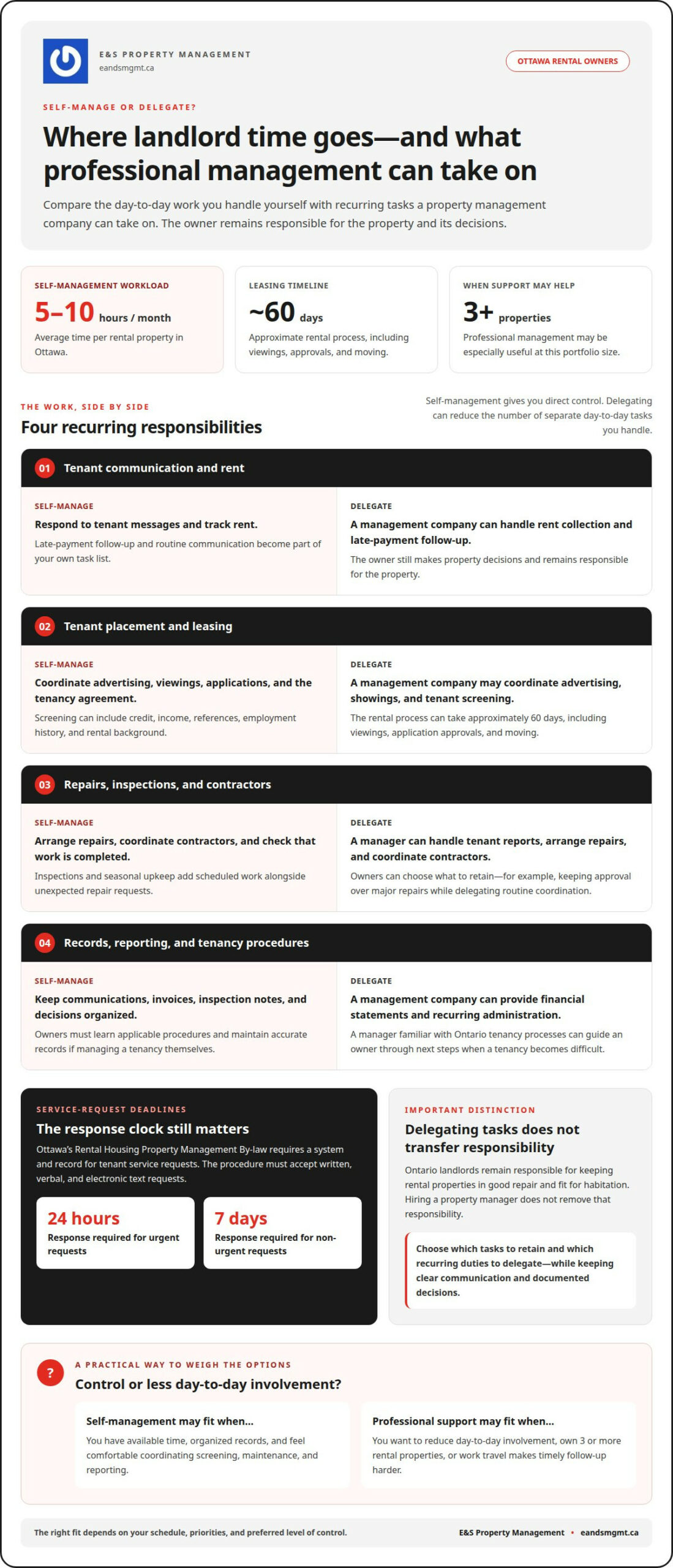
Self-managing an Ottawa rental averages 5-10 hours per month per property. That time can go toward tenant screening, rent collection, periodic checks, contractor coordination, and records. The workload varies by rental type, number of units, and condition: more units mean more communication to track, while a property needing frequent repairs requires more follow-up.
Tenant screening and leasing don’t have a fixed time requirement. Ottawa’s rental process can take approximately 60 days, including viewings, application approvals, and moving, with screening forming one part of that process. Reviewing applications, following up with prospective tenants, and preparing a tenancy agreement all take attention before a new tenant moves in.
Time also has an opportunity cost. Consider how those hours fit around paid work, family commitments, and other responsibilities. A landlord who can handle routine tasks during the day may experience the workload differently from someone who must take every call after work.
Inspections help identify issues and create a record of the property’s condition. Note concerns such as a leaking tap, damaged flooring, or a broken appliance, then arrange repairs and record when they’re completed. Keep tenant communications, invoices, and inspection notes together to track outstanding work and expenses.
Landlord insurance usually covers the building, landlord-owned contents, liability arising from ownership, and loss of rental income. Review how those protections relate to the property and its tenancy agreement, and keep policy documents accessible alongside maintenance records. If managing these moving parts is taking time from other priorities, consider professional rental oversight as a way to delegate day-to-day coordination.
3. Self-management compared with professional management
With self-management, residential property owners make decisions and handle each step themselves. That includes setting rental terms, responding to tenant messages, arranging repairs, tracking rent, and keeping records. The approach offers direct control, but each task competes with work and personal time. For one owner, a single repair can mean several calls: one with the tenant, another with a contractor, and a follow-up to confirm completion.
A property management company can take on recurring administration, including rent collection, late-payment follow-up, and financial statements. It may also coordinate advertising, showings, and tenant screening, which can involve checking credit, income, references, employment history, and rental background. That support can reduce the number of separate tasks an owner handles, while the owner remains responsible for decisions about the property.
Knowledge matters when a tenancy becomes difficult. Ontario’s Residential Tenancies Act governs rental requirements, and disputes may involve the Landlord and Tenant Board. A manager familiar with these processes can guide an owner through the next steps; self-managing owners need to learn the applicable procedures and keep accurate records. Either way, clear communication and documented decisions help prevent confusion.
Compare the options by listing tasks you want to retain and those you’d delegate. For example, an owner might keep approval over major repairs while assigning routine tenant communication and inspections to a manager. Professional management may be especially useful for owners with 3 or more rental properties, or when work travel makes timely follow-up harder. Self-management may suit an owner with available time, organized records, and comfort coordinating screening, maintenance, and reporting. The best fit depends on whether control or reduced day-to-day involvement matters more.
4. Benefits of hiring a property manager
A property manager can take recurring tasks off an owner’s schedule, from rent collection to tenant communication. For example, a manager may follow up on late payments, respond to maintenance requests, and prepare monthly financial statements and annual summaries. These records can help organize rental income and expenses for tax preparation.
Tenant placement can also consolidate several steps. A manager may review rental pricing against neighbourhood trends, current listings, and recent rental activity, then advertise the unit and conduct showings. Screening can include checking credit, income, references, employment history, and rental background. This creates a consistent process for assessing applicants and moving from a vacant unit to an approved tenancy.
Ontario’s Residential Tenancies Act (RTA) sets out requirements for landlords and tenants. When a tenancy issue arises, a property manager may help an owner understand the relevant process, including steps involving the Landlord and Tenant Board. Organized records of requests, communications, and actions taken make it easier to follow the timeline and respond methodically.
Maintenance coordination is another practical benefit. A manager can arrange repairs with licensed trades and conduct regular inspections to identify concerns before they become more costly. An inspection might reveal a small leak or damaged surface that needs attention. The manager can document the issue, coordinate the work, and track its completion, while the owner retains oversight of the investment.
Professional support may be useful when work travel, multiple responsibilities, or a vacant unit makes prompt follow-up difficult. It doesn’t remove the owner’s responsibility for the property, but it can reduce the number of day-to-day tasks they personally handle. For a steadier approach to tenant placement, reporting, and property upkeep, explore professional property management.
E&S Property Management
E&S Property Management helps Ottawa rental owners reduce the day-to-day work of managing a home. Its Full-Service Property Management covers ongoing responsibilities, while its Tenant Placement Service supports the process of finding and placing a tenant.
Regular Property Inspections keep property conditions under review, and Financial Reporting and Accounting provide organized records of rental activity. These services can suit owners whose schedules make tenant coordination, inspections, or financial administration difficult to manage themselves. If you prefer to stay involved, decide which responsibilities you want handled and which you’d rather retain.
For a practical conversation about your rental management needs, contact E&S Property Management.
Choose a Rental Management Approach That Fits Your Life
Make your decision based on the role you want your rental to play in your life, not only on the tasks you can handle this week. The time commitment of self-managing a rental property in Ottawa is easier to assess when you consider your schedule during busy periods, your comfort with tenant communication, and how much responsibility you want to retain.
Before choosing, identify which responsibilities you want to manage personally and which you’d prefer to delegate. This distinction can help you find an arrangement that suits your preferred level of involvement while bringing structure to the work. Your ideal balance may change as work, family commitments, or your rental situation shifts, so revisit the decision when your circumstances change.
A clear next step can turn uncertainty into a manageable plan. Contact E&S Property Management today to discuss your rental management needs and consider the support that fits your priorities.
Frequently Asked Questions
Do You Really Need a Property Manager in Ottawa?
Not necessarily. A manager can help when you can’t reliably give the rental the attention its ongoing tasks require. Consider whether you can respond to tenant messages, arrange repair visits, keep records, and follow up until work is complete. If those duties repeatedly compete with work or travel, delegating some or all of the management can be a practical choice for your Ottawa rental.
How fast can you actually get into the unit when something goes wrong?
Access depends on whether the issue is an emergency. For a routine repair in Ontario, a landlord generally gives the tenant 24 hours’ notice before entering; emergencies such as a fire or gas leak are exceptions. A dripping tap can usually be scheduled with the tenant, while a serious leak may need urgent coordination. Prompt access still depends on arranging entry and keys.
Ready to Simplify Your Life as an Ottawa Landlord?
Professional support can take rental coordination off your plate if ongoing responsibilities demand more attention than you want to give them. E&S Property Management offers full-service property management, tenant placement, and regular property inspections for residential rentals. Discuss which tasks you want handled and which you’d prefer to oversee. Contact E&S Property Management to explore support that fits your priorities.
Should you hire someone, or can you make the distance work?
You can manage a property from a distance if you have a dependable way to coordinate tenant communication, local access, and repair follow-up. Distance alone doesn’t determine the right choice; what matters is whether someone can act when a contractor needs entry or an issue needs an on-site assessment. For an owner living a few hours away, a manager can provide a local point of coordination.
What actually breaks when the owner lives two or three hours away?
The response chain can become harder to manage. For example, a tenant reports a loose handrail, but the owner can’t inspect it promptly, arrange a contractor’s access, and confirm the work in person. Each handoff needs clear communication and follow-up. If details are missed between the report, repair appointment, and completion, a minor concern may remain unresolved longer than intended.
How many hours per month does it take to self-manage a rental property in Ottawa?
Self-managing an Ottawa rental averages 5-10 hours per month per property. That estimate can include routine communication, rent administration, records, inspections, and contractor coordination. A vacant unit or a stretch of repair work may demand more attention than a quieter month. Track the time spent on recurring tasks and interruptions to see how the workload fits your schedule.