A bounced rent cheque can create a payment problem, but charging more than Ontario permits can create a second dispute. If you’re asking what to do when a tenant’s cheque bounces in Ontario, you may recover the NSF charge your financial institution charged and an administration fee of up to C$20. Don’t treat either charge as rent arrears on an N4 notice.
It’s understandable to want the rent replaced quickly and the situation handled fairly. A calm, written message can explain what happened, what remains unpaid, and how the tenant can pay. A clear record also helps keep the next steps orderly.
This article explains which bounced-cheque charges may apply, what to include in your communication and records, and how Ontario’s non-payment notice rules connect to an L1 application. You’ll also see when a payment arrangement may help and why following the proper process matters if the rent remains unpaid.
Key Takeaways
- Confirm the returned cheque with your bank, then document the rent still owing and any permitted charges separately.
- Keep dated notes of tenant communications, copies of notices and proof of delivery to support a clear record.
- Discuss payment options respectfully; a payment arrangement must be voluntary, and the Landlord and Tenant Board may consider whether you tried to work with the tenant.
- Use the correct notice and application process for unpaid rent, and keep non-rent charges off an N4 notice.
- Consider full-service property management if rent collection, financial records and ongoing property oversight are becoming difficult to manage.
Keeping records of communications and payment arrangements
A clear record separates the original rent payment from later discussions. Make a dated note when the bank confirms the cheque was returned. Include the cheque date and amount, the bank’s stated reason, the rent period affected, and when you contacted the tenant. If the reason is unclear, record that rather than assuming the tenant caused the return.
Review the lease before discussing a replacement payment. Note the agreed rent amount, due date, accepted payment method, and any term about returned cheques or administration charges. In Ontario, an administration fee for an NSF cheque cannot exceed C$20, and a lease cannot create a late-rent fee. Keep the bank’s returned-item charge separate from rent in your ledger and any message to the tenant.
For each conversation, record the date, time, method, and main points. Save emails and texts, and make a brief factual note after phone calls. For example, note that you explained which rent remains unpaid and that the tenant said they would pay by electronic funds transfer on an agreed date. Keep the tenant’s response, including any disagreement about the amount.
A payment agreement can make expectations clearer, but it must be voluntary. Ontario landlords can’t impose a payment plan or evict a tenant for refusing one. If an eviction application for unpaid rent is underway, the landlord and tenant may settle it through a payment agreement approved by the Landlord and Tenant Board using the Board’s proper form. Save the signed agreement and records showing whether each payment was received.
Offer a practical alternative payment method, such as a money order, cashier’s cheque, or electronic funds transfer. Record the method the tenant chooses, the amount expected, and when payment arrives. Ontario landlords can’t require rent by pre-authorized debit or post-dated cheque, so don’t make either a condition of an arrangement.
Keep copies of formal notices and proof of delivery with the rent ledger. Store them alongside bank records, receipts, agreements, and communication notes. A file organized by rent period makes it easier to match payments to the balance and show what was received, when it arrived, and how any shortfall was addressed.
What Can You Charge a Tenant for a Bounced Rent Cheque in Ontario?
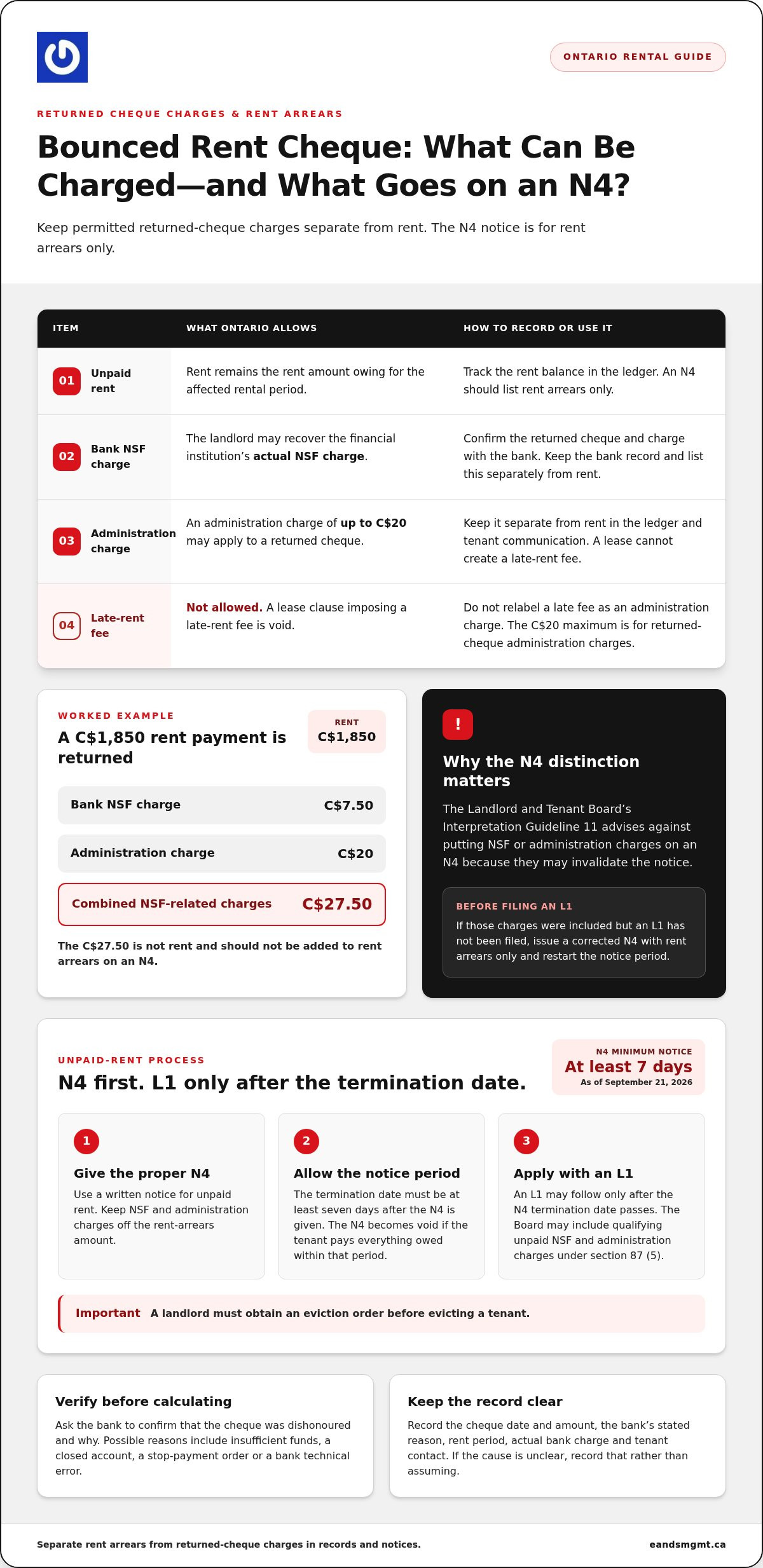
If you’re assessing what to do when a tenant’s cheque bounces in Ontario, start by confirming the return with your bank. You may recover its actual NSF charge and an administration charge of up to C$20, but not a late-rent fee.
Confirming a Returned Cheque
Confirming a returned cheque means asking your bank to verify that it was dishonoured and why. This matters because insufficient funds, a closed account, a stop-payment order, or a bank technical error could each explain the return.
Record the bank’s confirmation, the cheque amount and date, and the NSF charge. Then write to the tenant with the confirmed reason, rent still owing, any permitted charges, a payment deadline, and the consequences of non-payment. Don’t state a cause the bank hasn’t verified. If the bank’s information changes, update your written record and calculation.
Recovering Unpaid Rent
Recovering unpaid rent means seeking the rent balance through Ontario’s prescribed process, while keeping related charges separate. A returned-cheque charge and an administration charge aren’t rent, so don’t add them to rent arrears in your ledger or N4 notice.
Ontario’s Residential Tenancies Act generally prohibits fees or penalties unless an exemption applies. For a returned cheque, a landlord may recover the financial institution’s NSF charge and an administration charge of up to C$20. Keep the bank record and lease terms with your calculation. For landlords deciding what to do when a tenant’s cheque bounces in Ontario, separating the charges helps keep any notice focused on rent.
For example, if monthly rent is C$1,850 and the bank charges C$7.50, total NSF-related charges may be C$27.50, including the C$20 administration charge. Those amounts still aren’t rent. The Landlord and Tenant Board’s Interpretation Guideline 11 advises against putting NSF or administration charges on an N4 because they may invalidate the notice. If you included those charges but haven’t filed an L1, issue a corrected N4 with rent arrears only and restart the notice period.
A landlord can’t charge a rent late fee, and a lease clause imposing one is void. Rent is considered late the day after its due date, with no grace period under the Act. Don’t relabel a late fee as an administration charge; the C$20 maximum applies to returned-cheque administration charges.
To seek an eviction order for unpaid rent, give the tenant the proper written N4 notice. As of September 21, 2026, its termination date must be at least seven days after the notice is given. The N4 becomes void if the tenant pays everything owed within that period. An L1 application may follow only after the termination date passes. A landlord must obtain an eviction order before evicting a tenant.
L1 application to the Landlord and Tenant Board
An L1 application asks the Landlord and Tenant Board for an eviction order and payment of rent arrears. A landlord can file only after the N4 termination date has passed, so the notice, its service, and the rent ledger must align.
Keep the L1 claim focused on unpaid rent. NSF and administration charges aren’t rent and shouldn’t appear on the N4 notice. The Landlord and Tenant Board may include qualifying unpaid NSF cheque charges and administration charges in a landlord’s application under section 87 (5). Keep those charges distinct from rent in your calculation and supporting records.
Before filing, compare the N4 with the rent ledger and payment history. Record the rent owing, payments received, and any changes to the balance. If the tenant pays the arrears, additional rent, and the landlord’s application fee before an eviction order, the Board must discontinue the non-payment application. NSF charges aren’t included in those listed payments.
The stated Landlord and Tenant Board filing fee for an L1 or L10 application is C$201, or C$186 through the Tribunals Ontario Portal. Include the applicable fee in your planning, and retain the filing confirmation with the application record. An L1 concerns a tenant still in possession; the L10 is for money claims against a former tenant.
An L10 may apply when a tenant has moved out and unpaid NSF charges remain. A landlord may apply to the Board to collect money from a former tenant only if the tenant moved out on or after September 1, 2021. The application must be made within one year from when the tenant ceases to possess the rental unit. The Board can order up to C$50,000 on a former-tenant money claim.
Serving an L10 requires attention to separate deadlines. Serve the former tenant with the application and Notice of Hearing at least 30 days before the hearing. Submit proof of service to the Board at least 20 days before the hearing. Don’t leave the former tenant’s copy at the rental unit after they’ve moved out. If you need an alternative service method, submit that request at least 40 days before the hearing.
Keep the formal application, bank record, lease, rent ledger, notices, and proof of service together. These documents help show which amount is unpaid, whether the NSF charge remains outstanding, and how the application was served. For a current tenant, the L1 process addresses rent arrears and possible eviction; for a former tenant, the L10 deadline and service rules govern the money claim.
Ontario landlord-tenant rules and the Landlord and Tenant Board
Ontario’s Residential Tenancies Act sets limits on charges and eviction steps after rent goes unpaid. The Landlord and Tenant Board handles disputes through applications, hearings, and orders.
Legal Limits on NSF Charges
Ontario landlords may recover the NSF charge their financial institution charged for a returned cheque, plus an administration charge of up to C$20. This distinction matters because neither charge is rent, even if the lease discusses returned cheques.
The Residential Tenancies Act generally prohibits fees or penalties unless an exemption applies. A landlord can’t add a late-rent fee, and a lease clause requiring one is void. Itemize the bank’s charge and any administration charge separately from rent owing. This makes clear what the tenant is being asked to pay.
Board Hearings and Orders
A Landlord and Tenant Board hearing gives both parties a chance to present their records and explain the situation. The Board may offer mediation before a hearing, but neither party has to reach an agreement.
For an application about unpaid rent, the Board must consider whether the landlord tried to work with the tenant to catch up. A tenant disputing fees can explain why they believe a charge breaches the Act. A tenant or former tenant may also apply to recover money collected contrary to the Act within one year after it was collected or retained.
Filing and Enforcement Costs
The stated Landlord and Tenant Board filing fee for an L1 or L10 application is C$201, or C$186 through the Tribunals Ontario Portal. Include the applicable amount when considering the cost of a formal application.
If the Board issues an eviction order, a landlord can’t enforce it personally. A court enforcement officer, or sheriff, carries out the eviction under the order. An LTB hearing may be scheduled several weeks to a few months after filing, so the unpaid balance can change while the matter proceeds.
Bank Charges for Returned Cheques
The amount depends on the financial institution and the returned payment, so use the actual charge shown in your bank record.
If a tenant disputes the bank charge, share the returned-item record and separate it from the C$20 maximum administration charge. If they dispute an eviction notice, they can respond through the Landlord and Tenant Board process and explain their position at the hearing. A landlord cannot change locks or shut off utilities to pressure payment.
Communicating professionally with the tenant
A bounced cheque can feel personal, but a professional message keeps the focus on the rent and next steps. Contact the tenant after confirming the return with your bank, and explain only the reason the bank provided. Insufficient funds, a closed account, a stop-payment order, or a bank technical error may each explain a returned cheque.
Send a neutral written message identifying the original cheque date and amount, the rent period affected, and the balance still unpaid. State the bank’s confirmed reason, any permitted NSF-related charges, and a clear payment deadline. Separate rent from other charges so the tenant can see what is owed as rent and what relates to the returned cheque.
For example, write: “The cheque dated [date] for [amount] was returned by the bank. The rent payment for [period] remains unpaid. Please let me know how you plan to pay the rent balance by [deadline].” Add the bank-confirmed reason and any permitted charges. Avoid blame or presenting an assumption as fact.
Invite the tenant to explain their situation and propose a practical way to replace the payment, such as an electronic funds transfer or money order. Record the proposed amount, method, and expected date, then confirm the details in writing. Any agreement must be voluntary. Ontario landlords can’t impose a payment plan or evict a tenant for refusing one.
If both parties agree to a schedule, state each payment date and amount, how payments will be made, and how each payment received will be recorded. Don’t describe a discussion as a binding agreement unless both sides have accepted its terms. If an unpaid-rent eviction application is underway, the Landlord and Tenant Board may approve a formal payment agreement on its proper form.
Keep a communication log with the date, time, and method of each contact. Save emails and texts, and make brief factual notes after calls. Retain copies of formal notices and proof of delivery. A record of the tenant’s response, payments received, and any missed agreed date can clarify the history if the dispute reaches a hearing.
The Residential Tenancies Act, 2006 makes it an offence for a landlord to harass or threaten a tenant to get them to move out. Don’t threaten eviction, change locks, or shut off utilities to pressure payment. Use the proper Landlord and Tenant Board notice and application process; as of September 21, 2026, an N4 gives a seven-day minimum notice period.
Keep each message concise, factual, and focused on resolving the rent issue. This gives the tenant a clear opportunity to respond while preserving a record of the communication and any payment arrangement.
Contact the tenant after your bank confirms the cheque was returned. There is no additional waiting period stated here.
E&S Property Management: Full-Service Property Management
E&S Property Management helps Ottawa landlords with consistent oversight of rent collection, property records, and tenant matters. Its Full-Service Property Management brings these responsibilities together, including Financial Reporting and Accounting to organize rental income and expenses. Regular Property Inspections support ongoing oversight, while the Tenant Placement Service can help when a rental needs a new tenant.
Professional management may help when returned payments, notices, and records become difficult to coordinate alongside other property responsibilities. With these tasks handled as part of broader rental oversight, landlords can focus on decisions while keeping payment documentation organized.
To discuss your property management needs, contact E&S Property Management.
Build a steadier process for the next rent cycle
A returned cheque can prompt a review of how payment issues are handled across your rental. Set a consistent approach for documenting concerns, communicating with tenants, and deciding when professional oversight would make day-to-day ownership easier. This groundwork can help keep future decisions calm and organized.
If you’re considering what to do when a tenant’s cheque bounces in Ontario, look beyond the immediate payment. E&S Property Management offers Full-Service Property Management, Tenant Placement Service, and Regular Property Inspections to support Ottawa landlords with ongoing property responsibilities. These services can suit owners who want help coordinating tenant matters and managing their rental consistently.
You can take the next step at your pace. Explore property management with E&S Property Management and discuss an approach that fits your property. With a clear process and the right support, you can move forward with greater confidence in managing your rental.
E&S Property Management can help with ongoing rental administration
E&S Property Management offers Full-Service Property Management, including tenant placement, regular property inspections, financial reporting and accounting, and emergency maintenance response. If a bounced cheque raises concerns about the next steps or your rental’s ongoing administration, these services can help.
For non-resident tax administration, E&S Property Management also supports NR6 and NR4 filing, including processing NR6 forms, monthly tax withholdings, and issuing annual NR4 slips.
Frequently Asked Questions
Can I require my tenant to pay by pre-authorized debit after a returned cheque?
No. Ontario landlords can’t require rent by pre-authorized debit, even after a cheque is returned. You can ask the tenant to use another payment method, but keep that request separate from any claim that they must accept a payment plan. For example, offer an electronic funds transfer or money order and ask which option they can use. Record their response and any agreed payment details in writing.
Can you add a late fee on top of the NSF charge?
No. Ontario landlords can’t charge a late-rent fee, even if the lease includes one. A returned cheque is different: you may recover the actual NSF charge your financial institution charged, plus an administration charge of up to C$20. Keep each amount separately itemized. For example, don’t add a late fee to the tenant’s balance just because the replacement rent payment arrives after its due date.
Can you insist on certified funds after a cheque bounces?
You can request certified funds, but don’t present that request as a required payment method after one returned cheque. Suggest practical alternatives, such as a money order, cashier’s cheque, or electronic funds transfer, and discuss which method the tenant can use. If you both agree to a payment arrangement, put the chosen method, amount, and expected payment date in writing. A payment plan must remain voluntary.
Can you take the bounced month out of the last month’s rent deposit?
Don’t treat the last month’s rent deposit as an automatic payment for the current month’s arrears. The deposit is held for the tenant’s final rental period, so show the bounced month as unpaid in your rent records. If the tenant proposes using the deposit differently, document the discussion and any agreement rather than silently changing the ledger. Keep the deposit record separate from the returned-cheque balance.
Can you tell a tenant that a bounced cheque is a criminal matter?
Don’t treat every returned rent cheque as a criminal matter. A cheque may be returned for several reasons, including insufficient funds, a closed account, a stop-payment order, or a bank error. Confirm the bank’s stated reason before discussing it, and avoid threats or assumptions about intent. For unpaid rent, communicate the balance and use Ontario’s Landlord and Tenant Board process rather than pressuring the tenant.
What should an Ontario landlord do when a tenant’s rent cheque is returned for insufficient funds?
First, ask your bank to confirm the return and its reason, then check your rent ledger for the unpaid amount. Send the tenant a factual written message identifying the affected rent period and a way to discuss replacement payment. Save the bank record and the tenant’s response. If rent remains unpaid, use the proper Ontario notice and application process, keeping non-rent charges separate from rent arrears.
Can an Ontario landlord charge a tenant a fee for a bounced rent cheque, and how much?
Yes, within limits. You may recover the NSF charge your financial institution charged for the returned cheque and an administration charge of no more than C$20. You can’t add a rent late fee, even if the lease says otherwise. Keep the bank’s charge and administration amount itemized separately, and don’t include them as rent on an N4 notice.
How can a tenant pay overdue rent after a cheque bounces in Ontario?
A tenant can propose a replacement payment method, such as an electronic funds transfer, money order, or cashier’s cheque. The landlord and tenant can discuss an option and record the amount, method, and expected date in writing. Landlords can’t require pre-authorized debit or post-dated cheques. Keep proof of payment and update the rent record to show when the funds arrived.