
The biggest return from a property manager may not be a lower bill; it may be less time spent managing vacancies and tenant turnover. Whether hiring a property manager is a good investment in 2026 depends on how management costs compare with the time and work you’d otherwise take on. In Ontario, advertising and placing a single tenancy can take 15 to 25 hours, making your own time an important part of the calculation.
It’s reasonable to focus first on the management fee, since it’s the most visible cost. But a useful comparison also includes tenant placement, vacancy periods, maintenance, and the value of having fewer day-to-day responsibilities.
This article helps you weigh those factors for a Canadian rental property, including how tenant screening and vacancy management affect the overall investment. You’ll learn what to consider before deciding whether professional management fits your finances, property, and available time.
Key Takeaways
- Compare management fees with the time and responsibilities you’d otherwise take on, not just the rent collected.
- Account for tenant placement and vacancy periods when assessing the cost of turnover and its effect on rental income.
- Consider how tenant screening and ongoing oversight can help you manage the practical risks of finding and retaining tenants.
- Review what a management arrangement covers, including maintenance coordination, inspections, and financial reporting.
- Ontario landlords must serve an N1 rent increase notice at least 90 days before the increase takes effect.
Self-management time and opportunity costs
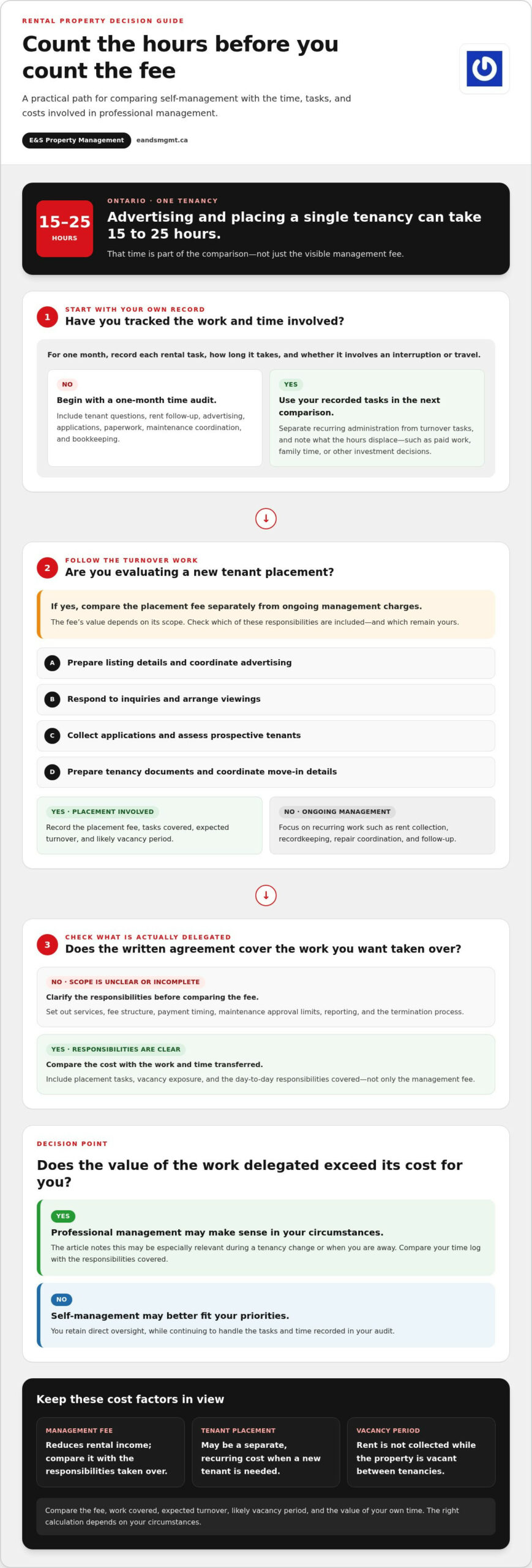
Managing a rental yourself costs more than the hours spent answering tenant messages. In Ontario, advertising and placing a single tenancy can take 15 to 25 hours. Add rent collection, recordkeeping, repair coordination, and follow-up, and landlord tasks can interrupt work or personal commitments throughout the year. To decide whether hiring a property manager is a good investment in 2026, include the value of that time alongside the direct costs.
Start with a simple time audit. For one month, record each rental task, how long it takes, and whether it requires an interruption or travel. Include calls, messages, contractor access, lease paperwork, and bookkeeping. Then note what those hours displace, such as paid work, family time, or other investment decisions. This makes the opportunity cost specific to your circumstances instead of relying on an assumed hourly rate.
- Track time spent on tenant questions and rent follow-up.
- Record hours used for advertising, applications, and tenancy paperwork.
- Note maintenance coordination, including arranging access and following up.
- Separate recurring administration from turnover tasks.
Are property management fees tax deductible for Canadian landlords? Their tax treatment depends on the rental activity and how the expense relates to earning rental income. Keep invoices and accounting records to support your tax reporting.
What provincial and municipal rules apply to property managers in Canada? Rules depend on the property’s location and the task involved. In Ontario, the Residential Tenancies Act governs nearly every aspect of the landlord-tenant relationship, including notices and rent increases.
When does hiring a property manager make financial sense in Canada? It may make sense when the value of the work delegated exceeds its cost, particularly during a tenancy change or when you’re away. Compare your time log with the responsibilities covered.
What risks and drawbacks come with hiring a property manager? The fee reduces rental income, and delegated oversight means giving up some direct control. Communication problems or unclear responsibilities can also cause friction, so define reporting and approval steps.
What should a Canadian property management agreement include? Set out the services, fee structure, payment timing, maintenance approval limits, reporting, and termination process. Clear written responsibilities help prevent confusion when a tenant requests repairs or a vacancy begins.
Tenant placement and leasing fees
Starting a tenancy involves more than publishing an advertisement. Landlords need to attract suitable applicants, review applications, communicate with prospective tenants, and prepare the tenancy. A tenant placement fee is a separate cost from ongoing management charges. Its value depends on what the service includes and how much of the process you would otherwise handle yourself.
Ontario property managers may charge a separate fee to place a new tenant. Because the fee can be tied to rent, compare its structure with the placement tasks covered. For example, a service may include advertising, applicant screening, and lease preparation, or cover a narrower scope. The written agreement should state which tasks are included and when the fee applies.
Before comparing options, map the placement process from vacancy to move-in. Note who handles each step and what you would still need to do:
- Prepare the listing details and coordinate advertising.
- Respond to inquiries and arrange viewings.
- Collect applications and assess prospective tenants.
- Prepare tenancy documents and coordinate move-in details.
This breakdown helps you compare the fee with the time, effort, and vacancy exposure involved. If you manage tenant placement yourself, you retain direct oversight but also handle each task. If you delegate, the fee reduces rental income, and the responsibilities transferred depend on the agreement. Consider both sides instead of treating the fee as an isolated expense.
Turnover also changes the calculation. A placement fee may recur whenever you need a new tenant, so turnover frequency affects annual cash flow. A longer tenancy spreads the cost across more months of occupancy; a shorter one makes each placement expense more prominent. Vacancy between tenancies adds another factor, since rent is not collected during that period.
To assess the overall value, list the fee, work covered, expected turnover, and likely vacancy period. Compare the total with your own time and the effort of coordinating each task. The price depends on the property and placement scope, and is provided after a quote request. Costs may reflect responsibilities such as advertising, reviewing applicants, and preparing tenancy paperwork.
Clear terms matter as much as the fee. Record when payment is due, what happens if an applicant does not proceed, and whether ongoing management begins after placement. Those details help you avoid treating a leasing charge as though it automatically covers future rent collection or maintenance coordination. If you’d prefer to hand off the placement process, explore support with tenant leasing tasks.
Tenant screening and vacancy management
A vacant rental creates two linked tasks: selecting a suitable tenant and limiting the time before occupancy resumes. Screening assesses applicants; vacancy management coordinates the property, listing, and move-in process. A missed step in either area can create extra work, such as reopening applications after a candidate withdraws or finding unfinished repairs before move-in.
Use the same screening sequence for each applicant. First, collect complete application details. Then review them against consistent, relevant criteria, such as the applicant’s ability to meet tenancy obligations. Follow up on unanswered questions and keep clear records of the decision. A repeatable process helps you compare applications fairly instead of relying on a quick impression during a busy showing period.
- Organize each application so important details are easy to compare.
- Follow up on missing information before making a decision.
- Record the reason for choosing an applicant.
- Keep communication clear if an application cannot proceed.
Vacancy management begins before the previous tenant leaves. Note any necessary repairs, coordinate access, and prepare listing information. Once the unit is ready, arrange viewings and review completed applications promptly. These steps help prevent avoidable delays between preparing the property and selecting the next tenant.
Screening and speed need to work together. Rushing to fill a unit can leave important application details unresolved; taking too long to respond can slow the process. Set a clear workflow for reviewing applications and communicating next steps. If a candidate withdraws, return to the remaining applications and identify what still needs follow-up.
Vacancy risk also depends on the property and its local rental market. A unit that needs repairs, has limited viewing access, or is listed with incomplete details may take more coordination to prepare and show. For Ottawa landlords, assess the property’s condition, listing readiness, and tenant interest together. That gives a more useful picture than judging vacancy by screening alone.
To compare self-management with professional oversight, identify who handles each stage: application review, tenant communication, property readiness, and move-in coordination. Then consider which tasks are difficult to complete consistently alongside other responsibilities. Delegation can help when you need a coordinated process; managing the steps yourself may suit owners who prefer direct involvement and have the time.
The goal isn’t simply to fill an empty unit quickly. Consistent screening and an organized vacancy plan help you make a considered choice while keeping next steps clear for applicants and owners.
Maintenance coordination and landlord stress
A maintenance request can trigger a chain of tasks: understand the issue, arrange access, coordinate repairs, and update the tenant. For an Ottawa landlord living elsewhere, even a leaking tap can require several calls and scheduling decisions. Delegated coordination offers more than convenience: it provides a clear process from the first report through follow-up.
Start by recording the tenant’s description, the affected area, and any immediate concern. A message saying “water near the sink” needs clarification: is the leak active, and can the tenant safely contain it? Clear details help determine the next action and avoid repeated calls for basic information. Record the initial report and each update.
Once the issue is understood, make responsibilities clear. Identify who arranges access, communicates with the repair professional, and updates the tenant. If a fridge stops working, for example, someone must confirm the problem, coordinate a visit, and tell the tenant what happens next. Unclear ownership can leave everyone waiting for someone else to act.
- Log the maintenance request and the tenant’s description.
- Clarify access arrangements and the best way to contact the tenant.
- Coordinate the repair visit and share relevant updates.
- Record the work completed and any follow-up needed.
These steps also reduce the mental load of tracking several open tasks. A landlord handling a repair personally may need to respond to the tenant, find a suitable professional, arrange entry, and confirm completion. When the property is far away or the landlord is working, each handoff can add another interruption. A consistent record makes outstanding tasks easier to track.
Maintenance expenses affect the investment calculation, but their size depends on the repair, the property’s condition, and the work required. A minor fixture repair differs from a larger plumbing or building issue. Rather than treating maintenance as one predictable bill, review the property’s repair history and record completed work. This can reveal recurring problems and inform future planning.
Before delegating, define approval and communication steps in writing. Clarify how repair requests are received, who authorizes work, how updates are shared, and how completed jobs are recorded. An agreed process matters especially when an urgent request arrives while the landlord is unavailable. It gives everyone a practical sequence to follow instead of relying on scattered messages or memory.
For owners who want fewer repair-related interruptions, compare both coordination time and maintenance spending. Delegation can simplify tenant communication, access, and repair follow-up, but it doesn’t eliminate the property’s underlying repair needs. The decision depends on how much control you want to retain and how reliably you can manage each step yourself.
What services are included in Canadian property management fees?
A management fee is useful to compare only when you know which responsibilities it covers. One agreement may include rent collection and tenant communication, while another may charge separately for tenant placement or maintenance coordination. Read the service list alongside the fee schedule, then mark each task as included, charged separately, or retained by you. This makes different arrangements easier to compare.
For a residential rental, check whether regular management covers day-to-day administration, such as collecting rent, communicating with tenants, keeping rental records, and coordinating maintenance requests. Then review how often you’ll receive financial statements and what they contain. A record of rent received, expenses paid, and outstanding items helps you understand the property’s operating activity.
Some services arise only at particular points in a tenancy. Tenant placement, inspections, and move-in coordination may be listed separately from ongoing management. Check what each task includes in the written agreement, such as advertising and applicant review for placement, or documented observations after an inspection. A clear scope distinguishes recurring management from work triggered by a vacancy or property visit.
Legal administration is another area to examine. In Ontario, landlords must serve an N1 rent increase notice at least 90 days before the increase takes effect. Ontario’s 2026 rent increase guideline is 2.1%. An agreement should clarify who prepares notices and tracks deadlines, while the landlord remains responsible for understanding obligations under the Residential Tenancies Act.
Use a checklist to compare the agreement’s practical coverage:
- Rent collection, tenant communications, and financial reporting.
- Tenant placement, application review, and tenancy paperwork.
- Maintenance request coordination and repair approval procedures.
- Inspection frequency, written records, and owner updates.
- Separate charges, payment timing, and termination terms.
Next, match each listed service to a real task at your property. If you live away from the rental, maintenance access and tenant updates may matter most. If you handle repairs yourself, reporting and rent administration may be more relevant. This step-by-step comparison shows whether the arrangement fits the work you want to delegate, rather than relying on a broad label such as “full service.”
For a clearer view of how responsibilities can be organized, review property management support options and compare them with the tasks your rental requires.
For context, property management fees in Ontario typically range from 8 to 12 percent of monthly rent collected, though the services covered still determine the value.
E&S Property Management: Full-Service Property Management
E&S Property Management offers full-service property management for residential landlords who want to delegate ongoing responsibilities. If tenant turnover is taking time, its Tenant Placement Service supports the process of finding and placing tenants. Regular Property Inspections provide structured oversight, while Financial Reporting and Accounting help keep rental activity organized. These services can be relevant when you’re balancing a rental with work, living away from the property, or seeking a clearer view of its administration. The right support depends on which tasks you want handled and how involved you prefer to remain. To discuss your property management needs, visit E&S Property Management.
Make Your Next Property Decision With Confidence
Whether hiring a property manager is a good investment in 2026 depends on the balance you want between direct control and delegated responsibility. Before deciding, identify the tasks you want to keep, the work you’d rather hand off, and the level of financial visibility you need. That gives you a practical basis for discussing management arrangements, rather than focusing on a fee in isolation.
E&S Property Management offers Full-Service Property Management, Tenant Placement Service, and Regular Property Inspections. If those services match the responsibilities you want help managing, discuss your rental property and priorities with the team. Outline what matters most, from tenant placement to ongoing oversight, and consider how professional management fits your plans.
Contact E&S Property Management to discuss your property management needs and take a considered next step for your rental.
Frequently Asked Questions
What Does Property Management Actually Cost?
Property management costs depend on the services and responsibilities in the agreement. Separate recurring management from tenant placement, repair expenses, and other charges before comparing options. For example, ask whether a maintenance invoice is billed separately from the manager’s coordination work. Then compare the full annual arrangement with the tasks you’ll continue handling yourself. This gives you a clearer cost picture than focusing on one fee.
What does a property manager charge in Canada in 2026?
There isn’t one fee that applies to every Canadian rental; charges depend on the property and contracted scope. Ongoing administration, tenant placement, and maintenance coordination may be treated differently in an agreement. For an Ottawa rental, compare written service descriptions and identify which charges recur, arise during a vacancy, or relate to specific work. This clarifies the arrangement without assuming another property’s terms apply to yours.
How much rental income or time can a property manager save landlords?
A property manager can take on defined landlord tasks, but doesn’t create rental income by itself. In Ontario, advertising and placing a single tenancy can take 15 to 25 hours. The time you reclaim depends on which placement and ongoing responsibilities are delegated. Income impact depends on occupancy, rent collection, and property expenses, so assess those separately rather than treating time saved as guaranteed additional income.
How do property management fees vary by province and city in Canada?
Fees can vary with local market conditions, property needs, and the scope of contracted work, so don’t assume the same structure applies across Canada. Provincial tenancy rules also shape the administration landlords must manage. In Ontario, the Residential Tenancies Act governs nearly every aspect of the landlord-tenant relationship, including notices and rent increases. For an Ottawa property, compare agreements based on the responsibilities covered, not location alone.


