
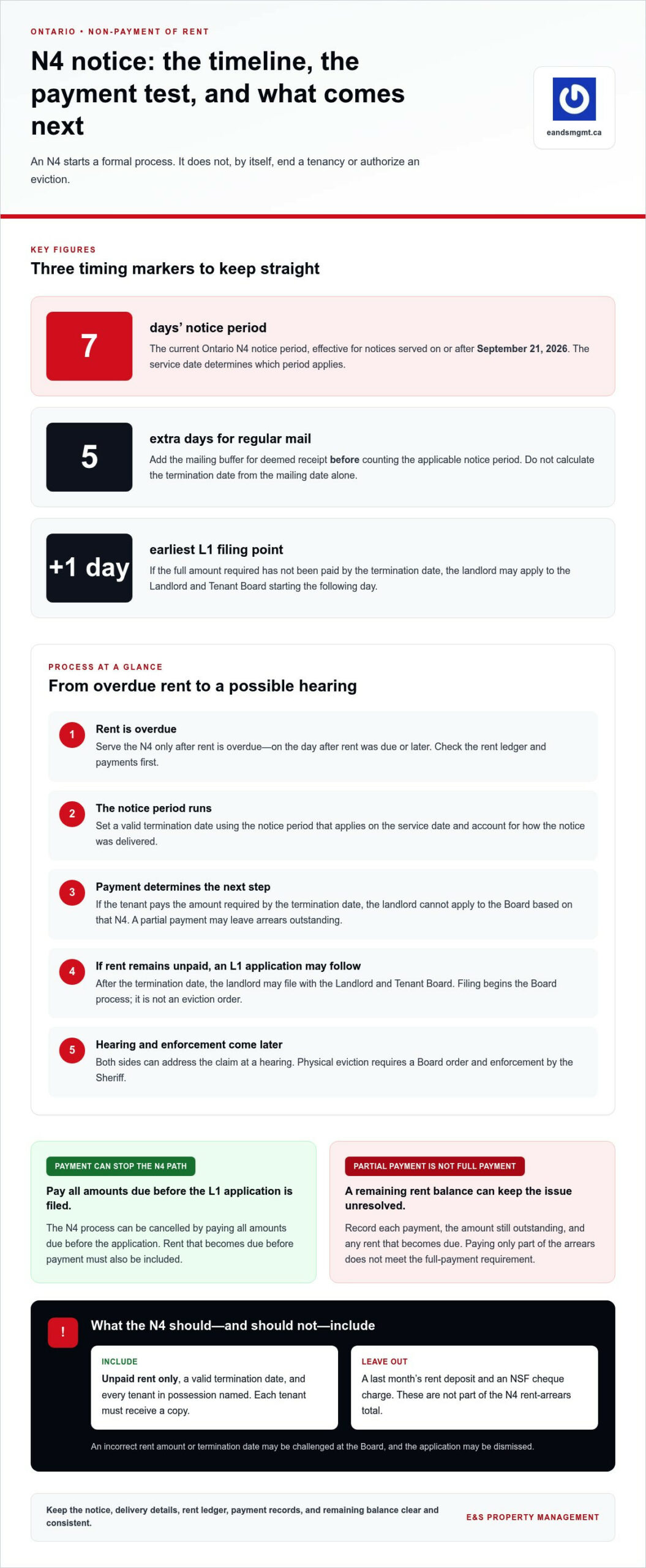
A partial rent payment doesn’t automatically stop an N4 process. For landlords serving an N4 notice for non-payment of rent in Ottawa, Ontario’s current notice period is 7 days, effective September 21, 2026. If the tenant hasn’t paid the full amount due by the termination date, the landlord can apply to the Landlord and Tenant Board starting the following day; paying only part of the arrears doesn’t meet that requirement.
An N4 can feel like a decisive step toward eviction, but it doesn’t end a tenancy by itself. The amount paid, when it’s paid, and whether more rent comes due can all affect what happens next, so keeping a clear record matters.
This article explains what an N4 notice means, how it must be served, and what follows if rent remains unpaid or a tenant makes a partial payment. You’ll also learn what to expect at an LTB hearing and how rent payments can change the eviction process, so you can approach the next steps with greater clarity.
Key Takeaways
- An N4 notice doesn’t evict a tenant on its own; the next steps depend on the notice, rent payments, and the Landlord and Tenant Board process.
- Calculate the termination date according to how the notice is served, since mail and courier affect when it’s deemed received.
- A partial payment may leave rent arrears unresolved. Keep clear records of payments, the remaining balance, and any rent that becomes due.
- Make sure the notice names every tenant in possession and that each tenant receives a copy.
- At a hearing, the parties can present their positions, but physical eviction requires an order and enforcement by the Sheriff.
Does serving an N4 mean the tenant is automatically evicted?
No. Serving an N4 notice doesn’t end the tenancy or automatically evict the tenant. If the tenant pays the amount claimed by the termination date, the landlord can’t apply to the Landlord and Tenant Board based on that notice.
The notice begins a formal process for unpaid rent, not an immediate removal. A tenant doesn’t have to move out by the termination date. If the landlord still seeks eviction, they can apply to the Board starting the day after that date. If the tenant moves out by the termination date, the tenancy ends on that date.
An N4 should identify every tenant in possession of the rental unit, the rent arrears, and the termination date. According to the Landlord and Tenant Board, every tenant in possession must be named. The amount should cover unpaid rent only, not a last month’s rent deposit or an NSF cheque charge.
Correct dates depend on both the applicable notice period and how the notice is delivered. As of September 21, 2026, the N4 notice period is 7 days. The termination date must also account for when the notice is deemed received. For regular mail, add five days for deemed receipt before counting the notice period.
For example, an N4 sent by regular mail has a five-day mailing buffer, followed by the applicable notice period. Don’t simply count from the mailing date. A May 2026 example used a May 2 service date and a May 16 termination date, before the period changed on September 21, 2026.
Use the correct N4 form and check the rent calculation before serving it. Include rent that is actually unpaid, then document payments and the remaining balance. A wrong rent amount or termination date may be challenged at the Board, and the application may be dismissed.
The change introduced through the Fighting Delays, Building Faster Act, 2025, makes the date of service especially important. Don’t apply the new 7-day period to a notice served before September 21, 2026. The date the notice is served determines which period applies.
Serving an N4 notice for non-payment of rent in Ottawa therefore requires care with the form, arrears, delivery date, and termination date. If the tenant hasn’t paid the full amount by the deadline, the landlord may file an L1 application starting the next day. That filing begins the Board process; it doesn’t itself authorize eviction.
Can A Landlord Recover Unpaid Rent Through the Eviction Process?
In Ontario, an N4 is the formal starting point for addressing unpaid rent. Recovering arrears through eviction still requires an application to the Landlord and Tenant Board and a Board order.
N4 Notices for Unpaid Rent
An N4 is a notice to end a tenancy because rent remains unpaid under section 59 of the Residential Tenancies Act, 2006. It tells the tenant what rent is outstanding and gives them a chance to pay before the landlord seeks eviction. This distinction matters: the notice starts a process, but it isn’t an eviction order or a guarantee of rent recovery.
Keep the claim limited to unpaid rent. A last month’s rent deposit and an NSF cheque charge don’t belong in the N4 arrears total. Separating rent from other charges helps make the amount clear and reduces the risk of disputes about the notice.
Serving an N4 for Unpaid Rent
Serve an N4 only after rent is overdue. In Ontario, a landlord must wait until the day after rent was due before giving the notice. That timing creates a clear record: the rent due date has passed, and the stated rent remains unpaid.
Before serving it, compare the rent ledger with payments received and identify the correct balance. Include every tenant in possession by name; the Landlord and Tenant Board says each must receive a copy. A complete notice helps connect the amount claimed to the tenancy and the people responsible for rent.
Unpaid Rent Notice Timelines
As of September 21, 2026, the N4 notice period in Ontario is 7 days. The change affects how soon a landlord may take the next step, so use the period that applies on the notice’s service date rather than relying on an older template or timeline.
If the tenant hasn’t paid the full arrears within the notice period, the landlord may file an L1 application with the Landlord and Tenant Board. The tenant can cancel the N4 process by paying all amounts due before that application is filed. Rent that becomes due before payment must also be included in what the tenant pays.
Rules for Unpaid Rent Notices
An Ontario N4 must state the unpaid rent and a valid termination date. The notice period is only one part of calculating that date; delivery method also affects when the notice is deemed received. For example, regular mail adds a five-day mailing buffer, so counting from the day of mailing alone can produce an incorrect date.
After an L1 application, the Landlord and Tenant Board process gives both sides a chance to address the claim. A tenant may explain payments or dispute the arrears, while the landlord must support the amount requested. Before filing, reconcile the rent ledger and preserve payment records, since a partial payment may leave a balance outstanding.
Eviction hearing and enforcement timelines
After an N4 expires, an Ottawa landlord may apply to the Landlord and Tenant Board if rent remains unpaid. An N4 alone doesn’t end the tenancy or authorize an eviction; a hearing and Board order come before enforcement.
After serving an N4, an Ottawa landlord may file an L1 application starting the day after the termination date if the tenant hasn’t paid the required amount. Hearing waits can range from a couple of months to longer, depending on the Board’s caseload and application type. Regaining possession after a first missed rent payment typically takes 3-6 months minimum.
The L1 filing fee is separate from the arrears. The C$200 filing fee applies to an L2 application, not an L1, so don’t treat it as the L1 fee.
At the hearing, the landlord presents the rent ledger, N4, proof of service, and records of payments received. A clear timeline helps the Board compare the amount claimed with the tenancy’s payment history. The landlord can attend and explain the claim, while the tenant can respond and provide evidence.
A tenant who disputes the arrears should gather payment records, receipts, bank statements, or written messages that explain the disagreement. Providing relevant evidence to the landlord and the Board before the hearing helps both sides address the figures. In many cases, the tenant and landlord can also discuss a payment plan with an LTB mediator before an eviction hearing.
Tenants may challenge the rent balance, point to payments missing from the landlord’s records, or dispute whether the notice was completed or served correctly. A partial payment is relevant evidence, but it doesn’t by itself show that all rent owing has been paid. For L1 applications filed on or after September 21, 2026, a tenant raising other issues must give written notice at least 7 days before the hearing and pay half of the claimed arrears at least 7 days before it.
After the hearing, Tribunals Ontario generally issues a written order within about 30 days. A tenant typically has 11 days to leave after an eviction order. If they don’t, only the Sheriff can physically enforce eviction; a landlord can’t change locks to remove a tenant.
The landlord must request a Writ of Possession and file the eviction order within six months of the order being granted. The Court Enforcement Office typically schedules a physical eviction 2-3 weeks after an order when the tenant hasn’t left voluntarily. Those steps explain why a hearing date is not the same as immediate possession.
How to serve a tenant with an eviction notice
For an Ontario rent arrears case, serving an N4 begins the formal eviction process, but the notice itself doesn’t evict anyone. Correct delivery, complete copies, and a clear record help establish what the tenant received and when.
Use the N4 for unpaid rent, then serve it using an allowed method: in person, by mail, or by posting it. The Landlord and Tenant Board requires every tenant in possession to be named, and each tenant must receive a copy. If a rental unit has two named tenants, prepare and deliver a copy for each.
Keep a dated copy of the completed notice and record how it was served. These records can help explain the notice’s contents and delivery if the tenant disputes service at an LTB hearing. Before serving it, check that the names, rent arrears, and termination date match the tenancy records.
Service method affects the notice timeline. For regular mail, the N4 is deemed received five days after mailing, so the termination date must account for that buffer. The current Ontario notice period is 7 days as of September 21, 2026. A date counted from mailing alone may be too early.
Payment can stop the process before an L1 application is filed. If the tenant pays all amounts due before filing, the tenant can cancel the N4 process. The tenant must also pay any additional rent that becomes due on or before the payment date. A partial payment may reduce the balance, but it doesn’t satisfy the full amount owing.
After serving the notice, record every payment with its date and amount. Compare the updated balance with the N4 claim before taking the next step. If the tenant pays the full amount, retain proof and don’t file an L1 based on that notice. If rent remains unpaid, the landlord may apply to the Landlord and Tenant Board starting the day after the termination date.
A tenant may dispute the rent calculation, service, or termination date on the notice. At a hearing, payment receipts, bank records, and messages between the landlord and tenant can help clarify the disagreement. Organize records by date, including any partial payment and the balance remaining afterward.
An N4 doesn’t give a landlord permission to remove a tenant or change the locks. If the tenant doesn’t leave, the landlord must follow the Board process and obtain an order before enforcement. The Sheriff is the only party authorized to physically enforce an eviction in Ontario.
Handling partial rent payments after an N4
A partial payment reduces the balance but doesn’t, by itself, cancel an N4. The key question for Ontario landlords is whether the tenant pays all amounts due before the landlord files an L1 application with the Landlord and Tenant Board.
Keep the notice and rent ledger together. Record the payment date, amount received, balance remaining, and any new rent due. For example, if a tenant pays part of the arrears before the termination date, update the ledger instead of treating the N4 as automatically void. The full amount stated in the notice must be paid to cancel the process before L1 filing.
Rent that comes due also matters. A tenant who receives an N4 must pay additional rent becoming due on or before the date they pay the stated amount. So, if the tenant pays the original arrears later, calculate the current total rather than relying only on the earlier notice figure.
Before you serve an N4, confirm the rent balance and the dates in your records. The notice is for unpaid rent, not a last month’s rent deposit or an NSF cheque charge. If you receive a partial payment after service, document how it changes the arrears and keep the receipt or transaction record with the monthly rent ledger.
As of September 21, 2026, Ontario’s N4 notice period is 7 days. If the tenant hasn’t paid the full amount by the termination date, a landlord may apply to the Board starting the next day. A payment that leaves arrears outstanding doesn’t erase the option to file, but the application should reflect payments already received.
Timing matters if a tenant offers payment near filing. If the tenant pays all amounts due before the L1 application is filed, the N4 process can be cancelled. Compare the payment against both the notice balance and rent that became due by the payment date. Keep proof of when funds were received, since that date can determine whether payment came before filing.
After filing, keep the original notice, updated ledger, payment records, and communications about any proposed payment plan. At an LTB hearing, these documents help explain the amount still claimed and how each payment was credited. A tenant may provide receipts or other evidence disputing the balance, so dated records help both sides present a clear account.
The practical takeaway is simple: acknowledge every payment, recalculate the balance, and distinguish partial payment from full payment. For support keeping rental records organized alongside property oversight, explore full-service property management.
E&S Property Management: Full-Service Property Management
E&S Property Management can help Ottawa landlords manage the work surrounding a rental property, from tenant placement to ongoing oversight. If rent collection, records, inspections, and maintenance coordination are becoming difficult to manage alongside an N4 matter, Full-Service Property Management brings these responsibilities together.
Regular Property Inspections help landlords stay informed about a property’s condition, while Financial Reporting and Accounting supports clear oversight of rental income and expenses. For a vacant unit, the Tenant Placement Service helps with the next stage of finding a tenant. These services support day-to-day property management, while LTB applications and hearing decisions remain part of the Board process.
For a more organized approach to managing your Ottawa rental property, contact E&S Property Management to discuss your needs.
Put a steadier rental plan in place
Serving an N4 notice for non-payment of rent in Ottawa can bring an immediate paperwork challenge, but it can also prompt a more sustainable approach to managing the rental. Clear records, consistent oversight, and a thoughtful plan for tenant transitions help make future decisions easier to handle.
E&S Property Management supports ongoing rental oversight through Full-Service Property Management, Regular Property Inspections, and Tenant Placement Service. These services help landlords manage their property beyond a single rent dispute, while the Landlord and Tenant Board remains responsible for its applications and decisions.
If you’re ready to discuss support for your rental property, contact E&S Property Management. A considered next step can help you move forward with greater clarity and care.
Frequently Asked Questions
What Is an N4 Notice?
An N4 notice is Ontario’s formal notice for ending a tenancy over unpaid rent. It identifies the rent owed and gives the tenant a deadline to pay before the landlord can pursue an eviction application. It isn’t an eviction order. For example, a landlord can’t use an N4 alone to remove a tenant or change the locks; the Landlord and Tenant Board process must follow.
Can I give an N4 the day after rent is late?
Yes. In Ontario, a landlord must wait until the day after rent was due before giving an N4 for non-payment. If rent was due on the first of the month, the notice may be served the following day if it remains unpaid. Before serving, compare the rent ledger with received payments so the notice reflects the actual arrears, not a payment that is still being processed.
Do I need a lawyer to serve an N4?
Not necessarily. The main requirements are using the correct N4, recording the unpaid rent accurately, naming every tenant in possession, and serving the notice properly. A landlord facing a disputed balance or complicated payment history may want legal advice to understand the issues before filing an application. Tenants who need help understanding an N4 can seek advice from their community legal clinic.
How long does eviction take in Ontario?
After a first missed rent payment, regaining possession typically takes 3-6 months minimum, and Landlord and Tenant Board hearing waits can extend for several months. The timing depends on the application, the Board’s caseload, whether the tenant disputes the claim, and what follows the order. If a tenant doesn’t leave voluntarily, the Sheriff handles physical enforcement after the landlord follows the required process.
Should I deduct the last month’s rent deposit on the N4?
No. An N4 should claim unpaid rent, not a last month’s rent deposit. Keep the deposit separate from the arrears calculation rather than subtracting it to create a different balance. For instance, if rent is overdue while the tenant still occupies the unit, record that unpaid rent in the notice and maintain a separate record of the deposit for its proper use.
What is an N4 notice for non-payment of rent in Ontario?
It’s the Ontario notice a landlord uses to seek an end to a tenancy because rent hasn’t been paid, under section 59 of the Residential Tenancies Act, 2006. It applies to unpaid rent only, not charges such as an NSF cheque fee. The notice gives the tenant an opportunity to pay before the landlord applies to the Landlord and Tenant Board.
What are the current Ontario N4 notice periods for monthly, weekly, and daily tenancies?
As of September 21, 2026, the Ontario N4 notice period is 7 days. The current period applies regardless of whether rent is paid monthly, weekly, or daily. Delivery still matters for calculating the termination date: regular mail adds a five-day buffer because the notice is deemed received five days after mailing. Don’t count only from the day you put it in the mail.
How is the termination date calculated on an N4 notice in Ontario?
Start with the date the notice is deemed received, then allow the applicable 7-day period before setting the termination date. For regular mail, add five days for deemed receipt before counting that period. Courier delivery is deemed received the first day after sending, or the next non-holiday business day. These receipt rules mean the date sent and the date received aren’t always the same.


