
A hearing date on the calendar doesn’t mean your preparation window is over. For LTB hearing preparation for landlords in Ottawa, organize evidence around the application and notice, then file it with the Landlord and Tenant Board and serve it on the tenant separately. Filing evidence with the Board doesn’t, by itself, serve the tenant; direct service is also required unless the tenant has signed the Board’s consent to disclosure through the portal.
If you’re preparing for an LTB hearing as a landlord in Ottawa, it’s understandable to feel pressure to get every detail right. A clear, organized record can help you present your case calmly and keep important dates, documents, and events easy to follow.
This guide explains how to organize and serve your evidence, prepare for the hearing, and respond thoughtfully if the other party asks to adjourn. You’ll also learn how to create a concise exhibit index and prepare for the practical details of a remote hearing, so you can approach the process with greater clarity.
Key Takeaways
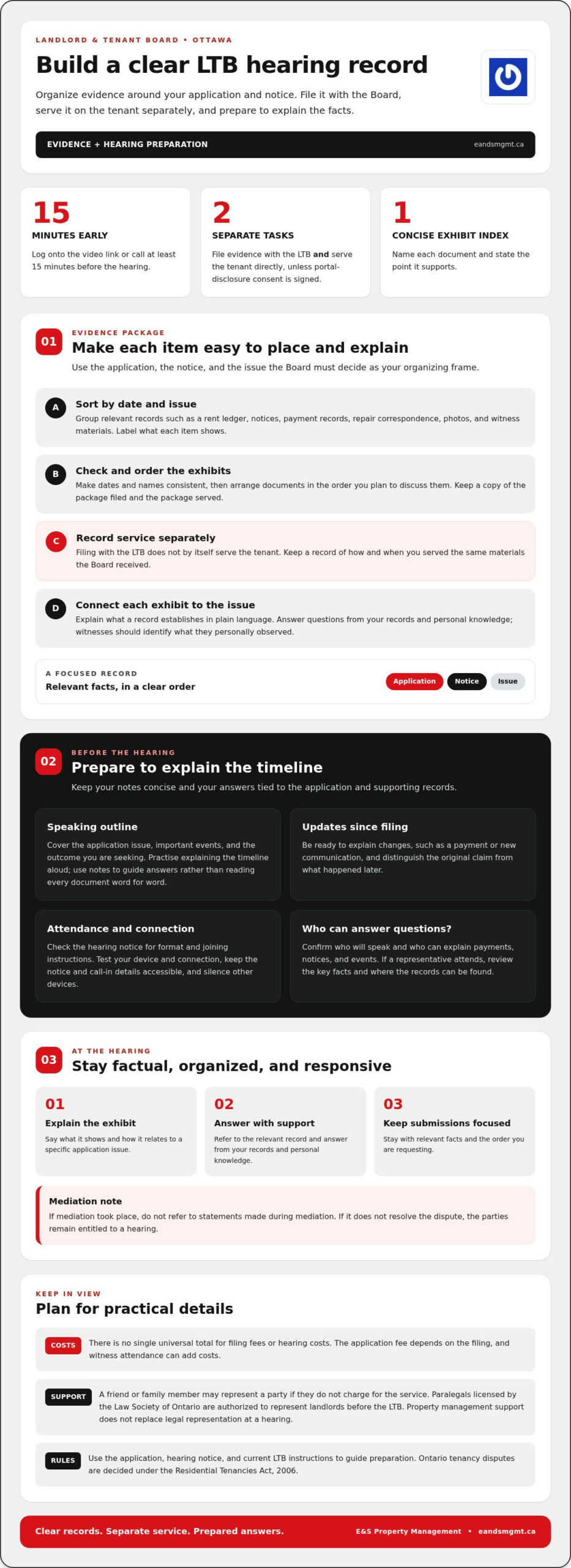
- Match each document to the issue in your application, and arrange the evidence in a clear order with a short exhibit index.
- Filing evidence with the LTB doesn’t automatically serve it on the tenant; plan for the required separate service process.
- Prepare your hearing notes, documents and witnesses in advance, and make a clear plan for attending or sending a representative.
- If the tenant requests an adjournment, be ready to explain how delay would affect your case and what practical steps could address the concern.
- Use the notice and application as your preparation checklist, then keep the hearing record focused on the facts each document helps establish.
Filing evidence with the LTB and serving it on the tenant
Build your evidence package around the application, the notice, and the issue you need the Landlord and Tenant Board (LTB) to decide. Treat filing with the Board and serving the tenant as separate tasks.
-
Organize Documents, Photos, and Witness Materials
Sort documents by date and issue, such as a rent ledger for arrears, copies of notices, payment records, repair correspondence, and relevant photos. Label each item so you can explain what it shows. Ask witnesses to organize their notes and identify what they personally observed. Avoid relying on material that doesn’t relate to the application or establish a relevant fact.
-
Prepare the Landlord’s Evidence Package
Create a concise exhibit index that names each document and states the point it supports. For example, an arrears ledger may show payment history, while a dated notice may establish what was communicated. Check that dates and names are consistent across your documents, then arrange the exhibits in the order you’ll discuss them. Keep a copy of the filed package and the package served on the tenant.
-
Present Evidence and Submissions
At the hearing, explain each exhibit in plain language and connect it to a specific issue in your application. The adjudicator may ask when an event happened, how a record was created, or what a photo shows. Answer from your records and personal knowledge, then refer to the relevant exhibit. Keep your submissions focused on the facts and the order you’re requesting.
The hearing gives each side an opportunity to present evidence and respond to the other party’s case. If mediation took place, don’t refer to statements made during mediation.
- Separate filing from service. Uploading evidence to the LTB doesn’t, by itself, serve it on the tenant. Serve the tenant directly as well, unless they’ve signed the Board’s consent to disclosure through the portal. Keep a record of how and when you served the package, and ensure the tenant receives the same materials as the Board.
- Plan for hearing costs and questions. There isn’t one universal total for filing fees or hearing costs. The application fee depends on the filing, and witness attendance can add costs. At the hearing, expect to explain the timeline, records, and evidence supporting your request.
How should a landlord prepare for an LTB hearing?
Effective LTB hearing preparation for landlords in Ottawa starts with a clear plan for attendance, speaking notes, and the order you’re requesting. Decide who can explain the tenancy facts and respond to the member’s questions.
-
Prepare as a Self-Represented Client
Draft a concise outline covering the application issue, important events, and the outcome you’re seeking. Practise explaining the timeline aloud, then mark details that may need clarification. Avoid reading every document word for word; use your notes to guide clear answers. Common mistakes include missing the hearing, relying on inconsistent records, or raising facts unrelated to the application.
As part of your LTB hearing preparation in Ottawa, plan how you’ll explain changes since filing, such as a payment or new communication. A precise update helps distinguish the original claim from what has happened since.
-
Consider Mediation and Representation
Decide whether to attend yourself or have someone represent you, and ensure they understand the file. A friend or family member may represent a party if they don’t charge for the service. According to the Law Society of Ontario, paralegals licensed by the Society are authorized to represent landlords before the LTB.
If mediation doesn’t resolve the dispute, the parties remain entitled to a hearing. Don’t disclose what was said during mediation; prepare instead to present relevant facts and evidence.
- Confirm the hearing arrangements. Read the hearing notice for the format and joining instructions, then test your device and connection. The LTB says participants should log onto their video link or call at least 15 minutes before the hearing. Keep your application and speaking outline nearby, and silence other devices to limit interruptions.
- Make an attendance plan. Confirm who will speak and who can answer questions about payments, notices, or events. If a representative is attending, review the important facts together and identify where to find supporting records. Good LTB hearing preparation for landlords in Ottawa also includes a backup plan for connection problems, such as keeping the hearing notice and call-in details accessible.
- Find suitable legal support if needed. Ottawa landlords seeking representation before the LTB can turn to a paralegal licensed by the Law Society of Ontario. Property management provides a different kind of support. It can help with ongoing rental responsibilities, but it doesn’t replace legal representation at a hearing.
Ontario residential tenancy disputes and the Residential Tenancies Act
Use the application, hearing notice, and current Landlord and Tenant Board instructions to guide your preparation. Ontario tenancy disputes are decided under the Residential Tenancies Act, 2006, and the evidence should address the specific issue before the Board.
-
Understand the Applicable Rules and Processes
Start by matching your application type to the LTB notice and its instructions. The Landlord and Tenant Board decides the hearing format, and most cases are scheduled virtually. Hearings may also take place in person, by telephone, or in writing. Check the notice for deadlines and required forms, because an L1 rent-arrears case follows different steps from other applications.
The Tribunals Ontario Portal lets users upload evidence, check file status, and use a dispute-resolution tool. Before the hearing, compare the notice, rent ledger, payment history, and communications to keep your records consistent. The applicant must prove the case on a balance of probabilities, so connect each requested order to relevant facts and supporting documents.
-
Address Rent Arrears Before an L1 Hearing
Update your rent ledger when the tenant makes a payment, and retain a dated record of each amount received. For an Ontario L1 application filed on or after September 21, 2026, the tenant must pay the landlord half of the claimed arrears at least 7 days before the hearing. Track whether that payment arrives and bring the updated calculation to the hearing.
For an L1 or L9 application, the LTB requires landlords to submit the completed Application Information Update 5 business days before the hearing. Use it to reflect the current account, not an earlier balance. Separate rent owing from later payments, and make the figures easy for the member to follow.
-
Prepare for the Board to Decide the Dispute
Review the legal issue in your application and identify the facts the LTB must decide. A landlord’s responsibilities may include following the proper notice and application process; a tenant may raise issues supported by written notice and evidence. For rent cases, tenants seeking to raise maintenance or other issues must give written notice and evidence at least 7 days before the hearing.
Prepare a timeline linking each notice, response, payment, or repair record to the dispute. If maintenance is relevant, organize work orders and correspondence. If arrears are central, use a clear account history. This helps the member assess the issues without sorting through unrelated material.
- Confirm witnesses and hearing logistics. Identify which witnesses can speak to events they personally observed, such as a payment discussion or a repair visit. The LTB says participants should log onto their video link or call at least 15 minutes before the hearing. Keep the hearing notice, application, and updated records accessible, and plan who will answer questions about each part of the file.
Adjournment requests and delay-related prejudice
Prepare a clear response if either party asks to change the hearing date. Explain the practical effect of a delay, identify any accommodation needs, and keep the LTB hearing notice available.
- Assess the adjournment request in light of the circumstances. Note why the other party wants more time, what they need to do, and whether an agreement could address the concern without postponing the hearing. Then identify concrete effects of delay, such as a witness becoming unavailable or records becoming harder to obtain. Connect each point to this residential tenancy application rather than relying on general frustration. The member needs specific information to consider, not simply a claim that delay is unfair.
- Explain prejudice with dated examples. If postponement would affect an eviction application, describe the practical consequences and support them with relevant records. For example, explain how a missed appointment or a witness’s changing availability affects your ability to present evidence. Distinguish an immediate consequence from a concern that might arise later. Keep your explanation measured and identify a practical step that could reduce the impact, such as preserving a record or arranging a witness’s availability.
- Respond promptly to a request to change the hearing date. If you need a new date, make the request as soon as you know you cannot attend and clearly explain why. If the tenant asks to reschedule, note the request and share your position through the process described in the hearing notice. Don’t assume an informal agreement between landlord and tenant changes the LTB date. Continue preparing unless the Board reschedules the hearing, and retain the notice and related correspondence.
- Address access needs and attendance directly. Tribunals Ontario offers support services that include requesting access to a computer, internet, or phone as an accommodation. A tenant may request accommodations if a remote LTB hearing would be unfair to them. If the tenant doesn’t attend or send a representative, tell the member, confirm your own attendance, and present the evidence supporting your application. The result depends on the application and hearing record, so don’t treat absence alone as an automatic eviction order.
- Keep the deadline and next steps visible. Review the hearing notice for instructions about a date-change request, then record when you submitted it and any response. If the LTB doesn’t reschedule, attend as scheduled and be ready to proceed. If an adjournment is granted, note the new date and any directions from the member, including what each party must provide before then. This creates a practical record of the decision and helps prevent missed steps in the residential tenancies act process.
Preparing the hearing alongside the notice
Use the notice as your first hearing checklist, not just as proof that a step occurred. Compare its details with the application, service record, and evidence before deciding what you need to explain.
- Match the notice to the application. Confirm that the tenant’s name, rental address, stated reason, and termination date align across the notice and application. Then check that your hearing evidence addresses the conduct or event described. For example, if the application concerns rent arrears, organize records that explain the balance and relevant payments. If the facts have changed, prepare a clear timeline instead of relying on an outdated summary.
- Build a date-by-date service checklist. Record when the notice was served, how it was served, and the hearing date shown in the Notice of Hearing. Certain landlord applications to end a tenancy and evict must be served at least 5 days before the hearing. Applications for an above-guideline rent increase proceeding as an oral hearing, a care-home tenant transfer, or a rent-reduction variation must be served at least 30 days before the hearing.
- Separate notice issues from the underlying dispute. Dedicate one section of your hearing notes to the notice, including its stated reason and service details. Use another section to explain the events behind the application, such as unpaid rent or a documented incident. This helps you answer questions in sequence and show how the notice, application, and requested order relate. Don’t let unrelated correspondence obscure the facts the Board must decide.
- Check special filing deadlines against your case type. A motion by a party must be served at least 48 hours before the time set in the Notice of Hearing. For an above-guideline rent increase based on increased municipal taxes or utilities proceeding as a written hearing, the application must be served within 20 days, as specified in the LTB notice. Identify whether either process applies, then note its deadline beside the hearing date.
- Prepare to explain each discrepancy. Compare the notice, application, service record, and supporting documents line by line. If a date or amount differs, write down the reason and identify the record that clarifies it. This gives you a concise explanation if the member asks about the difference. For continuing rental administration, get help organizing landlord responsibilities so tenancy records and notices remain orderly.
E&S Property Management: Full-Service Property Management
E&S Property Management helps Ottawa landlords manage residential rentals through tenant placement, regular property inspections, and financial reporting and accounting. These services support organized records and property oversight, but they don’t replace hearing preparation or legal representation. If you’re balancing tenancy administration with a dispute, full-service property management can support day-to-day responsibilities while you focus on the hearing process.
If you’re considering support with managing your rental property, visit E&S Property Management to learn more.
Build a steadier approach to your rental responsibilities
A hearing can also prompt you to make future tenancy records easier to manage. A consistent routine for tracking communications, inspections, and property finances helps you stay organized as a landlord, whether or not a dispute is active. Strong LTB hearing preparation for landlords in Ottawa starts with a clear record, while steady property oversight can support your work beyond the hearing.
E&S Property Management offers Full-Service Property Management, Tenant Placement Service, and Regular Property Inspections for landlords who want support with ongoing rental responsibilities. These services complement your hearing preparation; they don’t replace legal representation or the steps required for an LTB proceeding.
If you’re ready to discuss support for your rental property, contact E&S Property Management. Taking one practical step toward a more organized process can make the work ahead feel more manageable.
E&S Property Management and LTB Hearing Preparation
If you need help managing a rental property alongside LTB hearing preparation, E&S Property Management offers full-service property management, tenant placement, regular property inspections, financial reporting and accounting, and emergency maintenance response.
For tax-related support, E&S Property Management assists with NR6 and NR4 filing, including processing NR6 forms, monthly tax withholdings, and issuing annual NR4 slips. Consider contacting the company when you need help with these property management or tax administration tasks.
Frequently Asked Questions
Can you help if I am already scheduled for a hearing?
Yes, you can organize your preparation around the scheduled hearing date. Start by checking the hearing notice for the format, joining details, and any directions specific to your application. Then identify the main issue the member must decide and prepare a short timeline of key events. For Ottawa landlords, focusing on the existing notice and application turns the remaining preparation time into practical, targeted steps.
What is cross-examination?
Cross-examination is questioning a witness who has given evidence for the other party. Its purpose is to test the witness’s account, clarify details, or identify differences between their testimony and other records. For example, a landlord might ask a tenant about the date of a payment described differently in the rent ledger. Keep questions focused on relevant facts, not arguments or speeches disguised as questions.
What is direct examination?
Direct examination is questioning your own witness to bring out relevant evidence. A landlord can ask clear, open questions about what the witness personally saw, heard, or did. For example, ask a property representative to describe a visit and the conditions they observed, rather than suggesting an answer. Prepare topics in a logical sequence, and distinguish personal observations from information the witness learned from someone else.
Why is procedure so important in tribunal matters?
Procedure gives both parties a fair opportunity to understand and respond to the case before the member decides it. In an Ontario tenancy dispute, missed instructions or unclear records can distract from the facts you need to establish. Treat each direction in the hearing notice as a task: note the deadline, responsible person, and required document. This routine helps keep your presentation focused on the application.
How do landlords in Ottawa prepare for an Ontario Landlord and Tenant Board hearing?
Ottawa landlords can turn the hearing notice into a practical checklist. Confirm who will attend, identify the specific order requested, and rehearse a brief explanation of the tenancy timeline. If your records show a later payment or changed circumstance, prepare to explain how it affects the issue before the Board. Keep speaking notes short enough to use during the hearing, rather than as a script to read aloud.
What documents and evidence should an Ottawa landlord bring to an LTB hearing?
Bring records that support the specific issue in your application, such as the tenancy agreement, relevant notices, payment history, communications, repair records, or dated photographs. If a witness is important, note which facts they can personally confirm. For instance, a repair invoice may show work completed, while a message may establish when the concern was reported. Use the hearing notice and application to decide which materials are relevant.
How do landlords file and serve evidence and documents for an Ontario LTB hearing?
Landlords can upload evidence through the Tribunals Ontario Portal, but filing and serving are separate tasks. The tenant must also receive the evidence directly unless they have signed the Board’s consent to disclosure through the portal. Keep a copy of what you submitted and a record of service. Before filing, arrange documents in a useful order so you can find an exhibit promptly during questions.
What are the current LTB hearing deadlines and notice requirements for landlords?
Deadlines depend on the application and hearing format, so use the Notice of Hearing and applicable LTB instructions for your file. Certain landlord applications to end a tenancy and evict require service at least 5 days before the hearing; specified oral proceedings require at least 30 days. A party’s motion must be served at least 48 hours before the hearing time. For L1 or L9 applications, the LTB requires the completed Application Information Update 5 business days before the hearing.


