
A property manager’s value isn’t measured only by rent collected. Explaining the value of a property manager to a skeptical spouse means looking at who handles tenant communication, inspections, maintenance coordination, financial records and compliance tasks, and which responsibilities remain with you as owners.
It’s reasonable to question whether a management fee belongs in your shared household expenses. The useful comparison isn’t the fee against doing nothing; it’s the fee alongside the time, organization and oversight involved in managing a rental home yourselves.
This article breaks down a property manager’s contributions, the financial and compliance risks careful management can help address, and ways to discuss the expense as a household decision. You’ll also see how to divide responsibilities clearly, grounding the conversation in the work involved and the support your property needs, rather than assumptions about what management is worth.
Key Takeaways
- Assess a property manager’s value by the responsibilities they take on, not just the rent they collect.
- Understand how organized records, financial oversight and attention to compliance-related tasks can help manage rental-property risks.
- Discuss the management expense as a shared household decision, with a clear view of each partner’s priorities and responsibilities.
- Consider how E&S Property Management’s tenant placement, inspections, financial reporting and full-service support could fit your rental needs.
Financial and non-financial contributions
A property manager contributes through financial administration and practical oversight, not rent collection alone. To assess that contribution, separate the work that supports rental income from the time and coordination it removes from your household.
Financial Contributions
Financial contributions include the records, reporting and income oversight that help owners understand a rental property’s performance. A monthly record, for example, can show rent received, expenses paid and outstanding items together. This gives both partners a clearer basis for discussing the property’s finances and whether the management expense fits their priorities.
For couples, explaining the value of a PM to a skeptical spouse can start with the work behind each financial entry: rent to record, invoices to organize and income to reconcile. If you manage these tasks yourselves, one partner may carry more of the administration, even when both share the property’s financial results. Compare the expense with the responsibilities it covers, rather than viewing the fee in isolation.
Organized reporting also makes decisions more specific. A record of recurring maintenance expenses, for instance, can help distinguish routine costs from an unusual repair. Both partners can review rental income and expenses using the same information instead of relying on memory or separate spreadsheets. Records won’t erase expenses, but they can support a more informed household discussion.
Non-financial Contributions
Non-financial contributions include the time, communication and coordination involved in managing a rental property. A manager can, for example, serve as a central point for tenant questions and maintenance arrangements. This matters when those interruptions otherwise fall unevenly on one partner or disrupt work, travel or family routines.
Consider a repair request arriving during a busy workday. Responding can involve understanding the issue, communicating with the tenant, arranging next steps and keeping everything organized. Owners handling it themselves need to make room for each part, not just the repair. A manager’s oversight and follow-through can reduce this day-to-day load.
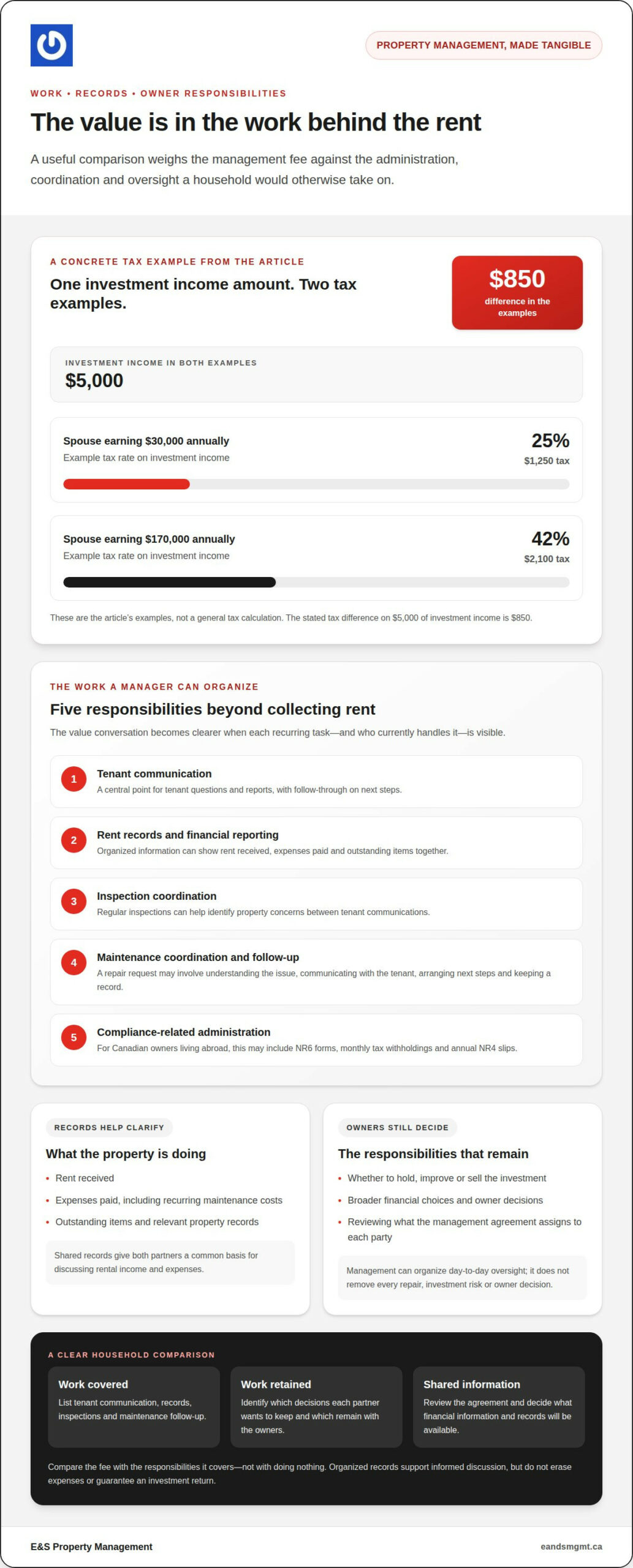
Another way to explain the value of a PM to a skeptical spouse is to map recurring tasks and their impact at home. List who currently handles tenant communication, rent records, inspection coordination and maintenance follow-up. Then discuss how those responsibilities could change and which decisions each partner wants to retain. This makes the comparison about specific work and shared priorities, not assumptions about what a manager does.
A spouse earning $30,000 annually could pay tax at 25% on investment income, compared with 42% for a spouse earning $170,000. On $5,000 of investment income, tax would be $1,250 versus $2,100, a difference of $850.
Investment and compliance risks
Rental property risk isn’t limited to a vacant month or an unexpected repair. Owners also need consistent records, clear tenant communication and timely follow-through. A property manager can organize these moving parts, but professional oversight doesn’t remove the owner’s investment decisions. Separating the roles helps couples discuss what management can address and what remains their responsibility.
Consider a maintenance issue reported by a tenant. Delayed communication or unclear responsibility can allow a small concern to become a larger repair. A manager can receive the report, coordinate next steps and record the response. Regular inspections can also identify property concerns that might otherwise go unnoticed between tenant communications. These practices support informed decisions, but they can’t prevent every repair or guarantee a particular investment return.
Investment risk also depends on the rental property itself. A couple might face a vacancy, an unexpected expense or a change in plans for the home. A manager’s records can help show how rent and operating expenses affect the property’s performance. The owners still decide whether to hold, improve or sell the investment. This distinction keeps expectations clear: management supports day-to-day oversight, while owners remain responsible for broader financial choices.
Compliance-related administration is another area where process matters. For Canadian owners living abroad, the work may involve processing NR6 forms, monthly tax withholdings and issuing annual NR4 slips. These records connect rental income with required administration. In situations involving overseas service or changing ownership details, missing paperwork can complicate an otherwise routine process. A well-organized file helps keep documents, dates and property records together for review.
A written management agreement is central to understanding who handles each task. It sets out the manager’s responsibilities and the decisions retained by the owner. For example, the agreement can clarify how maintenance requests are handled and how owners receive financial information. Couples can review these responsibilities together and identify which risks the arrangement addresses. The discussion then becomes specific: what work is delegated, what oversight remains and what records will be available.
For a practical discussion, choose one situation, such as a tenant repair request or an overseas tax document. Trace the steps from the first report to the final record, then identify where an owner’s decision is needed. This makes potential gaps easier to see without assuming that management removes every risk. Professional property management oversight can help organize responsibilities that otherwise fall to the household.
Money management and shared expenses
Property management is also a household budgeting decision. Partners can discuss how the expense fits alongside rental income, shared costs and the responsibilities each person currently carries.
Start with the principle you already use for shared expenses. Some couples split household costs 50-50, while partners with uneven incomes may prefer a 70-30 arrangement. Those examples offer possible frameworks, not a rule for every household. The right approach should feel fair to both members of the relationship and reflect how you already manage joint financial decisions.
Next, decide whether the management expense belongs in the rental property budget or your shared household budget. That distinction can change how each partner views the result. If it’s a property expense, consider it alongside rental income and other operating costs. If it’s a household expense, discuss how to divide it according to your usual approach. Either way, decide together and use the same method consistently.
A practical conversation can follow three steps:
- Agree on the purpose: identify which responsibilities the expense would cover.
- Choose a fair split: consider 50-50, 70-30 or another arrangement that suits your finances.
- Set a review point: revisit the decision after you’ve seen how the arrangement affects your workload and budget.
For example, one spouse may handle tenant messages while the other tracks rental expenses. If management changes that division, discuss both the financial contribution and the time each person gains or gives up. The expense may feel different when weighed against the current workload, rather than viewed as a new line item alone. Keep the discussion focused on a shared result: a workable plan neither partner sees as unfair.
Partners don’t need identical priorities to reach an agreement. One may value lower household costs, while the other wants fewer interruptions or clearer responsibility for rental administration. Name those priorities before debating how to divide the expense. If you disagree, return to the actual tasks and decide which matter most to each person. A compromise should work for both partners, rather than leaving one responsible for the cost or the work.
For support organizing rental-property responsibilities around your household’s needs, explore property management support.
Another option to discuss is whether a spousal loan fits your circumstances. Spousal loans may be useful when a higher-income spouse has capital available for long-term investment that isn’t needed for immediate expenses. Consider this alongside your shared budget and how you want to handle rental property responsibilities. The aim is to discuss the arrangement openly, rather than assume one approach suits every couple.
For context, one example describes a married couple with a combined annual income of $200,000, with one spouse earning $30,000 and the other $170,000. Different incomes can shape how partners think about contributions, but they do not mean that all values and priorities will align. Partners are advised not to expect all of their values and priorities to align, but to discuss differences openly and respectfully. A compromise should work for both partners, with neither feeling that they have been treated unfairly.
E&S Property Management
E&S Property Management can help turn a discussion about cost and responsibility into a clearer rental management plan. Its Full-Service Property Management brings day-to-day oversight together, while Tenant Placement Service, Regular Property Inspections, and Financial Reporting and Accounting address specific parts of the workload.
This support may be useful when household members disagree about who handles tenant matters, property checks or rental records. Reviewing the responsibilities covered can help both partners understand what would shift from the household and which decisions would remain theirs. That makes it easier to weigh management against shared priorities, rather than treating the expense as an isolated line item.
If you’d like to discuss how property management could fit your rental and household needs, contact E&S Property Management.
Make your next conversation practical
A useful next step is to choose one rental responsibility that creates friction at home and discuss how you’d like it handled. This keeps the conversation focused on a shared decision, rather than on which partner is right. You might also agree on what information you both need before deciding how involved you want to be.
For couples weighing practical support, E&S Property Management offers Full-Service Property Management, Tenant Placement Service and Regular Property Inspections. These services can help clarify which responsibilities could be delegated and which decisions you prefer to keep between you. The goal is a plan that fits both your rental property and household priorities.
For a thoughtful next step, contact E&S Property Management to discuss your property management needs. A calm conversation can help you and your spouse move forward with greater clarity and confidence.
Frequently Asked Questions
Roles and responsibilities: who does what?
The management agreement and the owners’ decisions define who handles each responsibility. For example, a manager may coordinate a tenant’s repair request, while the owners retain decisions about major property investments. Before agreeing to management, clarify how routine issues are handled, when owner approval is needed and how updates are shared. This gives both spouses a concrete picture of the arrangement.
What if the conversation doesn’t go well?
Pause the discussion and identify the concern behind the disagreement. One spouse may be focused on cost, while the other worries about losing control of the property. A useful way to explain a property manager’s value to a skeptical spouse is to discuss one specific responsibility, such as handling a tenant concern, then return to the broader decision once both partners feel heard.


