
Hiring a property manager doesn’t have to mean taking control away from your parents. It can give them experienced support with the work of owning a rental home while they remain involved in the decisions that matter. If you’re wondering how to convince my parents they need a property manager, start by focusing on the responsibilities causing them the most stress.
It’s understandable if your parents are cautious about handing over tasks they’ve managed themselves. A calm, practical conversation can explain how professional management may help with tenant placement, rent collection, inspections, maintenance coordination and financial reporting, without suggesting they must give up oversight of their property.
This guide covers four ways to explain the value: connect management to your parents’ needs, outline what a manager handles, discuss how to compare services and fees, and show why relevant experience matters. You’ll get a clearer picture of how property management works, what can affect its cost and how to keep the conversation supportive rather than persuasive.
Key Takeaways
- Start the conversation by identifying which rental-property responsibilities are taking the most time or causing the most stress.
- Compare management companies by their services, reputation, agreement terms and how clearly they explain their fees.
- Weigh management costs against the time and coordination involved in handling the property yourselves.
- Look for relevant residential property management experience and familiarity with Ontario landlord-tenant requirements.
1. Benefits of professional property management
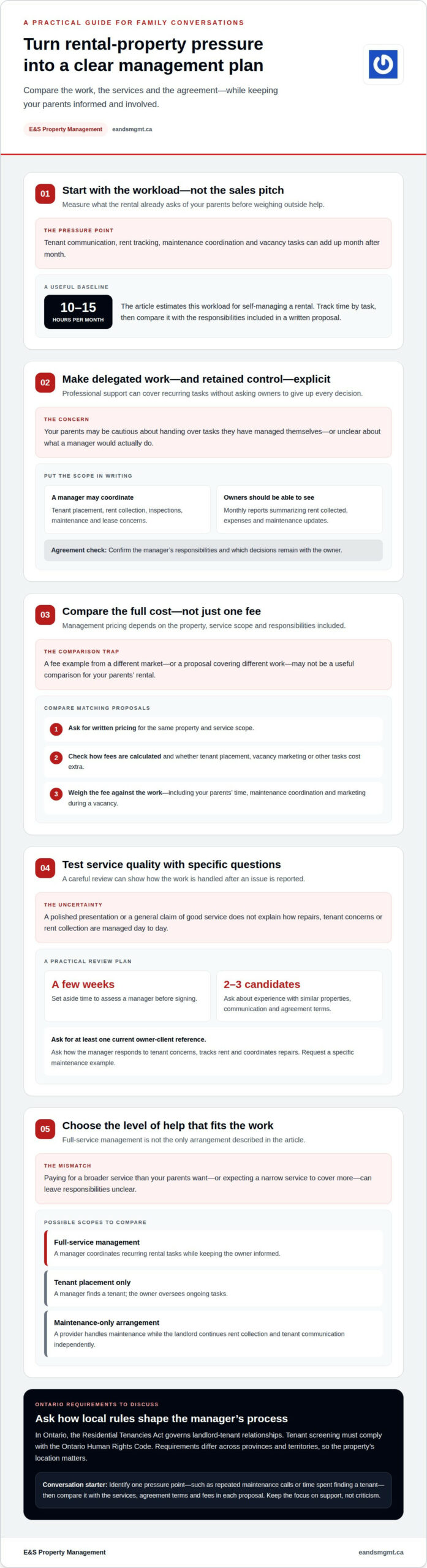
A property manager can take recurring rental tasks off a parent’s plate while keeping them informed. For example, monthly reports can summarize rent collected, expenses and maintenance updates, making it easier to follow the rental property’s performance without handling each detail.
Managers can also coordinate finding a tenant, arranging inspections and addressing lease concerns. They enforce lease terms, including rent payment and property maintenance obligations, and respond to violations. That structure can help keep routine responsibilities from becoming family disagreements.
In Ontario, the Residential Tenancies Act governs the relationship between landlords and tenants in residential properties. It sets rules for rent increases, deposits, eviction procedures, maintenance responsibilities and each party’s rights. Tenant screening must also comply with the Ontario Human Rights Code. Requirements differ across provinces and territories, so the property’s location determines which landlord-tenant rules apply.
Parents often ask what they would be delegating. A property manager can coordinate tenant placement, rent collection, inspections and maintenance while keeping the owner informed. The management agreement should clearly describe the manager’s responsibilities and the decisions that remain with the owner.
The main benefit is organized oversight; the trade-off is paying for professional help and sharing control over day-to-day tasks. This can suit parents who are busy, live far from the rental property or find tenant issues difficult to manage. Owners who prefer hands-on involvement may value a narrower role instead.
To discuss the idea without creating conflict, start with one concrete pressure point, such as repeated maintenance calls or time spent finding a tenant. Ask what your parents would most like help with, then compare those needs with a manager’s services. Keep the conversation focused on support, not criticism.
Hiring children should not be presented as an automatic tax benefit. If a child performs legitimate, age-appropriate work, parents can document duties and hours, pay regularly and keep records of the arrangement. Federal tax treatment depends on the circumstances, so a Canadian tax professional can explain what applies before the family relies on a particular tax outcome.
2. Evaluating companies’ reputation, services, and pricing
Set aside a few weeks to assess a property manager before your parents sign. Ask two or three candidates about their experience with similar real estate, such as a single rental home or a multifamily property. Compare their service descriptions, communication approach and agreement terms, rather than relying on a polished presentation alone.
References can reveal how a manager handles day-to-day responsibilities. Ask for at least one current owner-client reference, then ask how the manager responds to tenant concerns, tracks rent collection and coordinates repairs. A specific example, such as how a maintenance issue was handled, gives your parents a clearer picture than a general claim of good service.
Contractor networks and maintenance processes also matter. Ask how requests are assigned, how repair updates reach the landlord and how expenses appear in owner reports. The agreement should explain who approves work and how urgent issues are handled. These details show what happens between reporting a problem and completing a repair.
Read the management agreement line by line. Confirm which tasks are included, how fees are calculated, whether separate charges apply to tenant placement or other work, and how either party can end the arrangement. A management fee depends on the property, service scope and responsibilities; providers give pricing after a quote request. Compare the same responsibilities across each written proposal.
Alternatives to full-service management include hiring a manager only to find a tenant, then having the owner oversee ongoing tasks. Some providers also offer maintenance-only arrangements, while a landlord can continue handling rent collection and tenant communication independently. Match the scope to the work your parents actually want to delegate.
For Ontario rentals, the Residential Tenancies Act governs landlord-tenant relationships, and tenant screening must comply with the Ontario Human Rights Code. Ask candidates how these requirements inform their processes. A careful comparison helps your parents assess reputation, service fit and agreement terms together.
3. Property management fees and time commitment
Estimate the work first. Managing a rental property yourself would likely take 10-15 hours per month, including tenant communication, rent tracking, maintenance coordination and vacancy tasks. Your parents can record how long each task takes, then compare that monthly workload with the responsibilities included in a management proposal.
To estimate whether a manager could save time or money, compare the written fee proposal with the hours and expenses your parents currently spend. Include the value of their time, maintenance coordination and marketing during a vacancy. A manager’s fee is given after a quote request; costs depend on the property and the responsibilities included.
For an Ottawa rental, compare proposals based on the same property and service scope rather than relying on a fee example from another market. Local rental conditions and agreement terms can affect management and leasing charges. Ask how each fee is calculated and whether tenant placement, vacancy marketing or other tasks carry separate charges.
Leasing and vacancy management deserve separate attention. During a vacancy, a manager may coordinate marketing, respond to prospective tenants and arrange showings or applications. The agreement should clarify which leasing tasks are included, when a separate fee applies and how the manager reports progress to the owner.
Ask for a clear cost breakdown, not just a headline rate. The proposal should distinguish ongoing management from tenant placement and explain any charges for additional work. That makes it easier to compare expected expenses with rental income and the tasks your parents would still handle.
Property management fees alone don’t show the full value. Consider how professional oversight could reduce the time your parents spend coordinating tenants, repairs and vacancies, while recognizing that it does not guarantee higher income or lower costs. Review the workload, identify the tasks they want to delegate and assess the agreement’s full fee structure.
4. Property management expertise and experience
A property management company’s experience matters most when it matches the property and the support an owner needs. A single rental home has different day-to-day demands from a larger portfolio. Ask how the manager handles tenant screening, inspections, maintenance concerns and owner communication in situations like your parents’.
Look for specific examples, not broad claims. Ask how the manager documents an inspection, communicates a repair concern and follows up with the owner. A clear process helps your parents understand how routine oversight works and where they remain involved. The written agreement should also explain how responsibilities are divided.
Professional designations can provide another point of reference, but they don’t replace relevant experience. The Certified Property Manager designation is issued by the Institute of Real Estate Management. Your parents can consider a manager’s designation alongside practical experience with residential rentals and the tasks they want to delegate.
Expertise also includes understanding the rules that apply to residential properties. These may involve landlord-tenant requirements, health and safety codes, building and zoning regulations, and eviction procedures. In Ontario, the Residential Tenancies Act governs landlord-tenant relationships. Ask how the manager accounts for applicable requirements in screening, maintenance coordination and lease administration.
For an investor with one property, focus the discussion on the work that creates the most uncertainty. Your parents could ask how the manager handles a maintenance issue from the initial report through the owner update. The answer can show whether the manager’s communication and oversight match the family’s expectations.
Use these details to frame the conversation around experience, not age or ability: professional support can complement what your parents already know. If they want structured oversight for a residential rental, explore professional property management as one way to understand how those responsibilities can be handled.
E&S Property Management
E&S Property Management can help parents who want professional support managing a residential rental while staying informed about their property. Its services can bring tenant placement, regular inspections and financial reporting into a more organized process, with full-service management available for owners seeking broader oversight.
This can be a useful next step once your parents have identified recurring tasks they would rather delegate or want a clearer picture of professional management. Use the questions in this guide to discuss responsibilities and priorities together, then consider whether the support matches their expectations.
For a conversation about their rental property and management needs, contact E&S Property Management.
Start a Conversation That Respects Their Choices
If you’re thinking about how to convince my parents they need a property manager, start by asking what they want rental ownership to look like in the years ahead. Their answer can guide a respectful discussion about which responsibilities they enjoy and where support might help. The goal isn’t to decide for them, but to understand what matters to them.
A thoughtful approach to how to convince my parents they need a property manager leaves room for their concerns and preferences. Rather than trying to win the conversation, ask whether any part of managing the rental feels burdensome. Give them time to weigh the idea and decide what feels right.
If you’re still thinking about how to convince my parents they need a property manager, consider starting with a calm conversation about their priorities. To explore whether professional management could suit your family, contact E&S Property Management. A small, respectful next step can make the decision easier to consider together.
Frequently Asked Questions
Do You Need a Single Family Property Management Company?
Not necessarily. An owner can self-manage a single-family rental if they have the time and feel comfortable coordinating its needs. A property manager may help if your parents live far from the home, want organized records or prefer a consistent point of contact for tenants. In Ottawa, consider whether managing the property fits their schedule and comfort level.
How does the cost of a property manager compare with self-managing a rental property?
Compare the proposed management fee with the time and direct expenses your parents take on themselves, such as arranging contractors, advertising a vacancy and managing tenant communications. The scope of service and property needs shape the comparison, so match included tasks before weighing options. Management pricing depends on the case and is provided after a quote request; relevant factors include the property and requested responsibilities.
What signs indicate that a landlord should hire a property manager?
Professional help may be useful if rental responsibilities repeatedly disrupt your parents’ work or family plans, or if they live too far away to oversee the home comfortably. Difficulty keeping tenant records, contractor updates and financial documents organized can also signal that support would help. For Ottawa owners, reviewing the day-to-day workload can clarify which responsibilities to delegate.


