
Imagine waking up in a different time zone to find a 7% interest penalty from the CRA simply because a paper notice from the City of Ottawa sat in an empty mailbox for three weeks. It’s a heavy burden to carry when you’re trying to focus on your life abroad; the distance can make even simple administrative tasks feel like a looming crisis. You likely feel that managing your investment shouldn’t be this stressful, and you’re right. That’s why professional Ottawa non-resident landlord tax services are so vital for owners who need a reliable set of eyes on the ground.
We understand the specific anxiety that comes with balancing a 3.75% municipal tax increase against complex federal withholding requirements. This guide will help you regain control by demystifying the 2026 tax landscape. You’ll learn how to successfully file your NR6 form before the January 1 deadline to keep more of your rental income in your pocket. We’ll walk through the essential 2026 calendar, explain how to bridge the gap between City Hall and the CRA, and provide the clarity you need to ensure your Ottawa residential property remains a source of stability rather than a source of worry.
Key Takeaways
- Master the 2026 municipal timeline by identifying the specific deadlines for interim and final property tax installments in Ottawa.
- Discover how professional Ottawa non-resident landlord tax services help you navigate the 25% CRA withholding requirement and the strategic benefits of a Section 216 election.
- Understand the critical January 1 deadline for Form NR6, which allows you to reduce your tax burden by paying based on net rental income rather than gross revenue.
- Learn the proper steps to declare your property for the Ottawa Vacant Unit Tax to ensure your tenanted residence is exempt from additional municipal charges.
- Protect your investment from the current 7% CRA interest rate on overdue taxes by establishing a reliable system for managing your federal and local obligations.
Understanding Municipal Property Tax in Ottawa for 2026
Property tax in Canada is the lifeblood of municipal services, funding everything from the snow plows on Elgin Street to the emergency responders in Barrhaven. For landlords living abroad, it’s a fixed cost that requires careful monitoring. In Ottawa, your tax bill is a municipal levy based on the value assigned to your home by the Municipal Property Assessment Corporation (MPAC). Because these assessments can shift, your investment strategy must account for the 2026 residential tax increase of 3.75% approved by the City Council.
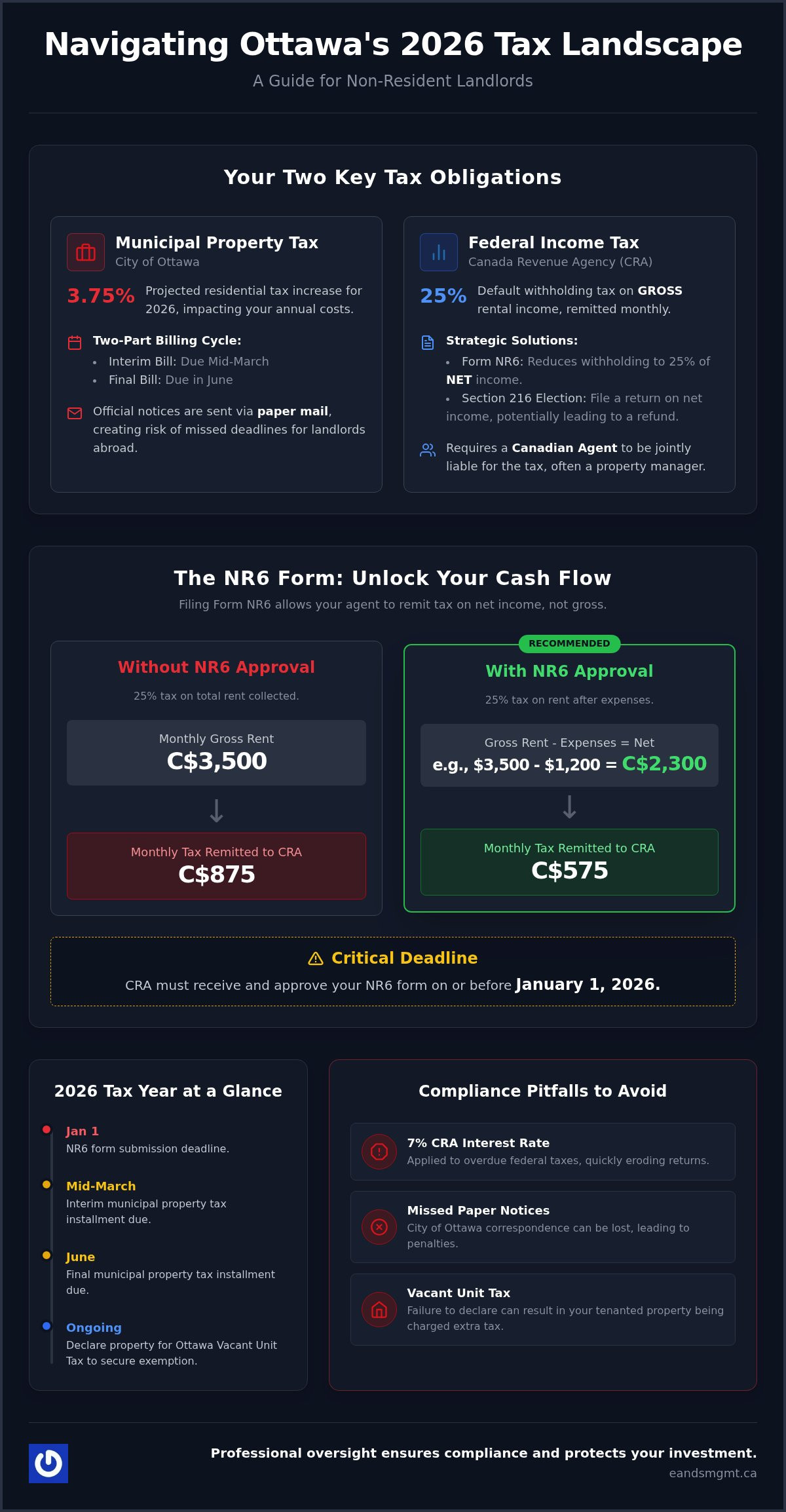
The city operates on a two-part billing cycle that remains consistent year over year. You’ll receive an Interim bill in February, typically due in mid-March, which represents 50% of the previous year’s total. The Final bill is issued in May with a June deadline, reflecting the new 2026 tax rates and any assessment changes. For those managing payments from overseas, missing these specific windows can lead to immediate interest penalties, complicating your year-end financial reporting.
The 2026 Ottawa Residential Tax Rates
The 2026 budget impacts your annual carry costs through both city-wide levies and ward-specific charges. While the average residential tax rate sits between 1.2% and 1.23%, the actual dollar amount varies significantly by property type. A detached home in a mature neighborhood like Westboro will naturally command higher taxes than a suburban townhome or a downtown condo. It’s vital to factor this 3.75% increase into your 2026 cash flow projections to ensure your rental income covers these rising municipal obligations without straining your personal finances.
Managing City Correspondence from Abroad
The distance between your current home and Ottawa can create a dangerous gap in communication. The City of Ottawa continues to rely heavily on paper mail for official tax notices. If a bill is sent to your rental property and your tenant forgets to forward it, you may only discover the oversight when penalties have already accrued. While you can register for a MyServiceOttawa account to view your balance online, digital systems don’t always replace the need for a physical presence.
Many Foreign Service members and expatriates find that utilizing professional Ottawa non-resident landlord tax services provides the necessary layer of protection. Having a local guardian to receive municipal mail and verify assessments ensures that you never miss a deadline. This level of oversight transforms a potentially stressful administrative cycle into a streamlined, hands-off process, giving you the peace of mind that your Ottawa assets are secure and compliant.
Federal Income Tax: CRA Obligations for Non-Residents
Federal tax compliance is often the most significant source of anxiety for our clients living abroad. Under the Income Tax Act, the Canada Revenue Agency (CRA) defaults to a 25% withholding tax on the gross rental income you receive. This means if your Ottawa property generates C$3,500 in monthly rent, C$875 must be remitted to the CRA by the 15th day of the following month. Without a clear strategy, this requirement can create a significant strain on your monthly cash flow, especially when combined with mortgage payments and maintenance costs.
Understanding your CRA obligations for non-residents is the first step toward finding financial relief. By making a Section 216 election, you choose to be taxed on your net income-your revenue minus eligible expenses-rather than the total amount collected. This election often results in a lower tax liability and a potential refund of overpaid withholdings. However, to access these benefits, you must have a Canadian Agent who is a resident of Canada and agrees to be jointly liable for the tax. This is why specialized Ottawa non-resident landlord tax services are so valuable; they provide the local authority required to protect your interests and simplify your reporting.
The NR6 Form: Reducing Your Monthly Withholding
The NR6 form is a powerful tool for preserving your monthly liquidity. When the CRA approves this form, it allows your agent to withhold 25% of your estimated net income instead of the gross rent. You’re permitted to deduct legitimate operating costs, including property management fees, essential repairs, and the 2026 Ottawa property taxes we discussed in the previous section. Timing is critical here. The CRA must receive and approve your NR6 on or before January 1, 2026, or before the first rental payment is due. Missing this window means you’ll likely have to wait until the following year to file for a refund of the higher gross withholdings.
NR4 Slips: Your Annual Reporting Requirement
Compliance continues through the end of the fiscal year with the issuance of NR4 slips. These documents report the total gross rental income and the amount of non-resident tax withheld throughout the year. Your agent must provide this slip to both you and the CRA by March 31st. Errors in these filings are a common trigger for federal audits, which can be difficult to manage from a distance. We’ve seen how much relief our clients feel when they delegate these administrative burdens. Choosing comprehensive financial reporting ensures that every slip is accurate and every deadline is met, allowing you to focus on your life abroad while your Ottawa investment remains in good standing.
Ottawa-Specific Tax Considerations for Non-Residents
Owning property in the nation’s capital involves more than just keeping up with federal withholdings. Local legislation in Ontario and specific municipal bylaws in Ottawa create a unique tax environment that can be difficult to monitor from thousands of miles away. One such factor is the Non-Resident Speculation Tax (NRST). In 2026, this provincial tax remains a critical consideration for non-residents purchasing residential property in Ontario, currently set at a rate of 25%. While this is primarily a closing cost, any changes in your residency status while holding the asset can have downstream effects on your overall investment strategy and future tax exposure.
Local rental market trends also play a role in your annual reporting. As Ottawa continues to see shifts in neighborhood demand, your property’s assessed value and potential rental income will fluctuate. Staying ahead of these changes requires a proactive approach to Ottawa municipal property tax management. By utilizing professional Ottawa non-resident landlord tax services, you can ensure that local levies are correctly integrated into your broader financial plan, preventing unexpected costs from eroding your ROI.
Navigating the Ottawa Vacant Unit Tax (VUT)
The Vacant Unit Tax (VUT) is perhaps the most frequent source of “administrative panic” for our clients. The City of Ottawa requires a mandatory declaration every year to confirm whether your property was occupied for at least 184 days. Even if your property is fully tenanted, failing to submit this declaration by the mid-March deadline results in the property being deemed vacant by default. This triggers a tax of 1% of the assessed value, which can amount to thousands of CAD in unnecessary charges. We help you maintain a digital trail of lease agreements and utility records to prove occupancy, ensuring you qualify for the residential rental exemption and avoid these steep penalties.
Property Tax vs. Rental Income Deductions
One of the few silver linings of the 3.75% municipal tax increase is its impact on your federal return. Your Ottawa property tax is considered a fully deductible business expense when calculating your net rental income. It’s also helpful to check your local school support designations; while this doesn’t change the total amount you pay, it ensures your tax dollars are allocated according to your preferences. To claim your Ottawa municipal tax on a Section 216 return, you simply list the total amount paid during the calendar year under the ‘Taxes’ category on Form T1159. This small step is vital for reducing your overall federal tax liability and maximizing the efficiency of your Ottawa investment.
Compliance Pitfalls: What Happens if You Miss a Filing?
Missing a filing is rarely a matter of intent; it’s usually the result of a busy life lived across borders. However, the CRA doesn’t distinguish between a forgotten form and a deliberate omission. For the latter half of 2026, the interest rate on overdue taxes is holding steady at 7%. This compounding interest can quickly turn a small oversight into a significant financial drain. Beyond the interest, the most painful consequence is losing your legal right to file on a net basis. If you miss the window for your Section 216 election, the CRA may insist on the full 25% tax on your gross income, leaving you unable to deduct your mortgage interest or management fees.
On the municipal side, the City of Ottawa is equally methodical. While the city won’t initiate tax sale proceedings immediately, persistent delinquency on your property tax account can eventually lead to a public auction of the property. This process usually begins once taxes are two years in arrears. Without a local steward to monitor these accounts, “compliance drift” sets in. This is a slow accumulation of small errors that eventually creates a tangled mess of penalties and legal risks. Professional Ottawa non-resident landlord tax services act as a stabilizing force, ensuring these drift points are corrected before they become crises.
Common Mistakes for Expats and Foreign Service Officers
Many Foreign Service officers assume their tenants will handle the 25% remittance to the CRA. This is a risky assumption, as tenants often lack the technical knowledge to navigate the CRA’s portal correctly. If they fail to remit, the CRA holds the landlord liable. Another frequent error occurs during a hectic posting transition when the annual NR6 renewal is forgotten. Without a current NR6, your agent is legally required to revert to gross withholding. Finally, many owners miscalculate their net income by failing to track local maintenance costs, which directly reduces the amount of tax you owe.
The Voluntary Disclosures Program (VDP)
If you realize you’ve fallen behind, there’s a path back to compliance. The Voluntary Disclosures Program (VDP) allows you to correct past mistakes and pay what you owe without facing the most severe penalties or prosecution. It’s an invitation to step forward and fix the record. A seasoned property manager can audit your local tax history to identify exactly where the gaps are. If you receive a CRA notice while you’re abroad, don’t let it sit. The first step is to engage an expert who can communicate with the CRA on your behalf. We provide specialized NR6 and NR4 tax filing support to help you navigate these corrections and restore your peace of mind.
How E&S Property Management Protects Your Interests
Since 1981, we’ve dedicated ourselves to the meticulous care of residential properties in the Ottawa market. For over 40 years, we’ve stood as a reliable partner for landlords posted around the globe, ensuring their assets remain secure and their obligations are met. Our specialized Ottawa non-resident landlord tax services are designed to remove the weight of compliance from your shoulders. We don’t just manage buildings; we act as your dedicated steward, navigating the intricate requirements of both the CRA and the City of Ottawa with the wisdom that only four decades of experience can provide.
One of the most critical roles we fill is acting as your official Canadian Agent. As we’ve explored, the CRA requires a resident representative to facilitate Section 216 elections and manage monthly remittances. We handle the entire cycle of federal reporting, from processing your monthly withholdings to the annual preparation of NR4 slips and NR6 applications. By delegating these administrative duties to a seasoned hand, you ensure that every C$ is accounted for and every deadline is met with precision. Our team also coordinates directly with the City of Ottawa, managing property tax payments and the essential Vacant Unit Tax declarations so you never face a default penalty.
The E&S ‘Protective Guardian’ Approach
Foreign Service members often trust us with their most valuable asset: their primary family home. We understand that leaving your residence in someone else’s hands is a significant act of trust. Our approach centers on a seamless transition where we take over the complex logistical burdens of property ownership. You no longer need to worry about time zones or missing paper mail from City Hall. Instead, you can explore our Non-Resident Tax Services to see how we transform a cycle of stress into a narrative of order and clarity.
Financial Reporting and Transparency
Clarity shouldn’t be a luxury. Through our modern digital owner portal, you can access your tax documents and financial statements at any time, from anywhere in the world. We organize your records meticulously, ensuring they’re ready for your Canadian accountant or tax preparer when the filing season arrives. This level of transparency provides the peace of mind that comes from knowing your investment is being protected by a technically proficient partner who understands the personal value of your home. If you’re ready to move toward a more secure and simplified investment experience, contact us for a stress-free management quote today.
Securing the Future of Your Ottawa Property Investment
Managing a rental property from abroad involves a complex interplay of municipal deadlines and federal reporting requirements. We’ve seen how a 3.75% property tax increase or a missed NR6 filing can disrupt your financial equilibrium. These challenges don’t have to define your experience as a landlord. By integrating professional oversight with a clear understanding of the 2026 tax landscape, you can transform your investment into a truly passive asset that grows in value without demanding your constant attention.
Our team provides specialized Ottawa non-resident landlord tax services backed by over 40 years of expertise in the local residential market. We’ve spent decades acting as a protective guardian for Foreign Service members, offering comprehensive NR6 and NR4 administration that removes the stress of CRA compliance. You deserve the confidence that comes from knowing every detail is managed by a seasoned hand, from Vacant Unit Tax declarations to monthly withholdings.
Secure Your Ottawa Investment with Expert Management. Your property in the capital is a vital part of your financial future; let’s work together to keep it secure and prosperous while you’re away.
Frequently Asked Questions
Do I have to pay Ottawa property tax if I live outside of Canada?
Yes, you’re still responsible for municipal property taxes even if you live abroad. The City of Ottawa bases these taxes on the physical location of the asset, not your residency status. For 2026, the City Council approved a 3.75% tax increase, which applies to all residential property owners. Missing these payments can lead to substantial penalties and eventually a tax sale, so it’s vital to have a local system for managing these bills while you’re posted overseas.
What is the NR6 form and why is it important for Ottawa landlords?
Form NR6 is a federal document that allows you to pay tax on your net rental income rather than the gross amount. Without an approved NR6, the CRA requires a 25% withholding on every dollar of rent collected. By filing this form before January 1, 2026, you can deduct expenses like repairs and management fees first. This process significantly improves your monthly cash flow and ensures you aren’t overpaying the government throughout the year.
How much is the non-resident tax on rental income in Canada for 2026?
The default non-resident tax rate for 2026 is 25% of your gross rental income. This means if your tenant pays C$3,000, you must remit C$750 to the CRA monthly. However, most owners use Ottawa non-resident landlord tax services to transition to a net-income basis. This allows you to pay 25% only on the profit remaining after expenses, which is a much more sustainable financial model for long-term property investment in the capital.
Can my Ottawa property manager act as my CRA agent for tax withholding?
Absolutely. In fact, having a professional property manager act as your Canadian agent is the most reliable way to ensure compliance. To use the NR6 form, you must appoint an agent who is a resident of Canada and willing to be jointly liable for your tax obligations. E&S Property Management has served as a protective guardian for Foreign Service members since 1981, providing the technical proficiency needed to handle these sensitive federal duties.
What is the deadline for filing a non-resident tax return (Section 216)?
Your filing deadline depends on whether you submitted an NR6 form earlier in the year. If the CRA approved your NR6, you must file your Section 216 return by June 30, 2026. If you didn’t file an NR6 and paid tax on your gross income, you generally have two years from the end of the tax year to file. We always recommend meeting the June deadline to keep your financial records current and avoid any confusion.
How do I avoid the Ottawa Vacant Unit Tax if I am posted abroad?
You avoid the Vacant Unit Tax by submitting a mandatory declaration to the City of Ottawa every year. Even if your home is fully occupied by a tenant, the city will deem it vacant if you miss the mid-March deadline. A “deemed vacant” status triggers a tax of 1% of the property’s assessed value. We handle these declarations for our clients to ensure their residential rental exemption is properly recorded and no unnecessary charges are applied.
What happens if I forget to remit the 25% rental tax to the CRA?
Forgetting to remit this tax triggers immediate interest charges from the CRA. For the latter half of 2026, the interest rate on overdue taxes is 7%. Beyond the financial cost, the CRA may revoke your ability to file on a net basis for the year. This forces you to pay tax on your gross revenue without any deductions for mortgage interest or repairs, which can turn a profitable investment into a significant monthly loss.
Are property management fees tax-deductible for non-residents?
Yes, they are. Professional fees for Ottawa non-resident landlord tax services and daily management are considered legitimate business expenses. When you file a Section 216 return, you can subtract these costs from your gross rent to determine your taxable net income. This deduction is one of the most effective ways to lower your overall tax liability while ensuring your property receives the high-level care and professional oversight it needs while you’re living abroad.


