A condo corporation can restrict rentals through its governing documents, but a board-made rule must be reasonable and consistent with the declaration and by-laws. For Ottawa landlords, condo corporation rules can affect whether a unit may be rented, what tenants must follow, and how a lease is reported. Under section 83 of Ontario’s Condominium Act, an owner must notify the corporation within 10 days of entering into or renewing a lease.
It’s understandable to wonder whether a condo board can simply tell you that renting your unit isn’t allowed. The answer depends on the corporation’s declaration, by-laws and rules, as well as the City of Ottawa’s requirements for the type of rental you plan to offer.
This guide explains lease notifications, inspections and enforcement, how common elements are maintained, and which rules tenants must receive. It also shows how condo requirements fit alongside Ontario tenancy obligations, so you can understand what applies before a rental issue becomes a source of stress.
Key Takeaways
- Understand what lease changes must be reported to the condo corporation and when Ottawa’s short-term rental permit requirement applies.
- Learn how corporations can pursue compliance when a landlord or tenant breaches governing documents.
- See how responsibility for shared and exclusive-use areas can depend on the condominium’s declaration.
- Know which condo rules tenants need to receive and how restrictions on pets, parking, noise or rentals may affect a tenancy.
Condo corporation lease notifications
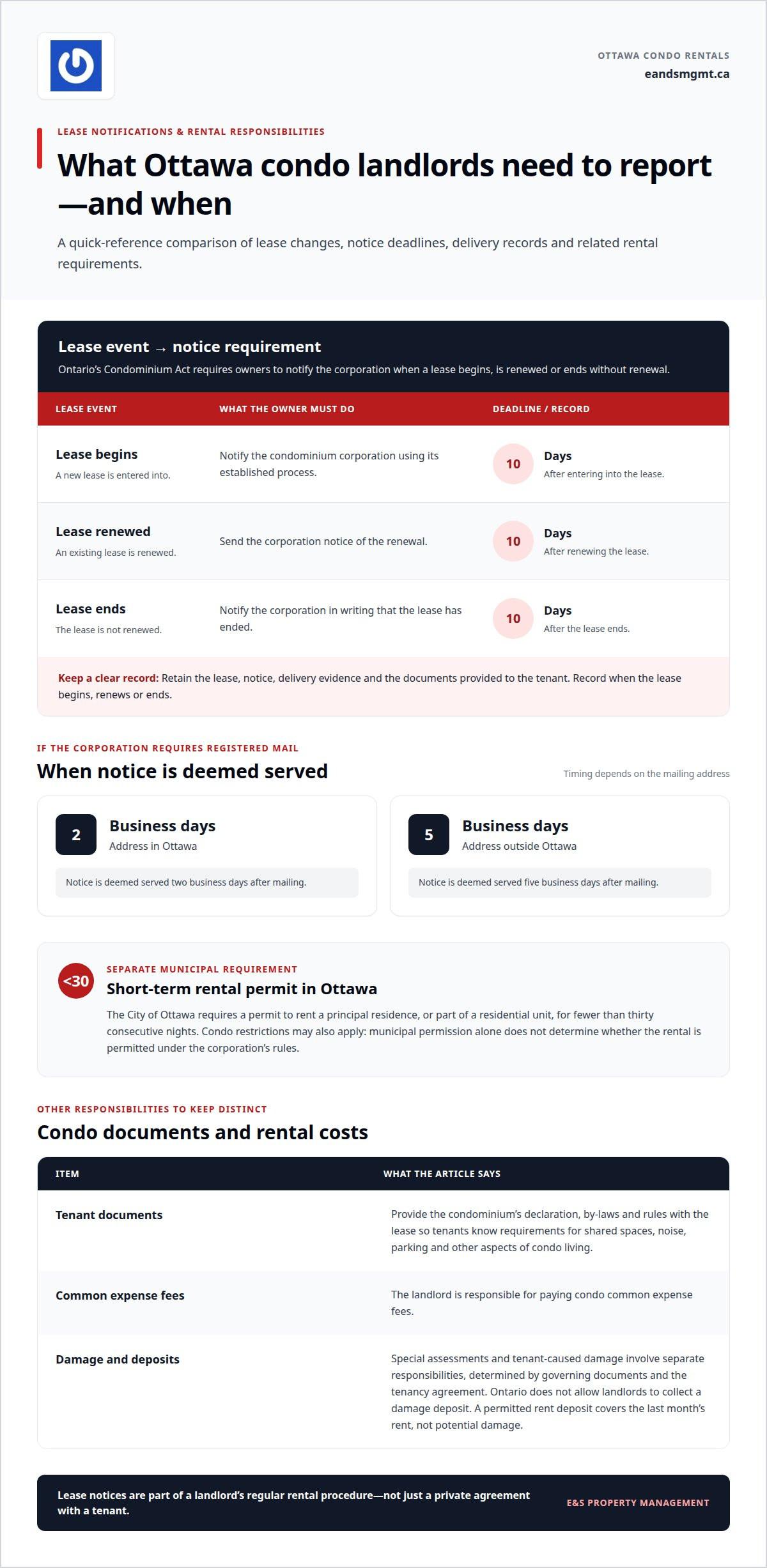
Section 83 of Ontario’s Condominium Act, 1998 requires an owner to notify the condominium corporation within 10 days of entering into or renewing a lease. If a lease ends and isn’t renewed, the owner must also notify the corporation in writing within 10 days. These deadlines make lease changes part of a landlord’s regular rental procedure, not just a private agreement with a tenant.
Give the corporation the required notice using its established process. If the corporation’s by-law requires registered mail, notice is deemed served in Ottawa two business days after mailing. For an address outside Ottawa, it is deemed served five business days after mailing. Keep a copy of the notice and mailing record with the rental unit’s lease documents.
Tenants also need the condominium’s declaration, by-laws and rules. Providing these documents with the lease helps explain requirements for shared spaces, noise, parking and other aspects of condo living. Tenants can then understand which corporation rules apply, while the landlord remains responsible for communicating with the corporation about the lease.
The landlord is responsible for paying condo common expense fees. Special assessments and tenant-caused damage involve separate responsibilities, determined by the corporation’s governing documents and the tenancy agreement. Ontario doesn’t allow landlords to collect a damage deposit. A permitted rent deposit covers the last month’s rent, not potential damage.
Short-term rentals involve a separate City of Ottawa requirement. A permit is required to rent a principal residence or part of a residential unit for fewer than thirty (30) consecutive nights, according to the City of Ottawa. Condo restrictions may also affect whether that rental is permitted, so municipal permission alone doesn’t settle the corporation’s rules.
For a clear record, retain the lease, notices, delivery evidence and the documents given to the tenant. Record when a lease begins, renews or ends, then send the relevant notice within the 10-day period. This simple procedure helps landlords meet notification responsibilities and gives the corporation current rental information.
By-law inspections and enforcement
A condo corporation can pursue compliance when an owner or tenant breaches its declaration, by-laws or rules. As a landlord, address the specific conduct and keep a clear written record of what happened.
Responding to tenant rule violations
Respond by discussing reported conduct with the tenant and taking reasonable steps to resolve the specific breach. Understanding Ottawa condo corporation rules for landlords means distinguishing a tenant’s actions from the rule that applies. For example, assess a complaint about a vehicle against the actual parking provision rather than treating it as a confirmed violation.
Write to the tenant with the concern, the relevant rule and the change being requested. Keep copies of the complaint, the tenant’s response and any follow-up. If the corporation continues enforcement, provide relevant correspondence and cooperate with its process. Section 134 of Ontario’s Condominium Act allows an application to the Superior Court of Justice to enforce compliance.
Disputing rules and enforcement actions
A dispute challenges whether a rule applies or whether the corporation’s enforcement is justified. Ottawa condo corporation rules for landlords are easier to assess when you set out the concern, supporting documents and requested outcome clearly in writing. This helps separate a disagreement about events from a challenge to the rule itself.
Ontario’s Condominium Act addresses mediation and arbitration in section 132. Section 134 provides for an application to the Superior Court of Justice to enforce compliance. Keep notices, dates, responses and supporting records together if an enforcement issue becomes a formal dispute. These routes address different stages of a disagreement; the available process depends on the issue.
For a maintenance concern, record the unit’s condition separately from the alleged rule breach. Regular Property Inspections can help maintain consistent property condition records.
Common elements and exclusive-use common elements
Common elements are areas or facilities governed by the condominium’s documents, rather than solely by an individual landlord. The corporation is responsible for maintaining and repairing common areas, but the declaration may allocate repair responsibilities differently. This distinction matters when a problem affects a balcony, parking space or another area connected to a rental unit.
An exclusive-use area may be available to one unit while still being considered a common element. Its permitted use and maintenance responsibilities depend on the condominium’s governing documents. For example, a declaration may assign a particular repair duty to an owner. Don’t assume exclusive use makes every repair the owner’s responsibility, or that the corporation must handle every repair.
Start with the registered declaration and related documents. Check how they describe the area, who may use it, and who must maintain or repair it. The declaration is especially important because it can change the usual allocation between the corporation and owners. A signed lease can explain the tenant’s obligations, but it doesn’t replace the corporation’s governing documents.
Do Ottawa condo rules differ for standard, vacant-land and common-elements condominiums? The practical answer depends on each condominium’s registered declaration and the areas it identifies as units or common elements. The documents, not the label alone, determine which maintenance provisions apply to a specific area.
For a repair concern, identify the affected area and compare it with the declaration’s wording before deciding who should address it. A leak affecting an exclusive-use balcony, for example, may involve different responsibilities from damage inside the residential unit. Record the issue and the corporation’s response so you can discuss responsibility with reference to the relevant documents.
The Residential Tenancies Act, 2006 also governs residential tenancies in Ontario, while the condominium’s declaration and other documents address the corporation’s property responsibilities. Landlords should communicate applicable use and maintenance expectations to tenants. Clear information helps prevent a tenant’s use of an area from being mistaken for authority to alter or repair it.
Condominium corporation rules as an additional layer
Beyond the day-to-day terms of a tenancy, formal approval and registration shape how condominium restrictions operate. These steps matter when a proposed rental policy affects owners’ use of their units.
Laws governing corporations and landlords
Approval and registration requirements for condominium by-laws depend on the governing framework. A declaration amendment has a higher consent threshold: at least 80% or 90% of voting units, depending on the amendment. These requirements help distinguish a formally adopted restriction from an informal board direction.
This distinction can matter to landlords during a purchase or when a corporation changes its governing documents. A parking rule, for example, differs from a change to the declaration that alters permitted unit use. Before treating a restriction as binding, consider which document it appears in, what approval it received and whether it was registered.
Short-term rentals in Ottawa condos
Ottawa’s short-term rental framework also has a process for recording condominium prohibitions. Under section 39 of the City’s by-law, an authorized condominium corporation representative may apply to register or remove a prohibition. Part V also allows a condominium corporation, landlord or housing co-operative to apply for registration.
An application to register a condominium prohibition requires evidence that a majority of owners approved the by-law. Owner approval therefore plays a practical role in the City’s registration process. When assessing a proposed short-term arrangement, distinguish the corporation’s internal decision from the separate municipal registration process. Informal communications alone don’t prove registration.
Keep the relevant approval and registration records with the rental property’s management documents. For help coordinating the ongoing administration of an Ottawa rental, get property management support.
E&S Property Management
E&S Property Management helps Ottawa landlords manage the practical work of a condo rental while accounting for corporation requirements. Full-Service Property Management brings tenant placement, regular property inspections, and financial reporting and accounting together to keep rental administration organized. Tenant Placement Service can help when preparing to rent a unit, while inspections provide ongoing oversight of its condition. This support can be useful when lease administration, tenant communication and property records become difficult to manage alongside condo obligations. The corporation’s declaration, by-laws and rules still govern the unit, so clear records and consistent management remain important.
For support with your Ottawa rental, contact E&S Property Management.
Make your next rental decision with clarity
A workable approach to Ottawa condo corporation rules for landlords starts before the next lease, tenant concern or maintenance issue arises. Keep rental documents together, record communications and respond consistently to changes in the tenancy. With the relevant details at hand, you can make decisions without relying on memory under pressure.
Property management can bring structure to the ongoing work of owning a rental, from coordinating tenant matters to organizing property records. The right level of support depends on how involved you want to be and which responsibilities you’re ready to delegate. You can take the next step at your own pace, with a clear understanding of the work involved.
Contact E&S Property Management to discuss support for your Ottawa rental. With a steady process in place, you can move forward with greater confidence.
E&S Property Management and Ottawa Condo Rules for Landlords
E&S Property Management offers Full-Service Property Management and Tenant Placement Service for landlords who want support applying condo corporation rules to their rental. Its services also include Regular Property Inspections, Financial Reporting and Accounting, and Emergency Maintenance Response.
When you need help with landlord responsibilities, E&S Property Management also provides NR6 and NR4 Tax Filing Support. This includes processing NR6 forms, monthly tax withholdings, and issuing annual NR4 slips.
Frequently Asked Questions
But can your condo board tell you that you’re not allowed to?
A condo can restrict renting when the restriction is supported by its governing documents. A board can’t create an unreasonable rule that conflicts with the declaration or by-laws. If owners disagree with a new rule, they may requisition a meeting to challenge it. The key is whether the restriction comes from an enforceable document, rather than the board’s preference alone.
Can a Condo Building Require a Minimum Lease Term?
A minimum lease term may apply if the condominium’s governing documents impose a valid rental restriction. There is no universal minimum term for every Ottawa condo. Check how the declaration, by-laws and rules define permitted rentals, then ensure the tenancy agreement’s term fits those requirements and Ontario tenancy law. A private lease can’t override a valid condominium restriction.
Can a Condo Corporation Ban Long-Term Rentals?
A condominium declaration can restrict how units are used, including rental use, so a restriction may affect long-term tenancies. The wording and legal status of the relevant document matter; a board announcement alone doesn’t establish a ban. If a restriction appears to conflict with another governing document, compare their authority and terms before relying on it to make a rental decision.
Can the Condo Board Reject Your Tenant?
A board’s ability to object depends on the condominium’s governing documents, not simply on personal preference. The documents may restrict rental use, but tenants are also protected from discrimination under Ontario’s Human Rights Code. For example, a tenant’s disability-related need for a service or support animal may require accommodation. Distinguish a valid, document-based concern from an objection based on a protected ground.
Can an Ottawa condo corporation restrict or prohibit renting out a unit?
Yes, a condominium declaration can restrict unit use, including rentals, and corporation documents can also regulate short-term rentals. The City of Ottawa’s rules apply separately, so municipal permission doesn’t override a corporation restriction. A rental arrangement may meet City requirements but still conflict with the condominium’s registered documents. Consider both sets of rules before deciding how to rent the unit.
What rental restrictions can Ottawa condo bylaws and rules impose on landlords?
Condominium documents may address rental use and practical matters such as parking, pets, smoking and noise. A board-made rule must be reasonable and consistent with the declaration and by-laws. Some restrictions also interact with human rights obligations, including accommodation for a disability-related service or support animal. Read the exact wording, since a parking rule and a rental prohibition affect landlords differently.