What does planning for capital expenditures on my Ottawa rental look like before the roof leaks or the heating system fails? Major work is easier to manage when it’s part of a property’s lifecycle plan, rather than an urgent expense that disrupts cash flow and tenants’ routines.
Start by identifying likely projects, separating routine repairs from lasting improvements, and considering how the work fits around tenants and Ottawa’s changing seasons. A practical plan won’t prevent every surprise, but it can clarify priorities and give you more time to prepare.
This guide explains how to turn inspection findings into a prioritized project list, build a flexible budget, schedule work around tenant needs, and organize invoices and tax records. The CRA’s treatment of an expense depends on the specific work, so keep tax classification separate from decisions about when a project needs attention.
Key Takeaways
- Separate routine upkeep from work that may extend an asset’s useful life or improve the property. Tax classification and maintenance urgency are separate decisions.
- Create an asset register for major systems and appliances to track condition, service history, and potential future projects.
- Prioritize work based on safety, active damage, asset condition, recurring issues, and tenant impact.
- Planning for capital expenditures on my Ottawa rental is easier with a repeatable process for budgeting, scheduling, and keeping project records organized.
- Regular inspections and coordinated project oversight can turn property observations into a prioritized plan, with records supporting monthly and annual financial reporting.
Capital Expenditures on an Ottawa Rental: What Counts and Why Planning Matters
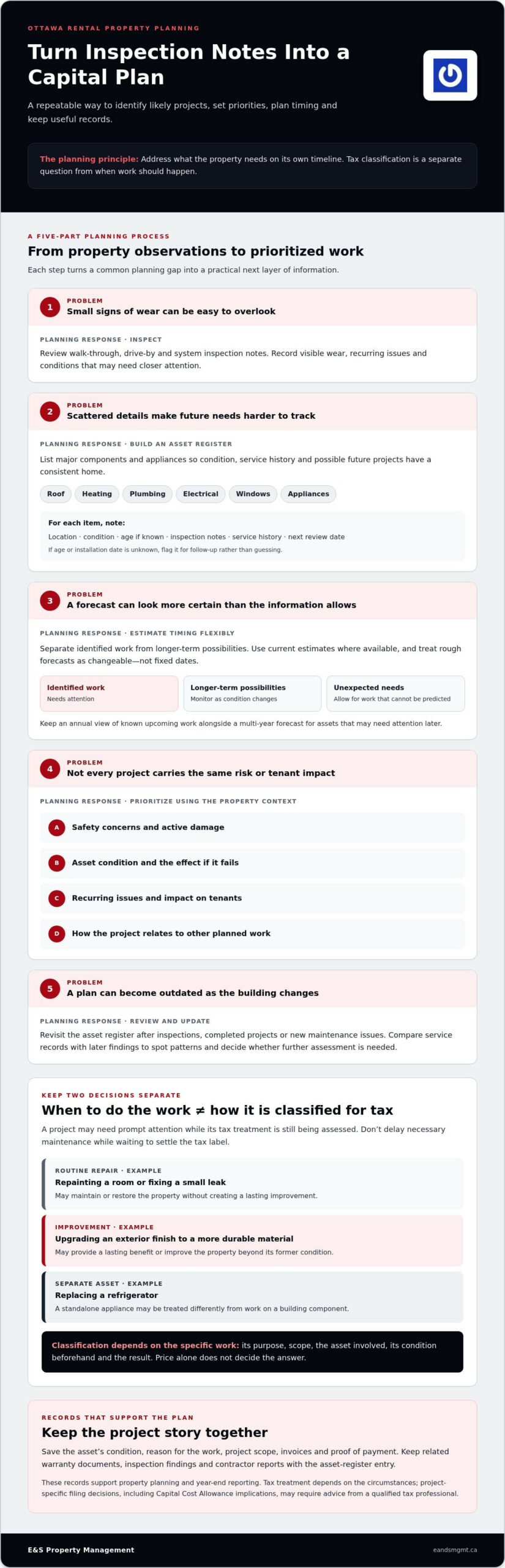
Routine upkeep keeps a rental in serviceable condition. Larger work may extend an asset’s useful life, restore it after substantial deterioration, or improve the property beyond its original condition. That distinction matters for tax reporting, but it doesn’t determine when the work should happen. For planning for capital expenditures on my Ottawa rental, consider two questions separately: how the expense may be classified for tax purposes, and when the work should happen to protect the building and support tenants.
In general, a capital expenditure creates a lasting benefit, while day-to-day work mainly maintains the property. The CRA’s Rental Income guide explains the tax distinction, and this overview of capital expenditure provides a broader accounting definition. Classification depends on the specific work, including its purpose and effect. Price alone, or the property’s value, doesn’t decide the answer.
| Work type | Example | What to consider |
|---|---|---|
| Routine repair | Repainting a room or fixing a small leak | May maintain or restore the property without creating a lasting improvement. |
| Improvement | Upgrading an exterior finish to a more durable material | May provide a lasting benefit or improve the property beyond its former condition. |
| Separate asset | Replacing a refrigerator | A standalone appliance may be treated differently from work on a building component. |
How to distinguish a repair from a capital improvement
The CRA’s considerations include whether the work creates a lasting benefit, represents a betterment, happens repeatedly as ordinary upkeep, or restores something to its original condition. Repainting is a familiar maintenance example. A substantial exterior upgrade that changes the material and provides a durable benefit may point toward capital treatment. The scope, condition before the work, and result all matter.
Consider the asset involved, too. Patching a building component may be treated differently from replacing it with a substantially improved version. A new appliance is a separate asset, not simply a repair to the building, so different rules may apply. The same type of work may receive different tax treatment depending on its purpose, scope, and the asset it affects.
Why classification is not the whole capital plan
A project may need prompt attention even if its tax classification is still being assessed. A developing leak, for example, calls for a decision about preventing damage and arranging work. Whether the resulting expense is current or capital is a separate filing question. Don’t delay necessary maintenance while waiting to settle the tax label.
Record the asset’s condition, the reason for the work, its scope, invoices, and proof of payment. These details support property planning and year-end reporting. Tax treatment depends on the circumstances, so ask a qualified tax professional about project-specific filing decisions, including any Capital Cost Allowance implications. That keeps the tax question grounded in the actual work while your maintenance plan addresses the property’s needs.
How to Build a Capital Expenditure Plan for Your Ottawa Rental
A useful plan turns inspection observations and maintenance records into a forward-looking view of the property. It won’t predict every project, but it can show what is known, what needs follow-up, and what may need attention later. Start with the available information and update the plan as the building’s condition changes.
- Inspect. Review walk-through, drive-by, and system inspection notes. Record visible wear, recurring issues, and conditions that may need closer attention.
- Inventory. Create an asset register for major components, including the roof, heating, plumbing, electrical systems, windows, and appliances.
- Estimate timing. Separate identified work from longer-term possibilities. Use current estimates where available, and don’t treat a rough forecast as a fixed date.
- Prioritize. Consider each asset’s condition, the effect of failure, tenant impact, and how the project relates to other planned work.
- Review. Revisit the register after inspections, completed projects, or new maintenance issues so it reflects the property’s current condition.
Create a property-specific asset inventory
Start with components that protect the building or support essential services, then add other assets and planned upgrades. For each item, record its location, condition, age if known, inspection notes, service history, and next review date. Keep invoices, warranty documents, inspection findings, and contractor reports with the related entry. If the age or installation date is unknown, flag it for follow-up rather than guessing.
The register gives observations a consistent place to live. For example, you can review a note about recurring heating issues alongside service records and later inspection findings. That context can help distinguish an isolated repair from a pattern that may call for further assessment.
Forecast timing and funding without false precision
Group potential work into three categories: identified work that needs attention, longer-term possibilities to monitor, and unexpected needs. Create an annual view of known upcoming work alongside a multi-year forecast for assets that may need attention later. There’s no universal reserve percentage for every rental. Use the property’s age, condition, records, and current estimates to shape the forecast.
A useful capital plan records both the work you expect and the uncertainty you still need to manage. Update assumptions when new information comes in, and keep the project forecast separate from routine operating costs. Tax classification is another distinct question. The Canada Revenue Agency guidance on capital cost allowance offers general information, while a qualified tax professional can advise on filing decisions.
Regular inspections can help turn condition notes into a prioritized project list. E&S Management Services provides Ottawa residential property management, including inspections, maintenance coordination, and project management.
How to Prioritize Ottawa Rental Capital Projects and Compare Options
A project list is most useful when it shows what needs attention first, what can be scheduled, and what can wait for review. Rank items using consistent criteria, then revisit the ranking as conditions change. This helps keep a cosmetic upgrade from taking precedence over a problem affecting safety, building systems, or tenants.
Rank work by risk, condition, and timing
Start with immediate health or safety concerns and active damage, such as a leak affecting other parts of the property. Next, consider assets in poor or declining condition, repeated service calls, and the consequences of failure. Use inspection notes and qualified contractor assessments to understand the issue rather than relying on appearance alone. Consider tenant impact, particularly when a system or area is essential to daily use.
A simple project matrix makes trade-offs easier to see. For each item, record its status against these factors:
- Safety: Is there a known concern that needs prompt attention?
- Active failure: Is damage or a system problem happening now?
- Asset condition: What do inspection findings and assessments say?
- Recurrence: Is the same issue returning despite previous repairs?
- Tenant impact: Could the work affect comfort, access, or use of the home?
Ottawa’s seasons can affect timing. Address heating concerns carefully before cold weather, while exterior projects may depend on suitable conditions and access. Revisit the schedule if weather shifts, tenant needs change, or another project affects the same area. Bundling related work may be worth considering, but not if it delays a higher-risk repair.
Compare repair, replacement, and upgrade choices
Once you’ve set a project’s priority, compare practical options. A repair may address the immediate fault. Replacement may make sense if the asset’s condition or recurring problems point to a broader need. Phased work may help manage disruption or coordinate tasks. Compare the proposed scope, expected service life, tenant disruption, and available assessment and estimate details. A higher-cost option isn’t automatically better value, and no project guarantees higher rental income.
Priority answers how soon the work matters; tax category answers how the expense may be treated for filing. Keep those decisions separate. Ontario rent-increase eligibility is a distinct legal question, not a reason to assume a project will qualify for an increase. Check current Ontario rules before making decisions based on possible rent recovery. Record the issue, options considered, timing, tenant impact, and final choice to support future reviews.
How to Schedule, Document, and Oversee Capital Work in Ottawa
A prioritized project still needs a clear path from decision to completion. Treat the work as a sequence: define the scope, gather written estimates, plan tenant access, coordinate the work, review completion, and file the records. A consistent process can reduce confusion for owners and tenants, especially when work affects essential services or shared areas.
- Define the scope. Describe the issue or intended result, the areas involved, and any related work to consider. Clear details make estimates easier to compare.
- Gather project information. Keep written estimates and relevant inspection findings. If the scope changes, record what changed and why.
- Plan access and communication. Set the work sequence, access arrangements, tenant communication contact, and steps to manage safety and disruption. Follow applicable Ontario requirements for notice and entry.
- Schedule the work. Consider tenant needs, contractor coordination, weather, and the property’s systems. Exterior work may depend on suitable conditions, while heating-related work needs careful planning around cold weather.
- Review and file. Record completion details, outstanding items, and final project documents together.
Coordinate contractors and tenant access
Before work begins, confirm that the project scope, access plan, work sequence, and communication arrangements are understood. Keep contractors’ written estimates, reports, and updates with the project file. If timing shifts or the work expands, document the decision and any effect on access or disruption. A written record provides a clearer reference than informal updates alone.
Plan carefully when work affects heating, plumbing, entrances, or areas residents use regularly. Explain the expected work and access arrangements clearly, while following applicable Ontario requirements. Weather can also change the sequence. Exterior work may need to move, while maintaining essential heating during cold periods remains an operational concern.
Keep records useful for operations and tax preparation
Create a project file for each major job, linked to the property and the component involved. Include estimates, approvals, inspection reports, photographs, invoices, payment records, and completion notes. Before-and-after observations and the contractor’s description can help clarify what was repaired, replaced, or changed. Record scope changes as they happen rather than reconstructing decisions later.
Organized records support property oversight and help connect project spending with monthly and annual financial reporting. Tax classification depends on the facts of the work, so have a qualified tax professional assess the reporting treatment. E&S Management Services coordinates maintenance and capital work as part of its Ottawa property management services. Learn about Ottawa property management with E&S.
How E&S Helps Ottawa Landlords Plan and Manage Capital Work
Capital planning is easier when property observations, maintenance coordination, project decisions, and financial records work together. E&S Management Services Ltd. brings over 40 years of property-management experience to Ottawa residential rentals, helping owners organize property needs and coordinate work while managing the logistics.
From inspection findings to a managed work plan
Walk-throughs, monthly drive-by inspections, and system inspections provide different views of a property’s condition. E&S conducts two walk-through inspections per year, along with monthly drive-by inspections of occupied properties and semi-annual system inspections. Recorded observations can help reveal patterns, such as recurring maintenance needs or a system that may require further attention. That information gives owners context for discussing timing and deciding whether to monitor an issue, investigate it, or plan a project.
When a project is identified, E&S provides project management and maintenance coordination, including oversight through its network of trusted contractors. Coordinating the work brings together practical details such as scope, access, contractor activity, and property operations. Owners can stay involved in key decisions while delegating day-to-day coordination, or take a more hands-on role with support. Project coordination helps organize the process, but does not guarantee a particular outcome.
That continuity is useful over time. A concern documented during an inspection can inform later planning, while notes from completed maintenance or project work add context to future reviews. Instead of treating each issue as a separate event, owners can use the record to understand how the property’s needs are developing and decide on next steps.
Support for local and overseas Ottawa rental owners
Managing a property from another city or country can make it harder to stay close to changing conditions and project details. E&S has more than 30 years of experience serving Canadian Foreign Service personnel abroad, providing relevant local oversight for owners living at a distance. Clear project records and financial reporting help keep property information organized, whether an owner prefers regular involvement or a more hands-off arrangement.
Invoices, project notes, and maintenance records can be connected with the monthly and annual financial statements owners receive. This makes the property’s operational history and financial information easier to follow, while giving a tax professional supporting information for project-specific filing decisions. Tax treatment still depends on the circumstances, and project coordination doesn’t determine whether an expense qualifies for a deduction.
A property manager can turn inspection findings into an organized work plan, coordinate maintenance and project details, and keep records connected to financial reporting. Ottawa landlords looking for this ongoing support can explore residential property management in Ottawa.
Make Your Next Property Review the Starting Point
A capital plan doesn’t need to predict every repair. Its value is in giving you a clearer way to make decisions as the property changes. Choose one manageable next step: review a major system’s condition, update a project record, or set a date to revisit work you’ve been monitoring. Regular attention can make planning for capital expenditures on my Ottawa rental feel more deliberate and less reactive.
If coordinating the process takes more time than you can give, E&S can bring property oversight and project planning together. The team’s property-management experience includes working with Canadian Foreign Service personnel abroad. Regular inspections, project management, and contractor coordination help connect property needs with owner decisions.
Explore residential property management in Ottawa to find ongoing support for your rental.
Frequently Asked Questions
How do I know whether work on my rental is a capital expense or a current expense?
Consider what the work does, not just what it costs. Routine work that maintains or restores a property may be a current expense, while work that creates a lasting benefit or improves the property may be capital. Fixing a single damaged section, for example, may differ from a broad project that upgrades an entire system. The CRA considers the facts and circumstances, so ask a qualified tax professional about uncertain cases.
Can I deduct a capital expenditure on my Ottawa rental in the year I pay for it?
Usually, a capital expenditure isn’t deducted in full in the year you pay for it. Eligible capital costs may instead be claimed over time through Capital Cost Allowance (CCA), subject to CRA rules. CCA is generally optional and can’t be used to create or increase a rental loss; claiming it may also affect tax when you sell. Confirm the treatment with a tax professional before filing.
How much should I set aside for capital expenditures on a rental property?
There isn’t one reserve amount that suits every Ottawa rental. Base your funding plan on the building’s age and condition, known upcoming work, available estimates, and the funds you can realistically keep accessible. Separate planned projects from a contingency for unexpected needs, then revisit the amount as estimates or inspection findings change. A reserve is a planning tool, not a guarantee that every future expense will be covered.
Can a landlord increase rent after making capital improvements in Ottawa?
Not automatically. Ontario landlords may apply to the Landlord and Tenant Board for an above-guideline increase for certain qualifying capital expenditures, but the work must meet the applicable criteria and the Board must approve the application. Don’t assume an improvement will qualify or that its full cost can be recovered through rent. Check current Ontario rules and get advice specific to the property before relying on a possible increase.
What records should I keep for capital work on my rental?
Keep a project file that connects each document to the rental property and the work performed. Include estimates, approvals, invoices, proof of payment, inspection or contractor reports, relevant photographs, and notes on completion or changes to scope. If an invoice covers several tasks, request a clear description or breakdown so the record shows what was done. Organized documentation supports property management and gives your tax professional information for filing decisions.
When is the best time to schedule major work on an Ottawa rental?
Schedule around the project’s urgency, tenant needs, access, and weather, rather than choosing a season by default. Work affecting heating needs careful planning before and during Ottawa’s cold months; exterior projects may depend on suitable weather. Allow time to coordinate access and communicate expected disruption. If an issue could cause active damage or affect safety, don’t postpone necessary attention just to wait for a more convenient season.
Can a property manager oversee capital projects if I live outside Ottawa?
Yes. A residential property manager can coordinate project activity locally while keeping an owner informed and involved in decisions. E&S Property Management works with local landlords and has experience serving Canadian Foreign Service personnel abroad. Inspections, contractor coordination, and organized project records can help owners follow property needs from a distance without managing every logistical detail themselves.