
What if a tenancy rule that seems straightforward changes how you should handle rent, repairs, or a notice? The ontario residential tenancies act affects much of the landlord-tenant relationship, but its legal language can make everyday responsibilities difficult to pin down.
If you’re wondering whether your rental arrangement is covered or what to do when a problem arises, start by identifying the type of housing and the circumstances. The rules can vary, and using the wrong process or form may make an already stressful issue harder to resolve.
This 2026 guide follows the tenancy lifecycle, from the Act’s general scope to rent, maintenance, notices, and disputes. It also explains where to find current forms and authoritative information. E&S Property Management manages residential properties in Ottawa, including homes for Canadian Foreign Service personnel serving abroad. This guide is for general information, not legal advice. When a situation turns on specific facts, consult current Ontario resources or seek advice suited to the circumstances.
Key Takeaways
- Learn why the ontario residential tenancies act may apply based on the housing arrangement, not simply the property’s label.
- Understand what to review in a tenancy agreement, including how the Ontario Standard Lease relates to rent, deposits, and other charges.
- See how maintenance, access, and tenant responsibilities continue throughout a tenancy, and why following the right process matters.
- Recognize that an eviction notice is not the same as an eviction order, and learn how the Landlord and Tenant Board handles eligible disputes.
- Explore how clear communication, organized records, and regular maintenance routines support responsible rental management in Ottawa.
What the Ontario Residential Tenancies Act covers, and who it protects
The ontario residential tenancies act governs many landlord-tenant relationships in Ontario. It sets out rules for residential tenancies and defines responsibilities and protections for landlords and tenants. Whether it applies, and which provisions govern, depends on the actual housing arrangement, not simply whether the property is called an apartment, house, or rooming home.
That distinction matters. Two people renting rooms in similar-looking buildings may fall under different rules because of how the home is occupied or which facilities they share. Other laws may apply at the same time. For example, Ontario’s Human Rights Code may protect people from discrimination in housing, independently of the tenancy rules.
Which rental homes and tenancy arrangements are generally covered?
Many familiar arrangements fall within the Act, including renting a self-contained apartment, leasing a house, or renting a room in a rooming or boarding home. Most residential tenancies are covered by most of the Act’s provisions, but not every rule applies to every home or circumstance. Don’t rely on the property’s label alone.
To assess the arrangement, identify who lives in the building, which facilities occupants share, and whether the housing is part of a specialized program. Compare those details with the current statute. The Residential Tenancies Act, 2006 Wikipedia article offers background on the law’s purpose and history, but Ontario’s current legislation is the source for its wording and exceptions.
When might the Act not apply in the usual way?
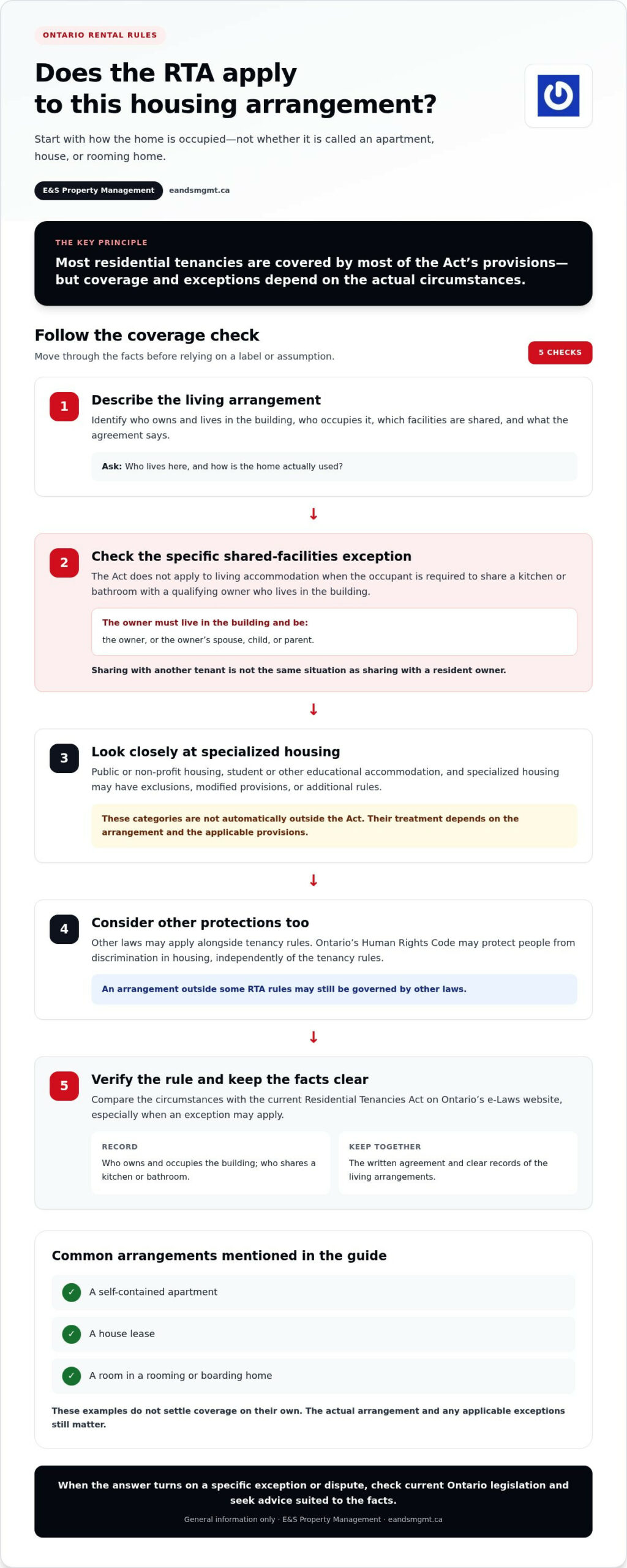
One specific exception concerns shared facilities. The Act does not apply to living accommodation where the occupant or occupants are required to share a kitchen or bathroom facility with the owner, or with the owner’s spouse, child, or parent, if that owner lives in the building. The statutory conditions matter. Sharing with another tenant, for example, is not the same situation as sharing with a resident owner.
Some public or non-profit housing, student or other educational accommodation, and specialized housing may also be subject to exclusions, modified provisions, or additional rules. Those categories are not automatically outside the Act; their legal treatment depends on the arrangement and applicable provisions. Check the current Residential Tenancies Act on Ontario’s e-Laws website when the facts appear close to an exemption, and review any other relevant legislation or program rules.
- Describe the arrangement precisely: note who owns and occupies the building, who shares a kitchen or bathroom, and what the agreement says.
- Check the exception itself: a room rental, student housing, or non-profit setting is not automatically exempt.
- Consider overlapping protections: an arrangement outside some RTA rules may still be governed by other laws, including human-rights protections.
General information can explain the rules, but it can’t determine the outcome of an individual dispute. If a housing arrangement or conflict turns on an exception, review the current legislation and seek advice suited to the specific facts. A written agreement and clear records of the living arrangements can help make that review more straightforward.
Ontario tenancy agreements, rent, and deposits: understand the rules before signing
A written tenancy agreement gives both parties a shared record of the home, rent, and agreed terms. It can prevent misunderstandings, but it cannot override the law. A clause that conflicts with the ontario residential tenancies act may not be enforceable simply because it appears in a signed contract.
What should landlords and tenants understand before signing?
For most qualifying residential tenancies entered into on or after April 30, 2018, Ontario’s Standard Lease is required. The official form sets out common terms and includes information about rights and responsibilities. Some arrangements are exempt from the standard form requirement, so confirm whether the tenancy qualifies and use the current version. Ontario’s Official Residential Tenancies Act, 2006 is the authoritative source for the legislation behind these requirements.
Before signing, confirm the rent amount and due date, what is included, the tenancy term, and any additional terms. Put agreed changes or clarifications in writing, keep a copy of the signed lease, and store related notices, receipts, and payment records together. A well-organized file makes it easier to confirm what was agreed and when payments or notices were given.
How do rent increases and deposits work in general?
Not every amount requested at the start of a tenancy is automatically permitted. In general, Ontario landlords may collect a rent deposit for the last rental period, subject to legal limits. It is not a damage deposit. A separate key deposit may be allowed when it reflects the expected replacement cost of keys or access devices and is refundable when they’re returned. Other deposits or charges may be restricted, so check the rules before paying or requesting them.
Rent increases are governed by rules about timing, notice, and applicable limits. For most rent-controlled units, the 2026 guideline is 2.1% for an increase that doesn’t require Landlord and Tenant Board approval. The guideline doesn’t apply to every unit. For example, residential units first occupied for residential purposes after November 15, 2018, are exempt from the cap. Other exceptions and approval requirements may affect a particular tenancy.
The applicable rent rule depends on the tenancy, the unit, and the law that applies. Before acting, confirm the current requirements rather than relying on an old form, a previous year’s guideline, or a verbal understanding. The 2026 guideline is not a substitute for checking eligibility and notice requirements.
- Before signing: confirm the written terms match what both parties agreed to.
- Before paying or requesting a charge: identify what it is for and whether the law permits it.
- Before changing rent: check the current guideline or exemption, timing, notice rules, and any approval requirement.
For landlords managing these details alongside rent collection and tenant communication, residential property management can help keep agreements and records organized. For a specific legal concern, consult current Ontario resources or seek advice based on the tenancy’s circumstances.
Repairs, landlord entry, and tenant responsibilities during a tenancy
Maintenance and access work best when responsibilities are clear and communication is documented. Under the ontario residential tenancies act, a tenant reporting a leak or broken fixture does not remove the landlord’s maintenance obligations. Tenants also have responsibilities, including ordinary cleanliness and care of the rental unit.
How should repair and maintenance concerns be handled?
Landlords are generally responsible for keeping a rental unit and residential complex in a good state of repair, fit for habitation, and compliant with applicable health, safety, housing, and maintenance standards. That obligation continues during the tenancy, even if a tenant reports a problem or the lease assigns tasks between the parties. A tenant is generally responsible for ordinary cleanliness and for damage caused wilfully or negligently by the tenant, another occupant, or someone the tenant permits in the complex. Reasonable wear and tear is different.
There isn’t one universal response deadline for every repair. Urgency and applicable requirements depend on the problem, relevant standards, and circumstances. A tenant should report an issue promptly in writing, describe its location and impact, and keep dated messages, photos, and replies. A landlord or manager can log the report, arrange assessment and repairs, communicate about access, and retain invoices or completion notes. If the matter remains unresolved, the Landlord and Tenant Board (LTB) resources explain where to find information about its processes and forms.
When can a landlord enter a rental unit?
For ordinary entry, the landlord generally needs a valid reason under the Act and must follow its notice requirements. In many situations, written notice must state the reason, date, and time, with entry scheduled between 8 a.m. and 8 p.m. The Act also recognizes exceptions, including emergencies and circumstances where the tenant consents at the time of entry. Because requirements depend on the reason for entry, check the current legislation before scheduling access. A routine inspection isn’t the same as an emergency.
| Situation | Landlord or manager | Tenant |
|---|---|---|
| Repair reporting | Receive and record the concern; assess and coordinate maintenance under applicable obligations. | Report problems promptly and share relevant details. |
| Repair follow-up | Communicate about next steps and keep records of work arranged and completed. | Preserve dated messages and provide reasonable access as required by law. |
| Unit access | Use a legally permitted reason and follow the applicable notice rules or exception. | Review the stated purpose and timing, and communicate concerns promptly. |
These duties complement one another, but they aren’t interchangeable. A tenant’s report doesn’t transfer the landlord’s repair obligation, and the landlord’s maintenance role doesn’t remove the tenant’s responsibility for their own conduct. Clear records help both sides track what was reported, what action followed, and how access was arranged.
Ending a tenancy, eviction notices, and Landlord and Tenant Board disputes
A notice can be alarming, but it doesn’t by itself authorize a landlord to remove a tenant. Under the ontario residential tenancies act, next steps depend on the notice type, its stated reason, and what the recipient does. A tenant may also give notice to end a tenancy, with the required process depending on the circumstances.
A landlord’s notice is not an enforceable eviction order. If a tenant doesn’t leave after receiving a termination notice, the landlord generally must apply to the Landlord and Tenant Board (LTB) and obtain an order. An eviction order is enforced through the Court Enforcement Office, commonly called the sheriff, not by a landlord taking matters into their own hands.
What should someone do after receiving a notice?
Pause and review the document carefully. Identify its form or notice type, the reason given, the dates, and any instructions or options to respond. Don’t assume a notice is valid or invalid based on its title alone. Check the current official form and guidance promptly, because deadlines and rights vary by process and can affect what happens next.
For example, as of September 21, 2026, the notice period for an N4 notice for non-payment of rent is seven days. Other notice types have different requirements, and forms may change. Verify the current version and applicable dates as soon as you receive a notice. Keep a copy, note when and how it was served, and gather relevant records, such as:
- The lease and any written changes
- Rent receipts, account statements, and payment messages
- Landlord-tenant communications and copies of notices
- Photographs, repair requests, and maintenance records if they relate to the issue
Organize the materials by date. A clear timeline helps you explain what happened without relying on memory, whether you’re responding to a notice or preparing an application.
How does the Landlord and Tenant Board resolve disputes?
The LTB provides information about its processes and decides eligible disputes between landlords and tenants. Depending on the application and current procedures, parties may have an opportunity to resolve issues through mediation, a facilitated discussion, or proceed to an adjudicator for a hearing and decision. Mediation may help parties reach an agreement, but neither participation nor a particular outcome is guaranteed. An adjudicator considers the evidence and applicable law before issuing an order.
Follow the process in order: read the notice, record all dates, preserve relevant evidence, then consult current Tribunals Ontario guidance about forms, filing, and next steps. If you receive an LTB order, act quickly. As of July 1, 2026, the deadline to request a review was reduced to 15 days. Confirm the deadline that applies to your order. For questions about how the law applies to your facts, consider speaking with a licensed legal professional or community legal clinic. Property management can help landlords organize tenancy administration, but it doesn’t replace legal advice or the LTB.
Landlords can find details about residential property management support for keeping rental administration and records organized.
Applying the Ontario Residential Tenancies Act to Ottawa rental management
Understanding the ontario residential tenancies act is one part of responsible rental management. The day-to-day work is turning obligations into dependable routines: communicate clearly, keep records current, and follow through on maintenance. These habits help landlords and tenants understand what was reported, agreed, and done, without treating administration as a substitute for legal advice.
What practical records help keep a tenancy organized?
A complete, consistently maintained file makes routine decisions easier to track and can clarify events if a question arises. Keep documents together and date them as they’re received or created. Useful records include:
- Signed tenancy agreements and written changes
- Notices, with the date and method of delivery recorded
- Inspection records and notes about observed conditions
- Repair requests, follow-up messages, and maintenance updates
- Invoices and records of work arranged or completed
- Relevant tenant and landlord communications, including rent-related correspondence
For example, if a tenant reports a recurring leak, a dated request, follow-up notes, and the related maintenance record help establish the sequence of events. Keep records factual and specific. A short note about what was observed or arranged is more useful than an unclear entry added much later.
How can professional Ottawa management support compliance routines?
For a landlord managing a rental property from elsewhere, consistent local administration helps keep tasks moving and information accessible. Tenant selection and lease administration establish a clear start to the tenancy; rent collection and financial reporting keep accounts organized; inspections and maintenance coordination support ongoing property oversight. Clear communication connects these activities, so tenants know where to direct questions and managers can track what needs attention.
E&S Property Management has over 40 years of property management experience, including more than 30 years serving Canadian Foreign Service personnel abroad. Its residential management services include tenant selection, rent collection, inspections, maintenance coordination, financial reporting, and representation before the Landlord and Tenant Board. Inspections include two walk-throughs per year, monthly drive-by inspections of occupied properties, semi-annual system inspections, and bi-annual smoke and carbon monoxide sensor checks. Weekly inspections are conducted during the heating season and for vacant properties in summer. These routines support organized property oversight, but they don’t replace legal counsel or determine the outcome of a dispute.
A useful management routine is steady rather than complicated: record an issue when it comes in, document the next step, keep communication with the tenant clear, and retain related paperwork in the property file. Regularly review agreements, notices, payment records, and maintenance history to spot gaps early. For owners living outside Ottawa or abroad, a consistent process for sharing updates and keeping records is especially valuable.
For experienced support with the ongoing responsibilities of an Ottawa rental property, learn about residential property management in Ottawa.
Make your next rental decision with greater confidence
Understanding the ontario residential tenancies act is a useful starting point, but each tenancy has its own details. Keep agreements and records organized, communicate decisions clearly, and consult current Ontario guidance when a specific question arises. If a dispute turns on how the law applies to your circumstances, seek advice suited to those facts.
For Ottawa property owners, consistent oversight can make rental management more orderly. E&S Property Management supports residential property administration, from inspections and maintenance coordination to Landlord and Tenant Board representation. Its services help keep day-to-day responsibilities moving, while legal questions remain with the appropriate legal resources.
To discuss support for your Ottawa rental property, explore residential property management in Ottawa.
Frequently Asked Questions
Does the Ontario Residential Tenancies Act apply when a tenant shares a kitchen or bathroom with the landlord?
Sometimes. The ontario residential tenancies act may not apply when an occupant is required to share a kitchen or bathroom with the owner, or the owner’s spouse, child, or parent, and the owner lives in the building. This is a specific exception; sharing facilities with another tenant alone doesn’t establish it. Other protections, including human-rights laws, may still matter. Review the current Act on Ontario e-Laws or seek advice based on your arrangement.
Does a landlord have to provide an Ontario Standard Lease?
Yes, for many qualifying residential tenancies, landlords must provide the Ontario Standard Lease, subject to the Act’s rules and exceptions. Check the current Ontario Standard Lease guide and form, since the requirement doesn’t cover every housing arrangement. Before signing, review the rent, included services, and additional terms, then keep a signed copy. If a required lease hasn’t been provided, consult Ontario’s current guidance promptly about requesting one and the steps available.
Can an Ontario landlord ask for a security deposit?
Ontario generally restricts security deposits. A landlord may usually collect a rent deposit for the last rental period, within the statutory limit, but it isn’t a fund for damage or unpaid repairs. A key deposit may be treated differently from a damage deposit, and other requested charges aren’t automatically permitted. Review the lease and Ontario’s current legislation to understand the rules for your tenancy before paying or requesting a deposit.
What can a tenant do if the landlord does not make a repair?
Report the problem in writing, keep a copy, and document its condition with dated notes or photographs. Record replies and follow-up, too. Landlords have maintenance obligations, but the appropriate response depends on the problem and applicable standards, so there isn’t one fixed deadline for every repair. If it remains unresolved, review current Landlord and Tenant Board information about tenant applications and possible remedies. Seek legal help for urgent or case-specific questions.
Can a landlord evict a tenant without an order from the Landlord and Tenant Board?
No. A landlord’s termination notice alone doesn’t authorize physically removing a tenant. If the tenant doesn’t leave and the landlord wants to pursue eviction, the landlord generally must apply to the Landlord and Tenant Board and obtain an order; enforcement is handled by the Court Enforcement Office. The correct steps depend on the reason and current law. Read the notice, note its dates, and promptly check current Board guidance or seek legal assistance.
Where can I find Ontario’s current rent increase guideline?
Find the current figure and related instructions on the Ontario government’s rent increase guideline page. First check whether the guideline applies to your unit; exemptions and other rules can affect the permitted increase. Don’t rely on a past year’s figure or assume a percentage applies to every tenancy. Review the official guidance for the applicable year and confirm the notice and timing requirements before a landlord changes rent.


