
What if the best way to stay in control of your rental property is to agree on when you need to step in and when you can leave the details to your manager? Learning how to work effectively with your property manager starts with clear roles, timely communication, and shared expectations. That clarity matters when you’re juggling a busy schedule or managing an Ottawa property from abroad.
It’s natural to want updates about repairs, tenant concerns, inspections, and finances without overseeing every day-to-day task yourself. A productive working relationship gives you a clear picture of what your manager handles, which decisions need your input, and how you’ll receive important information. You can choose to be hands-off or closely involved, as long as you and your manager agree on the arrangement.
This article explains how to set communication preferences and decision-making boundaries, what information to provide, and how to respond when a decision is needed. You’ll also learn how regular inspections, maintenance coordination, and financial reporting can help you stay informed while your manager handles the practical work of caring for your residential property.
Key Takeaways
- Agree on communication channels, update frequency, and what counts as urgent so important information doesn’t get lost.
- Clarify which tasks your manager can handle independently and which decisions need your approval.
- Use clear, concise messages that identify the property, describe the issue, explain its urgency, and state what decision is needed.
- Set repair preferences and approval boundaries before maintenance issues arise.
- Choose an involvement level that suits your schedule, while staying informed through inspections, maintenance updates, and financial reporting.
What Effective Work With a Property Manager Looks Like
A well-managed rental doesn’t require you to monitor every conversation or approve every routine task. It does require you to know who is responsible for what, receive useful information, and be available to give direction when a decision falls to you. Whether overseeing long-term residential units or premier hospitality properties like Luxury Vacation Stays, treating the management relationship as an ongoing partnership—rather than a handoff where one side disappears—ensures the property remains well maintained and profitable.
It’s reasonable to want visibility into repairs, tenant concerns, and the condition of a property you value. That doesn’t mean you need to oversee every operational detail. The goal is an agreed level of oversight: your manager coordinates day-to-day work, while you stay informed and take part when your approval or knowledge is needed. A general overview of Property management can also help explain the range of responsibilities involved.
What should a landlord and property manager each handle?
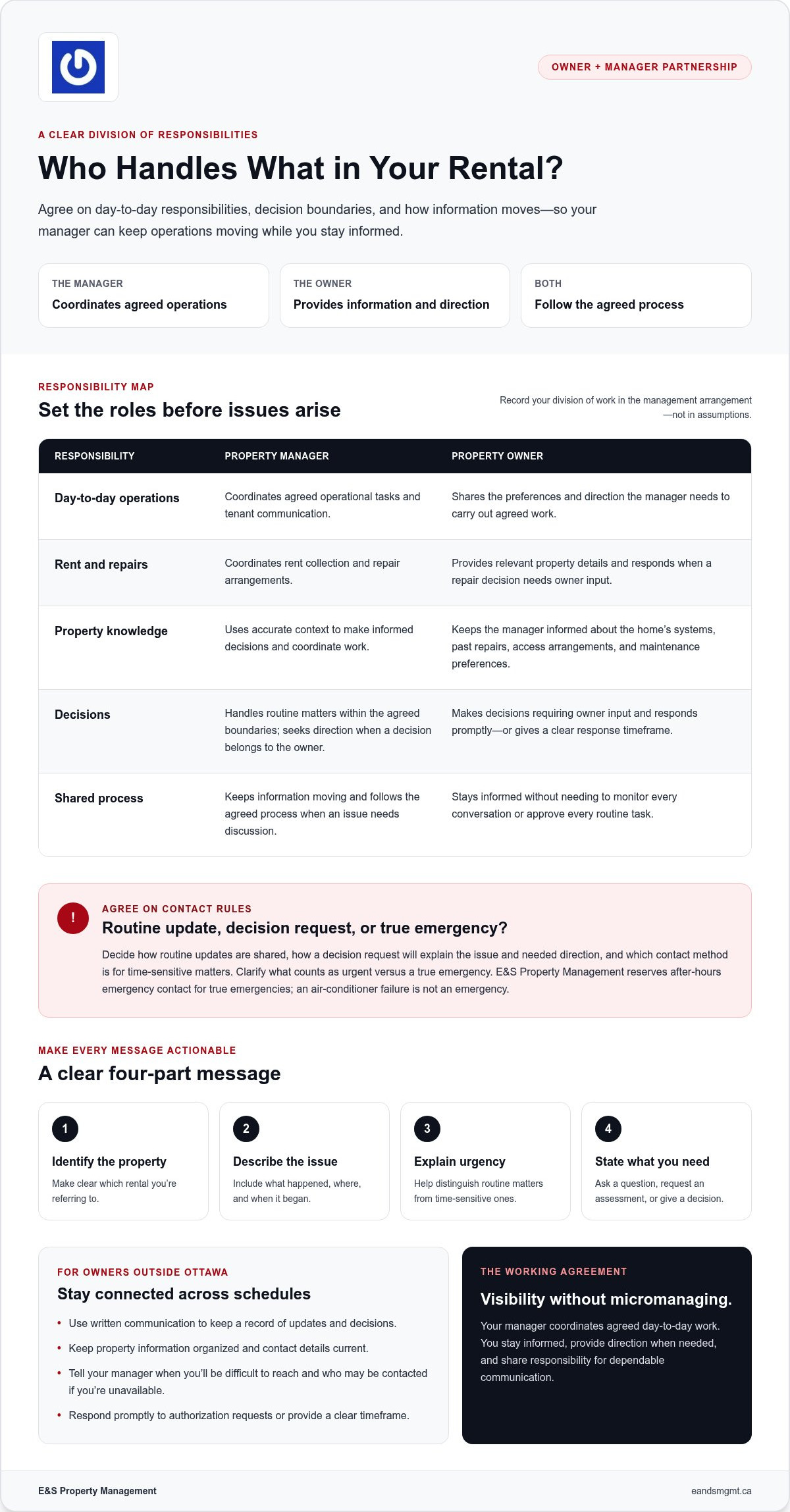
Share relevant information about the home’s systems, past repairs, access arrangements, and maintenance preferences. If a repair question requires your input, respond promptly and clearly. Agree on the division of work and record it in your management arrangement rather than relying on assumptions.
- Manager: Coordinates agreed operational tasks, tenant communication, rent collection, and repair arrangements.
- Owner: Provides accurate property information, shares preferences, and makes decisions that require owner input.
- Both: Keep information flowing and follow the agreed process when an issue needs discussion.
How do clear expectations improve the relationship?
Small assumptions can create avoidable frustration. You may expect a regular update, while your manager may plan to contact you only when a decision is required. Agree early on how routine information will be shared and which matters need a direct discussion. That gives both sides a reliable reference point.
An effective owner-manager relationship is a shared working arrangement with clear responsibilities, dependable information, and timely decisions that keep the property’s day-to-day management moving. With that foundation, oversight becomes less about checking every task and more about receiving useful information and providing direction when it’s needed.
Set Communication Rules That Keep Your Ottawa Rental on Track
Good communication isn’t about sending more messages. It’s about knowing how information will be shared, which issues need your attention, and how to reach each other when a decision can’t wait. Agreeing on these basics early helps prevent missed updates and confusion, especially if you’re busy or living outside Ottawa.
What should you agree on at the start?
Set a routine for updates about the tenancy, maintenance, inspections, and financial reporting. Decide which channel works best for updates you may need to refer back to, and which contact method is appropriate for time-sensitive matters. Share your current contact details, typical availability, and the best way to reach you if your schedule or location changes.
- Routine updates: Agree on a format and schedule that provide useful visibility without unnecessary messages.
- Decision requests: Clarify how your manager will describe the issue, share relevant information, and explain what direction is needed from you.
- Urgent contact: Discuss what qualifies as urgent and how to distinguish it from a true emergency. E&S Property Management reserves after-hours emergency contact for true emergencies. An air-conditioner failure isn’t an emergency.
- Property information: Keep access instructions, relevant records, and details about the home’s systems current so your manager can act with accurate context.
Make messages easy to act on. Identify the property, describe what happened, explain how urgent it is, and say whether you’re asking a question or making a decision. Instead of writing “There’s a leak,” explain where you noticed it and when it began. If you need your manager to arrange an assessment or want to approve a proposed next step, say so clearly.
How can remote Ottawa landlords stay informed?
If you’re outside the city, written communication provides a useful record of updates and decisions across different schedules and time zones. Keep property information organized, and let your manager know when you’ll be difficult to reach or who may be contacted if you’re unavailable. When your manager requests authorization or a decision, reply promptly or give a clear timeframe for your response.
E&S Property Management has served Canadian Foreign Service personnel abroad for more than 30 years. That experience makes clear communication, accurate records, and a dependable process for getting owner direction especially important. You can stay connected to your Ottawa rental without trying to manage every daily detail from a distance.
Clear communication is a practical part of residential property management in Ottawa. Set the routine together, keep your information current, and make the next step clear in each message.
Agree on Roles, Decisions, and Reporting Before Issues Arise
Which decisions should owners clarify in advance?
Discuss maintenance preferences, access instructions, and whether you have owner-recommended vendors. Share relevant details about the property, such as known issues or past repairs, so your manager has useful context when coordinating work. Record who can authorize different types of decisions and how approval will be requested. The aim isn’t to create a complicated rulebook, but to make the process clear before a decision becomes time-sensitive.
Think about the choices you want to hear about and the matters you’re comfortable delegating. Keep your preferences practical and revisit them if your circumstances change. Clear authority helps your manager understand when to proceed within the agreed role and when to bring a decision to you.
How can financial reporting support owner oversight?
Monthly and annual financial statements give you a view of your property’s financial activity without requiring you to track each transaction as it happens. Set aside time to review them, note your questions, and ask for clarification in an organized way. For example, group questions about an expense or reporting period in one message rather than sending separate requests over time.
For non-resident Canadian landlords, clarify how withholding tax collection and NR6 and NR4 filing support fit into the management and reporting arrangements. This is a coordination point to discuss, not a substitute for tax advice about your circumstances.
Ultimately, how to work effectively with your property manager comes down to agreeing on authority and staying informed through reliable reporting. When roles are documented and financial information is reviewed regularly, delegation can support oversight rather than reduce it. You don’t need to be involved in every daily task to stay connected to how your Ottawa rental is managed.
Create a Practical Routine for Maintenance, Inspections, and Emergencies
Maintenance is easier to coordinate when everyone knows what happens after an issue is reported. A clear process helps your manager assess the situation and arrange the next step. Your timely replies and useful property information help keep work moving, while regular inspections give you a clearer picture of the home’s condition, even if you’re not nearby.
Use this sequence for repair concerns, adapting it to the urgency of the issue:
- Report clearly. Identify the property and the problem’s location. Describe visible symptoms, when they began, and any immediate safety concern. Share photos or other useful details if available.
- Assess urgency. Your manager can review the information and determine whether the matter is routine or needs an emergency response.
- Agree on the next action. Provide any owner direction or authorization required under your agreed arrangements, and respond promptly to questions that could affect timing.
- Document the outcome. Keep the manager’s response, agreed action, and relevant follow-up information with the property records.
How should you communicate a repair or maintenance issue?
Give enough context to help your manager understand what’s happening. “Water is appearing under the kitchen sink” is more useful than “There’s a plumbing problem.” Include when you noticed it, whether it’s continuing, and any access instructions that could help. Avoid arranging separate work that might conflict with your manager’s coordination. Share any preferred vendors or other maintenance preferences in advance.
For planned inspections or repair visits, keep access details current and pass along relevant information about the home, such as known system issues or recent work. E&S carries out regular property inspections, including walk-throughs and drive-by inspections, and coordinates maintenance and repairs. Inspections help document property condition and identify items that may need attention. If your manager raises a repair question after an inspection, a timely, clear response can help determine the next step.
What counts as an emergency for an Ottawa rental?
Use E&S Property Management’s emergency guidance to distinguish an urgent threat from a routine repair. Examples include broken water pipes, flooding, serious roof or gas leaks, dangerous electrical faults, loss of utilities, unsafe conditions, and furnace failure during heating months. Air-conditioner failures are not considered emergencies.
If a situation appears to fit an emergency example, use the designated emergency contact process rather than treating it like routine maintenance. E&S provides after-hours emergency contact support for true emergencies. For non-emergency issues, follow the regular reporting and coordination process you’ve agreed on with your manager.
Knowing what to report and how to follow up is part of how to work effectively with your property manager. If you want support coordinating maintenance and regular inspections for your Ottawa rental, explore E&S property management support.
How E&S Management Helps Owners Work Effectively With Their Property Manager
A good working relationship should fit the way you want to own your rental. Some Ottawa landlords prefer to delegate most day-to-day matters, while others want to stay closely involved in decisions and updates. E&S Property Management works with owners across that range, with responsibilities and communication shaped around the agreed level of involvement.
That flexibility can be especially useful if you live outside Ottawa or have a demanding schedule. E&S is a family-owned Ottawa residential property management firm founded in 1981, with more than 40 years of experience and over 30 years serving Canadian Foreign Service personnel abroad. Its experience working with remote owners reflects the importance of clear reporting and dependable coordination when an owner can’t be present at the property.
What does a well-supported management relationship include?
Support can connect the stages of rental ownership instead of treating each responsibility as a separate task. E&S provides tenant placement, rent collection, lease preparation, and tenant screening, including credit checks and references. Maintenance services include arranging and overseeing repairs, while regular inspections help owners stay informed about property condition. Monthly and annual financial statements provide a view of the rental’s financial activity.
E&S also provides representation before the Landlord-Tenant Board. Together, these services support owners with tenant relations, property care, financial reporting, and matters that may require formal representation. The owner remains part of the relationship by sharing relevant information, choosing an appropriate involvement level, and responding when a decision needs their input.
For owners who want to take a more hands-off role, agreed reporting and clear escalation points can maintain visibility without requiring involvement in every operational detail. Owners who prefer closer oversight can stay active in decisions while relying on management support for coordination. Neither approach requires a one-size-fits-all arrangement. Clear expectations help the working relationship succeed.
How can an owner get started with E&S?
Start by discussing your Ottawa rental, your priorities as an owner, and how involved you’d like to be. Think about what you want delegated, the information you’d like to receive, and the kinds of decisions you want brought to you. Those preferences provide a practical foundation for agreeing on a management relationship that suits your property and circumstances.
E&S’s family-owned roots and long history in Ottawa bring continuity to that conversation. The aim is to establish a clear working arrangement, so you know how property management, tenant matters, inspections, repairs, and financial information will be handled, whether you live nearby or abroad.
If you’re considering support for your residential rental, discuss property management for your Ottawa rental. A conversation about your property and preferred involvement level is a practical first step toward a more organized owner-manager relationship.
Make Your Next Step a Clear One
A dependable property-management relationship doesn’t have to be set once and left untouched. As your priorities, availability, or plans for your Ottawa rental change, revisit the arrangement to make sure it still gives you the right balance of oversight and breathing room. A thoughtful check-in can keep expectations aligned before a new situation puts them to the test.
If you’re considering how to work effectively with your property manager, begin by identifying what peace of mind means for you: knowing when decisions need your attention, receiving information in a useful form, or having confidence that routine matters are being handled. You don’t need to be involved in everything to remain a thoughtful, informed owner.
Before discussing your management needs, note what you’d like to stay involved in and what you’re ready to delegate. This gives you a practical starting point and helps turn general preferences into a working arrangement that feels right for you.
E&S Property Management can help you shape an approach that suits your property and preferred role. Discuss management for your Ottawa rental and take a practical first step toward a clearer working relationship. With shared expectations in place, you can care for your rental while making room for the rest of your life.
Frequently Asked Questions
How often should I communicate with my property manager?
Agree on a communication rhythm that fits your property and preferred level of involvement. There’s no single schedule for every Ottawa landlord. You might prefer a set check-in for general updates, with separate contact when something needs your decision. Review whether the arrangement is working after a major repair, a change in your availability, or a period when you’ve had more questions than usual.
What information should I give my property manager?
Share accurate information that helps your manager oversee the home and coordinate access. Useful details include known issues, past repairs, property systems, access instructions, and maintenance or vendor preferences. If your contact information or availability changes, pass that along promptly. For example, updating a changed building entrance code can prevent confusion when access is needed for an inspection or repair.
Can I still be involved if I hire a property manager?
Yes. You can choose a hands-off role or stay closely involved in decisions, updates, and property oversight. Establish how much involvement you want and which matters your manager should bring to you. If you’re working out how to work effectively with your property manager, consider which decisions you want to retain and which routine tasks you’re comfortable delegating.
What should I do if I disagree with my property manager?
Raise the concern directly and calmly, focusing on the specific decision or information that prompted it. Refer to the responsibilities and approval process you’ve agreed on, then ask for the reasoning behind the proposed approach. If you reach a different decision together, record the agreed next step so you have a shared reference. For an ongoing disagreement, arrange a focused conversation rather than letting frustration build through scattered messages.
Should I contact my property manager directly about tenant repairs?
Yes. Contact your property manager so the repair can be handled through the agreed maintenance process. If a tenant reports an issue to you, pass along their description, when it began, and any relevant details instead of arranging separate work independently. This helps avoid conflicting instructions and keeps the repair history together. For a safety concern or a situation that may be an emergency, use the appropriate urgent contact process.
What counts as an after-hours emergency for an Ottawa rental?
Examples include broken water pipes, flooding, serious roof or gas leaks, dangerous electrical faults, loss of utilities, unsafe conditions, and furnace failure during heating months. E&S’s after-hours emergency contact is intended for true emergencies, not routine maintenance. An air-conditioner failure isn’t considered an emergency. If the situation presents an immediate danger, follow the emergency process provided for the property rather than waiting for a routine update.


