What if the real cost of managing a rental isn’t the management fee, but the hours and attention it takes from everything else? If you’re asking when does it make sense to hire a property manager, consider how much time you have, how close you are to the property, and how demanding its day-to-day needs have become.
Weigh a manager’s ongoing fee against the work you’re already doing. Tenant questions, maintenance coordination, inspections, rent collection, and financial records can add up, especially when work or distance makes it difficult to respond promptly. Professional oversight can ease that pressure, while self-management may suit an owner with the time and systems to handle those responsibilities.
This guide compares the workload of self-management with the support a professional manager can provide. You’ll consider how distance, tenant communication, property demands, and reporting needs affect the decision, along with what to review before making a change. For Ottawa landlords, E&S Property Management brings experience dating back to 1981 and helps owners coordinate the responsibilities of rental ownership.
Key Takeaways
- To decide when does it make sense to hire a property manager, weigh your available time, proximity to the rental, and comfort handling ongoing responsibilities.
- Map the work involved from preparing for a vacancy to coordinating maintenance, so recurring tasks don’t catch you by surprise.
- Compare self-management and professional support across time, control, coordination, continuity, and fees. Delegating defined tasks doesn’t mean giving up ownership decisions.
- Check your availability, distance, property demands, and preferred level of involvement to see where management support could help.
- Before transitioning, organize leases, property records, repair history, and tenant information, and clarify your priorities for communication, reporting, and maintenance oversight.
When does it make sense to hire a property manager? Start with your situation
Start with a practical question: does managing the rental still fit your available time, location, and other responsibilities? The answer isn’t determined by how many properties you own. One rental can demand considerable attention if tenant communication, repairs, or turnover repeatedly compete with work and family life. A larger portfolio may still feel manageable if you have the time and systems to oversee it.
Ask whether the pressure is temporary or persistent. A busy week or a short period of travel may call for a temporary adjustment. But if you regularly struggle to respond, arrange repairs, or keep follow-ups on track, a more lasting arrangement may make sense. Property management involves coordinating tenant, property, and administrative needs, as outlined in What is property management?
Which landlord circumstances point toward professional management?
Limited availability can make routine tasks harder to handle consistently. A demanding job, a new family responsibility, or multiple commitments may leave little room to respond to tenant questions and follow through on maintenance. Distance adds another challenge: inspections, repair coordination, and urgent issues can be difficult to manage personally when you can’t readily reach the property.
For example, an Ottawa owner who relocates across Canada or is posted abroad may need reliable local oversight while away. The question isn’t whether the owner cares about the home, but whether they can stay involved at the level the property requires from a distance.
When might self-management still suit an owner?
Self-management can work well if you have time, live close enough to attend to the property, and feel comfortable coordinating tenant communication and maintenance. You may value direct control and have routines that keep responsibilities organized. There’s no single approach every landlord needs to follow.
Still, a single property isn’t automatically a light commitment. A vacancy, recurring repairs, or a change in your work schedule can make its demands more noticeable. Consider how reliably you can handle the tasks over time, not just during a quiet stretch.
A useful readiness check is to consider four things: how available you are, how close you live, how complex the property’s needs are, and how involved you want to remain. If one challenge is short-lived, you may be able to adjust your routine. If several persist, professional oversight can bring continuity to tenant communication, inspections, maintenance coordination, and reporting. Ottawa-based E&S Property Management has served the residential market since 1981, offering local experience for owners whose time or proximity has become a constraint.
What does self-managing a rental property really require?
Self-management is a cycle, not a single task. Before a vacancy, an owner may need to prepare the unit, coordinate applicant inquiries, and manage the steps involved in placing a tenant. During the tenancy, the work continues through communication, rent follow-up, inspections, record-keeping, and maintenance. Each item may seem manageable on its own, but together they create an ongoing commitment that can be hard to fit around work, family, or travel.
Which responsibilities take consistent attention?
Some responsibilities happen on a schedule; others arise as circumstances change. A self-managing landlord may need to coordinate prospective applicants, keep lease records organized, follow up on rent, and respond to tenant questions. They also need to schedule inspections, arrange repairs, track maintenance history, and maintain clear financial records and reporting.
Repairs don’t always arrive at a convenient time. A minor issue might take only a few messages to resolve, while a more involved repair can require updates, access arrangements, and coordination with others. Urgent requests add uncertainty: the owner may need to pause another commitment to assess what needs attention and arrange a response.
A self-managing landlord coordinates applicants, tenancy records, rent follow-up, tenant communication, inspections, maintenance, and financial reporting.
That’s the recurring workload in a sentence, but the time it takes varies. A quiet period can make the role feel straightforward. A vacancy or a cluster of repair requests can quickly change the pace.
How can an owner judge the value of their own time?
Track the work before deciding. For a representative period, note the time spent on tenant messages, administrative tasks, rent follow-up, inspections, and maintenance coordination. Include short calls and follow-up messages; small interruptions can be easy to overlook when they’re scattered throughout the week.
Then compare the record with your other commitments and the level of involvement you want. Could those hours be used more productively elsewhere, or do you prefer staying close to each decision? The tally won’t capture everything. Also consider the stress of interruptions, the effort of keeping tasks organized, and whether you can respond reliably when you’re busy or away.
This exercise can help clarify when does it make sense to hire a property manager: when the ongoing work no longer fits comfortably into your schedule, or when timely follow-through is becoming difficult. For owners considering a different arrangement, Ottawa residential property management provides a coordinated approach to tenant, property, and financial responsibilities while leaving ownership decisions with the landlord.
Self-managing vs. hiring a property manager: how to compare the trade-offs
Both approaches involve trade-offs. Self-management gives you direct control, but you also handle coordination and follow-through. A property manager can take on responsibilities defined in your agreement, while you remain the owner and retain major decisions. Compare more than convenience: consider the time, oversight, and involvement each option requires.
| Consideration | Self-managing | Hiring a property manager |
|---|---|---|
| Owner time | You handle recurring tasks and interruptions yourself. | Some agreed responsibilities are delegated, reducing your day-to-day coordination. |
| Control | You stay directly involved in routine matters and decisions. | You set expectations and retain ownership decisions, while the manager handles the responsibilities assigned to them. |
| Coordination | You organize tenant placement, communication, inspections, reporting, and maintenance. | These activities can follow coordinated processes within the agreed service scope. |
| Continuity | Follow-through depends on your availability and systems. | Management provides an ongoing point of coordination for the responsibilities it covers. |
| Ongoing fees | You avoid a management fee but contribute your own time and attention. | You pay for professional oversight, with fees and included services varying by arrangement. |
What do landlords gain, and give up, when they delegate?
Delegation can shift recurring coordination, such as tenant placement, inspections, financial reporting, and maintenance follow-up, into a more consistent process. It doesn’t mean handing over every decision. You can remain involved in significant choices while relying on the manager for agreed operational tasks. The trade-off is an ongoing fee and less direct involvement in everyday details. For some owners, that structure creates room to focus elsewhere; others prefer to remain hands-on.
How should management fees fit into the decision?
Assess the fee alongside the scope, not as a standalone number. Consider which responsibilities are included and how the arrangement addresses communication, reporting, inspections, and maintenance coordination. Then compare that support with the time you currently spend and the level of oversight you want. A lower fee may not cover the same scope as a broader management arrangement, so compare like with like.
Management is worthwhile when the value of dependable oversight and a reduced workload outweighs the fee and the direct involvement you’re willing to give up. That’s a useful way to answer when does it make sense to hire a property manager without assuming every owner needs one. When comparing options, list the tasks you want covered and assess the fee against that specific scope.
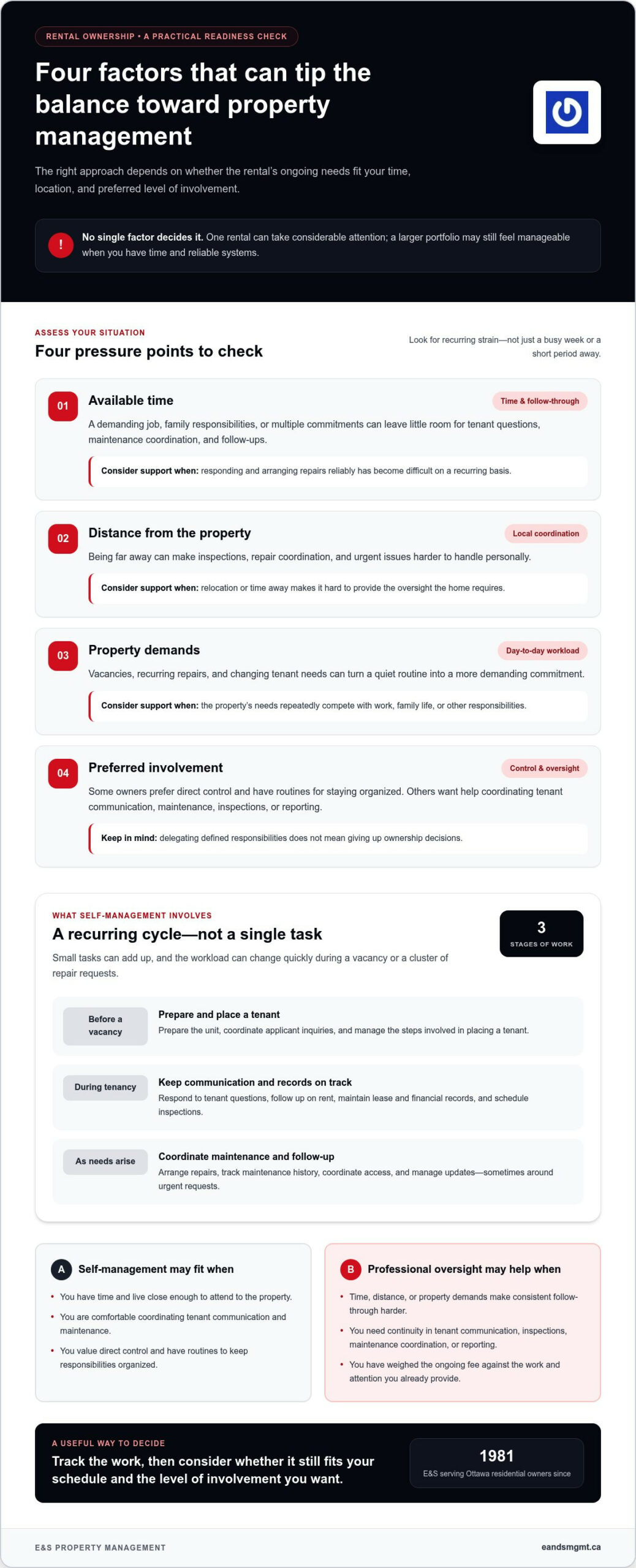
When do distance, tenant needs, or property demands tip the balance?
Distance and workload don’t affect every landlord in the same way. Use this four-part check to see whether your current approach still fits:
- Availability: Can you respond to tenant communication and follow up consistently around work, travel, and other commitments?
- Proximity: Can you get to the property when an inspection or in-person coordination is needed?
- Task complexity: Are repairs, tenant needs, or responsibilities across multiple properties becoming difficult to coordinate and track?
- Desired involvement: Do you want to manage routine details yourself, or would you prefer to retain key decisions while delegating defined responsibilities?
One difficult week doesn’t necessarily mean you need a permanent change. But if several answers point to a recurring gap, professional oversight can provide continuity. More than one property can increase the number of communications, records, inspections, and maintenance items to coordinate, though even a single rental can become demanding under the right circumstances.
Does owning a rental from abroad change the decision?
It can. An owner outside Canada may find it harder to attend in person, coordinate local maintenance, or stay on top of tenant communication across time zones. For Ottawa homeowners posted abroad, a local manager can coordinate agreed responsibilities while the owner remains involved in important choices.
Some non-resident landlords may also need support with NR6 and NR4 tax filings. Tax processes and Ontario tenancy requirements can change, so verify current details through official CRA and Ontario sources before acting. A dedicated Foreign Service Officer property-management guide and non-resident tax explainer can provide more detail on those subjects.
How can an owner make a practical decision?
Look beyond today’s workload. Consider whether you can consistently handle routine responsibilities and respond when issues arise, and whether your current arrangements support orderly oversight without taking more time than you can comfortably give. Separate immediate pressures from longer-term plans, such as a move, additional properties, or a desire to be less involved.
The answer to when does it make sense to hire a property manager often becomes clearer when you assess all four factors together. If time, distance, complexity, and your preferred involvement point toward delegation, explore Ottawa property management support for tenant, property, and financial oversight.
Switching to Property Management with Confidence
A smooth transition starts with clarity. Before delegating, decide what you want help with, how you prefer to receive updates, and which decisions you want to make yourself. Clear priorities give the management arrangement a practical foundation and help prevent important details from getting lost during handover.
What should an owner prepare before handing over responsibilities?
Gather the information that helps someone understand the property and its current tenancy. An organized handover can include:
- Lease documents and tenant contact information
- Property details, access information, and relevant records
- Maintenance and repair history, including outstanding items
- Financial records related to the rental
- Your preferences for communication, reporting, and involvement in decisions
You don’t need to create a perfect file before beginning. Even a clear list of what’s available and what needs follow-up can provide a reliable starting point. Discuss how you’d like to receive updates and how maintenance matters should be communicated, so expectations are clear from the outset.
With E&S Property Management, coordinated residential management can include tenant placement, rent collection, inspections, financial reporting, and maintenance coordination. The goal is to organize the recurring work while keeping you informed and involved according to your priorities.
What does professional oversight look like in Ottawa?
E&S Property Management has served Ottawa’s residential market since 1981, bringing more than four decades of experience to local property owners. The firm also supports Canadian Foreign Service members managing homes while posted abroad. Whether you’re nearby or living elsewhere, coordinated attention to tenants, property conditions, maintenance, and financial information can make ownership easier to oversee.
Before moving ahead, clarify what you want to delegate, what you want to decide personally, and what kind of reporting helps you feel informed. This makes it easier to assess whether the arrangement fits your property and the way you want to manage it. If you’re still asking when does it make sense to hire a property manager, consider whether a defined handover would address the tasks or distance that have become difficult to manage alone.
If professional oversight feels like the right next step, discuss your Ottawa property and management priorities with E&S Property Management. A clear conversation can help you consider the transition and identify support that fits your ownership needs.
Choose the Level of Support That Fits Your Rental
The decision isn’t about how many properties you own. It’s about whether you have the time, proximity, and desire to manage the ongoing work consistently. If tenant needs, maintenance coordination, or distance are placing a lasting strain on your schedule, professional oversight may be a practical next step. If you’re nearby, available, and comfortable handling the responsibilities, self-management may still suit you.
So, when does it make sense to hire a property manager? Consider the workload you’re carrying, the involvement you want to retain, and whether your current approach will still work as circumstances change. E&S Property Management has served Ottawa’s residential market since 1981, coordinating tenant placement, inspections, rent collection, financial reporting, and maintenance. The firm also supports Canadian Foreign Service members and other owners managing Ottawa homes from abroad.
If you’re weighing your options, talk with E&S Property Management about your Ottawa rental and the oversight that fits your priorities. A clear plan can help you move forward with confidence.
Frequently Asked Questions
When does it make sense to hire a property manager?
It often makes sense when rental responsibilities repeatedly compete with work or personal commitments, you live too far away to oversee the home easily, or tenant, maintenance, and administrative tasks are becoming difficult to coordinate. To answer when does it make sense to hire a property manager for your situation, consider your desired involvement and whether the management service covers the tasks you need help with.
Is it worth hiring a property manager for one rental property?
It can be, because the number of properties alone doesn’t determine the workload. Consider how much time your rental requires, how close you live, and whether you can respond to tenant questions and maintenance needs consistently. Then compare the responsibilities included in a management arrangement with the tasks you’d delegate and its fee. The decision should reflect your priorities, not a rule about portfolio size.
Can I manage my rental property myself from another country?
Some owners self-manage from abroad, but distance can make tenant communication, inspections, maintenance coordination, and time-sensitive decisions harder. Think through how local property needs will be handled and how you’ll keep tenant and financial records organized. Non-resident landlords should review current Canada Revenue Agency guidance for their circumstances. E&S Property Management provides NR6 and NR4 tax filing support for non-resident landlords.
How many rental properties should I own before hiring a property manager?
There’s no universal property count that makes management necessary. One Ottawa rental may demand considerable attention if you’re busy or live far away, while several properties may remain manageable if you have experience, time, and organized processes. Consider the tenant communication, maintenance coordination, and administrative work involved across your rentals. Let the actual demands and your availability guide the decision, rather than relying on a fixed threshold.
What does a property manager take care of for a landlord?
Responsibilities depend on the agreed service scope. Full-service residential management may include tenant placement, rent collection, inspections, maintenance coordination, and financial reporting. E&S Property Management provides these forms of oversight for Ottawa residential properties. A manager handles the responsibilities assigned to them, while you remain the owner and retain ownership decisions. Before delegating, compare the proposed scope with the tasks you currently manage yourself.
Will hiring a property manager guarantee higher rental income?
No. Hiring a property manager can’t guarantee higher rental income, and results depend on factors such as the property, tenant circumstances, and agreed services. Professional oversight can coordinate leasing, rent collection, maintenance, and reporting, but it shouldn’t be treated as a promise of increased income or savings. Assess whether the management support addresses your workload and priorities, and consider the service scope and fee as part of your decision.
What should I consider before hiring a property manager in Ottawa?
Start by deciding which responsibilities you want to delegate and how involved you’d like to remain. Compare the service scope for tenant placement, rent collection, inspections, maintenance coordination, and financial reporting with your property’s needs. Clarify your communication and reporting preferences, too. For questions about Ontario tenancy matters or Canadian tax requirements, consult current authoritative sources. Ottawa owners can also consider a manager’s experience supporting local and overseas landlords.