
What if an employer confirms a job but won’t share the applicant’s salary? Screening does not have to stop there. Knowing how to verify tenant employment and income in Ottawa means weighing relevant evidence consistently instead of relying on one document or income type. You can seek a clear picture of whether the rent is affordable while respecting an applicant’s privacy and rights.
A fair process can account for salaried work, self-employment, contract earnings, benefits, and other income sources without treating one as automatically more reliable. In Ontario, landlords may request income information when they also request credit references and rental history, but they must not discriminate based on a protected ground, including source of income. Obtain written consent before conducting credit or background checks where required.
This guide explains what evidence may help, what to do when an employer cannot confirm details, and how to assess applicants with different financial circumstances. You’ll also learn how to record each step and apply the same criteria to every applicant, giving you a clearer, more defensible basis for a rental decision.
Key Takeaways
- Learn how to verify tenant employment and income in Ottawa with a repeatable process focused on relevant evidence, not assumptions.
- Choose documents that fit each applicant’s circumstances, and ask about suitable alternatives when a particular record isn’t available.
- Use consistent criteria and authorized checks to assess applications in line with Ontario’s human-rights and privacy requirements.
- Keep clear notes of what you requested, reviewed, and considered so your rental decision is easier to explain and support.
- Consider professional tenant placement support if you want a more structured screening process, especially if you own property remotely or have limited time.
Why verify tenant employment and income before renting in Ottawa?
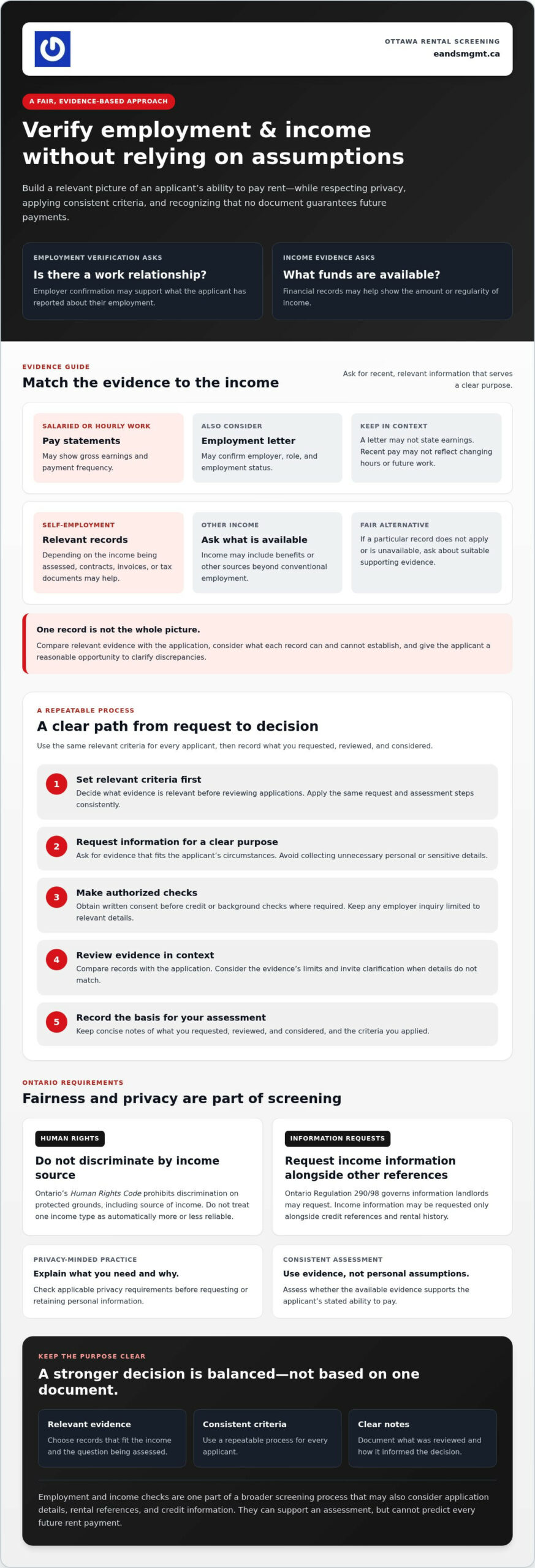
Checking an applicant’s employment and income can help you assess the information they’ve provided, but it cannot predict every future rent payment. Verification means comparing relevant claims with reliable evidence and understanding what that evidence does, and does not, establish. It is one part of a broader screening process that may also consider application details, rental references, and credit information.
Employment and income checks answer related but distinct questions. Employment verification can confirm whether an applicant has a work relationship with an employer. Income evidence can help show the amount or regularity of funds available to pay rent. An applicant may have a current job but variable hours, while another may have consistent income from self-employment or multiple sources. Neither a job title nor a well-known employer proves that rent will always be paid on time. A document reflects a particular period, not a guarantee about future circumstances.
For a general overview of information landlords may consider, see this Tenant screening process reference. The goal is to build a relevant, balanced picture, not to treat any single document as conclusive.
What employment and income checks can, and cannot, show
An employment letter or employer confirmation may support a claim about a work relationship. Pay statements or other financial records may offer evidence of income. Each has limits: a letter may not state earnings, and a recent pay statement may not reflect changing hours or future work. Consider each record in context rather than assuming that an employment type or job title predicts reliability.
Why consistency matters for Ottawa landlords
Set relevant criteria before reviewing applications, then follow the same request and assessment steps for each applicant. Consistency makes your decisions easier to explain and helps prevent personal assumptions from influencing the outcome. Keep concise notes of the evidence reviewed and the criteria applied.
Ontario’s Human Rights Code prohibits discrimination on protected grounds, including source of income. Ontario Regulation 290/98 also governs the information landlords may request. Income information may be requested only alongside credit references and rental history. These requirements make a neutral, documented process especially important. Focus on whether the available evidence supports the applicant’s stated ability to pay, not whether their income follows a preferred path. A repeatable approach to how to verify tenant employment and income in Ottawa helps keep that distinction clear.
Which documents can verify a tenant’s employment and income?
The right evidence depends on what the applicant has reported and what you need to confirm. An employment letter can help establish a work relationship, while pay statements or other financial records may help show income amount and payment frequency. One document may not answer both questions. Ask for recent, relevant information that serves a clear purpose rather than requesting a large collection of personal records.
Evidence for salaried and hourly employees
For an employee, recent pay statements may show gross earnings and payment frequency. An employment letter may confirm the employer, role, and employment status without stating salary. Compare the documents with the application, note any discrepancies, and give the applicant a reasonable opportunity to clarify them. If you plan to contact an employer or conduct a check, obtain consent where required and limit the inquiry to relevant details.
Evidence for self-employed and other income sources
A standard pay statement will not suit every situation. Depending on the income being assessed, a self-employed applicant might provide relevant contracts, invoices, or tax documents. Applicants may also receive income from sources other than conventional employment. Ask what evidence they can provide to support the income they’ve reported, and consider a proportionate alternative if a particular document does not apply.
Documents should be recent enough to reflect the applicant’s current circumstances and relevant to the purpose of verification. Avoid collecting unnecessary sensitive details. Before requesting or retaining personal information, check the privacy requirements that apply to your process and explain what you need and why. The Ontario Human Rights Commission’s policy on human rights and rental housing is a useful reference for understanding landlords’ obligations and how screening practices can raise human-rights concerns.
Use the purpose of the check to guide your evidence request:
- Work relationship: an employment letter or, with appropriate consent, confirmation from the employer.
- Employee earnings: recent pay statements showing amounts and payment frequency.
- Self-employment: relevant contracts, invoices, or tax documents that support the income described.
- Other income: suitable records that substantiate the applicant’s stated source and amount.
There is no universal document set for every applicant. A thoughtful approach to how to verify tenant employment and income in Ottawa matches the evidence request to the applicant’s circumstances, then checks whether the information is consistent and relevant. If you’d prefer experienced local support with applicant screening and lease execution, explore E&S Property Management’s tenant placement service.
How to verify employment and income step by step in Ottawa
A clear sequence helps you check an applicant’s claims without turning screening into an open-ended investigation. Use the same framework for every application, while tailoring the evidence request to the applicant’s circumstances.
- Set your criteria. Decide what information you need to assess the application and how you’ll consider it. Focus on relevant evidence rather than job title, employer reputation, or assumptions about a particular income type.
- Request appropriate evidence. Ask for documents that support the applicant’s stated employment and income. If an item is unavailable or does not fit their situation, invite them to suggest a suitable alternative.
- Confirm details carefully. Compare documents with the application. If you need to contact an employer, obtain and record the applicant’s authorization where applicable, and ask only relevant questions.
- Assess the whole application. Consider employment and income evidence alongside the other information requested through your screening process. Keep credit checks separate from income verification, and confirm consent requirements before ordering or using a credit or background check.
- Document the decision. Note what you requested and reviewed, any clarification received, and the criteria used. Keep records secure and follow applicable privacy and retention requirements.
For guidance on fair screening in rental housing, consult the Ontario Human Rights Commission policy. Check current requirements for information requests, consent, and applicant records before putting your process in place.
How to contact an employer respectfully
Keep the inquiry narrow. With the applicant’s authorization, you might ask an employer to confirm a stated role or whether the applicant currently works there. Do not seek unrelated personal details. Record the contact date, who you reached, the response, and any limits on what they could disclose. If authorization or disclosure requirements are unclear, pause and confirm what applies before proceeding.
What to do when an employer will not confirm salary
An employer may confirm employment but decline to discuss compensation under its disclosure policy. That limited response does not, by itself, show that the applicant misrepresented their income. Explain what remains unverified and give the applicant an opportunity to provide other relevant evidence, such as recent pay statements or another document suited to their income source. Assess any alternative evidence using the same criteria you apply to comparable applications.
This measured approach to how to verify tenant employment and income in Ottawa makes the process easier to repeat and explain. Landlords who want support coordinating applicant screening and lease execution can review E&S Property Management’s tenant placement service.
How to assess income fairly under Ontario rules
Assess income evidence within Ontario’s legal framework, not through assumptions about who is likely to pay rent. The Ontario Human Rights Code protects applicants from discrimination on protected grounds, including source of income. Ontario Regulation 290/98 sets conditions for requesting income information: landlords may request it only when they also request credit references and rental history. Check current wording and guidance before setting your screening process. The Ontario Human Rights Commission’s policy on human rights and rental housing is a useful starting point.
Avoiding discriminatory income screening
Apply the same relevant criteria to each applicant, while recognizing that the evidence supporting income may differ. Do not rank salaried employment, contract work, self-employment, and other income sources based on assumptions. Avoid using a fixed rent-to-income ratio as the sole reason to reject an application. Instead, consider the evidence in context and assess the applicant’s stated ability to pay using consistent criteria.
This comparison shows what common records may establish, and where their limits lie:
| Evidence type | What it may establish | Limitations |
|---|---|---|
| Employment letter | Role or employment status | May not confirm pay or future job stability |
| Recent pay statements | Reported earnings and payment frequency | Reflect a limited period and may not show future income |
| Contracts or invoices | Work arrangements or billed income | Don’t necessarily confirm payment or ongoing work |
| Relevant tax documents | Reported income for a past tax period | May not reflect current earnings |
Privacy, consent, and keeping screening records
Request only information connected to assessing the application, and confirm applicable privacy obligations before collecting, using, or retaining personal records. Get and document authorization where required before contacting employers or references, and confirm consent requirements before conducting credit checks. Keep applicant information secure, limit access, and establish a retention and disposal approach informed by current legal advice and business policy.
A consistent process can make how to verify tenant employment and income in Ottawa easier to explain while respecting applicants’ different circumstances. If you’d like support with structured screening and leasing, explore E&S Property Management’s tenant placement service.
Ottawa tenant verification: DIY vs. professional help
Handling screening yourself gives you direct oversight, but you’ll also need to set criteria, review documents, coordinate authorized checks, and keep clear records. That workload can be difficult to manage if you own a rental remotely or have limited time. Whether you choose a DIY process or professional support, the goal is the same: apply relevant criteria consistently and make a decision you can explain.
A practical checklist before choosing an applicant
Before making a decision, check that your process is complete and consistent. Use this checklist:
- Confirm that each requested document relates to a stated screening criterion.
- Give the applicant an opportunity to clarify gaps or offer relevant alternative evidence.
- Complete any authorized checks you’ve decided to use, following current requirements.
- Assess the evidence using the same criteria applied to other applicants.
- Record what you reviewed and the reasons for your decision in neutral, factual language.
If the information does not fit a standard template, pause before drawing conclusions. A brief follow-up may clarify whether an apparent gap reflects a different income arrangement or simply a document that is unavailable.
How professional tenant placement can reduce administrative burden
Professional help may be useful when you’re balancing screening with other responsibilities, managing a property from outside Ottawa, or looking for a more structured approach to applicant checks and leasing. Ask what the service includes, how applicant information is handled, and how the provider addresses consent, alternative evidence, and consistent criteria. Delegating tasks can reduce administration, but it does not guarantee a particular tenant or outcome.
E&S Property Management is an Ottawa residential property management firm founded in 1981. Its tenant placement service includes applicant screening, background checks, credit verification, and lease execution. Its local focus may help landlords considering support with the steps involved in placing a tenant, while the landlord remains responsible for making a fair, well-documented decision.
Understanding how to verify tenant employment and income in Ottawa can help you decide which parts of screening you’re comfortable managing and where assistance may be valuable. If you’d like to discuss a structured local approach, Discuss Ottawa tenant placement with E&S Property Management.
Make your next rental decision with greater confidence
A sound screening process does not promise that rent will always arrive on time. It helps you make a clearer decision by checking relevant employment and income evidence, considering the full application, and applying consistent criteria. Keep records factual, and give applicants a fair opportunity to clarify information or provide suitable alternatives.
Knowing how to verify tenant employment and income in Ottawa can bring structure to a process that often feels uncertain. If coordinating applicant screening and leasing takes more time than you can comfortably manage, professional tenant placement may be worth considering.
E&S Property Management is an Ottawa residential property management firm founded in 1981. Its tenant placement service includes applicant screening, background checks, credit verification, and lease execution. Full-service management also includes rent collection and tenant relations, providing ongoing support beyond tenant placement without guaranteeing a particular tenant outcome.
Discuss tenant placement with E&S Property Management to explore whether local support fits your needs. A fair process and clear records can help you move forward with greater confidence.
Frequently Asked Questions
Can a landlord in Ontario ask for proof of a tenant’s income?
Yes. Landlords may request relevant income information to assess a rental application, subject to Ontario’s requirements. Ontario Regulation 290/98 permits landlords to request income information when they also request credit references and rental history. Requests and decisions must respect human-rights and privacy obligations. Ask only for information tied to consistent screening criteria, explain why it’s needed, and assess evidence fairly across applicants with different income sources. Check current legal guidance before establishing your process.
What documents can a landlord use to verify employment and income?
Depending on the applicant’s circumstances, useful evidence may include recent pay statements, an employment letter, relevant tax documents, or records supporting self-employment or contract income. An employment letter may confirm a role or work relationship without stating earnings, while pay statements may show income over a limited period. No single document suits everyone. Request only relevant information, store it securely, and let applicants clarify discrepancies or suggest appropriate alternatives.
Can a landlord contact an applicant’s employer in Ottawa?
Employer contact may help confirm application details, but obtain and document the applicant’s authorization where required before reaching out. Keep questions narrow and relevant, such as whether the applicant works there or holds the stated role. Employers may limit what they disclose, including salary. A restricted response does not automatically mean the applicant provided false information. Invite the applicant to support their stated income with suitable records and document the steps taken.
How can a landlord verify income if an applicant is self-employed?
A landlord can ask a self-employed applicant for relevant records that support the stated income, such as tax documents, contracts, invoices, or other suitable evidence. These records may show reported earnings or work arrangements, but they may not establish future income or confirm that every invoice was paid. Apply the same underlying assessment criteria used for other applicants, avoid unnecessary sensitive details, and check current Ontario privacy and human-rights guidance before setting procedures.
Can a landlord reject an applicant because their income is low?
A rental decision should be based on relevant information and comply with Ontario’s Human Rights Code and other applicable requirements. Do not make assumptions about an applicant’s circumstances or income source, and avoid applying an unexplained threshold differently from one person to another. Assess the available evidence using clear, consistent criteria and record your reasons. If the decision is uncertain or may involve a protected ground, consult current Ontario Human Rights Commission guidance or seek legal advice.
Should Ottawa landlords use a rent-to-income ratio to screen tenants?
A rent-to-income ratio can look straightforward, but it should not replace an individualized review of relevant application information. Ontario Human Rights Commission guidance cautions against using a strict ratio as the sole reason for denying an application. Before adopting a threshold, check current Ontario guidance and confirm that it is appropriate and applied consistently. Consider the evidence in context, including different income arrangements, and document the reasons for your decision rather than relying on one calculation.
What should a landlord do if an employer will not confirm an applicant’s salary?
An employer’s limited disclosure does not automatically show that an applicant misrepresented their income. Tell the applicant what remains unverified and invite them to provide relevant alternatives, such as recent income records, contracts, or other documents suited to their circumstances. Keep the request proportionate and use the same approach for comparable applications. Record what you requested, what the applicant provided, and how you considered the evidence in your decision.


