Does the title “property manager” tell you whether someone is licensed? Not necessarily. If you’re wondering how to verify a property manager is licensed in Ontario, first identify the work they’ll do and whether they’ll manage an individual rental or provide services to a condominium corporation. The regulator to check depends on that distinction, so searching the wrong registry may leave important questions unanswered.
Before signing an agreement or handing over responsibility for your rental home, ask for clear information about the manager’s role. Ontario requires individuals and businesses providing condominium management services to hold a valid Condominium Management Regulatory Authority of Ontario (CMRAO) licence. Other rental management work may fall under Real Estate Council of Ontario (RECO) registration requirements, depending on the activities involved. Exemptions can apply.
This guide explains which regulator to check, how to search official public records, and how to confirm you’ve found the right person or business. You’ll also learn what to clarify about duties and responsibilities before signing or transferring property tasks, so you can compare providers with more confidence.
Key Takeaways
- To learn how to verify a property manager is licensed in Ontario, identify the work they’ll perform before choosing the regulator to check.
- Use the official RECO or CMRAO public records, then match the result to the person and business named in your proposed agreement.
- A registry search can clarify registration or licence status, but it won’t establish service quality, suitability, or what your contract covers.
- Before sharing keys, funds, or personal information, ask who will sign the agreement and who will carry out any regulated activities.
- Review the agreement alongside the manager’s duties, including inspections, rent collection, maintenance coordination, and financial reporting.
Does a Property Manager Need a Licence in Ontario?
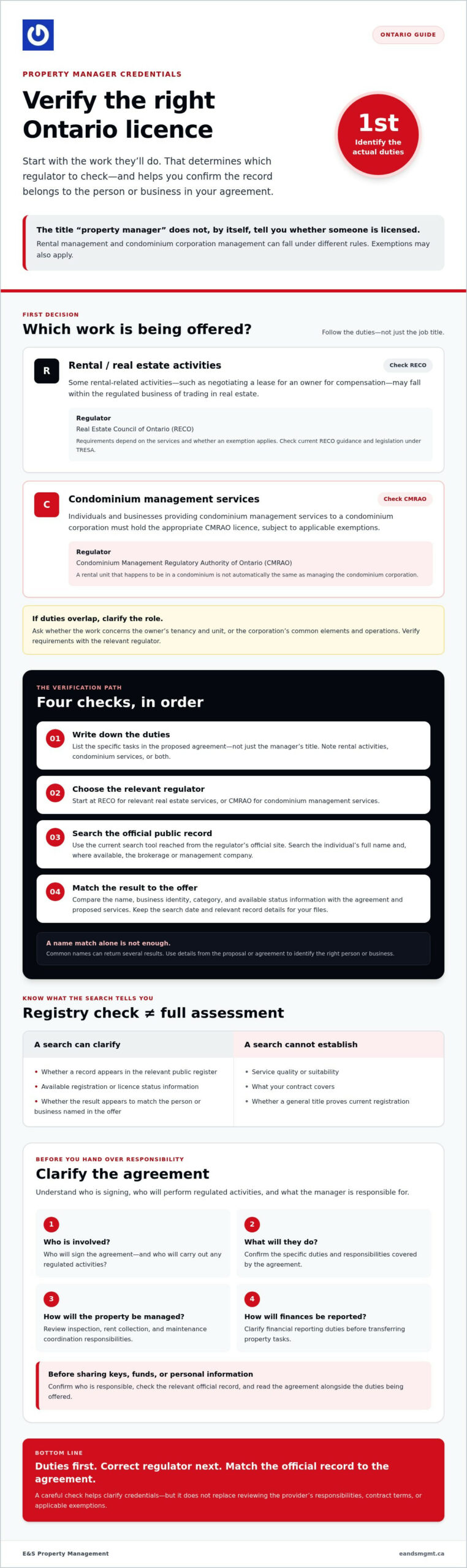
In Ontario, licensing requirements depend on the work a person performs, not simply the title “property manager.” Coordinating repairs and inspections for a rental home may involve different rules from negotiating leases for an owner or managing a condominium corporation. Before checking credentials, list the actual duties in the proposed agreement.
Quick regulator guide: If the duties involve activities regulated as trading in real estate, check the Real Estate Council of Ontario (RECO) and current rules under the Trust in Real Estate Services Act, 2002 (TRESA). If the work is condominium management services, check the Condominium Management Regulatory Authority of Ontario (CMRAO) and its licensing requirements.
Quotable takeaway: Identify the manager’s duties first, because the work they perform determines which regulator and credentials you should check.
When RECO registration may be relevant
RECO regulates registered real estate professionals in Ontario under TRESA. Some rental-related activities, such as negotiating a lease on behalf of an owner for compensation, may fall within the regulated business of trading in real estate. The details matter, including the services provided and whether an exemption applies. Check RECO guidance and current legislation rather than assuming every person who manages a rental needs the same registration.
For historical context, the former Real Estate and Business Brokers Act (REBBA) was replaced by TRESA. A company name, business card, or title such as “property manager” doesn’t prove that an individual or brokerage is currently registered with RECO.
When CMRAO licensing may be relevant
CMRAO regulates condominium management in Ontario. If someone provides condominium management services to a condominium corporation, the applicable licensing framework is separate from RECO’s regulation of real estate services. Individuals and businesses providing condominium management services must hold the appropriate licence, subject to applicable exemptions. Some roles, such as uncompensated condominium board directors, may be exempt. Confirm how the rules apply to the specific role and duties.
Managing an individual rental home that happens to be a condominium unit isn’t automatically the same as managing the condominium corporation. Clarify whether the proposed work concerns the owner’s tenancy and unit, or the corporation’s common elements and operations. If duties overlap, ask the provider to explain which activities it will perform and verify requirements with the relevant regulator.
That distinction is the starting point for how to verify a property manager is licensed in Ontario. Review official RECO, CMRAO, and Ontario legislation resources for current requirements and exemptions before relying on a general label or informal assurance.
How to Check a Property Manager’s Ontario Licence Step by Step
A careful search involves more than entering a name and accepting the first result. To understand how to verify a property manager is licensed in Ontario, start with the duties in the proposed agreement, find the relevant official regulator record, and check that it belongs to the person or business offering those services.
- Write down the duties. Note whether the manager will handle rental activities that may fall under RECO’s rules, condominium management services regulated by CMRAO, or both. Include specific tasks, not just the job title.
- Choose the relevant regulator. For real estate services, begin at the RECO website. For condominium management services, use the CMRAO website. Follow links from the regulator’s official site to its current public search tool instead of relying on a third-party directory.
- Search official records. Enter the individual’s full name and, where the search allows, the brokerage or management company name. If a common name returns several results, use details from the proposal or agreement to narrow the search. Don’t assume the first matching result is the right person.
- Match the result to the offer. Compare the record’s name, business identity, category, and available status information with the agreement and proposed services. Save the search date and relevant record details, such as the result page or licence information, for your files.
Search the correct official public register
RECO and CMRAO provide public search resources through their official websites. Search for the individual first, then check the business or brokerage if the tool offers that option. Search fields and record details may differ, so rely on what the regulator’s current search page displays. If you can’t tell whether a result is relevant, contact the regulator using the details on its official website rather than guessing.
Match the record to the person and service
Compare the person’s legal name and the business named in the record with the proposed agreement, email signature, and contact information. Check whether any listed registration or licence category and status fit the work being offered, and review other information the record provides. A similar name alone isn’t enough.
A matching name matters only when the record also fits the person, business, and service being offered. If the agreement names one company but the search result points to another, ask for clarification before signing or transferring responsibilities. Keep a dated copy of your search so you can refer back to it if details change.
For an overview of the tasks an Ottawa residential property manager may handle, explore residential property management services.
What an Ontario Licence Search Can and Cannot Confirm
A regulator search is a useful check, but it has limits. It may confirm that a person or business appears in the relevant official record and show information the regulator makes public. It doesn’t automatically establish that the provider is a good fit, that its services meet your needs, or that the proposed agreement protects your interests.
How to interpret a status or business listing
Read the regulator’s current explanations for any status or category displayed. Don’t infer what a label means from its wording alone, or rely on an old screenshot or a result without context. Check whose record you’re viewing: it could belong to an individual, a brokerage, a condominium manager, or a management company. These records are not interchangeable.
If a person’s name doesn’t appear in one register, that alone doesn’t prove they’re acting improperly. The work may fall under a different regulator, an exemption may apply, or the search may not have identified the right person or entity. Revisit the duties involved and ask the regulator for clarification if the result remains uncertain.
What a licence search does not replace
Registration or licensing is one part of due diligence, not a full endorsement. It doesn’t tell you whether the provider’s approach suits your property, how promptly they communicate, or what they’ve agreed to do. These questions matter whether you’re entrusting an Ottawa rental home to a local manager or coordinating oversight from elsewhere.
Read the agreement carefully. Confirm the services, decision-making authority, financial reporting arrangements, and termination terms in writing. Ask for references and clarify what insurance details are available. This broader review complements the search and helps you understand how to verify a property manager is licensed in Ontario without treating one record as the whole answer.
Questions to Ask If a Property Manager’s Licence Is Unclear
An unclear search result is a reason to ask for clarification, not to assume misconduct. Before sharing keys, transferring funds, or providing personal information, ask the prospective manager to explain how their role, business identity, and credentials fit together. Their answers should be consistent with the written agreement.
Questions about credentials and responsibilities
Keep the conversation practical and specific. You can ask:
- “Which regulator’s requirements apply to the services you’ll provide, and why?”
- “What are the full legal names of the individual and business that will sign my agreement?”
- “What registration or licence details should I use to check the relevant official record?”
- “Who will handle leasing, rent collection, maintenance coordination, and tenant communications?”
- “Will anyone else perform activities that may require registration or a licence?”
These questions help clarify the working arrangement without treating a job title or company name as proof of registration. They also give you details to compare with the agreement and regulator records. If you’re still learning how to verify a property manager is licensed in Ontario, request the details in writing so you can check them rather than relying on a verbal assurance.
When to pause and seek clarification
Pause before signing or transferring responsibilities if the legal name in the agreement differs from the business presented to you, the person responsible for regulated work is unclear, or the explanation doesn’t match the official search. Ask the provider to resolve the discrepancy and give you the correct details. Search results can be incomplete or difficult to interpret, so allow the provider to clarify.
For example, an Ottawa landlord serving abroad may need someone to oversee a rental home, coordinate tenant communications, and arrange maintenance while the owner is away. Before handing over access or financial responsibilities, the owner can confirm which legal entity will contract with them and who will perform each task. Written clarity is especially helpful when decisions must be coordinated from a distance.
If the registration question remains unresolved, contact RECO or CMRAO through its official channels and describe the specific duties involved. If you’re unsure how the law applies or what an agreement means, consider independent legal advice. Take time to understand the arrangement before proceeding.
To review the types of support available for an Ottawa rental home, explore residential property management.
Choose an Ontario Property Manager With Confidence
A sound decision follows a clear sequence: identify the duties, check the regulator that applies, make sure the record matches the person and business, then review the agreement before signing. That’s the practical approach to how to verify a property manager is licensed in Ontario, and it gives you a stronger basis for comparing providers.
Verification is only one part of the decision. The agreement should explain what the manager will handle, how you’ll receive updates, and what authority you’re granting. For rental oversight, clear arrangements for tenant placement, rent collection, regular property inspections, maintenance coordination, and financial reporting help you understand how the work will be carried out.
Compare service scope after verification
Look beyond a general promise of “full service.” Ask how tenant placement and rent collection are handled, what regular inspections include, and how maintenance issues are reported and coordinated. Clarify which decisions require your approval, what financial reports you’ll receive, and how often you can expect communication. If emergency maintenance response is part of the proposed service, confirm how it works and how you’ll be kept informed.
Owners living abroad should also ask how ongoing property oversight will work across time zones and how financial information will be shared. If you need help with non-resident tax administration, clarify whether the provider offers NR6 and NR4 tax filing support and what information you’ll need to provide. Put agreed responsibilities in writing so both parties understand them from the start.
A measured next step for Ottawa landlords
Before speaking with a management firm, prepare a short overview of your property, priorities, and the responsibilities you’re considering delegating. Note questions about inspections, maintenance, rent collection, reporting, communication, and the agreement. This makes it easier to assess whether the proposed services suit your situation, whether your home is in Ottawa or you’re arranging oversight from abroad.
E&S Property Management focuses on residential property management in Ottawa and was founded in 1981. Its more than four decades of experience are useful context when comparing local management options, but experience isn’t a substitute for checking applicable credentials and reviewing the agreement.
To review the services available for Ottawa landlords, visit E&S Property Management.
Take the Next Step With Confidence
Choosing a property manager starts with understanding the work they’ll do. Identify the duties, check the appropriate Ontario regulator, match the public record to the person and business, then review the agreement carefully. That’s the practical framework for how to verify a property manager is licensed in Ontario. Remember that a credential search is only one part of deciding whether a provider is the right fit.
Once you’ve confirmed the relevant details, compare how each manager handles tenant placement, rent collection, inspections, maintenance coordination, and financial reporting. Clear expectations can help you protect your property and stay informed, whether you live nearby or are managing an Ottawa rental from abroad.
E&S Property Management is an Ottawa residential property management firm founded in 1981, with more than four decades of experience. To learn about its services and decide whether they suit your needs, explore E&S Property Management’s support for Ottawa landlords.
Frequently Asked Questions
Does every property manager in Ontario need a licence?
No. The requirement depends on the services performed and the person’s legal role, not simply their job title. Activities involving trading in real estate may fall under RECO’s framework, while condominium management services are regulated separately by CMRAO. Exemptions may also apply. Check current requirements with RECO, CMRAO, or a legal professional who can assess the specific duties and arrangement.
How do I check if a property manager is registered with RECO?
Use the official public search on the RECO website. Search the individual’s full name and, where available, the brokerage or business name. Compare the listing with the person offering services and the identity named in your proposed agreement. To understand how to verify a property manager is licensed in Ontario, check the result’s current status and details, then contact RECO directly if the listing is unclear or doesn’t match.
Is a property manager the same as a condominium manager in Ontario?
Not necessarily. “Property manager” can refer to someone managing an owner’s rental home, while “condominium manager” may describe someone providing management services to a condominium corporation. The roles can involve different duties and regulatory requirements. CMRAO regulates condominium management in Ontario. Identify what the person will actually do and check current rules with CMRAO or the relevant regulator rather than relying on a title.
Can I manage my own rental property without a licence in Ontario?
Owner self-management may be treated differently from providing property management services to someone else, but the answer can depend on the exact arrangement and activities involved. Don’t assume every situation follows the same rule, particularly if other people or a condominium corporation are involved. Check current Ontario requirements and any applicable exemptions with RECO or CMRAO. If the legal position remains uncertain, seek advice from a lawyer.
What should I do if I cannot find a property manager in the public register?
One unsuccessful search isn’t conclusive. Check the spelling of the person’s name, search the business or brokerage identity if the register allows it, and confirm you’re using the regulator relevant to the services offered. Ask the manager to clarify their legal name and role. If the result still doesn’t make sense, contact RECO or CMRAO directly before signing an agreement, transferring funds, or handing over property responsibilities.
Does a licence guarantee that a property manager is trustworthy?
No. A verified licence or registration confirms information shown in the regulator’s record, but it doesn’t guarantee service quality or prove that a manager is the right fit for your property. Review references, the written agreement, financial reporting arrangements, and available insurance details separately. Discuss communication expectations and confirm who will handle specific tasks. These checks help you assess the full working relationship, not just credentials.