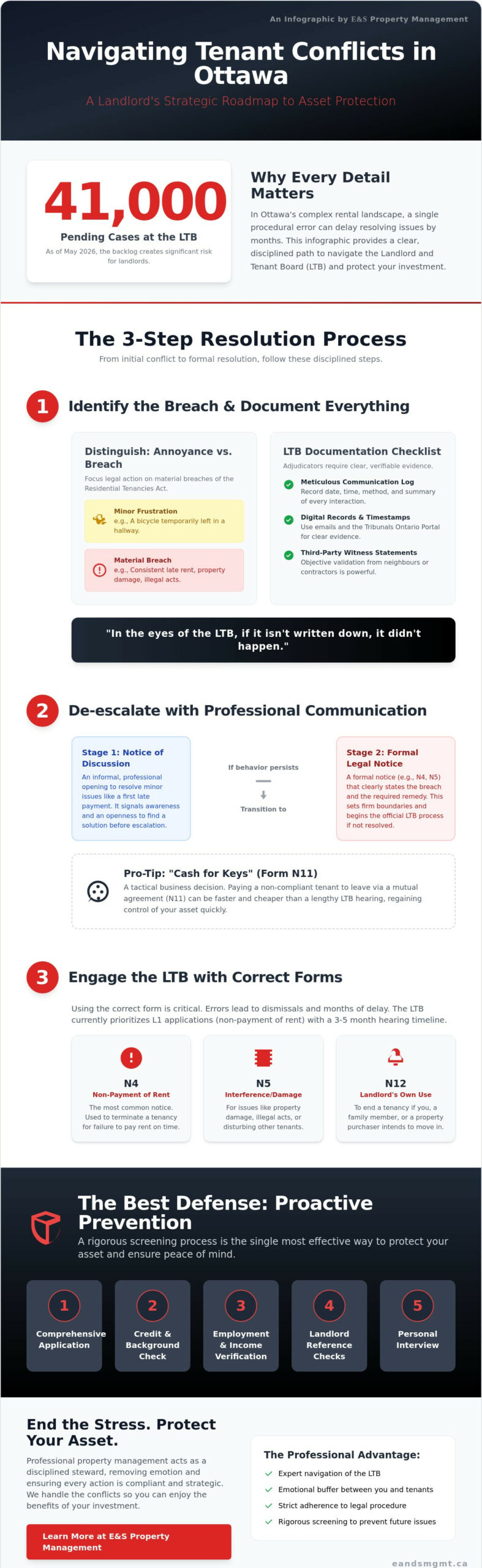
As of May 2026, the Landlord and Tenant Board faces a pending caseload of approximately 41,000 cases. If you’re struggling with how to deal with a problem tenant in Ottawa, a single procedural error can delay your resolution by several months. You likely feel the weight of this backlog, especially if you’re facing unpaid rent or property damage while managing your investment from a distance. Delays are costly. Being a landlord should provide financial security, not constant legal anxiety and mounting debt. When conflicts arise, the priority is to regain control through disciplined stewardship.
Managing these challenges requires a shift from emotional reactions to professional Management Solutions. This guide provides a clear roadmap to navigate the Residential Tenancies Act, leverage the LTB’s current 3 to 5 month prioritization for L1 applications, and protect your asset. You’ll learn the strategic steps needed to resolve conflicts legally while transitioning toward a stress-free management model. We will explore the latest legislative updates, including the impacts of Bill 60, to ensure your property remains a profitable and protected investment.
Key Takeaways
- Distinguish between minor tenant frustrations and a material breach of the lease to ensure your legal actions are grounded in the Residential Tenancies Act.
- Master the art of professional communication by using a “Notice of Discussion” to resolve disputes before they escalate to a formal LTB hearing.
- Learn exactly how to deal with a problem tenant in Ottawa by correctly filing N4, N5, or N12 forms to avoid costly delays at the Eastern LTB office.
- Discover how professional property management acts as a disciplined steward to protect your asset and maintain operational efficiency during tenant conflicts.
- Implement a rigorous five-point screening process to prevent problematic placements and ensure long-term asset preservation and peace of mind.
Identifying Problematic Behaviour and Essential Documentation
Professional asset preservation begins with distinguishing between a tenant who is merely frustrating and one whose actions constitute a material breach of the lease. When you’re learning how to deal with a problem tenant in Ottawa, your first step is a clinical evaluation of the situation against the Residential Tenancies Act, 2006. Ontario law is highly specific. A tenant who leaves a bicycle in the hallway might be annoying, but a tenant who consistently pays rent late or interferes with the reasonable enjoyment of other residents is committing a breach that warrants formal action.
Verbal agreements are a significant liability for property owners in Ontario. In the eyes of a Landlord and Tenant Board (LTB) adjudicator, if it isn’t written down, it didn’t happen. You should maintain a meticulous communication log for every interaction. This log must include the date, time, method of contact, and a summary of the specific outcome. Transitioning to a professional stewardship model means moving away from casual text messages and toward documented, formal correspondence that creates a clear, chronological narrative of the conflict.
Most conflicts fall into three primary categories: non-payment of rent, illegal acts, and interference with reasonable enjoyment. Non-payment is the most common and requires immediate action with an N4 notice. Interference is more complex, often involving noise complaints, aggressive behaviour, or harassment of other tenants. Identifying these categories early allows you to select the correct legal path and minimize the financial damage to your investment.
Common Red Flags in the Ottawa Rental Market
Watch for persistent late payments accompanied by the “cheque is in the mail” excuse. This is often the first sign of impending financial loss. In the local market, unauthorized occupants or subletting without consent are also rising issues that can complicate your management. Additionally, keep an eye on property standards. If a tenant’s neglect leads to a City of Ottawa 3-1-1 inspection, you could face municipal fines for issues the tenant created. Regular property inspections help catch these risks before they escalate into costly legal battles.
The Documentation Checklist for LTB Success
Adjudicators prioritize clarity and verifiable evidence. Digital records, such as emails and PDF notices filed through the Tribunals Ontario Portal, are preferred for their clear timestamps. When documenting property damage, take high-resolution photos that include a recognizable object for scale and a digital timestamp. If you’re dealing with noise or behavioural issues, third-party witness statements from neighbours or maintenance contractors provide the objective validation needed for a successful application. These steps ensure your case is built on facts rather than hearsay, providing the steady hand needed to navigate a dispute.
Professional Communication: Resolving Disputes Outside of Court
Effective property management isn’t about winning arguments; it’s about protecting your investment. When considering how to deal with a problem tenant in Ottawa, the most efficient resolution often happens before a file reaches the Landlord and Tenant Board (LTB). Adopting a solution-oriented tone allows you to act as a disciplined steward rather than an emotional participant. This approach maintains the professional distance necessary to negotiate effectively while preserving your peace of mind. By focusing on asset preservation, you can often turn a high-conflict situation into a manageable business transaction.
A “Notice of Discussion” serves as a preliminary step to address issues like minor noise complaints or the first instance of late rent without the immediate threat of eviction. It signals that you’re aware of the problem and are open to a professional resolution. However, if the behavior persists, you must transition to a formal “Legal Notice.” This clarity prevents confusion and sets firm boundaries. It demonstrates that while you’re approachable, you won’t compromise on lease compliance or the integrity of your property.
Sometimes, the fastest way to resolve a conflict is a “Cash for Keys” agreement using Form N11. While it may feel counterintuitive to pay a non-compliant tenant to leave, it’s often a tactical business decision. With LTB hearing wait times for conduct issues currently averaging 5 to 8 months as of April 2026, a negotiated departure can save thousands in lost rent and legal fees. It’s a pragmatic strategy to regain control of your property quickly and move on to a more reliable tenant placement.
The Art of the Professional Consultation
Phrasing warnings correctly is essential for maintaining order. Instead of using accusatory language, frame the issue around the lease agreement. For example, cite specific clauses regarding “reasonable enjoyment.” Under Ontario RTA standards, reasonable enjoyment is defined as the right of a tenant to live in their home without significant or frequent disturbances to their peace, comfort, or privacy. Offering a structured payment plan for rent arrears is another effective tool. It shows the board you’ve made a good-faith effort to help the tenant, which strengthens your position if the case eventually proceeds to a hearing.
When Negotiation Fails: Transitioning to Legal Action
Every landlord reaches a “Point of No Return” where mediation is no longer cost-effective. If a tenant ignores multiple warnings or fails to adhere to a payment plan, you must shift to legal action immediately to mitigate further financial damage. Never attempt “self-help” evictions like changing the locks or cutting off utilities. These actions are catastrophic legal mistakes in Ottawa that lead to heavy fines and the immediate dismissal of your case. Instead, inform the tenant professionally that the formal legal process has begun. If the stress of these confrontations becomes unmanageable, seeking professional property management can provide the steady hand needed to resolve the crisis.
Navigating the Ontario Landlord and Tenant Board (LTB) in Ottawa
Understanding how to deal with a problem tenant in Ottawa eventually leads to the Eastern Office of the LTB, located at 255 Albert Street. While many hearings have shifted to a “Digital First” model via the Tribunals Ontario Portal, the regional context of the Eastern Office remains vital for local landlords. As of April 2026, the Ontario Landlord and Tenant Board (LTB) is managing a pending caseload of approximately 41,000 cases. This volume means that your application must be technically perfect. A single dismissal due to a clerical error can set your timeline back by six months or more.
Accuracy is your best defense against the current backlog. The Board requires “Perfect Service,” meaning any minor typo on an N-form, such as a misspelled street name or an incorrect cent in a rent arrears calculation, can lead to an immediate dismissal at your hearing. You must select the specific forms for your situation: N4 for non-payment of rent, N5 for behavioral issues or property damage, and N12 for personal use. Each form has its own mandatory notice period that must be followed strictly. For instance, an N4 requires a 14-day notice period for monthly tenants before you can take further legal steps.
Current data from April 2026 indicates that L1 applications for non-payment of rent are being prioritized, with wait times averaging 3 to 5 months. However, L2 applications involving tenant conduct or property damage still face longer delays of 5 to 8 months. This underscores why the documentation strategies mentioned in previous sections are so critical. You don’t want to wait five months only to have an adjudicator dismiss your case because your evidence was disorganized or your forms were incomplete.
How to File an LTB Application in Ottawa
Initiating a formal file requires a methodical approach to ensure your Management Solutions are legally sound. First, choose the correct N-form based on the specific lease violation identified in your communication log. Second, serve the notice according to RTA guidelines, ensuring you complete a Certificate of Service (Form P1) immediately. Third, file your L1 or L2 application through the Tribunals Ontario portal, paying the $48 online filing fee. Finally, prepare a comprehensive evidence binder that includes your digital photos, witness statements, and a clear ledger of all financial transactions.
The Role of the Sheriff in Ottawa Evictions
Only the Court Enforcement Office, commonly known as the Sheriff, has the legal authority to physically remove a tenant or change the locks during an eviction. You cannot perform these actions yourself, even with a signed LTB order in your hand. Once you receive an “Order of Eviction” from the Board, you must file it with the Sheriff’s office in the Ottawa region for enforcement. This process involves additional government-mandated fees and a secondary waiting period, which usually lasts several weeks depending on the current local caseload. A professional steward understands that the process isn’t over until the Sheriff officially returns possession of the property to you.
The Role of Professional Property Management in Crisis Resolution
Problem tenants often thrive when they sense a “DIY” landlord is emotionally invested or unfamiliar with the strict procedural requirements of the Residential Tenancies Act. They may use delays or minor maintenance issues as leverage to avoid paying rent. When you’re determining how to deal with a problem tenant in Ottawa, shifting to a professional management model changes the dynamic immediately. E&S Management Solutions serves as a disciplined steward, acting as the “Steady Hand” that handles all interactions with objectivity and legal precision. This buffer removes the emotional tax of direct conflict, allowing you to focus on your personal life or career while your investment remains protected.
Removing yourself from the direct line of fire is especially important when learning how to deal with a problem tenant in Ottawa effectively. With a pending caseload of 41,000 cases at the LTB as of early 2026, any interaction that isn’t handled with professional distance can lead to heated exchanges. Tenants may later use these interactions as evidence of “harassment” during a hearing to delay an eviction. A professional manager ensures every communication is documented and every notice is served correctly, closing the procedural loopholes that non-compliant tenants often exploit to extend their stay indefinitely.
Full-Service Management as a Legal Shield
- RTA Compliance: We ensure all actions, from rent increases (capped at 2.1% in 2026) to entry notices, follow the letter of the law.
- LTB Representation: Having a licensed representative appear at hearings ensures your case is presented logically, reducing the risk of a 3 to 5 month delay caused by a dismissed application.
- Operational Efficiency: Our emergency 24/7 maintenance response ensures repairs are completed quickly. This prevents tenants from filing T2 or T6 counter-claims, which currently take 9 to 12+ months to resolve.
Peace of Mind for Non-Resident Landlords
Managing an Ottawa property becomes significantly more complex when you’re posted abroad with Global Affairs or the Department of National Defence. Managing a crisis from a different time zone is nearly impossible without local expertise and regular property inspections. We specialize in supporting these members, providing full-service property management that includes NR6 and NR4 tax filing support to keep you compliant with the CRA. Investing in professional Management Solutions is significantly more cost-effective than absorbing the financial loss of a six-month eviction process and property restoration. If you’re currently facing a difficult situation, our full-service property management team can step in to restore order and protect your asset.
Long-Term Solutions: Preventing Problem Tenants Before They Sign
The most effective strategy for how to deal with a problem tenant in Ottawa is to ensure they never enter your property in the first place. This proactive approach forms the core of our stewardship philosophy. We view property management not as reactive crisis control, but as disciplined asset preservation. By implementing rigorous standards during the placement phase, you eliminate the legal and financial risks associated with the Landlord and Tenant Board’s 41,000-case backlog. A professional start creates a foundation of mutual respect and clear operational expectations.
While the Ontario Standard Lease is a mandatory requirement, many landlords fail to utilize the “Additional Terms” section to its full potential. These terms must remain compliant with the Residential Tenancies Act, but they’re essential for clarifying expectations regarding insurance requirements, smoke-free policies, and specific maintenance responsibilities. Setting these boundaries early discourages individuals who may not respect the integrity of your investment. Regular property inspections then serve as a vital secondary layer of protection. These visits allow us to identify behavioural shifts or unauthorized occupants long before they escalate into a legal material breach.
The E&S Tenant Screening Advantage
Our tenant placement service utilizes a rigorous five-point screening process built on 40 years of local Ottawa experience. We look beyond basic credit scores, which can often be misleading or incomplete. Our team verifies employment stability and conducts deep-dive interviews with previous landlord references to confirm a consistent pattern of reliability. This level of scrutiny is vital for identifying “professional tenants” who understand how to exploit the RTA for their own gain. For Foreign Service or DND members serving abroad, this local expertise provides the “steady hand” necessary to maintain operational efficiency from a distance.
Asset Preservation and Strategic Consulting
Moving from a model of crisis management to one of asset growth requires a shift in perspective. Every new tenancy we manage begins with a comprehensive move-in inspection report, supported by high-resolution video evidence. This documentation is your strongest shield if you ever need to prove property damage or neglect during a hearing. By maintaining these high standards, we instill a sense of security and confidence in our clients. Our goal is to ensure your property remains a stable, high-performing asset rather than a source of administrative chaos. If you’re ready to secure your property’s future, Protect your investment with E&S Management Solutions.
Protecting Your Investment Through Professional Stewardship
Resolving a tenant dispute requires a disciplined approach to asset preservation. You’ve learned that meticulous documentation, the “Perfect Service” of LTB forms, and strategic negotiation are the essential pillars for resolving conflicts. Mastering how to deal with a problem tenant in Ottawa means moving beyond the emotional tax of direct confrontation and adopting a management model based on operational efficiency. By prioritizing legal compliance and professional communication, you can mitigate financial damage and regain control of your investment property.
E&S Management Solutions provides the steady hand property owners need during these transitions. With over 40 years of residential expertise in the Ottawa market, we specialize in supporting Foreign Service and DND members who require reliable management while posted abroad. We handle every detail, from rigorous tenant screening to comprehensive NR6 and NR4 tax administration, ensuring your investment remains a source of security rather than stress. Get Peace of Mind with E&S Management Solutions and restore the stability your portfolio deserves. You don’t have to navigate these legal complexities alone. We’re here to protect your peace of mind and your asset.
Frequently Asked Questions
How long does it take to evict a tenant for non-payment of rent in Ottawa?
As of April 2026, the eviction process for non-payment typically takes 3 to 5 months from the date you file an L1 application. You must first serve an N4 notice, which provides a 14-day grace period for the tenant to pay the arrears. If the debt remains unpaid, filing immediately through the Tribunals Ontario Portal is the most efficient way to manage how to deal with a problem tenant in Ottawa.
Can I change the locks if my tenant hasn’t paid rent for three months?
No, you cannot change the locks, shut off utilities, or seize tenant property, regardless of how much rent is owed. These “self-help” evictions are illegal under the Residential Tenancies Act and can lead to heavy fines or the immediate dismissal of your LTB case. Only the Court Enforcement Office, or Sheriff, has the legal authority to physically remove a tenant from your property.
What is an N11 form, and how can it help me avoid the LTB?
An N11 is a voluntary “Agreement to End the Tenancy” signed by both the landlord and the tenant. This form allows you to bypass the 5 to 8 month wait times currently associated with conduct-related LTB hearings. It’s often used as part of a “Cash for Keys” strategy, providing a structured and legal way to regain possession of your asset without a protracted court battle.
What should I do if my tenant is damaging my Ottawa rental property?
You should immediately serve an N5 notice, which specifically addresses damage to the rental unit or interference with reasonable enjoyment. Document all damage with high-resolution, time-stamped photos and obtain written repair estimates from third-party contractors. This evidence is vital for your hearing at the Albert Street LTB office to ensure you receive an order for both eviction and compensation.
Do I need a lawyer to represent me at the Landlord and Tenant Board?
You aren’t legally required to have a lawyer, but having a licensed professional represent you ensures the “Perfect Service” required by adjudicators. With the LTB’s pending caseload of 41,000 cases, a single technical error on your forms can result in a dismissed application. Professional managers act as disciplined stewards, handling the filing and hearing process with the technical precision necessary to protect your investment.
Can a tenant refuse to leave after their lease expires in Ontario?
Yes, in Ontario, all fixed-term residential leases automatically convert to a month-to-month arrangement once the initial term ends. A landlord cannot evict a tenant simply because the lease has expired. To terminate the tenancy, you must provide a valid reason under the RTA, such as a material breach of the lease or a good-faith N12 notice for personal use.
What happens if I am posted abroad and my tenant stops paying rent?
If you’re serving abroad with the DND or Global Affairs, you need local Management Solutions to act as your legal representative. We manage the entire process, from serving N4 notices to attending virtual hearings and ensuring your NR6 and NR4 tax filings remain compliant. This prevents the financial loss and stress of trying to manage how to deal with a problem tenant in Ottawa from a different time zone.
How much does it cost to hire the Sheriff for an eviction in Ottawa?
Hiring the Sheriff involves government-mandated filing fees and a secondary waiting period that typically lasts several weeks. These costs are separate from your initial LTB filing fees and cover the physical enforcement of the eviction order. A professional manager coordinates this final step with the Court Enforcement Office to ensure the keys are returned and your property is legally secured.