
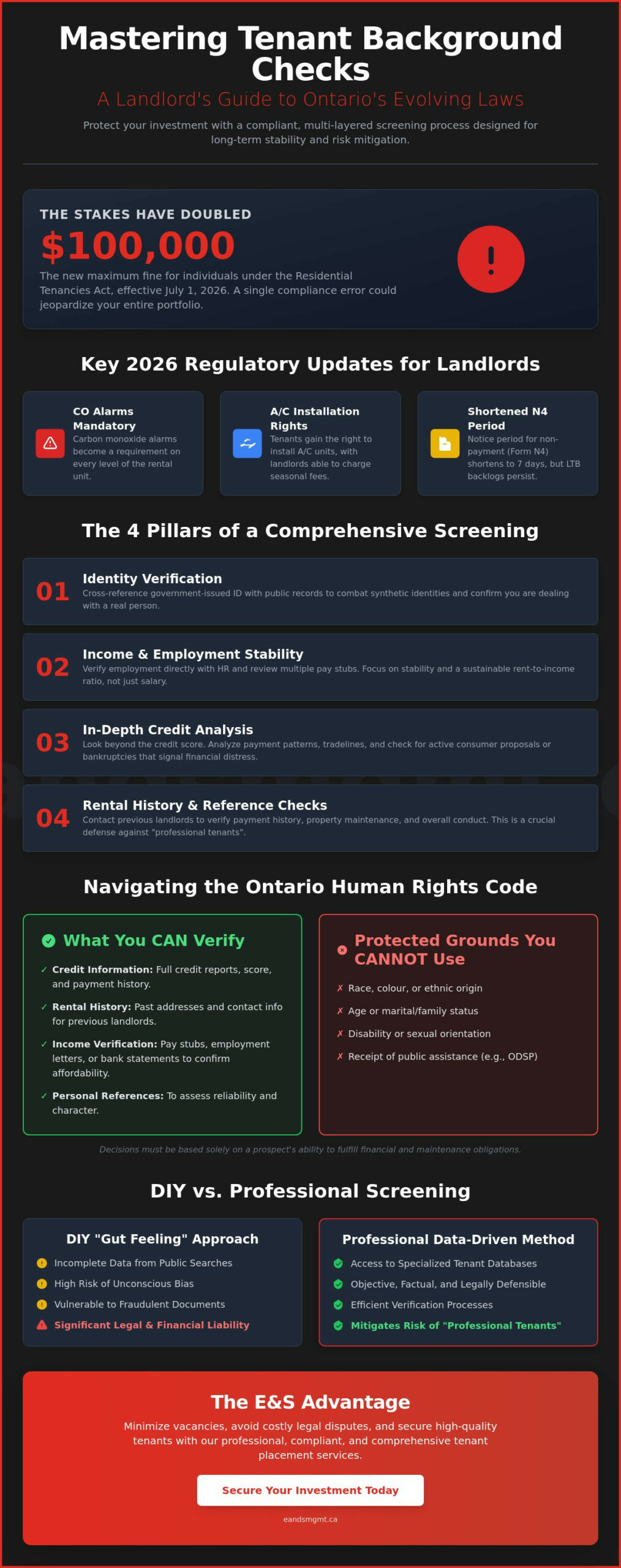
Would you risk a $100,000 fine just to fill a vacancy a few days faster? With the maximum penalties for Residential Tenancies Act offences doubling as of July 1, 2026, the margin for error in property oversight has vanished. You want a reliable resident who respects your investment, yet the fear of “professional tenants” exploiting the Landlord and Tenant Board backlog remains a persistent source of anxiety. Effectively conducting background checks for tenants Ontario is no longer just a recommendation; it’s a critical legal shield for your assets.
We understand that you need a screening process that is both efficient and legally airtight to protect against discrimination claims and fraudulent documentation. This guide provides the strategic resolution you need to master the complexities of provincial laws while securing long-term stability for your rental unit. We will detail the specific questions you can legally ask, analyze the new 2026 requirements for carbon monoxide alarms and air conditioning rights, and provide a methodical framework for verifying income. By the end of this article, you’ll have a clear path to placing high-quality tenants with confidence and precision.
Key Takeaways
- Learn how to navigate the Residential Tenancies Act to ensure every screening step remains fully compliant with 2026 provincial regulations.
- Master a multi-layered approach to background checks for tenants Ontario that evaluates financial stability and social reliability beyond simple credit scores.
- Understand the legal requirement for explicit written consent and how to apply the “Need to Know” principle to protect your property and reputation.
- Identify critical red flags and application inconsistencies that often signal high-risk “professional tenants” or fraudulent documentation.
- Discover how professional tenant placement provides a strategic resolution for property owners seeking to minimize vacancies and operational burdens.
Understanding Tenant Background Checks in Ontario
A background check is a comprehensive, multi-layered verification of a prospective resident’s financial history and social reliability. It serves as a defensive resolution against the high costs associated with rent arrears and property damage. In our current market, performing thorough background checks for tenants Ontario is a fundamental requirement for risk mitigation rather than an optional step. As of 2026, the stakes for property owners have increased significantly. With maximum fines for offences under the Residential Tenancies Act, 2006 doubling to $100,000 for individuals, the cost of a compliance error can be devastating to an investment portfolio.
Professional screening provides a steady hand in a landscape where the Landlord and Tenant Board (LTB) faces significant backlogs. While the notice period for non-payment (Form N4) has been shortened to a minimum of 7 days as of September 21, 2026, the actual eviction process remains time-consuming. A robust screening protocol ensures you select a resident who values the property and possesses the stable income required to meet their obligations. This foresight is especially critical given new 2026 regulations, such as the mandatory carbon monoxide alarms on every level and the tenant’s right to install air conditioning units. You need a tenant who will comply with these safety standards and fulfill seasonal fee requirements for electricity usage.
The Legal Framework: RTA and Human Rights
The Ontario Human Rights Code dictates the boundaries of your inquiry. You cannot make decisions based on protected grounds such as race, age, family status, or the receipt of public assistance. The LTB maintains strict oversight to ensure that screening processes don’t become discriminatory. Tenant screening in Ontario is a strictly regulated process of collecting only the information necessary to evaluate a prospect’s ability to fulfill their financial and maintenance obligations under a lease.
Why DIY Checks Often Fall Short
Many independent owners rely on “creeping” social media profiles or basic Google searches to vet applicants. These methods are inherently flawed and offer a fragmented view of a person’s history. A simple search might miss civil litigation in another province or “professional tenant” histories that only specialized databases track. Relying on a “gut feeling” is a significant liability; it often leads to unconscious bias, which can trigger human rights complaints and costly legal disputes. Professional background checks for tenants Ontario utilize verified data sources to replace intuition with objective facts, ensuring your placement process is both effective and legally defensible.
Essential Components of a Comprehensive Screening
Effective background checks for tenants Ontario require more than a cursory glance at a credit score. You need a multi-layered verification strategy to ensure the data provided is accurate and representative of the applicant’s true reliability. This process starts with identity verification. With the rise of synthetic identities, confirming that the applicant matches their documentation is the first step in asset protection. We utilize a structured approach that cross-references government-issued identification with public records to establish a clear and verified history for every prospect.
Rigorous verification of employment and income is the next pillar of a secure placement. You aren’t just looking for a high salary; you’re looking for stability and longevity. A tenant whose rent-to-income ratio is sustainable is far less likely to face arrears if economic conditions shift. We recommend requesting multiple pay stubs and confirming employment directly with the human resources department of the applicant’s employer to bypass the risk of fraudulent documentation.
Credit Reports and Financial Reliability
A high credit score can be deceptive. It might reflect a history of paying credit cards while hiding a pattern of late rental payments. When analyzing reports, look deeper into tradelines and payment patterns. Check for active consumer proposals or bankruptcies, as these indicate significant financial distress that a single number doesn’t capture. Understanding these nuances is a key part of Navigating Ontario’s Privacy and Disclosure Laws effectively. By focusing on financial reliability rather than personal lifestyle, you remain compliant with federal privacy standards while protecting your investment.
Reference Validation: Beyond the Phone Call
A phone call to a “previous landlord” is only useful if you’ve verified who is on the other end. “Professional tenants” often use friends to provide glowing, yet fraudulent, references. To counter this, verify the property ownership of the reference through public records or land registry searches. Ask specific, open-ended questions about maintenance habits and whether they would re-rent to the individual. This methodical inquiry often reveals inconsistencies that a standard reference check would miss.
Finally, search public records for past litigation or Landlord and Tenant Board disputes. While you cannot discriminate based on the exercise of legal rights, a history of repeated, frivolous litigation can be a significant red flag for future conflict. If the administrative burden of this level of detail feels overwhelming, our Tenant Placement Service provides a steady hand and a tailored resolution to ensure your investment is protected by the most reliable residents available.
Navigating Ontario’s Privacy and Disclosure Laws
Executing background checks for tenants Ontario requires a disciplined approach to data privacy. You must obtain explicit, written consent before initiating any search into a prospect’s history. This isn’t a mere formality; it’s a foundational requirement under the Personal Information Protection and Electronic Documents Act (PIPEDA). Your collection process should follow the “Need to Know” principle, which dictates that you only gather information directly relevant to the tenancy. Once the screening is complete, you are responsible for the secure storage and eventual disposal of this sensitive data. With RTA fines doubling on July 1, 2026, to $100,000 for individuals, a breach of privacy or a mishandled application is a risk your investment cannot afford.
When you choose to decline an applicant, your communication must be professional and objective. A vague or poorly articulated rejection can inadvertently trigger a discrimination claim. Focus your decision on verifiable financial data or a lack of arm’s-length references rather than personal characteristics. Providing a clear, data-driven reason for a rejection helps maintain your reputation as a fair and transparent property owner while minimizing legal exposure. For a broader perspective on your obligations, the Landlord and Tenant Board provides an official guide to Understanding Tenant Background Checks in Ontario.
What You Cannot Legally Ask in Ontario
The Ontario Human Rights Code identifies several prohibited grounds for inquiry. You cannot ask about an applicant’s race, ancestry, place of origin, sexual orientation, or family status. These factors have no bearing on a person’s ability to maintain a rental unit. Additionally, you must be cautious when discussing a “source of income.” Discriminating against an applicant because they receive Ontario Works or ODSP is a violation of the Code. You should also remember that requesting a Social Insurance Number (SIN) is optional. You cannot make the provision of a SIN a mandatory condition of the lease or the screening process.
Consent and Transparency Requirements
Standardizing your application form is a strategic resolution to ensure consistent and legal data collection. Every applicant should receive a clear privacy policy that explains how their information will be used, who will see it, and how long it will be retained. Transparency builds trust and demonstrates your competence as a professional landlord. If a tenant requests to see the results of the background checks for tenants Ontario that you performed, you should be prepared to share the findings. This open communication often resolves misunderstandings before they escalate into formal disputes at the LTB.
Interpreting the Data: Red Flags vs. Context
A data point in isolation rarely tells the full story. When performing background checks for tenants Ontario, you must look for the narrative within the numbers. “Professional tenants” often present polished applications that, upon closer inspection, reveal subtle inconsistencies. A discrepancy between an applicant’s stated previous address and the one listed on their credit report is a significant red flag. These gaps often hide a history of evictions or debt collections that the applicant hopes you won’t discover. A disciplined approach to data analysis ensures that these patterns are identified before a lease is signed.
Context is equally vital when evaluating financial history. A low credit score doesn’t always indicate a lack of reliability; it may simply reflect an individual who is new to Canada and hasn’t yet established a credit footprint. In these cases, we prioritize alternative verifications such as international bank statements or letters of credit from their previous institution. Conversely, unexplained “gap years” in rental or employment history often signal periods of instability or hidden legal disputes. You need a steady hand to distinguish between a tenant facing temporary hurdles and one who represents a systemic risk to your asset longevity.
Spotting Fraudulent Income Documents
Sophisticated document fraud is on the rise. Fake pay stubs and employment letters are easily obtained through online templates. Look for inconsistent fonts, misaligned columns, or tax deductions that don’t match provincial or federal rates. You can verify the existence and status of a potential employer by conducting a search through the Ontario Business Registry. Cross-referencing bank statements with claimed income sources provides an additional layer of security. If the deposits don’t align with the pay dates or amounts on the provided stubs, the risk of fraud is high.
Evaluating LTB History and Public Records
By 2026, databases like Openroom and CanLII have become essential tools for property owners. These platforms allow you to search for past eviction orders or non-payment filings. It’s important to distinguish between a resident who exercised their legal rights in a legitimate dispute and one who is a chronic non-payer. A pattern of multiple LTB filings across different properties suggests a “professional tenant” who exploits the system. Identifying these individuals during the screening phase is the most effective way to prevent future operational burdens. If you want to ensure your property is protected by a rigorous, data-driven process, contact our team for professional property oversight.
The E&S Advantage: Professional Tenant Placement
Software-based screening often fails to capture the nuanced realities of the local market. While automated reports provide a baseline, they lack the critical human oversight required to identify sophisticated fraud or “professional tenant” patterns. Our proprietary multi-layered verification process for Ottawa properties goes beyond simple data pulls. We combine rigorous background checks for tenants Ontario with localized expertise to ensure every placement aligns with your long-term investment goals. This disciplined approach minimizes operational burdens and establishes a foundation for asset longevity from the very first day of the tenancy.
Our Tenant Placement Service integrates seamlessly with the Ontario Standard Lease, ensuring all 2026 regulatory updates are addressed. This includes verifying compliance with the new carbon monoxide alarm requirements and establishing clear agreements regarding air conditioning usage. By managing these details upfront, we reduce vacancy time while maintaining the highest standards of security. Our role as a steady hand in property oversight means we identify potential friction points before they escalate into Landlord and Tenant Board disputes.
Expertise for Foreign Service and Expat Landlords
Managing an Ottawa rental while posted abroad presents unique logistical challenges. We provide a tailored placement resolution for Foreign Service members and expats by handling the entire screening process across different time zones. Reliability is paramount when you aren’t physically present to inspect your property or meet applicants. Beyond placement, we ensure your investment remains compliant with the Canada Revenue Agency. Our team handles NR6 and NR4 tax filing support, removing the administrative complexity of non-resident landlord status. You gain peace of mind knowing your home is managed by a professional steward who understands both local laws and your specific needs as an international stakeholder.
Securing Your Ottawa Investment
Local knowledge is indispensable when verifying the legitimacy of employers and the suitability of specific neighbourhoods. We understand the Ottawa economic landscape, from the stability of the public service sector to the growth of the local tech industry. This specialized regional knowledge allows us to verify income and employment with a level of precision that national screening platforms cannot match. We are committed to protecting your capital through diligent selection and proactive oversight. Protect your property with E&S Tenant Placement Services and secure a reliable, long-term tenant for your Ottawa investment.
Protecting Your Investment Through Strategic Oversight
Managing an investment property in 2026 requires a meticulous eye for detail and a commitment to compliance. As provincial laws evolve, the precision of your screening process becomes the ultimate safeguard for your capital. Prioritizing comprehensive identity verification and spotting sophisticated document fraud eliminates the operational burdens caused by high-risk placements. Executing thorough background checks for tenants Ontario is a strategic resolution that establishes order and foresight for your portfolio. This proactive approach ensures that your assets are occupied by residents who value stability as much as you do.
With over 40 years of Ottawa property management experience, we provide the steady hand needed to navigate these complexities. Our team offers specialized NR6 and NR4 tax support for non-resident landlords and maintains a licensed and insured network of local contractors to protect your asset longevity. You don’t have to manage the stress of vacancies or legal disputes alone. Secure your rental income with professional tenant screening from E&S Property Management. Taking the right steps today ensures a predictable and profitable future for your investment.
Frequently Asked Questions
Can I legally ask a tenant for their SIN in Ontario?
You can legally ask for a Social Insurance Number, but providing it is strictly optional for the tenant. You cannot refuse an applicant solely because they choose not to disclose their SIN. Most credit bureaus can perform background checks for tenants Ontario using other identifiers such as full name, date of birth, and current address to verify financial history.
How long does a typical tenant background check take in 2026?
A standard check typically takes between 24 and 72 hours to complete. While digital credit reports are often available instantaneously, manual verifications of employment and previous landlords may extend the timeline to five business days. We recommend initiating the process as soon as a qualified application is received to minimize vacancy periods and secure a commitment.
Can I refuse a tenant based on a criminal record in Ontario?
Refusing a tenant based on a criminal record is a complex legal area that requires extreme caution. The Ontario Human Rights Code protects individuals from discrimination based on a “record of offences” in specific contexts. Unless a conviction poses a direct, demonstrable risk to the safety of other residents or the property, a blanket refusal may trigger a human rights claim.
What is the minimum credit score required for a tenant in Ontario?
Ontario law doesn’t mandate a minimum credit score for rental applicants. Many landlords look for a score above 650 as a benchmark for financial reliability, but this should be evaluated alongside income stability and rental history. A lower score might be acceptable if the applicant provides a guarantor or has a valid explanation, such as being a recent arrival to Canada.
Is it legal to ask for a “pet deposit” during the screening process?
Asking for a “pet deposit” is illegal in Ontario under the Residential Tenancies Act. Landlords are only permitted to collect a rent deposit, usually the last month’s rent, and a refundable key deposit. Any additional fees or deposits for pets are void and unenforceable, even if the tenant signs an agreement consenting to the charge.
How do I verify a tenant’s income if they are self-employed?
To verify income for self-employed applicants, you should request their two most recent Notices of Assessment (NOA) from the CRA. Bank statements from the last six months also provide a clear view of cash flow and financial consistency. This methodical verification ensures the applicant meets the necessary rent-to-income ratios without the need for traditional pay stubs.
Can I contact a tenant’s current employer without their permission?
You cannot contact a tenant’s current employer without their explicit written consent. Privacy laws require that you obtain permission before reaching out to any third party for background checks for tenants Ontario. Including a clear consent clause in your standard application form is the most efficient way to ensure legal compliance and protect applicant privacy.
What happens if a tenant provides a fake reference?
If an applicant provides a fraudulent reference, you should immediately decline the application. Misrepresentation is a significant red flag that indicates a lack of reliability and a high potential for future conflict. Professional screening protocols involve verifying the identity and property ownership of the reference to ensure the feedback provided is authentic and truly arm’s-length.


