
What if the contract meant to protect your investment is actually the very thing leaving you vulnerable to Ontario’s complex legal landscape? It’s a question that keeps many property owners awake at night, especially as regulations like the Trust in Real Estate Services Act (TRESA) continue to redefine industry standards. You’ve worked hard to build your portfolio, and it’s natural to feel a sense of unease when handing over the keys to someone else. Finding a partner you can trust starts with a comprehensive property management agreement checklist Ontario landlords can rely on to ensure every detail is covered from the start.
We understand that the transition from managing everything yourself to delegating those burdens is about more than just paperwork; it’s about reclaiming your time and your peace of mind. You likely agree that the best partnerships are built on total transparency, yet the fear of hidden fees or legal liability in a pro-tenant environment remains a heavy weight for many. This guide will show you exactly how to navigate these contracts to shield yourself from common pitfalls. We’ll walk through essential clauses for CRA non-resident tax compliance and ensure your management team is prepared for the 2.1% rent increase guideline for 2026, leaving you with a professional roadmap for your investment’s long-term success.
Key Takeaways
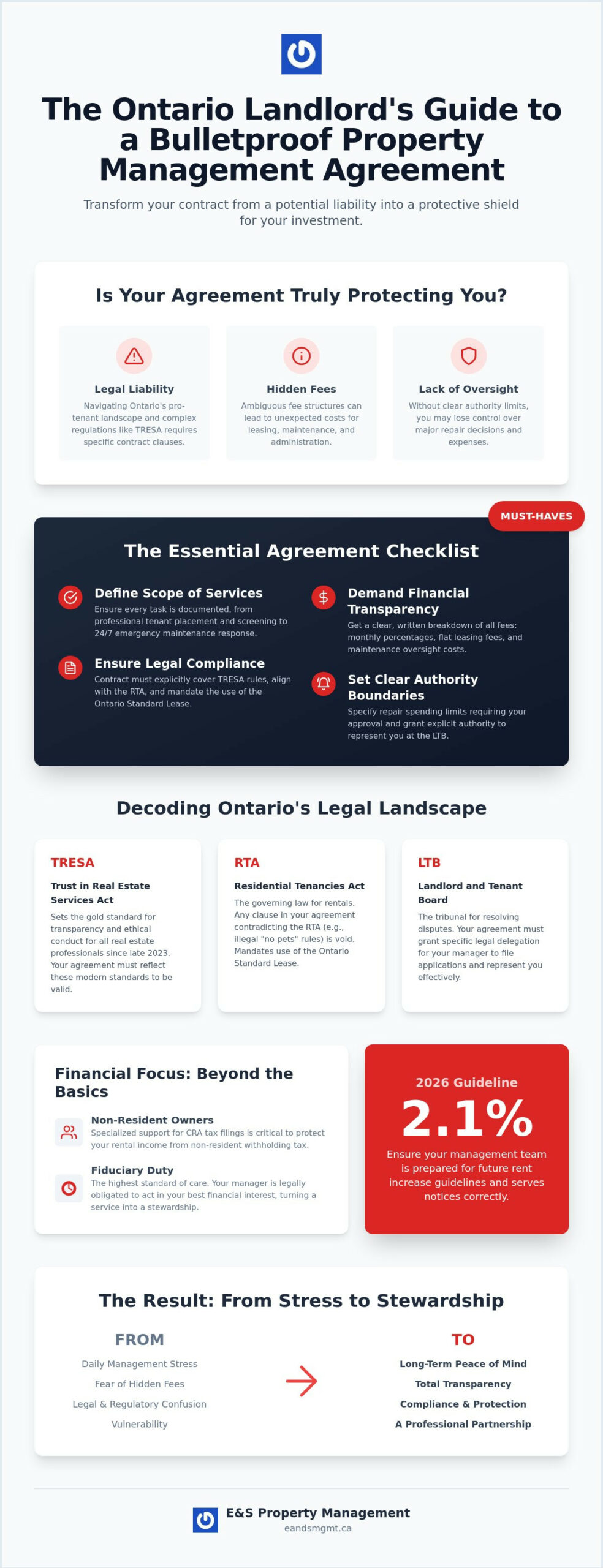
- Define the precise scope of work to ensure comprehensive oversight, from professional tenant placement to emergency maintenance response.
- Utilize a professional property management agreement checklist Ontario to confirm that every fee and administrative duty is transparently documented for your peace of mind.
- Protect yourself against legal liabilities by ensuring your management contract explicitly covers TRESA compliance and Landlord and Tenant Board representation.
- Simplify your financial obligations with specialized support for CRA tax filings, a critical step for non-resident owners seeking to protect their rental income.
- Identify the specific clauses that transform a standard contract into a protective partnership, moving you from daily stress to long-term relief.
What is a Property Management Agreement in Ontario?
At its core, a property management agreement is a legally binding contract that defines the working relationship between you, the property owner, and a professional management firm. It’s the document that grants a manager the authority to act on your behalf, handling everything from tenant screening to emergency repairs. Without this clear framework, the lines of responsibility can blur; this often leads to the very stress you’re trying to avoid. By establishing a property management agreement checklist Ontario landlords can use to vet their contracts, you ensure that no detail is left to chance. A well-crafted agreement serves as a protective shield, ensuring that your asset is managed with the same care you’d provide yourself. For those new to the industry, a Property management overview can help clarify the broad range of roles these professionals fill, but in Ontario, the specific legalities of the contract are what truly matter.
The Legal Foundation: TRESA and the RTA
Ontario’s rental market is governed by strict rules that don’t leave much room for error. Since late 2023, the Trust in Real Estate Services Act (TRESA) has set the gold standard for how real estate professionals must conduct themselves, emphasizing transparency and ethical behavior. Your agreement must reflect these modern standards to be valid. Additionally, every contract must align with the Residential Tenancies Act (RTA). If a manager includes clauses that contradict the RTA, such as illegal “no pets” rules or improper entry terms, those sections are void and can lead to costly disputes at the Landlord and Tenant Board. A vital part of your property management agreement checklist Ontario is verifying that the manager uses the mandatory Ontario Standard Lease for all tenancies, as failing to do so gives tenants the right to withhold rent.
Fiduciary Duty: Your Manager as Your Steward
When you sign an agreement, you aren’t just hiring a contractor; you’re appointing a steward for your wealth. This creates a fiduciary relationship, which is the highest standard of care recognized by law. It means your manager is legally obligated to act in your best interest, not their own. This protective layer is what allows you to step back and breathe, knowing that decisions regarding maintenance or tenant selection are made with your bottom line in mind. In Ontario property management, fiduciary duty is the legal and ethical obligation of a manager to prioritize your financial and legal interests above their own while caring for your property. By codifying this in your agreement, you transform a simple transaction into a partnership of mutual trust and professional accountability.
The Essential Property Management Agreement Checklist for Ontario
Reviewing a contract can feel overwhelming, but think of it as creating a roadmap for your future peace of mind. A well-structured agreement transforms a complex list of tasks into a predictable, manageable system. When you use a comprehensive property management agreement checklist Ontario, you’re looking for more than just a list of chores; you’re looking for clarity. Every service, from professional tenant placement to 24/7 emergency maintenance response, should be explicitly named. This prevents the “scope creep” that often leads to unexpected costs. Transparency in the fee structure is equally vital. You should see a clear breakdown of monthly management percentages, flat fees for leasing, and any costs associated with maintenance oversight. If a fee isn’t in writing, it shouldn’t be in your bank statement.
Defining the Scope of Authority
Trust is the foundation of this partnership, and setting clear boundaries helps that trust grow. Your agreement should specify a spending limit for repairs, allowing your manager to handle minor issues immediately while requiring your approval for larger capital expenditures. This balance ensures your property stays in top shape without you being bothered by every small faucet leak. Crucially, the contract must authorize the manager to act on your behalf at the Landlord and Tenant Board (LTB). Without this specific legal delegation, your manager may be unable to file necessary applications or represent your interests during a dispute. Regular property inspections should also be a non-negotiable part of this authority, providing you with documented proof that your investment is being respected.
Termination Clauses: How to Exit Gracefully
A professional relationship should last because it’s working, not because you’re trapped by a contract. Most reputable agreements in Ontario include a notice period of 30 to 90 days. This window provides enough time to transition tenant deposits, keys, and historical records without disrupting the tenant’s experience. Be wary of “just cause” clauses that make it nearly impossible to leave unless the manager commits a major error. You deserve the flexibility to move on if your goals change. Look closely for hidden termination fees that might penalize you for ending the partnership early. If you’re feeling uncertain about your current contract’s flexibility, reaching out for a second opinion on professional property management can help clarify what a fair exit strategy looks like.
Finally, ensure the agreement addresses liability and insurance with precision. In Ontario’s rental market, both the owner and the manager should carry specific coverage. The contract should include an indemnification clause that protects you from losses caused by the manager’s negligence, while also protecting the manager as they perform their duties in good faith. This mutual protection is the hallmark of a seasoned, professional partnership that prioritizes the long-term health of your rental property.
Ontario-Specific Legalities: TRESA, Liability, and the LTB
Ontario’s regulatory landscape has undergone a significant transformation that every landlord must recognize to stay protected. The shift from the old Real Estate and Business Brokers Act (REBBA) to the current Trust in Real Estate Services Act (TRESA) represents a commitment to higher ethical standards and greater transparency. In 2026, this means your manager is held to a stricter code of conduct, with the Real Estate Council of Ontario (RECO) authorized to impose fines of up to $50,000 for individual misconduct. When reviewing your property management agreement checklist Ontario, you must verify that your manager is fully compliant with these updated rules. This isn’t just about red tape; it’s about ensuring your representative acts with the highest level of integrity while managing your most valuable assets.
Navigating the Landlord and Tenant Board (LTB)
The LTB is the primary authority for resolving rental disputes, and your agreement should clearly define how your manager interacts with this body. Your manager should be empowered to issue critical notices, such as the N1 for rent increases or the N4 for non-payment, without a delay that could jeopardize your cash flow. In 2026, legal representative rules still allow property managers to attend hearings on your behalf, but your contract must explicitly grant this authority. Equally important is defining who bears the cost of legal or paralegal fees. A professional agreement will specify if these costs are included in your monthly fee or if they are billed as a separate disbursement, preventing any confusion when a hearing becomes necessary.
Insurance and Liability in the Ontario Market
Protecting your investment requires a dual layer of insurance coverage that leaves no room for ambiguity. First, your manager should be listed as an “Additional Insured” on your landlord insurance policy. This common industry practice ensures that both you and your management team are defended if a tenant or visitor is injured on the property. Simultaneously, you must confirm that the management firm carries its own Professional Liability insurance, also known as Errors and Omissions. This protects you if the manager makes a professional mistake, such as failing to perform a required inspection or miscalculating a rent increase under the 2.1% guideline for 2026.
For owners in the Ottawa area, liability often extends to local environmental challenges. Your property management agreement checklist Ontario should account for local bylaws regarding winter maintenance and snow removal. In Ottawa, failing to clear ice or snow within specific timeframes can result in heavy fines or personal injury claims. A seasoned manager will ensure these duties are contractually assigned to reliable contractors, shielding you from the physical and financial risks inherent in Ontario’s climate. This meticulous attention to local detail is what transforms a standard contract into a true safety net for your peace of mind.
Financial Transparency: Fees, Taxes, and Non-Resident Compliance
Financial clarity is the heartbeat of a successful rental partnership. When you look at a property management agreement checklist Ontario landlords often use, the breakdown of costs is usually the first place their eyes land. You’ll generally find two primary fee structures: percentage-based models, which align the manager’s success with your rental income, and flat-fee models, which provide a predictable monthly cost regardless of rent fluctuations. Beyond the base fee, your agreement should clearly define the “float” or reserve fund. This is a set amount of money, often held in a trust account, that allows your manager to address urgent repairs without waiting for a bank transfer. It’s a stabilizing force that ensures your property remains habitable and your tenants remain satisfied.
The Expat Landlord: Managing CRA Requirements
For those serving abroad or living outside Canada, the financial stakes are even higher. The Canada Revenue Agency (CRA) requires a 25% withholding tax on gross rental income for non-resident landlords. However, a seasoned manager acts as your Canadian agent, helping you file NR6 forms to reduce that withholding to a percentage of your net income instead. This significantly improves your monthly cash flow while you’re away. Each year, your manager should provide an NR4 slip, which is vital for your Canadian tax return. If you’re a Foreign Service officer or an expat, you can view our specialized Non-Resident Tax Administration Fees to see how we simplify this complex process for you.
Maintenance Coordination and Repair Oversight
When refining your property management agreement checklist Ontario, maintenance coordination is another area where transparency is paramount. Some firms apply a markup to contractor invoices, while others charge a flat coordination fee for overseeing repairs. Your agreement must specify which model is used and confirm that only licensed, third-party contractors are employed for work in the Ottawa area. A transparent repair oversight fee protects your asset’s value by ensuring maintenance is managed professionally rather than just being a source of hidden profit for the management firm. This approach ensures that every dollar spent on repairs is an investment in the longevity of your property.
Regular financial reporting, ideally provided on a monthly basis, should offer a line-by-line accounting of every dollar that enters or leaves your account. These statements aren’t just for tax season; they’re your window into the health of your investment. If you’re ready to experience the relief of total fiscal transparency, we invite you to learn more about our financial reporting and accounting services. Having a partner who handles the math means you can focus on the bigger picture of your financial future.
Beyond the Paperwork: The E&S Approach to Stewardship
A contract is only as strong as the hands that hold it. While a property management agreement checklist Ontario provides the necessary legal structure, true stewardship requires a partner who understands the emotional weight of your investment. Since 1981, we’ve navigated four decades of shifting rental laws and market cycles in the Ottawa area. This longevity isn’t just a number; it’s a deep well of wisdom that we use to shield our clients from the pitfalls that often catch less experienced firms off guard. We don’t just manage buildings. We protect the financial futures of the families who own them, ensuring every decision is made with a long-term perspective.
The E&S Difference: Experience and Empathy
For many of our clients, particularly those in the Foreign Service, their Ottawa home is their most significant asset and their eventual landing spot when they return to Canada. We act as a protective guardian for your property while you’re stationed thousands of miles away. Our methodical approach to regular property inspections and emergency 24/7 maintenance response ensures that your home is cared for with meticulous attention. This level of involvement allows you to move from the constant anxiety of “what if” to the calm relief of knowing a seasoned hand is overseeing every detail. We speak with the authority of experts but the heart of a neighbor, understanding that your property is more than just a line on a balance sheet.
Ready to Delegate? Your Next Steps
Transitioning your property to professional management should feel like a weight being lifted, not a new burden. If you’re ready to move beyond the paperwork and find a dedicated steward for your interests, the process is straightforward and steady. We begin with a quiet, professional conversation about your specific goals and the unique needs of your rental. We’re happy to provide a sample agreement that reflects a modern property management agreement checklist Ontario, tailored to the specific legalities of our local market and your personal situation.
Taking the first step is often the most difficult part of the journey toward peace of mind. We invite you to reach out and discover how our end-to-end support can simplify your life as a landlord. Contact E&S Property Management for a reassuring consultation and let us help you turn your real estate investment into a source of stability rather than stress. We’re here to walk you through every scenario with the patience and proficiency you deserve, acting as a reliable partner in your success.
Securing Your Rental’s Future with Confidence
Your property is a cornerstone of your financial security, and protecting it requires more than just luck. By following a comprehensive property management agreement checklist Ontario, you’ve taken the first step toward ensuring your investment remains a source of growth rather than a cause for concern. You now understand how modern regulations like TRESA and the intricacies of non-resident tax compliance form the foundation of a safe, professional partnership. These legal frameworks are meant to provide clarity, not confusion, when managed by a seasoned hand.
At E&S Property Management, we’ve spent over 40 years perfecting the art of stewardship in the Ottawa market. We’ve seen every regulation change and handled every maintenance emergency, allowing us to act as a stabilizing force for our clients. Whether you’re a local owner or a Foreign Service member requiring specialized NR6 and NR4 tax support, our 24/7 emergency maintenance response network is always standing guard. It’s time to trade the daily burdens of management for the peace of mind that comes with expert oversight.
Secure your investment with Ottawa’s trusted property stewards—Contact E&S today. We look forward to helping you navigate your next chapter with clarity and ease.
Frequently Asked Questions
Is a property management agreement legally required in Ontario?
While you aren’t legally forced to have a written contract to manage your own property, hiring a professional firm requires a formal agreement to comply with the Trust in Real Estate Services Act (TRESA). This document establishes the legal authority for the manager to act as your representative. It’s a vital part of any property management agreement checklist Ontario because it protects your rights and defines the manager’s fiduciary duties.
What is a typical property management fee in Ottawa?
Industry averages in Ontario typically range from 6% to 12% of the monthly rent collected, though some firms offer flat-fee models between $130 and $280 per month. You should also expect separate fees for tenant placement, which often cost between 50% and 100% of one month’s rent. These costs vary based on the level of service provided and the specific needs of your property.
Can I terminate my property management agreement if I am unhappy?
Yes, you can terminate your agreement, provided you follow the notice period specified in your contract. Most professional agreements in Ontario require between 30 and 90 days of written notice to ensure a smooth transition for the tenant. It’s important to review your exit clauses early to avoid unexpected penalties or hidden fees that might complicate your move to a new provider.
Does my property manager need to be a licensed realtor in Ontario?
Yes, anyone providing property management services for a fee in Ontario must be licensed under the Trust in Real Estate Services Act (TRESA). This means they must be registered with the Real Estate Council of Ontario (RECO) and work through a licensed brokerage. This requirement ensures that your manager is held to high ethical standards and carries the necessary professional liability insurance to protect your interests.
How do property managers handle non-resident tax for expat landlords?
A professional manager acts as your Canadian agent by withholding the required 25% tax on gross rental income and remitting it to the Canada Revenue Agency (CRA). They can also help you file an NR6 form to withhold tax on your net income instead, which keeps more cash in your pocket each month. At the end of the year, they’ll provide you with an NR4 slip for your tax records.
Who is responsible for repairs: the landlord or the property manager?
The landlord is ultimately responsible for the cost of maintaining the property in a good state of repair, as mandated by the Residential Tenancies Act. The property manager’s role is to coordinate these repairs, vet contractors, and ensure the work is completed to a high standard. Your agreement should specify a spending limit that allows the manager to handle minor repairs quickly while requiring your approval for larger expenses.
What happens to the tenant’s security deposit in Ontario?
In Ontario, the only legal deposit a landlord can collect is a rent deposit for the last month’s rent. Damage deposits or general security deposits are illegal under the Residential Tenancies Act. Your manager will hold this rent deposit in a trust account and must apply it to the final month of the tenancy, ensuring interest is paid to the tenant annually as required by law.
Can a property manager sign a lease on my behalf in Ontario?
Yes, a property manager can sign the Ontario Standard Lease on your behalf if your management agreement explicitly grants them this authority. This is a common practice that allows owners to remain hands-off while the manager handles tenant placement and onboarding. It’s a key item to verify on your property management agreement checklist Ontario to ensure your manager has the legal standing to represent you fully.


