
What if your decision to move on from a property manager wasn’t an act of conflict, but a strategic recovery of your most valuable asset? Many Ottawa landlords feel trapped by poor communication and hidden maintenance fees, staying in stagnant partnerships because they aren’t sure how to terminate a property management contract without facing steep penalties. It’s a heavy burden to carry, especially when you’re worried about missing NR6 tax documents or leaving your tenants in limbo. You deserve to feel like a protected owner, not a frustrated bystander in your own investment journey.
This guide provides the exact steps to achieve a clean break while ensuring your rental income remains steady and your legal obligations are fully met. We’ll walk you through notice periods and the administrative handoff with the meticulous care your property deserves, moving you from a state of stress to one of lasting relief. By the end, you’ll have a clear roadmap for recovering every essential document, from financial records to legal filings, and transitioning to a partner who acts as a dedicated steward for your interests.
Key Takeaways
- Recognize the subtle red flags, from chronic communication gaps to delayed financial reporting, that indicate your investment needs a more attentive hand.
- Navigate the complexities of your current agreement by distinguishing between “for cause” and “without cause” clauses to minimize potential fees.
- Master the professional steps for how to terminate a property management contract, ensuring a clean break that keeps your rental income flowing and your tenants informed.
- Use our comprehensive handover checklist to recover critical assets, including original Ontario Standard Leases and vital NR6 or NR4 tax documentation.
- Learn how delegating the transition to a seasoned expert can replace administrative anxiety with the peace of mind that comes from professional oversight.
Recognizing the Signs: When to End a Property Management Relationship
Trust is the foundation of any successful investment. When that trust begins to fray, it often manifests as a series of subtle, professional service failures rather than a single, dramatic incident. You might find yourself checking your bank account repeatedly for a rent disbursement that’s five days late, or perhaps your emails regarding a simple repair go unanswered for a week. These aren’t just minor inconveniences; they’re clear indicators that your current partner is no longer providing the level of care your asset requires. Understanding how to terminate a property management contract starts with identifying these chronic gaps before they cause permanent damage to your reputation or your bottom line.
The scope of professional property management involves much more than just collecting checks. It requires a meticulous eye for maintenance and a deep commitment to legal compliance. If you notice property degradation during your own occasional drive-bys, or if tenants reach out to you directly with unresolved complaints, the system has broken down. Even more critical is a failure to remain compliant with Ontario’s Residential Tenancies Act (RTA). A manager who ignores safety standards or mishandles legal notices isn’t just being lazy; they’re exposing you to significant legal liabilities that can be difficult to untangle later.
The Cost of Inaction
Staying with an ineffective manager has a measurable price. Poor communication and slow maintenance response times lead directly to higher tenant turnover and prolonged vacancy losses. Beyond the immediate loss of income, there’s the matter of fiduciary duty. In the context of Ottawa property management, fiduciary duty is the legal and ethical obligation of a manager to act solely in the best interest of the property owner, prioritizing the owner’s financial and legal well-being above their own. When this duty is neglected, the risk of litigation increases, and the long-term value of your property begins to slip away.
Professional Red Flags for Expat Landlords
For Ottawa’s Foreign Service members and expat landlords, the stakes are even higher. Managing a manager from across the globe is emotionally taxing, especially when transparency is lacking. You might face mismanaged NR6 tax withholdings, which can lead to complications with the Canada Revenue Agency. Another red flag is a lack of clarity in maintenance quotes from third-party contractors. You should never feel like you’re being overcharged simply because you aren’t there to inspect the work yourself. If the stress of wondering what’s happening at home outweighs the benefits of owning the property, it’s time to learn how to terminate a property management contract and find a partner who acts as a true guardian of your interests.
Reviewing the Fine Print: Notice Periods and Termination Fees
Reviewing your original agreement can feel like a daunting task, especially when you’re already feeling the weight of a strained partnership. However, understanding the specific language within your contract is the first step toward regaining control of your investment. When considering how to terminate a property management contract, you must first distinguish between termination for cause and termination without cause. If your manager has failed to perform specific duties outlined in the agreement, you may have grounds for a cause-based exit. In most other cases, you’ll be exercising a without cause clause, which typically requires a notice period but involves less legal friction. It’s a strategic move that allows for a smoother, more amicable transition, replacing administrative fog with the relief of a clear path forward.
Notice Period Requirements
In the Ottawa market, a standard notice period typically ranges from 30 to 60 days. It’s vital to remember that while the Ontario Residential Tenancies Act (RTA) provides strict protections for tenants, it does not dictate the terms of your commercial agreement with a property manager. This means your exit strategy is entirely governed by the document you signed. You’ll need to provide written notice, often calculated from the first of the following month, to establish an effective date. Be sure to check if your contract distinguishes between a management term and a leasing term. Sometimes, a manager might claim a right to fees for a tenant they placed, even after you’ve moved on. Consulting a 6-step guide to canceling your contract can provide additional clarity on the sequence of these administrative steps.
Hidden Costs of Breaking a Contract
Breaking a contract often involves more than just a simple goodbye. You might encounter administrative fees for file transfers or document preparation; these are often flat fees designed to cover the labor of handing over keys and records. Additionally, you’ll need to ensure all outstanding maintenance invoices are settled. A clean break requires a final accounting of your reserve fund. This is the money held back for repairs that should be returned to you in full upon the contract’s end. If the process feels overwhelming, reaching out for professional property management support can help you navigate these transitions with confidence. Watch out for automatic renewal clauses. These traps can lock you into another year of service if you don’t provide notice within a very specific window. Mark these dates on your calendar well in advance to ensure you aren’t caught off guard. Taking these steps ensures that your asset remains protected throughout the changeover.
The 4-Step Process to Terminate Your Management Contract
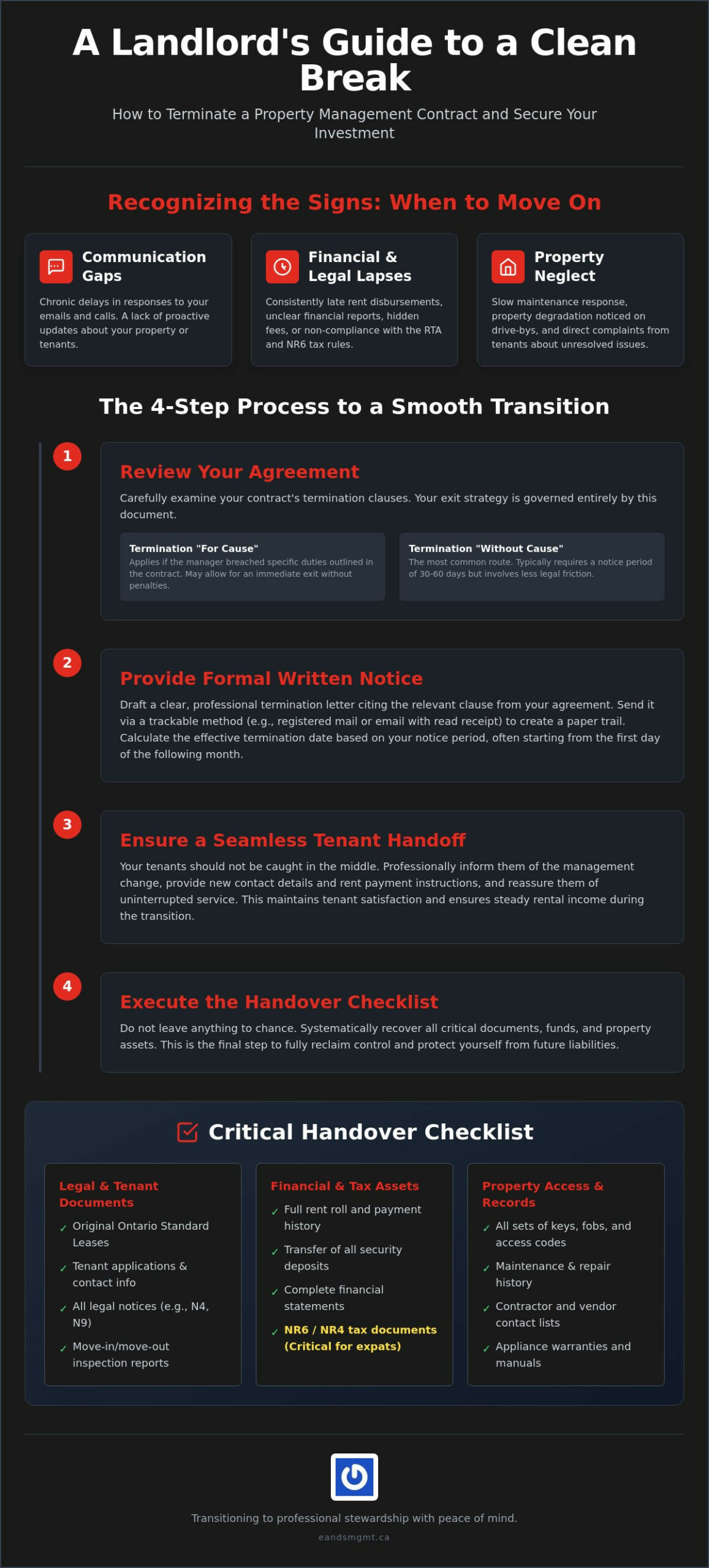
Once you’ve assessed your agreement, the transition from uncertainty to order begins with a structured plan. Learning how to terminate a property management contract is less about a confrontation and more about orchestrating a professional administrative handoff. By following a methodical approach, you protect your relationship with your tenants and ensure no detail, however small, falls through the cracks. This process is designed to move you from the stress of a failing partnership to the relief of professional oversight with minimal friction.
Step 1: The Formal Notice
Your formal notice should be a concise, professional document. It isn’t the place for airing grievances; it’s a business directive. Ensure you include the specific effective date of termination, a request for a final accounting statement, and a comprehensive list of documents to be returned. We strongly recommend sending this notice via registered mail. This creates a verifiable paper trail that protects you if the manager later claims they didn’t receive it. Maintaining a neutral, supportive tone during this period encourages the outgoing manager to remain cooperative, which is essential for a smooth document transfer.
Step 2: Tenant Communication
Your tenants are the heart of your investment. A management change can be unsettling for them, so clarity is your best tool. Introduce the new management team with a warm, professional letter that emphasizes continued service and stability. You must clearly state where future rent payments should be directed to avoid any arrears or confusion. Since the Ontario Standard Lease remains in effect regardless of who manages the property, reassure your tenants that their existing terms and rights are fully protected. This stability prevents unnecessary turnover and keeps your rental income steady.
Step 3: Final Accounting and Fund Transfer
Schedule a final accounting audit to reconcile all rent collected and expenses paid during the final month. In Ontario, this step is particularly important for the transfer of the Last Month’s Rent (LMR) deposit. You’ll need to ensure the outgoing manager transfers the full LMR amount, along with any interest accrued that is owed to the tenant. A clean financial break requires a line-by-line review of the final statement to ensure all reserve funds are returned to your account.
Step 4: Physical Handover of Assets
The final step is the physical recovery of your property’s access points. Coordinate a specific time for the handover of all keys, including unit keys, mailbox keys, and common area fobs. Don’t forget to request any electronic access codes for smart locks or garage entries. This physical transfer marks the official moment your property returns to trusted hands, allowing you to breathe a sigh of relief as the transition concludes.
The Handover Checklist: Documents and Tax Compliance
Recovering your property is a process of meticulous administrative detail. The actual termination notice is just the beginning; the true security of your asset lies in the documentation you recover during the final weeks of the agreement. When you’re learning how to terminate a property management contract, your goal is to ensure your new partner has everything they need to protect your interests from day one. This means gathering every original signed Ontario Standard Lease and any subsequent amendments that have modified the tenancy over time. Without these foundational documents, your legal standing with your tenants is weakened, leaving you vulnerable to misunderstandings or disputes that could have been easily avoided.
Financial and Legal Records
The tenant ledger is the heartbeat of your property’s financial health. It provides a full history of rent payments, showing exactly where a tenant stands and if any arrears exist. This document is the most critical piece of information for your new manager because it allows them to maintain rent continuity without a single day of confusion. For those living abroad, tax compliance is a non-negotiable priority that requires special attention. The NR4 slip is a mandatory document for expat landlords because it reports the gross rental income and the non-resident tax withheld throughout the year, ensuring you remain in good standing with the Canada Revenue Agency. Securing move-in inspection reports and high-resolution photos is also essential, as these provide the necessary justification for any future maintenance deductions or security deposit reconciliations.
Maintenance and Warranty History
Continuity in maintenance prevents minor issues from becoming expensive disasters. You need a list of active contractors and any ongoing service warranties that are still in effect for appliances or structural repairs. This is particularly important for “Life Safety” items like smoke and carbon monoxide alarm inspections, which must be documented to satisfy Ontario safety standards. Confirming that utility accounts are either settled or properly transitioned ensures you aren’t left with unexpected bills after the management change. For Foreign Service members or landlords stationed overseas, the physical handover of keys and fobs can be the most stressful part of the process. Since you can’t be there in person, your new manager acts as your eyes and ears, coordinating the recovery of access codes and physical keys on your behalf. If you’re feeling overwhelmed by these requirements, our team specializes in NR6 and NR4 tax filing support and comprehensive transition management to give you the peace of mind you deserve.
Transitioning to Professional Stewardship with E&S Property Management
Deciding to move on is the first step toward reclaiming your peace of mind. While the logistics of how to terminate a property management contract can seem overwhelming, you don’t have to navigate the transition alone. E&S Property Management acts as a stabilizing force for Ottawa landlords, providing the seasoned expertise needed to turn a stressful administrative cycle into a seamless handoff. We understand the specific anxieties that come with changing partners, especially when you’re managing from a distance or serving in the Foreign Service. Our goal is to replace your current burdens with the quiet confidence that comes from professional oversight.
Once you’ve made the decision to switch, the “relief of delegation” begins. We take over the heavy lifting of asset recovery, ensuring that every tenant ledger, Ontario Standard Lease, and maintenance record is accounted for. This meticulous audit of your property files is designed to provide immediate clarity, identifying any gaps in compliance or financial reporting that may have developed under previous management. By positioning ourselves as your dedicated steward, we shield you from the friction of the exit process and allow you to focus on your other priorities.
Our Seamless Onboarding Process
We take the lead in the administrative transition to ensure nothing is lost in the shuffle. This means we handle the direct communication with your outgoing manager to collect keys, fobs, and legal documents so you don’t have to manage the awkward conversations. Once the records are in our hands, we perform an initial “Property Health Check” to identify and fix any deferred maintenance or safety issues. We then introduce your tenants to our digital portal and responsive maintenance network, ensuring they feel supported and informed from day one. This proactive approach minimizes disruptions and protects your rental income during the switch.
Why 40 Years of Experience Matters
Experience isn’t just a number; it’s the wisdom gained from four decades in the Ottawa rental market. We’ve navigated every regulatory shift and managed through every economic cycle, allowing us to act as a protective guardian for your investment. Whether it’s providing precise financial reporting and accounting or navigating the complexities of NR6 and NR4 tax filings for expat owners, we provide the thoroughness your asset deserves. We treat every property as if it were our own, striking a balance between high-level authority and a supportive, neighborly approach. If you’re ready for a partner who prioritizes your relief, we’re here to help. Schedule a confidential consultation to discuss your transition and discover the difference that 40 years of dedicated stewardship can make for your Ottawa property.
Restoring Order and Stability to Your Investment
Transitioning away from a manager who no longer serves your interests is a vital step in protecting your property’s long-term value. By identifying service gaps early and executing a methodical 4-step transition plan, you ensure that your tenants remain secure and your rental income continues without interruption. Remember that the administrative precision of recovering your Ontario Standard Lease and essential tax records is what sets the stage for a successful future. Knowing how to terminate a property management contract gives you the power to choose a partner who acts as a true guardian for your asset.
You don’t have to carry the burden of this transition alone. Since 1981, we’ve provided over four decades of Ottawa expertise, acting as a stabilizing force for busy landlords and Foreign Service members alike. Our team specializes in the complexities of NR6 and NR4 tax compliance and maintains a trusted network of vetted, licensed Ottawa contractors to keep your property in peak condition. Let E&S Property Management handle your transition with professional care, replacing your current stress with the relief of seasoned oversight. Your investment is a significant part of your legacy, and we’re here to help you protect it with the meticulous care it deserves.
Frequently Asked Questions
Can I terminate my property management contract if there is no “cause”?
Yes, you can typically terminate your agreement without proving a specific failure as long as you follow the notice period outlined in your contract. Most professional agreements include a “termination without cause” clause that allows either party to end the partnership with 30 to 60 days of written notice. This is often the most efficient way to move forward when a relationship has simply run its course, allowing for a cleaner administrative break without the friction of a legal dispute.
What happens to the tenant’s security deposit or last month’s rent when I switch managers?
The outgoing manager is required to transfer the full last month’s rent (LMR) deposit, including any interest that has accrued, to your new management partner. Since security deposits for physical damages are not permitted under the Ontario Residential Tenancies Act, the LMR is the primary financial asset that must be moved. Your new manager will then place these funds into a designated trust account, ensuring your tenant’s rights are protected throughout the transition.
How much notice do I legally have to give my property manager in Ontario?
The notice period is governed by your specific commercial agreement rather than provincial law, though a 60-day window is standard in the Ottawa market. You should review your contract to see if notice must be given by the first of the month or if the countdown begins the day the letter is received. Understanding these fine-print details is a vital part of how to terminate a property management contract while avoiding unnecessary “buy-out” penalties or administrative fees.
Will my tenant be able to break their lease because I changed management companies?
No, a change in management does not give a tenant the legal right to terminate their Ontario Standard Lease. The lease is a binding contract between the property owner and the tenant that remains in effect regardless of who handles the daily operations. As long as you or your new manager provide clear, written instructions on where to direct future rent payments, the tenancy continues under its original terms without any interruption to your rental income.
What if my property manager refuses to hand over my documents or keys?
If an outgoing manager withholds your records or property access, you should immediately send a formal demand letter via registered mail that cites your contract’s termination requirements. Most companies will comply once they realize you are creating a verifiable paper trail for potential regulatory review. Having a seasoned new partner step in can also help, as they can act as a professional point of contact to facilitate the physical recovery of your keys and fobs.
As a non-resident, how does switching managers affect my NR6 tax filing status?
Switching managers requires you to update your NR6 status with the Canada Revenue Agency (CRA) to name your new manager as the authorized agent for tax withholdings. Because the CRA holds the manager liable for these remittances, your new partner must be properly registered to continue filing on your behalf. Managing this tax continuity is a critical step in how to terminate a property management contract for expat landlords who need to remain in good standing with the government.
Are there specific Ottawa bylaws I need to worry about during a management transition?
You must ensure that any required city registrations, such as those related to the Rental Housing Property Management Pilot Program, are updated with your new manager’s contact information. It’s also important to confirm that your new partner is well-versed in Ottawa’s specific property standards and waste management bylaws. This local expertise ensures that your asset remains compliant with municipal regulations from the very first day the new management team takes over.
How do I know if my new property manager is a better fit than my old one?
A superior manager is identified by their commitment to transparent communication, timely financial reporting, and a proactive approach to property maintenance. You should feel a sense of relief as they take over the administrative burdens that previously caused you stress. A better fit is a partner who acts as a dedicated steward for your investment, providing the professional oversight and meticulous care needed to protect your property’s long-term value.


