What if the most important asset for your rental property isn’t the location, but the rigorous process you use to protect it? For many owners, the fear of “professional tenants” or the confusion surrounding the 2026 updates to the Residential Tenancies Act can turn a valuable investment into a source of constant worry. You want a tenant who treats your property with respect and pays on time, yet the path to finding that person feels more like a legal minefield than a simple business transaction. Understanding how to find good tenants in Ottawa requires a blend of local expertise and a meticulous approach to vetting that prioritizes your security.
We understand the weight of this responsibility, especially if you’re managing your home from outside the city or across the globe. You need a streamlined system that balances the 2026 rent increase guidelines with the protective measures necessary to secure your financial future. This guide will show you the proven, local strategies for attracting reliable renters while staying fully compliant with Ontario’s strict laws. We’ll walk you through a clear roadmap for screening applicants effectively, shortening the timeline for non-payment issues, and building a stable, long-term relationship with your tenants.
Key Takeaways
- Learn how to target high-quality applicants by tapping into Ottawa’s stable employment sectors, including the federal government and the local tech industry.
- Discover why “rent-ready” maintenance and professional photography are essential for positioning your property to attract premium tenants who value quality.
- Master a rigorous and legally compliant screening process to understand exactly how to find good tenants in ottawa who prioritize financial reliability.
- Identify subtle behavioral red flags during property showings to protect your investment from “professional tenants” and future legal complications.
- See how a seasoned “protective guardian” approach can transform a stressful vetting process into a streamlined path toward long-term peace of mind.
Understanding the Ottawa Rental Landscape: What Defines a “Good” Tenant?
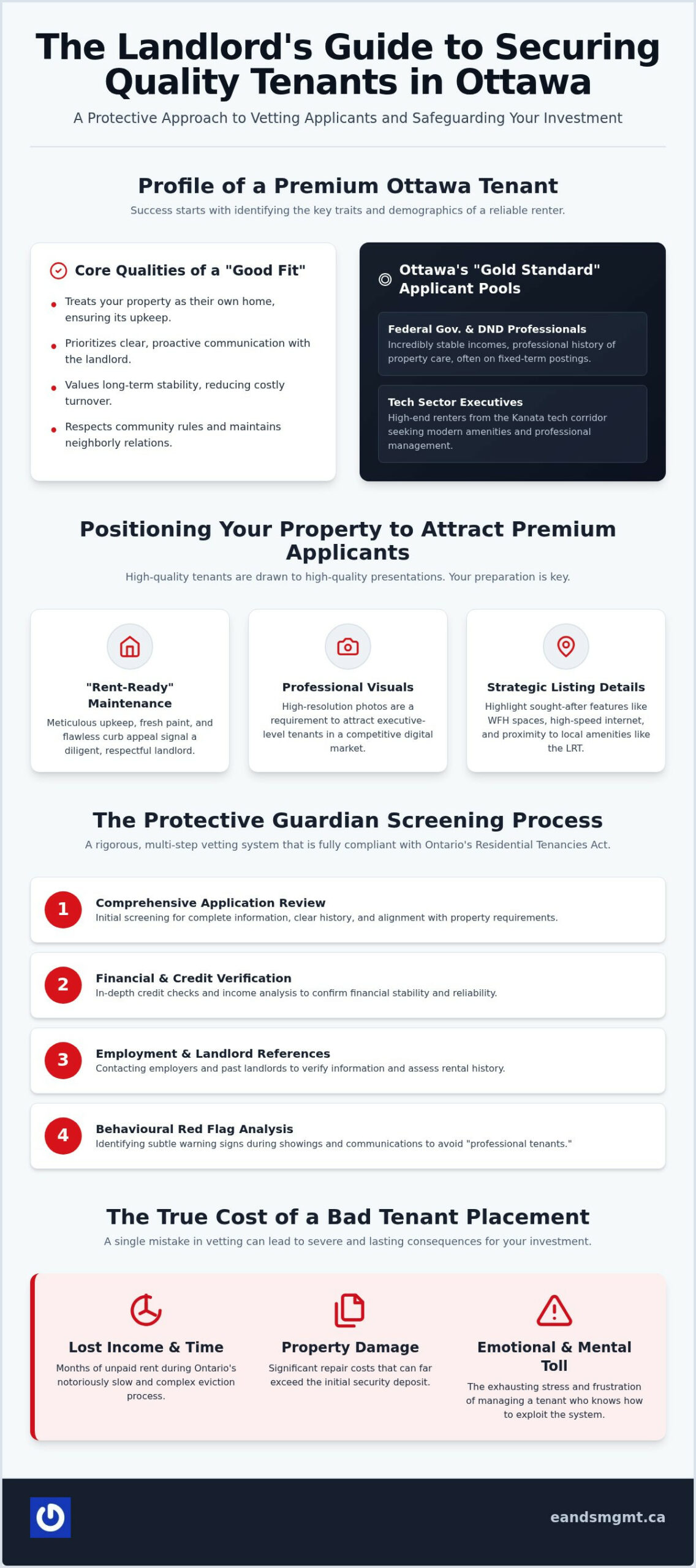
Success starts with knowing exactly who you’re looking for. In a city shaped by the federal government and a booming tech sector, the definition of a “good” tenant goes beyond a high credit score. It’s about finding a partner for your property who values stability as much as you do. While many landlords focus solely on the monthly rent check, true reliability includes property respect and proactive communication. When you understand how to find good tenants in Ottawa, you’re looking for someone who treats your investment as a home rather than just a place to stay.
A qualified applicant might meet the numbers on paper, but a “good fit” understands the nuances of your specific property. Whether you own a heritage house in Rockcliffe or a modern condo in Westboro, you need someone who communicates clearly and respects the community. In Ontario’s current regulatory climate, governed by the Residential Tenancies Act, 2006, the long-term value of keeping a reliable tenant is immense. With the 2026 rent increase guideline set at 2.1 percent, the peace of mind that comes from a steady, respectful occupant often outweighs the temporary gain of a turnover. Retention isn’t just about avoiding vacancy; it’s about protecting the physical and financial integrity of your asset.
Ottawa’s Key Tenant Demographics
Ottawa offers a unique pool of applicants that other cities can’t match. Foreign Service members and Department of National Defence professionals are often the gold standard for local landlords. They usually arrive on fixed-term postings, possess incredibly stable incomes, and have a professional history of property care. Meanwhile, the Kanata tech corridor continues to drive demand for high-end executive rentals. These tenants expect modern amenities and professional responsiveness. While Sandy Hill and areas near Carleton University offer high demand from students, these placements often require more frequent oversight and a different approach to risk management due to higher turnover rates.
The Emotional and Financial Cost of a Bad Placement
Getting the placement wrong carries a heavy burden that stays with you long after the lease is signed. Eviction in Ontario is a notoriously slow and complex process. A single mistake during the vetting phase can lead to months of lost income and significant property damage. Beyond the financial impact, the mental toll of managing a “professional tenant” who knows how to exploit the system is exhausting. This is why learning how to find good tenants in Ottawa is about more than just filling a vacancy; it’s about active protection and meticulous care from the very first interaction.
In the 2026 Ottawa market, a good tenant is a financially stable professional who prioritizes transparent communication and treats your rental property with the same meticulous care they would their own home.
Positioning Your Ottawa Property to Attract Premium Applicants
Attracting the right individual begins long before the first showing; it starts with how your property is presented to the world. High-quality applicants in Ottawa, particularly those in the federal government or the tech sector, have high standards. They look for a home that reflects their professional lifestyle. Ensuring your property is “rent-ready” means more than just a quick cleaning. It involves meticulous maintenance, fresh paint where needed, and impeccable curb appeal. When a property looks cared for, it signals to prospective renters that you are a diligent landlord who respects their living environment.
Visuals dictate applicant quality in the digital age. While smartphone snapshots might suffice for some, professional photography is a requirement for executive-level rentals. High-resolution images that showcase natural light and “work-from-home” readiness, such as dedicated office spaces or high-speed connectivity, will set your listing apart. This level of detail is crucial when you’re learning how to find good tenants in Ottawa, as it filters for applicants who are looking for quality and are willing to pay for it. A well-crafted description should highlight these features alongside local amenities like proximity to the LRT or neighborhood parks.
Pricing your property correctly is a delicate balance. As of June 2026, the average rent for a one-bedroom in Ottawa sits at $1,950, while two-bedroom units average $2,395. Overpricing can lead to long vacancies, while underpricing might attract a volume of applicants that becomes difficult to vet. Using local data ensures you stay competitive without leaving money on the table. If the process of preparing and pricing your home feels overwhelming, our tenant placement service can help streamline these initial steps to ensure your property hits the market with maximum impact.
Where to List Your Property in Ottawa
The days of relying solely on Kijiji are fading. Premium applicants often use specialized platforms or the Multiple Listing Service (MLS) for higher-end executive rentals. For those targeting the Canadian Foreign Service or Department of National Defence (DND) members, tapping into relocation networks like BGRS is essential. Understanding Ontario tenant rights is also vital during this phase to ensure your advertisements remain inclusive and legally compliant while you narrow your search.
Timing the Ottawa Rental Market
Ottawa’s market moves in distinct cycles. May and September are the busiest months, driven by academic schedules and the peak of the government posting season. If you find yourself listing a property during the winter, you’ll need a different marketing approach. Winter rentals often require emphasizing features like heated parking or efficient heating systems. By aligning your listing with the natural ebb and flow of the city’s employment and relocation cycles, you increase your chances of finding a stable, long-term tenant who fits your property perfectly.
The Rigorous Screening Process: Vetting Within Ontario Law
A standardized application process is your most effective shield against future disputes. Learning how to find good tenants in Ottawa means moving beyond gut feelings and into a structured, legal framework that treats every applicant with the same level of meticulous care. Fairness isn’t just a moral choice; it’s a legal requirement that protects you from claims of discrimination while ensuring you identify the most reliable individuals. By establishing a clear hierarchy of verification, you create a professional boundary that naturally filters for applicants who take their landlord and tenant responsibilities seriously.
The verification process starts with a credit report, but you must look deeper than the three-digit score. A high score can hide recent collection accounts or a history of late payments to utility companies. Conversely, a lower score might be the result of a recent life event rather than a pattern of financial negligence. You are looking for a history of reliability. When you combine this with employment verification and landlord references, a clear picture of the applicant’s character begins to emerge. In an environment where the time to pay overdue rent after an N4 notice is just 7 days as of September 2026, getting this initial vetting right is more critical than ever.
Ontario Human Rights and the RTA
Vetting must always happen within the boundaries of the Law. You cannot legally ask about an applicant’s family status, religion, or age during a showing or on an application form. To remain compliant, always use the mandatory Ontario Standard Lease. This document ensures that both parties understand their rights from day one, reducing the risk of “professional tenants” exploiting grey areas in a custom contract. Understanding these legal safeguards is a core part of how to find good tenants in Ottawa while maintaining your reputation as a professional landlord.
Verification Best Practices
In a city dominated by the public sector, verifying employment often requires a specialized touch. When confirming status with Global Affairs Canada (GAC) or the Department of National Defence (DND), look for official correspondence or secure pay stubs, as digital forgery has become increasingly sophisticated. To verify a previous landlord reference effectively, follow these steps:
- Cross-reference the landlord: Use public records or property tax data to ensure the person you are calling actually owns the property.
- Ask open-ended questions: Instead of asking if the tenant was “good,” ask “Can you describe a time there was a maintenance issue and how the tenant handled it?”
- Confirm the specifics: Verify the exact rent amount and the dates of the tenancy to ensure they match the application.
- The ultimate question: Always end by asking, “Would you rent to this person again without hesitation?”
This level of due diligence provides the relief that comes from knowing your property is in safe hands. It transforms a complex cycle of tasks into a manageable, professional routine that secures your investment for the long term.
Identifying Red Flags and Avoiding “Professional Tenants”
A “professional tenant” is not just someone who misses a payment; they are individuals who understand the legal system well enough to reside in a property without paying rent for as long as possible. They exploit the protections designed for honest renters, often leaving landlords with thousands of dollars in losses and significant property damage. Protecting your investment requires more than just a background check. It requires a keen eye for behavioral cues and a deep understanding of how to find good tenants in Ottawa who value their reputation. Identifying these risks early is the only way to avoid the stress of a long-term legal battle.
Subtle red flags often appear during the very first showing. Punctuality is a primary indicator of respect. If an applicant is late without a call, they may lack respect for your time and, eventually, your property. Pay attention to their level of inquiry. A high-quality tenant will ask about maintenance schedules, utility costs, and neighborhood safety. Conversely, an applicant who asks very few questions but is eager to sign the lease immediately may be hiding a history of recent evictions or poor planning. Urgency is often a warning sign that they are being forced out of their current home.
Inconsistencies in the application story are another major concern. If their employment dates don’t match their resume or if their previous landlord’s phone number leads to a friend instead of a property owner, the risk is too high to ignore. If you find these complexities overwhelming or simply don’t have the time to investigate every detail, our full-service property management provides the protective oversight and seasoned expertise needed to shield your home from these sophisticated risks.
The Landlord and Tenant Board (LTB) Reality
The reality of the 2026 LTB environment necessitates a “perfect” screening process. While the window to request a review of a decision was shortened to 15 days in July 2026, the backlog of cases still means that evictions are never “easy” or fast. Many landlords hold the myth that non-payment leads to an immediate move-out. In practice, even with the new 7-day N4 timeline effective September 2026, the process can still take months. A rigorous intake process is your primary insurance policy against this administrative gridlock.
Financial Red Flags
Financial stability is best measured by the 30 percent rule. In Ottawa, where the average two-bedroom rent is $2,395 as of June 2026, an applicant should ideally have a gross monthly income of approximately $8,000. Be cautious with “cash-only” income or unconventional employment that cannot be verified through official tax documents or bank statements. While a guarantor can provide an extra layer of security, remember that they have legal limitations under Ontario law. A guarantor’s presence does not replace the need for the primary tenant to be reliable and respectful of the property itself.
Professional Tenant Placement: The E&S Property Management Advantage
Since 1981, we’ve dedicated ourselves to the meticulous care of Ottawa properties. Our team understands that your home is more than an asset; it’s a piece of your future. This is why our “Protective Guardian” approach is so vital. We treat every placement with the same level of scrutiny we’d use for our own homes. With over 40 years of local experience, we’ve refined the process of how to find good tenants in Ottawa into a science that prioritizes your long-term relief over a quick turnover. We don’t just fill vacancies. We build tenancies that last.
Our expertise is particularly beneficial for members of the Canadian Foreign Service and Department of National Defence. When your career takes you away from the city, you need a stabilizing force on the ground. We provide a seamless transition from the initial marketing of your property to full-service property management. This end-to-end support ensures that your investment remains protected, your financial reporting is accurate, and your tenants are well-cared for while you’re focused on your mission abroad. Understanding how to find good tenants in Ottawa is the first step, but maintaining that relationship is where our seasoned hand makes the difference.
Marketing and Vetting While You Are Abroad
Managing a rental while posted at an embassy or a DND base shouldn’t be a source of constant anxiety. We handle the entire cycle for you. This includes coordinating “rent-ready” repairs with our network of reliable contractors and conducting regular property inspections to ensure your home is being respected. Our involvement also covers the complex administrative side of being a non-resident landlord. We provide dedicated support for NR6 and NR4 tax filing, ensuring you remain compliant with the CRA without having to navigate the paperwork alone from a different time zone.
The Peace of Mind Guarantee
The true value of a professional partner is the buffer we provide between you and the daily challenges of property ownership. In one case, our deep vetting process identified an applicant with a seemingly perfect credit score whose previous landlord reference was actually a friend using a burner phone. By catching these sophisticated red flags early, we saved the owner from a high-risk placement that could have resulted in months of lost rent and legal fees. This level of detail is what transforms property ownership from a burden into a secure, passive investment. We’re here to act as your dedicated steward, protecting your interests with every decision we make.
Let E&S find your next great tenant in Ottawa
Securing Your Rental Legacy in Ottawa
Finding the right tenant is the foundation of a successful investment, but it doesn’t have to be a source of constant stress. By prioritizing professional property positioning and a rigorous, legally compliant screening process, you protect both your financial interests and your mental well-being. Understanding how to find good tenants in Ottawa is about more than just checking a credit score; it’s about building a relationship based on mutual respect and clear communication. Whether you are navigating the nuances of the Ontario Standard Lease or identifying subtle behavioral red flags, a methodical approach ensures your property remains a source of stability.
With over 40 years of local experience, we specialize in the unique needs of Foreign Service members and non-resident landlords. Our comprehensive vetting process, which includes thorough credit and criminal background checks, acts as your protective guardian while you are away. You deserve the peace of mind that comes from knowing every detail is handled with meticulous care. Secure your investment with professional tenant placement in Ottawa and transition from the burden of management to the relief of professional oversight. Your property is a significant asset, and it deserves the steady hand of a seasoned expert.
Frequently Asked Questions
Can I ask a potential tenant for their Social Insurance Number (SIN) in Ontario?
You cannot legally require a tenant to provide their Social Insurance Number under Ontario law. While a tenant may choose to share it voluntarily to facilitate a credit check, you cannot refuse to rent to someone simply because they decline to provide it. Most professional screening tools used in how to find good tenants in Ottawa allow you to run comprehensive credit reports using only a name, current address, and date of birth.
What is the Ontario Standard Lease and is it mandatory for Ottawa rentals?
The Ontario Standard Lease is a mandatory document for most private residential tenancies in the province. It was designed to create a consistent, fair framework that protects both parties and reduces the risk of illegal clauses. If you fail to use this standard form, your tenant has the legal right to demand one and may even withhold one month’s rent if you don’t provide it within twenty-one days of their written request.
How much can I charge for a security deposit in Ottawa?
You are only permitted to collect a rent deposit, which is commonly referred to as “last month’s rent.” Charging a damage deposit or a general security deposit is illegal in Ontario. You may collect a key deposit, but it must be refundable and cannot exceed the actual replacement cost of the keys or fobs. This rule is a common point of confusion, so it’s vital to stay compliant to avoid disputes at the Landlord and Tenant Board.
How do I verify the income of a federal government employee?
Verifying a public servant’s income is relatively straightforward through a formal Letter of Employment and recent pay stubs. For those working in GAC or DND, you can often cross-reference their professional status through the Government Electronic Directory Services (GEDS). This public directory confirms their department and title, providing an extra layer of security when you are determining how to find good tenants in Ottawa within the stable public sector.
What should I do if a tenant applicant has a low credit score but a good job?
A low credit score isn’t always a reason for an immediate rejection; context is everything. You should look for the story behind the numbers, such as a past divorce or a medical event, rather than a pattern of financial neglect. In these scenarios, prioritize strong landlord references and consider asking for a guarantor. This balanced approach allows you to secure a reliable tenant while protecting your property’s financial integrity.
Is it better to list my Ottawa rental on Kijiji, Facebook, or MLS?
The best platform depends entirely on your target demographic and the type of property you own. While Kijiji and Facebook Marketplace generate a high volume of inquiries, the Multiple Listing Service (MLS) is often superior for attracting executive-level professionals and Foreign Service members. Using MLS typically involves a higher level of professional representation, which naturally filters for applicants who are looking for a long-term, high-quality home.
How do I find tenants if I am moving out of the country for a Foreign Service posting?
The most secure way to manage a transition abroad is through a professional tenant placement service. A local expert can handle the entire cycle, from “rent-ready” maintenance and professional photography to the final move-in inspection. This provides the relief of knowing your home is occupied by a vetted individual before you even board your flight. It’s the most effective way to ensure your investment is stabilized while you focus on your new role.
Can I refuse a tenant who has a pet in Ontario?
Under the Residential Tenancies Act, a “no pets” clause in a lease is generally void and unenforceable. You cannot evict a tenant simply for having a pet unless the animal is dangerous, causes excessive damage, or interferes with the reasonable enjoyment of other tenants. The only common exception is if the property is a condominium with specific bylaws that prohibit pets, which take precedence over the general rules of the RTA.