Imagine waking up in a different time zone, thousands of miles from your Westboro or Rockcliffe home, only to realize you’ve missed a critical CRA filing deadline. For many Ottawa residents serving abroad, the transition from local homeowner to non-resident landlord is often filled with these quiet moments of anxiety. You likely already feel that maintaining your property is a vital long-term investment, yet the administrative weight of Part XIII tax rules can be a heavy burden to carry alone. We believe that understanding NR4 slips for Ottawa landlords shouldn’t be a source of stress, but rather the foundation of a secure, worry-free posting.
This guide provides the clarity you need to navigate non-resident tax requirements with total confidence and precision. We’ll explore the essential differences between gross and net tax withholding, explain the 2026 deadlines you need to track, and show you how to optimize your cash flow through professional NR6 and NR4 management. We’ll walk through the specific steps to ensure your Ottawa rental remains fully compliant while you serve your country or pursue your career overseas. By the end of this guide, you’ll have a clear roadmap to protect your assets and regain the peace of mind you deserve.
Key Takeaways
- Learn how the NR4 slip serves as the definitive year-end summary of your property’s tax history, documenting both your gross rental income and the non-resident tax withheld.
- Gain clarity on the 25% withholding rule to avoid CRA penalties, making understanding NR4 slips for Ottawa landlords the first step toward total compliance.
- Explore how filing an NR6 application can optimize your monthly cash flow by shifting tax calculations from your gross rent to your net rental income.
- See how the data from your NR4 slip simplifies the process of filing a Section 216 tax return, helping you reclaim overpaid taxes and protect your bottom line.
- Discover the peace of mind that comes from professional administrative oversight, ensuring all CRA deadlines are met while you focus on your posting overseas.
What is an NR4 Slip? A Vital Guide for Non-Resident Ottawa Landlords
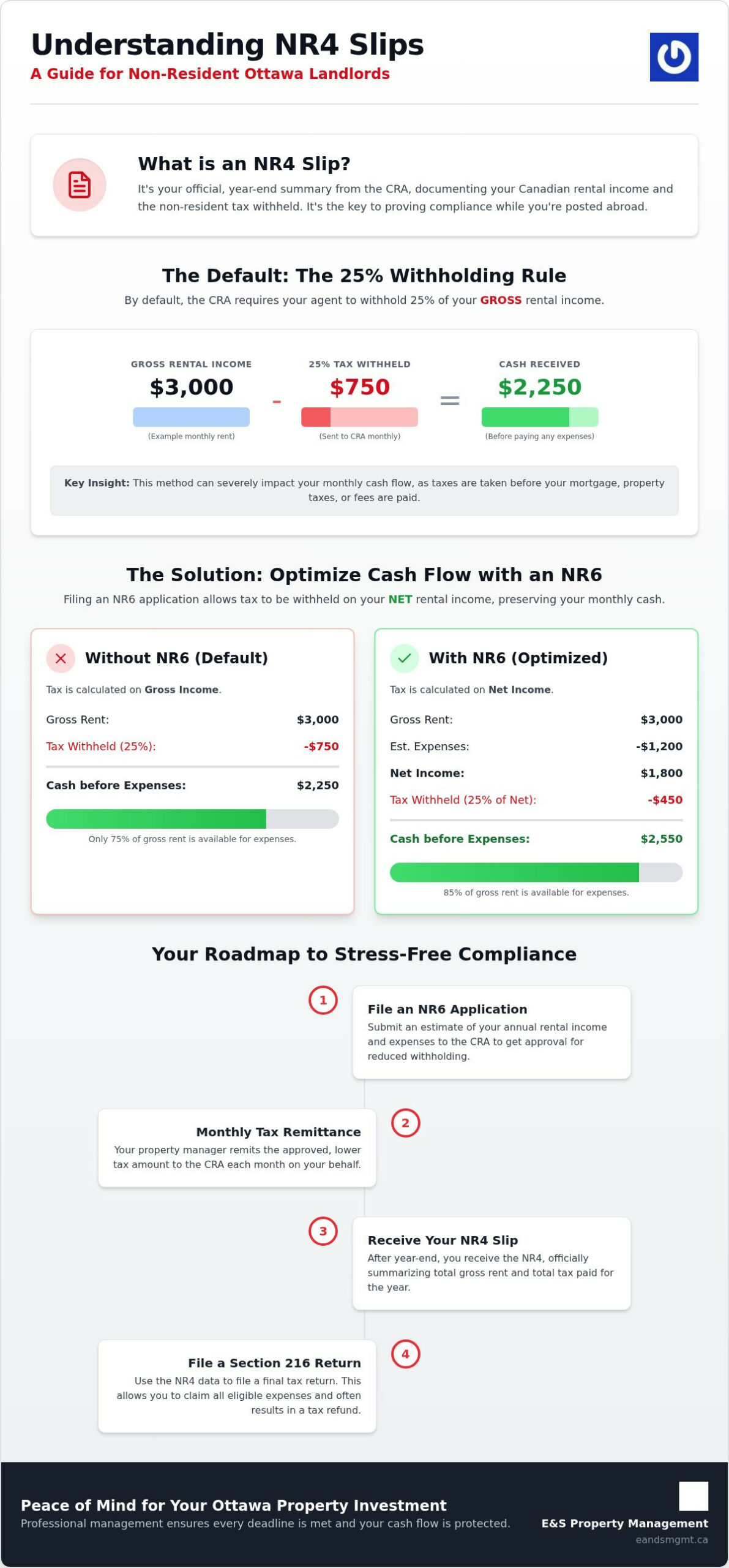
An NR4 slip is a formal information return issued by the Canada Revenue Agency (CRA) that documents the gross rental income you’ve earned and the non-resident tax withheld throughout the calendar year. Think of it as the final chapter in your property’s annual tax story. For those focused on understanding NR4 slips for Ottawa landlords, it’s helpful to view this document as a bridge between your Canadian assets and your international life. Under the framework of Taxation in Canada, the CRA mandates a statutory 25% withholding tax on rental income paid to non-residents, known as Part XIII tax. Your property manager, acting as your authorized agent, handles the monthly remittances and issues this slip to summarize those transactions for the year.
Why Ottawa Landlords Receive NR4s
Landlords in the capital often find themselves in unique positions. Many of our clients are members of the Canadian Armed Forces (DND) or Global Affairs Canada (GAC) heading out on multi-year postings. Whether you’re a factual non-resident who maintains significant residential ties or a deemed non-resident living entirely abroad, the CRA views your rental income as a taxable Canadian source. This remains true regardless of where you’re currently stationed or how long you’ve been away. The NR4 slip ensures that this income is reported correctly, reflecting the reality of your life as an expat while maintaining your standing with the tax authorities back home. It’s a routine but essential piece of the administrative puzzle for anyone managing property from a distance.
The Protective Role of the NR4 Slip
While paperwork can feel like an added burden, the NR4 slip actually serves as a powerful shield for your financial health. It acts as official proof of tax paid in Canada, which is often essential for claiming foreign tax credits and preventing double taxation in your host country. By documenting every dollar withheld, it protects you from the anxiety of potential CRA audits or unexpected interest charges. Understanding NR4 slips for Ottawa landlords allows you to delegate the heavy lifting to a seasoned hand, knowing that your home and your tax status are being watched over with meticulous care. We see this slip as a standard component of the relief provided by professional management. It transforms a complex logistical cycle into a simple, verified document that confirms your compliance and preserves your peace of mind.
The 25% Rule: How Rental Income Withholding Works on Your NR4
At its core, the CRA requires that 25% of your gross rental income be remitted to the government. This is the default Part XIII tax. When you receive your slip, you’ll see these figures clearly laid out. Box 16 represents your Gross Income; this is the total rent collected before any expenses like repairs, property taxes, or management fees are deducted. Box 17 shows the Non-Resident Tax Withheld. For a property in Westboro or Kanata, this withholding can significantly impact your monthly cash flow. It’s also vital to remember that all figures on the NR4 Slip Information must be reported in Canadian dollars (CAD). This applies even if you’re living in a country where the local currency fluctuates against the loonie, as the CRA requires a consistent standard for all Canadian source income.
Understanding Box 14 and Box 15: Income Codes
Box 14 on your slip is used to identify the type of income being reported, which for residential property is specifically designated as rental income. You’ll typically see Code 13 in Box 15, which the CRA uses to categorize Rents. If you co-own your Ottawa home with a spouse or partner, the CRA requires separate slips for each individual to reflect their specific share of the investment. This level of detail is part of understanding NR4 slips for Ottawa landlords and ensures that each owner’s tax obligations are handled with precision. It prevents the confusion that often arises when trying to split a single document between two different tax returns later in the year, providing a clean audit trail for both parties.
Common Errors in Withholding and How to Avoid Them
One of the most common pitfalls we see involves landlords relying on their tenants to handle tax remittances. While the CRA technically allows this, most tenants don’t have the technical knowledge to navigate monthly filings or the diligence to meet strict deadlines. A single missed payment or late remittance can trigger significant interest charges and audits. Many owners feel a sense of anxiety about over-withholding on gross income, but this is often a temporary state. Professional financial reporting and accounting helps manage this process, ensuring you stay compliant while paving the way for potential refunds through year-end returns. This structured approach moves you from a place of administrative burden to one of organized clarity, knowing a seasoned hand is protecting your interests. Understanding NR4 slips for Ottawa landlords means recognizing that these forms are not just tax documents; they’re proof of your commitment to maintaining your Canadian assets properly while you’re away.
NR6 vs. NR4 Slips: Balancing Monthly Cash Flow with Annual Reporting
The relationship between the NR6 and the NR4 is one of proactive planning versus retroactive verification. While the NR4 slip is the summary of what happened, the NR6 is your application to change the rules of the game in your favor. By filing an NR6, you’re asking the CRA for permission to withhold 25% of your net income rather than the gross. This shift is the primary mechanism for cash flow relief, ensuring you aren’t sending more money to the government than necessary each month. Deepening your understanding NR4 slips for Ottawa landlords involves seeing how this annual report serves as the final proof that your proactive NR6 strategy was executed correctly. This combination of forms allows you to manage your Canadian assets with the same precision you apply to your professional career abroad.
The NR6 Process: Moving from Gross to Net
To benefit from reduced withholding, the CRA requires a Canadian agent to act as your co-signer and primary point of contact. This agent, such as a professional property manager, takes on the legal responsibility for remitting the correct amount of tax on your behalf. When we prepare an NR6, we meticulously estimate your typical Ottawa property expenses to provide an accurate forecast. These estimates often include:
- Annual property taxes specific to your Ottawa ward.
- Anticipated maintenance and emergency repair budgets.
- Professional management and accounting fees.
- Insurance premiums and mortgage interest where applicable.
The January 1st deadline is a hard cutoff; if the CRA doesn’t have your approved NR6 by the start of the year, your agent must withhold 25% of the gross rent until the approval arrives. Acting early ensures your cash flow remains steady from the very first rent cheque of the new year. It’s a small but vital step that prevents the temporary loss of liquidity that can occur when the gross withholding rule is applied by default.
The NR4 as the Final Receipt
Once the year concludes, the NR4 slip acts as the official receipt for the tax strategy you initiated with the NR6. It confirms to the CRA that the taxes withheld and remitted throughout the year match the income levels reported. If your actual expenses were higher or lower than the estimates provided in your NR6, the NR4 provides the necessary data to reconcile those differences. When you move toward Filing a Section 216 Tax Return, this slip is the foundational document your accountant will use to ensure everything is balanced. Your NR4 slip acts as the final ledger, confirming that the reduced tax amounts remitted under your approved NR6 estimate align with the actual rental income received. This cycle of reporting ensures you stay in the CRA’s good books while keeping more of your rental income available for your own needs.
Beyond the Slip: Using Your NR4 to File a Section 216 Tax Return
If the NR4 slip is the official receipt of your tax story, the Section 216 tax return is your opportunity to refine the ending. For many, the 25% withholding on gross income feels like a heavy financial weight. Filing a Section 216 return allows you to be taxed on your net rental income instead, which often results in a significant refund. Your NR4 provides the essential data points your accountant needs to populate this return, acting as the verified starting point for your filing. Understanding NR4 slips for Ottawa landlords is the first step toward reclaiming overpaid tax and ensuring your investment remains as profitable as possible while you’re stationed abroad.
Timing is everything when it comes to these filings. If you utilized an NR6 to reduce your monthly withholding, you must file your Section 216 return by June 30th of the following year. Missing this deadline can lead to the CRA revoking your NR6 approval and demanding the full 25% of gross rent. If you didn’t file an NR6 and had the full 25% withheld from your gross rent, you generally have two years from the end of the tax year to file and claim a refund. This distinction is a common point of confusion that we help our clients navigate with ease.
Eligible Expenses for Ottawa Landlords
The true value of the Section 216 return lies in the deductions. You can subtract legitimate operating expenses from your gross rent to lower your taxable balance. For our clients, this typically includes E&S management fees, Ottawa property taxes, and repairs performed by local contractors. You can also deduct insurance premiums and the interest portion of your mortgage payments. It’s important to note that while mortgage interest is deductible, the principal portion is not. Having a professional hand manage your financial reporting and accounting ensures every eligible expense is captured, maximizing your potential refund without the stress of manual bookkeeping.
The Consequences of Not Filing
Choosing not to file a Section 216 return means you accept the 25% withholding as your “final tax” to Canada. For most landlords in high-value areas like Westboro or the Glebe, this is an expensive oversight. Without this filing, you lose the ability to carry forward terminal losses or utilize Capital Cost Allowance (CCA) to further offset your tax burden. We’ve seen how the transition from active homeowner to non-resident landlord can feel overwhelming, but these administrative steps are what protect your equity over the long term. Our structured reporting makes this process effortless for your accountant, providing a clear and organized path to compliance and cash flow optimization.
Stress-Free Tax Compliance: How E&S Property Management Protects Your Interests
Managing a property from a different time zone shouldn’t feel like a second job. Since 1981, we’ve acted as a stabilizing force for Ottawa landlords, particularly those serving with DND and Global Affairs Canada. We understand that your home is more than an asset; it’s a part of your future that requires meticulous care. By acting as your Canadian agent, we take on the full administrative burden of tax compliance. This includes filing your annual NR6 application, managing monthly remittances to the CRA by the 15th of each month, and the final issuance of your NR4 slip. Our role is to be the seasoned hand that handles these logistics so you can focus on your posting with total peace of mind.
The E&S Financial Advantage
Our approach to understanding NR4 slips for Ottawa landlords is built on a foundation of transparency and order. We utilize modern digital systems to track every transaction, ensuring that your year-end financial reporting is seamless and accurate. This level of detail is essential when it’s time for your accountant to file a Section 216 return. Beyond the numbers, our established network of reliable Ottawa contractors provides the detailed receipts necessary for maximizing your tax deductions. We know that being “out of sight” can lead to anxiety, so we provide personalized support that keeps you informed without overwhelming you. It’s about providing the relief that comes from knowing a dedicated steward is watching over your interests.
Getting Started with Professional Oversight
Transitioning your property to professional management is a straightforward process designed to shield you from common pitfalls. We begin by reviewing your current tax status and establishing the necessary CRA accounts if they aren’t already in place. Throughout the year, we coordinate directly with your Canadian tax professional to ensure they have the verified data needed for a smooth tax season. This collaborative approach ensures that your NR4 reflects a year of perfect compliance and that all deadlines, including the March 31st filing requirement, are met without fail. If you’re ready to move from administrative stress to professional clarity, we invite you to take the next step. Secure your Ottawa investment with E&S Property Management and experience the confidence of having a protective guardian by your side.
Securing Your Ottawa Investment While You Serve Abroad
Mastering the logistics of non-resident taxation is the final step in ensuring your property remains a source of stability rather than stress. We’ve explored how the NR4 slip acts as your official tax receipt and how proactive strategies like the NR6 application can significantly improve your monthly cash flow. By understanding NR4 slips for Ottawa landlords, you position yourself to reclaim overpaid taxes through a Section 216 return, protecting your equity for the long term. Since 1981, we’ve specialized in supporting DND and Global Affairs Canada members through these exact transitions, providing the seasoned oversight needed to navigate CRA requirements with precision.
You don’t have to manage these administrative burdens from thousands of miles away. Our team acts as your protective guardian, ensuring every remittance is made and every slip is issued on time. If you’re ready to exchange the anxiety of tax season for the relief of professional management, we invite you to Request a Consultation for Non-Resident Tax Management. Your home is a vital part of your future; let us help you protect it with the meticulous care it deserves. We look forward to being the reliable partner you can trust while you focus on your mission overseas.
Frequently Asked Questions
When is the deadline for receiving my NR4 slip in 2026?
The deadline for your agent to file the NR4 slip with the CRA and provide you with a copy is March 31, 2026. This date applies to all rental income collected during the 2025 calendar year. It’s a critical milestone for understanding NR4 slips for Ottawa landlords as it marks the beginning of the Section 216 filing season. Missing this date can delay your potential tax refund and complicate your international tax filings.
What should I do if my NR4 slip has an error in the gross income amount?
If you notice a discrepancy in your gross income, you should contact your property manager immediately to request an amended slip. Your manager will file a corrected version with the CRA and issue you a new copy. Accurate reporting is essential to avoid red flags during an audit. We maintain meticulous records to ensure your year-end figures align perfectly with your monthly statements, protecting your standing with the authorities.
Do I still need an NR4 if I am only renting my Ottawa home for one year?
Yes, you’re required to receive an NR4 slip even if you only rent out your home for a single year. Any amount of Canadian rental income paid to a non-resident triggers Part XIII withholding requirements. Whether you’re on a short-term DND posting or a one-year contract, the CRA expects full compliance. This ensures that your tax obligations are settled before you return to your Ottawa residence or move to your next assignment.
Can I file my Section 216 return without the NR4 slip?
You cannot file an accurate Section 216 return without the data provided on your NR4 slip. The CRA requires the specific figures from Box 16 and Box 17 to verify the income earned and the tax already paid. Your accountant uses this slip as the source of truth for your return. Attempting to file without it often leads to processing delays or the rejection of your expense claims and refund requests.
Why did my property manager withhold 25% of my rent even though I have expenses?
The 25% withholding is the statutory default applied to gross rent unless a proactive NR6 application was approved by the CRA before the tax year began. Without an approved NR6, your manager is legally required to withhold from the total rent collected, regardless of your property taxes or maintenance costs. This is why we emphasize early planning for our clients, as it prevents the temporary loss of monthly cash flow.
How do I report my Ottawa rental income on my host country’s tax return?
You should provide the NR4 slip to your tax professional in your host country to claim a foreign tax credit. Most countries, including the United States, have tax treaties with Canada to prevent double taxation. The slip serves as official proof that you’ve already paid tax on that income to the CRA. This ensures you only pay the difference, if any, required by your current country of residence.
Is the NR4 slip required for both condos and detached houses in Ottawa?
The NR4 slip requirement applies to all residential property types in Ottawa, including condos, townhomes, and detached houses. The CRA doesn’t distinguish between the physical structure of the property; the focus is entirely on the residency status of the owner. Whether you’re renting out a modern condo in the ByWard Market or a family home in Orleans, the same non-resident tax rules and reporting deadlines apply.
What happens if I forget to remit the non-resident tax to the CRA?
Failing to remit non-resident tax can result in significant penalties and interest charges from the CRA. Both the landlord and the Canadian agent can be held liable for the unremitted amounts. This is a primary source of anxiety for many expats, which is why delegating this task to a professional hand is so vital. We ensure every payment is made by the 15th of the following month to keep your investment protected.