
Discovering an unfamiliar face living in your unit feels like a straightforward trespass issue, but under Ontario law, treating them like an intruder can trigger individual fines of up to C$100,000. If you are asking whether you can legally remove an occupant who never signed your lease, the answer is yes, but the statutory rules demand absolute precision. Successfully dealing with unauthorized tenants in a rental property Ontario requires separating lawful roommates from unlawful transfers before taking formal action.
We know how unsettling this situation is. The blurred line between a tenant’s permitted guest and an unauthorized occupant creates genuine anxiety, particularly when a single procedural mistake at the Landlord and Tenant Board can derail your timeline. You don’t have to face this alone or risk severe penalties. In this guide, you’ll learn how to accurately verify an occupant’s legal status, protect your revenue within the strict 60-day discovery window, and file Form A2 under Section 100 without jeopardizing your rights. We’ll walk you through each step to restore order and safeguard your property with complete confidence.
Key Takeaways
- Distinguish between a tenant’s legal right to host guests or roommates and an unlawful assignment where the primary leaseholder completely vacates.
- Master the precise statutory steps for dealing with unauthorized tenants in a rental property Ontario, including filing Form A2 before the strict 60-day deadline expires.
- Protect your investment against catastrophic provincial penalties by avoiding self-help evictions and following lawful Landlord and Tenant Board enforcement channels.
- Discover how to correctly manage payments as compensation for use and occupation without accidentally creating a binding implied tenancy.
- Establish proactive defense strategies through professional tenant placement screening and regular property inspections to safeguard your rental asset long term.
Understanding Unauthorized Occupancy Under Ontario Residential Tenancy Law
Few situations cause more immediate friction for rental owners than discovering unfamiliar faces residing in their units. However, successfully dealing with unauthorized tenants in a rental property Ontario starts with grasping a fundamental legal distinction: lawful roommates are permitted occupants living alongside an active leaseholder, whereas unauthorized occupants are individuals who have taken over physical possession after the primary tenant has vacated without consent.
Under the Residential Tenancies Act, 2006 (RTA), Section 100 serves as the primary statutory framework regulating unlawful transfers, assignments, and subtenancies. When disputes arise over who holds legitimate tenancy rights, the provincial Landlord and Tenant Board evaluates whether the named leaseholder still retains their primary residence in the unit or has fully yielded control to someone else.
Guests and Roommates vs. Unauthorized Transfers
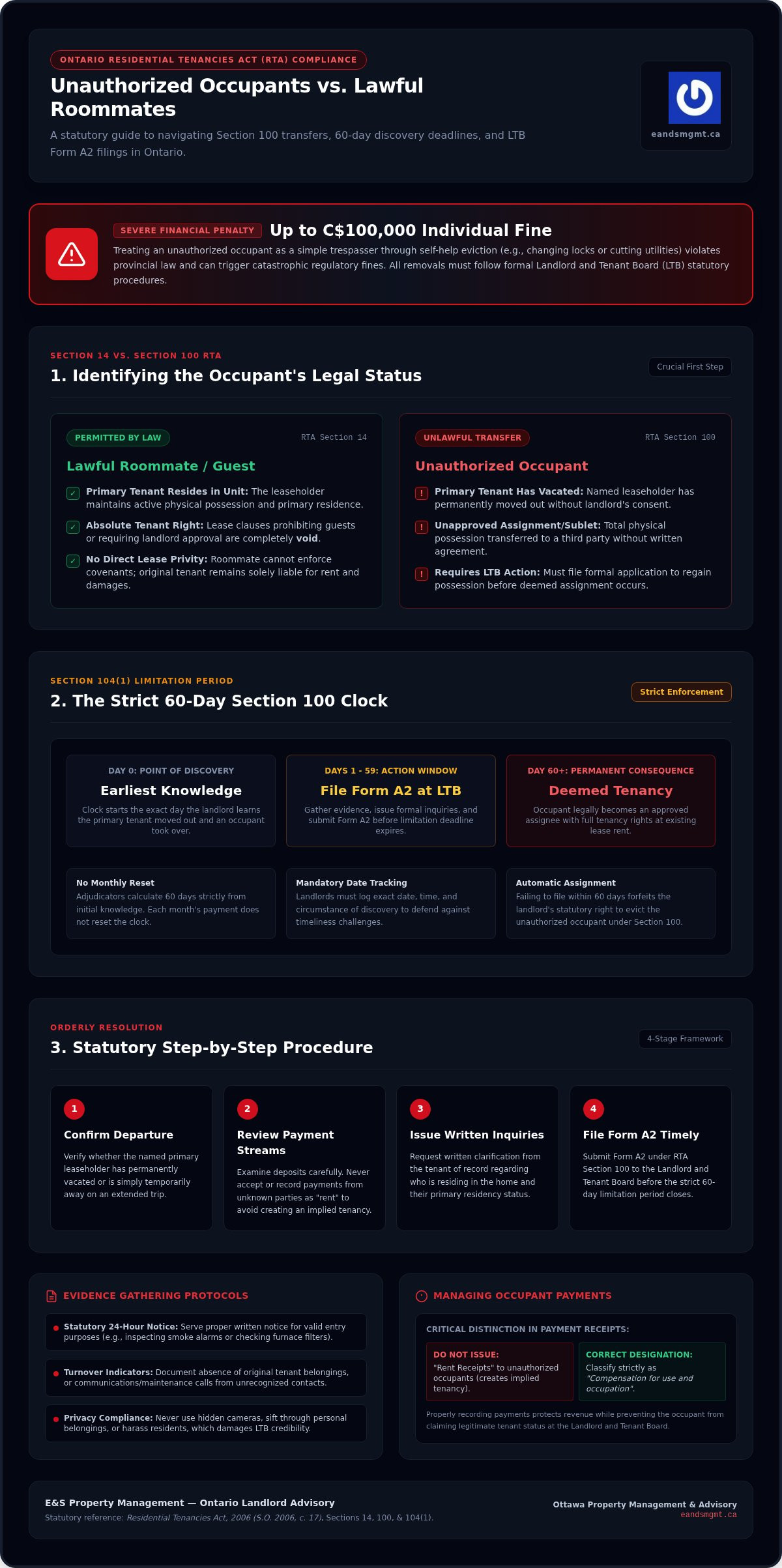
Ontario law grants tenants an unrestricted right to invite guests, romantic partners, or paying roommates into their homes. Under Section 14 of the RTA, any lease clause prohibiting guests or requiring landlord approval for extra occupants is completely void. Crucially, these roommates hold no legal status; they cannot enforce lease covenants against you, nor are they personally liable for unpaid rent or property damage. An arrangement only transforms into an unauthorized occupancy once the named tenant moves out permanently and transfers total physical control without your prior written agreement.
The Critical 60-Day Section 100 Clock
If you confirm that your named tenant has moved out and handed the keys to someone else, the clock starts ticking immediately. Under Section 104(1) of the RTA, a landlord has exactly 60 days from the date they discover the unauthorized occupancy to file a formal application with the tribunal. Missing this deadline brings severe legal consequences:
- Automatic deemed tenancy: Failing to apply within 60 days legally deems the unauthorized occupant to be an approved assignee, giving them full tenancy protections at the existing lease rate.
- Strict discovery enforcement: Adjudicators calculate the 60 days from your earliest point of knowledge, rejecting arguments that each new month resets the timeframe.
- Immediate documentation: You must record the exact date, time, and circumstances of how you learned of the occupant to protect your filing timeline.
Mastering this window ensures that dealing with unauthorized tenants in a rental property Ontario remains manageable, preserving your legal standing before an implied tenancy locks into place.
Step-by-Step Procedure for Addressing an Unauthorized Occupant in Ontario
Resolving an unapproved occupancy requires methodical preparation rather than hasty confrontation. When dealing with unauthorized tenants in a rental property Ontario landlords must follow an orderly, statutory workflow to protect their legal standing before approaching the tribunal.
- Confirm primary tenant departure: Verify whether the named leaseholder has permanently vacated or simply taken an extended trip.
- Review payment streams: Examine recent bank deposits to ensure incoming funds are tracked properly and not attributed to an unknown party as rent.
- Issue written inquiries: Request clarity from the tenant of record regarding who is residing in the home.
- File timely documentation: Submit the correct provincial application before the 60-day limitation period closes.
Gathering Objective Evidence Responsibly
Solid evidence builds successful cases. Schedule a routine property entry by serving a proper written 24-hour statutory notice stating a valid purpose, such as inspecting smoke alarms or checking furnace filters. During the visit, note signs of a complete turnover, like the total absence of the original tenant’s personal possessions. Keep records of maintenance requests submitted from unrecognized email addresses or phone numbers. Never install hidden cameras, sift through personal belongings, or harass residents, as invasive surveillance violates privacy laws and will damage your credibility before adjudicators.
Serving Written Inquiries to the Tenant of Record
Before assuming the worst, communicate directly with your primary tenant. Send formal correspondence via email and registered mail asking them to confirm their current physical residence. Ask directly whether an unauthorized assignment or sublet occurred without your written consent. Keep timestamped copies of every email, letter, and postal delivery confirmation. If the tenant confirms they vacated, their written admission becomes vital evidence. If they fail to reply, that silence helps establish abandonment when combined with your inspection logs.
Filing Form A2 with the Landlord and Tenant Board
Once you verify an unlawful transfer, you must file Form A2: Application about a Sublet or an Assignment through the Tribunals Ontario Landlord and Tenant Board portal. This application requires a C$201 filing fee and demands exact paperwork. Attach a copy of your original Ontario Standard Lease, written records proving when you first discovered the new occupant, and copies of your unanswered inquiries. When dealing with unauthorized tenants in a rental property Ontario property owners often find that partnering with a seasoned team for full-service property management provides the structured oversight needed to handle these procedural filings smoothly.
Critical Mistakes Ontario Landlords Must Avoid During Occupancy Disputes
Discovering that someone has taken over your property without permission naturally sparks frustration, but emotional reactions often lead to severe legal and financial setbacks. When dealing with unauthorized tenants in a rental property Ontario owners must protect their investment by adhering strictly to tribunal guidelines. A single misstep can transform a straightforward occupancy dispute into an expensive liability.
The Legal Danger of Self-Help Evictions
Taking matters into your own hands is strictly illegal in Ontario. Landlords must never change the locks, cut off essential utilities, remove entrance doors, or seize an occupant’s personal belongings. These self-help actions violate the Residential Tenancies Act, 2006, giving occupants grounds to file Form T2 (Application about Tenant Rights) against you.
The financial consequences of an unlawful eviction are severe:
- Substantial provincial fines: Maximum court-ordered fines for illegal evictions stand at C$100,000 for individual landlords and C$500,000 for corporations, alongside possible tribunal administrative penalties reaching C$50,000.
- Mandatory compensation orders: The tribunal can order you to pay the occupant’s out-of-pocket lodging expenses, moving costs, and substantial general damages for distress.
- Exclusive Sheriff authority: Even after obtaining a valid tribunal order, only the official Court Enforcement Office (Sheriff) holds the legal authority to enforce an eviction and change the locks.
Avoiding the Accidental Implied Tenancy Trap
Perhaps the most frequent procedural pitfall involves handling monthly payments. If an unauthorized occupant sends an Interac e-Transfer or direct deposit and you accept it without qualification, an adjudicator may rule that you established an implied tenancy. That simple deposit slip can strip away your grounds for removal.
Under Section 103 of the Act, you have the right to collect per diem funds for the ongoing use of your unit. However, you must handle this transaction with extreme care. Never issue a document calling the payment “rent” and never provide a standard rent receipt. Instead, confirm every transaction in writing with explicit phrasing: “Accepted strictly as compensation for use and occupation without prejudice to our pending Form A2 application, without creating a tenancy or waiving landlord rights.”
Maintaining this legal boundary requires disciplined administrative vigilance. When dealing with unauthorized tenants in a rental property Ontario property owners seeking steady guidance can turn to the seasoned professionals at E&S Property Management to ensure every notice and payment record stands up to tribunal scrutiny.
Navigating the Landlord and Tenant Board (LTB) Hearing Process
Patience and meticulous organization are vital once your application enters the provincial system. Because specialized disputes like Form A2 applications currently take approximately 5 to 8 months to reach a hearing date, an incomplete submission can set you back nearly a year. During the virtual proceeding, the adjudicator evaluates whether an unauthorized assignment or sublet legally occurred under the RTA. When your claim succeeds, the Board issues a formal order declaring the tenancy terminated, evicting the occupant, awarding daily compensation for use and occupation, and reimbursing your C$201 application fee.
Preparing Your Digital Evidence Package
The LTB conducts hearings almost entirely online, making structured digital presentation essential. You must upload all documentary evidence to the Tribunals Ontario Portal at least 7 days before your scheduled hearing date. Organize your materials into numbered exhibits with clear descriptive labels. Include the original Ontario Standard Lease, timestamped inspection records, written inquiries sent to the primary tenant, and bank records demonstrating that the original tenant stopped paying rent. Clear, orderly documentation allows the adjudicator to verify the timeline of discovery and tenant abandonment within seconds.
Exploring Mediation and Voluntary Resolution
Before facing a formal hearing, both parties typically have the opportunity to work with an LTB Dispute Resolution Officer. Mediation offers a constructive path to resolve the dispute without the stress of an adversarial proceeding. Through this process, you can negotiate a firm, voluntary departure date that gives the occupant reasonable transition time while protecting your asset.
Ensure that any mediated agreement is converted into a formal Board consent order with Section 78 reopening provisions. If the occupant fails to vacate by the agreed date, this clause allows you to apply for an immediate eviction order without attending another hearing. Settling through mediation shortens carrying delays, avoids costly appeals, and restores peace of mind far faster than a contested decision.
Successfully dealing with unauthorized tenants in a rental property Ontario requires balancing strict procedural compliance with steady, objective communication. When tribunal backlogs and complex paperwork feel overwhelming, you can delegate your property operations to our full-service management team to protect your investment and maintain uninterrupted peace of mind.
Long-Term Prevention: Protecting Your Rental Property from Unauthorized Occupants
Preventing an unauthorized occupancy dispute begins long before an applicant turns a key in the front door. While the tribunal offers legal remedies when things go wrong, proactive front-end management remains your strongest defense. Establishing thorough vetting protocols and consistent oversight shields your investment from the stress and expense of contested hearings.
Robust Tenant Screening and Lease Execution
A dependable tenancy starts with deep, objective verification. Relying simply on basic pay stubs or verbal assurances leaves your property vulnerable to deceptive arrangements, such as unauthorized sublets or covert assignments. Implement a multi-layered screening framework that verifies ongoing employment stability, pulls verified credit bureau histories, and connects directly with previous housing providers.
During the application phase, make sure every prospective adult occupant is identified by legal name and vetted individually. When signing the Ontario Standard Lease, review the statutory clauses that prohibit unauthorized subletting, assignment without consent, and illicit short-term commercial rentals. Setting clear expectations from day one ensures that prospective renters understand their legal boundaries and know you take lease compliance seriously.
Partnering with Experienced Local Property Managers
Regular property inspections serve as an essential early-warning system. Because Ontario’s deemed-tenancy clock runs out after sixty days, unmonitored properties create immense risk for owners. Routine, legally compliant visits allow you to identify unfamiliar occupants, verify physical leaseholder occupancy, and address maintenance issues before minor oversights escalate into complicated tribunal disputes.
For absentee owners and remote landlords, maintaining this level of ongoing vigilance can be daunting. With over four decades of residential management experience in Ottawa since 1981, E&S Property Management acts as a dedicated guardian for your portfolio. Our team supports local investors, remote property owners, and Canadian Foreign Service members posted abroad through structured tenant placement screening, rigorous compliance tracking, and scheduled property inspections.
Instead of dealing with unauthorized tenants in a rental property Ontario after an unlawful transfer occurs, professional management stops disputes before they start. Having seasoned professionals oversee your day-to-day operations protects your monthly cash flow, keeps your property fully compliant under the RTA, and gives you total peace of mind.
Take Control and Protect Your Rental Investment
Navigating tenancy challenges doesn’t have to drain your time or compromise your peace of mind. As you’ve seen, successfully dealing with unauthorized tenants in a rental property Ontario comes down to swift investigation, respecting the 60-day limitation window under Section 100, and avoiding costly self-help mistakes. When you handle communication objectively and document every step meticulously, you position yourself to resolve occupancy disputes through proper legal channels with minimal friction.
You don’t have to shoulder these complex administrative responsibilities on your own. With over four decades of dedicated residential property management in Ottawa since 1981, our team brings proven expertise managing rental compliance for local landlords and foreign service officers posted around the globe. From multi-stage applicant vetting to routine property inspections, we provide the steady oversight your portfolio deserves. Protect your Ottawa rental property with E&S Property Management today, and rest easy knowing your real estate assets are in seasoned, reliable hands.
Frequently Asked Questions
Can a tenant in Ontario have guests or roommates without the landlord approval?
Yes, tenants in Ontario hold a statutory right under Section 14 of the Residential Tenancies Act to host guests and paying roommates without landlord permission. Any lease clause restricting guests or charging extra fees is legally void. However, this rule only applies while the primary tenant continues residing in the unit as their principal home. Roommates hold no leaseholder rights and cannot enforce tenancy protections against the property owner.
What is the sixty-day rule for unauthorized occupants under Ontario law?
The sixty-day rule requires a landlord to apply to the Landlord and Tenant Board within 60 days of discovering an unauthorized occupant. Under Section 104 of the RTA, if you don’t file within this exact discovery window, the occupant is legally deemed to be an approved assignee. This deemed tenancy gives them full tenant rights at the original lease rate, permanently blocking you from removing them as an unauthorized occupant.
Can an Ontario landlord call the police to remove an unauthorized occupant?
No, Ontario police services will not remove an occupant from a residential rental unit because they treat occupancy disputes strictly as civil matters. Calling law enforcement won’t resolve the situation and can expose you to severe liability if you attempt a lock change. Only an official Court Enforcement Officer, commonly known as the Sheriff, possesses the legal authority to enforce an eviction order issued by the Landlord and Tenant Board.
What is the difference between an unauthorized sublet and an illegal assignment?
An unauthorized sublet occurs when a tenant vacates temporarily with the intention of returning, but transfers possession to a third party without landlord consent. An illegal assignment happens when a tenant vacates permanently and transfers all tenancy rights to another individual without written approval. In both situations, dealing with unauthorized tenants in a rental property Ontario requires filing Form A2 with the tribunal within the statutory 60-day limitation window.
What happens if a landlord accepts rent directly from an unauthorized occupant?
Accepting payment directly from an occupant without clear reservation can establish an accidental implied tenancy under Ontario law. Adjudicators often interpret unconditional rent acceptance as tacit landlord approval of an assignment. If you collect funds while awaiting a hearing, document in writing that the money is accepted strictly as “compensation for use and occupation without prejudice” to your pending application, avoiding any standard rent receipts or lease references.
Which Landlord and Tenant Board form is used to evict an unauthorized occupant?
Landlords must file Form A2, titled Application about a Sublet or an Assignment, through the Tribunals Ontario portal. You don’t serve standard termination notices like Form N4 or Form N5 because no formal tenancy exists with the occupant. Submitting Form A2 requires a C$201 filing fee and requests an eviction order, official tenancy termination, and daily compensation for the unauthorized occupant’s ongoing physical possession.
How does an Ontario landlord legally prove an occupant is unauthorized?
You prove unauthorized occupancy by gathering objective evidence demonstrating that the named tenant vacated permanently. Key proof includes written messages where the tenant admits moving out, returned registered mail, altered utility account holders, and scheduled inspection records noting the absence of the tenant’s belongings. For Ottawa housing providers, methodically logging this evidence ensures you succeed when dealing with unauthorized tenants in a rental property Ontario before the tribunal.


