
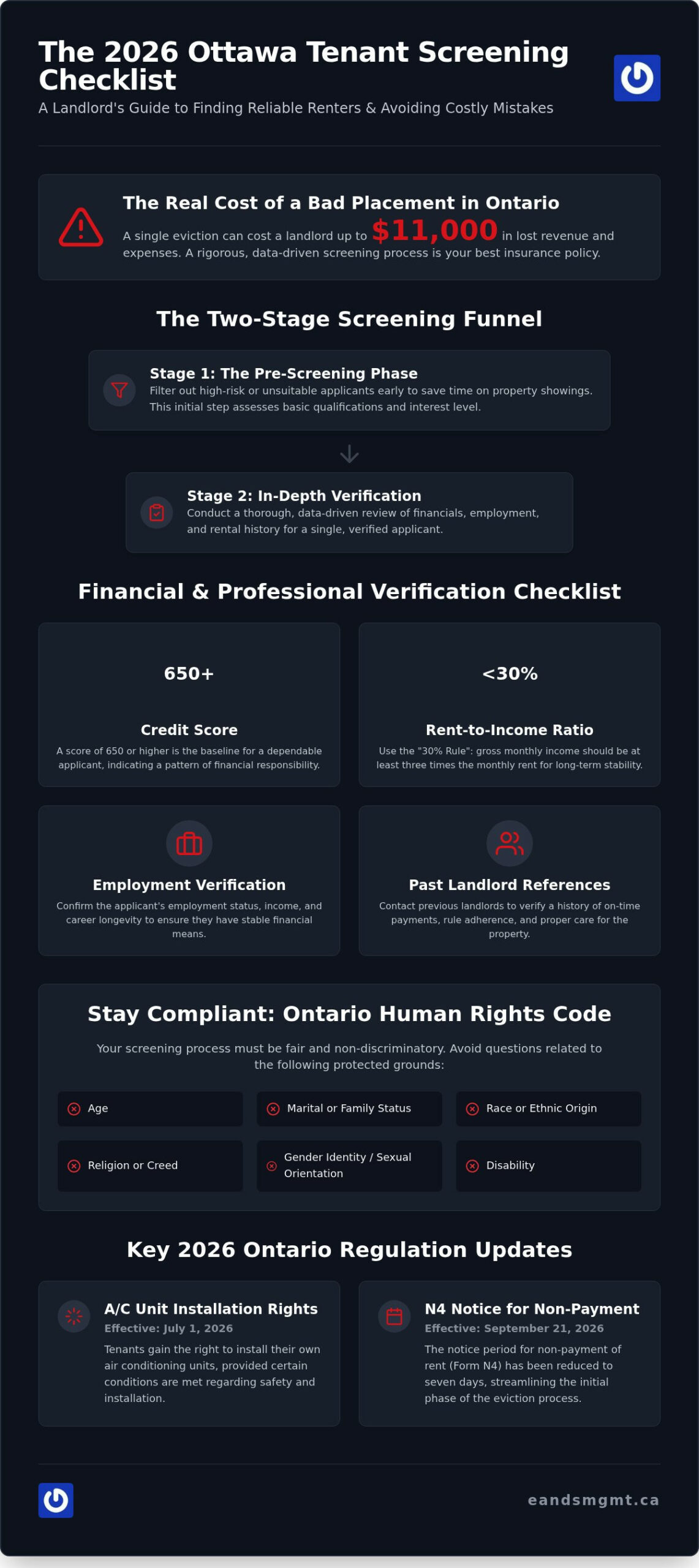
Did you know that a single bad placement in Ontario can cost a landlord as much as $11,000 in eviction expenses and lost revenue? For Ottawa property owners, especially those serving abroad or balancing a demanding career, that figure represents more than just a financial loss; it’s a source of deep, persistent anxiety. It is a heavy burden to carry when you are simply trying to protect your home and ensure your investment remains a stabilizing force in your life.
We understand that you want to be a fair, professional landlord, but the fear of non-paying tenants and the confusion over the Ontario Human Rights Code can make the process feel like a minefield. You aren’t alone in feeling that sifting through dozens of inquiries is a daunting task that takes up far too much of your limited time. This guide provides a comprehensive Ottawa tenant screening checklist for 2026, offering you a clear, legally-compliant path to finding reliable renters who will treat your property with care.
By following this structured framework, you’ll learn how to filter out high-risk applicants while staying firmly within provincial guidelines. We will walk you through essential financial verifications, the latest 2026 regulatory updates regarding air conditioning and N4 notice periods, and the specific red flags to watch for. This repeatable system is designed to replace your stress with the quiet confidence that your property is in good hands.
Key Takeaways
- Learn how to implement a two-stage screening funnel that filters out high-risk applicants before you invest time in property showings.
- Discover the specific “illegal questions” to avoid during interviews to ensure your process remains fully compliant with the Ontario Human Rights Code.
- Move beyond basic credit scores by using our Ottawa tenant screening checklist to verify long-term income stability and renter reliability.
- Understand the 2026 regulatory changes, including new notice periods and air conditioning rules, that impact how you manage new tenancies.
- Gain the clarity needed to decide between managing the screening process yourself or delegating to a professional Tenant Placement Service for total peace of mind.
The Foundation of a Reliable Ottawa Tenant Screening Checklist
Building a secure rental income starts with a perspective shift. You aren’t just looking for someone to fill a room; you’re selecting a temporary steward for your most significant financial asset. In Ottawa’s busy market, an effective Ottawa tenant screening checklist functions as a multi-stage funnel. This process begins the moment an inquiry hits your inbox and doesn’t conclude until the keys are safely in the tenant’s hands. By moving from a broad pool of applicants to a single, verified individual, you replace uncertainty with a structured path toward relief.
Relying on a “gut feeling” is a common trap that many well-meaning landlords fall into. Unfortunately, “professional tenants” often know exactly how to charm their way through an interview while hiding a history of non-payment. These individuals understand the complexities of the Landlord and Tenant Board (LTB) and may use those delays to their advantage. A rigorous, data-driven approach is the only way to see past a polished exterior. While you should always maintain a clear profile of your ideal tenant, this must be balanced with strict adherence to fair housing standards to ensure your process remains ethical and legal.
Why Screening is Your Best Insurance Policy
The financial impact of a poor placement can be devastating. Research shows that the average cost of an eviction for an Ontario landlord can climb as high as $11,000. This includes the loss of rent during lengthy LTB wait times, filing fees, and potential property damage. Tenant screening is a comprehensive risk-mitigation strategy designed to evaluate an applicant’s ability and willingness to fulfill their lease obligations while protecting the physical integrity of your property. A thorough tenant screening process acts as a shield, preserving your property value and your reputation within the neighborhood.
Ottawa-Specific Market Dynamics in 2026
The Ottawa landscape in 2026 presents specific challenges that require a localized strategy. Federal government hybrid work models have stabilized, creating a tenant base that often prioritizes home-office suitability over proximity to Tunney’s Pasture or downtown. This shift means you’ll likely face a high volume of inquiries for well-equipped units. Without a solid Ottawa tenant screening checklist, you could spend dozens of hours on unproductive showings.
You must also stay current with recent regulatory updates. As of July 1, 2026, Ontario tenants have the right to install their own air conditioning units under specific conditions. Additionally, the notice period for non-payment (N4) was reduced to seven days as of September 21, 2026. Understanding these nuances helps you select tenants who are not only financially stable but also prepared to follow the modern rules of the Ontario rental market.
Financial and Professional Verification: Beyond the Credit Score
Financial verification is the moment an applicant transitions from a name on a screen to a concrete financial partner. While the initial stages of your Ottawa tenant screening checklist focus on interest and fit, this phase requires a meticulous look at the numbers. It’s about ensuring the applicant has the means to honor their commitment without straining their own financial health. A reliable renter is one whose lifestyle and income exist in a sustainable balance, providing you with the long-term stability you deserve.
In the Canadian market, a credit score of 650 or higher is typically viewed as the baseline for a dependable applicant. However, the score is just a snapshot. You must also look at the rent-to-income ratio. A standard rule of thumb is the 30% rule, where the gross monthly income should be at least three times the monthly rent. This buffer protects both the tenant and your investment during unexpected life events or economic shifts. If the math doesn’t quite align, it might be time to look closer at their career trajectory and employment longevity.
The Anatomy of a Tenant Credit Check
When you pull a credit report, you are looking for patterns of responsibility. High debt loads or a history of late payments are significant red flags that suggest a tenant may struggle to prioritize rent. It’s also helpful to distinguish between “soft” inquiries, which don’t impact the applicant’s score, and “hard” inquiries. If a prospective tenant has a borderline score but excellent references and income, you might consider a co-signer or guarantor. This extra layer of security acts as a stabilizing force, giving you the peace of mind to proceed with an otherwise strong candidate.
Employment and Income Validation
Verifying income requires more than a quick glance at a pay stub. For standard employees, you should request T4s or recent Notices of Assessment (NOAs) to confirm annual consistency. Self-employed applicants may need to provide a more comprehensive view of their finances, such as bank statements or tax filings from the last two years. When you contact an employer, your goal is to confirm more than just a job title. You want to verify that the employment is permanent and stable. Staying informed on Ontario tenant screening laws ensures that your inquiries remain professional and legally compliant throughout this auditing process.
Managing these administrative details can feel like a full-time job, especially if you are balancing your own career or living abroad. If the thought of auditing financial documents feels like a heavy burden, a dedicated tenant placement service can provide the professional oversight you need to move forward with confidence.
The Pre-Screening Phase: Saving Time and Filtering Early
Managing a vacancy in a high-demand market can quickly become a full-time job. You might receive dozens of inquiries within hours of posting an ad, many of which are from applicants who haven’t fully read the listing. This is where your Ottawa tenant screening checklist moves into its most efficient phase: the pre-screening filter. By implementing a structured response system, you protect your schedule and focus your energy only on those who meet your baseline criteria.
The goal here is to establish a clear distinction between a casual inquiry and a formal application. Before you agree to a showing, you should send a standardized set of questions. This “First Contact” filter gauges seriousness and ensures that the applicant’s needs align with your property’s availability. Adhering to Ontario’s Rules for Tenant Selection during this initial touchpoint ensures you are collecting necessary information, such as income and rental history, in a way that respects provincial standards. This step prevents the exhaustion of meeting unqualified applicants and keeps your process organized and professional.
Top 5 Questions to Ask Before the Showing
These questions are designed to reveal deal-breakers before you even leave your house. If the answers don’t align with your requirements, you can politely decline the showing and move on to the next candidate.
- When are you looking to move? If their timeline doesn’t match your vacancy date, there’s no need to proceed.
- How many people will be living in the unit? Ensure the number fits comfortably within local occupancy bylaws and your property’s capacity.
- Do you have any pets? While you generally can’t ban pets in Ontario, knowing the types and sizes helps you prepare for the showing and discuss potential wear and tear.
- What is your preferred lease term? Most Ottawa landlords look for a minimum one-year commitment to ensure stability.
- Why are you moving? This open-ended question often reveals more than a credit score ever could, highlighting potential issues with previous landlords or sudden lifestyle changes.
The Art of the Phone Interview
A five-minute phone call provides a sense of relief that a text message simply cannot. This brief conversation allows you to hear the person behind the paperwork, gauging their communication style and reliability in real-time. If an applicant is evasive or consistently misses scheduled calls, it’s a signal that they may not be the right fit for a professional, respectful relationship. Use this time to set expectations and explain the next steps on your Ottawa tenant screening checklist. A candidate’s tone and transparency during this call often predict their future behavior as a tenant, allowing you to move forward with a candidate who values clear, professional communication as much as you do.
Navigating the Ontario Human Rights Code and Legal Compliance
Compliance isn’t just a legal hurdle; it’s the foundation of a professional relationship. Many landlords feel a sense of dread when navigating the Ontario Human Rights Code, fearing a simple mistake could lead to a costly tribunal hearing. A standardized Ottawa tenant screening checklist acts as your protective shield, ensuring you treat every applicant with the same level of care and fairness. By following a set system, you move from the stress of guesswork to the relief of a legally sound process.
One of the most critical steps in maintaining compliance is knowing which questions are strictly off-limits. In Ontario, your inquiries must focus on the applicant’s ability to be a good tenant, not their personal identity. You can’t ask about their plans for a family, their religious beliefs, or their place of origin. Specifically, avoid questions like “Are you planning to have children?”, “What is your ethnic background?”, or “Are you currently on social assistance?” These are considered discriminatory under provincial law. Even well-meaning questions about a person’s accent or marital status can trigger a human rights complaint if they influence your decision.
Protecting sensitive data is equally important. Under PIPEDA, you’re responsible for the secure storage and eventual destruction of an applicant’s social insurance number, credit report, and income statements. Once you’ve selected your renter, ensure you use the most current version of the Ontario Standard Lease for 2026. This document is mandatory for most residential tenancies and protects both parties by clearly outlining the rules of the home. Using the latest version ensures you’re compliant with recent changes to the Residential Tenancies Act.
Protected Grounds in Ontario
You must respect protected grounds such as family status, disability, and source of income. For instance, you cannot decline an applicant simply because their income comes from government assistance or social programs. Similarly, “No Pets” clauses are generally void in Ontario. While it’s tempting to look for reasons to say no, your decision must always be based on objective data like credit history and verified references. If you find these legal complexities overwhelming, our Tenant Placement Service can handle the entire process with professional precision and care.
Reference Checks: The Right Way to Ask
References are the final piece of the puzzle. While character references from friends provide some insight, they rarely offer the professional picture you need. Instead, focus on speaking with a previous landlord rather than the current one. A current landlord might be tempted to give a glowing review just to see a difficult tenant move on. A previous landlord has no such incentive and is more likely to provide an honest account of payment history and property care. Ask specific questions about whether they ever issued an N4 for late rent or if there were complaints regarding noise or maintenance.
Implementing Your System or Delegating to Ottawa Experts
Once you’ve gathered all the data from your Ottawa tenant screening checklist, the final step is moving from analysis to action. Making the final decision can feel like a heavy responsibility, as you are choosing the person who will live in your most personal asset. To remove the weight of emotion, many successful landlords use a weighted scoring system. By assigning points to objective criteria like credit stability, income-to-rent ratios, and the quality of previous landlord references, you create a clear, data-driven winner. This methodical approach provides a sense of relief, knowing your choice is backed by facts rather than just a fleeting impression.
The transition from “Approved” to “Leased” should be swift and professional. Once you have a verbal agreement, move immediately to the signing of the 2026 Ontario Standard Lease and collect the last month’s rent deposit. This deposit acts as a stabilizing force, securing the tenant’s commitment and allowing you to stop the marketing process. If an applicant hesitates at this stage, it may be a sign to revisit your runner-up candidates. Clear communication during this phase sets the tone for the entire tenancy, establishing you as a reliable and organized property owner.
The Remote Landlord Checklist
Managing an Ottawa property from a different time zone or while posted abroad presents unique challenges that a standard checklist might not fully cover. You’ll need a suite of digital tools to bridge the distance, including platforms for virtual showings and secure electronic signatures. However, technology can’t replace a local “boots on the ground” representative who can walk through the property and verify its condition. For non-resident owners, staying compliant with the Canada Revenue Agency is a vital administrative task. This includes managing NR6 undertakings and ensuring the correct NR4 tax withholdings are filed, tasks that require a meticulous hand to avoid significant penalties.
The E&S Advantage: 40 Years of Ottawa Expertise
Since 1981, we’ve acted as a protective guardian for Ottawa landlords, specializing in the specific needs of Foreign Service and DND members. We understand that your property is often your home, and we treat the selection process with the active protection it deserves. Our proprietary screening process goes beyond the basics, leveraging over 40 years of local wisdom to identify the most reliable renters in the capital. We handle the entire cycle of tasks, from professional photography and marketing to rigorous credit verifications and the final move-in inspection. Let E&S find your next perfect tenant—contact our Ottawa team today.
Securing Your Peace of Mind in the Ottawa Rental Market
Mastering the Ottawa tenant screening checklist is about more than just filling a vacancy. It’s about protecting your financial future and ensuring your property remains a source of stability rather than stress. By implementing a rigorous pre-screening funnel and conducting deep financial audits, you’ve taken the first steps toward a worry-free tenancy. You now have the tools to navigate the Ontario Human Rights Code with confidence, ensuring your process is as fair as it is thorough.
We know that managing these complexities can feel overwhelming, especially if you’re serving abroad or balancing a busy career. With over 40 years of experience in the Ottawa market, we specialize in supporting Foreign Service members and non-residents with comprehensive screening and essential NR6 and NR4 tax filing support. You don’t have to carry the burden of tenant placement alone. Secure Your Investment with Professional Tenant Placement and let a seasoned expert act as the dedicated steward for your home. You deserve the quiet confidence that comes with a perfectly matched tenant.
Frequently Asked Questions
Is it legal to ask for a credit check in Ontario?
Yes, it’s legal and highly recommended to include a credit check as part of your Ottawa tenant screening checklist. According to Ontario’s Rules for Tenant Selection, landlords can request credit information and reports to help assess an applicant’s financial reliability. This data provides a clear picture of their history with debt and bill payments. Most professional screening services in Canada cost between $25 and $75 per applicant to obtain these detailed reports.
Can I refuse a tenant with a pet in Ottawa?
In most cases, you cannot refuse a tenant simply because they have a pet once the lease is signed. Section 14 of the Residential Tenancies Act makes “no pet” provisions in a lease void. However, you can choose not to rent to an applicant with a pet during the initial screening phase. Once they move in, you can only seek eviction through the LTB if the pet causes damage, allergic reactions, or safety issues.
How much can I charge for a rental application fee in Ontario?
You cannot charge any amount for a rental application fee in Ontario. It’s illegal for landlords to require “key money” or any non-refundable fee just to process an application or consider a candidate. You are only permitted to collect a rent deposit, which is typically the last month’s rent, once a lease agreement is reached. Any administrative costs for screening are considered the landlord’s own cost of doing business.
What is the most important question to ask a previous landlord?
The most revealing question to ask a previous landlord is, “Would you rent to this person again?” This simple inquiry cuts through generic praise and forces the reference to consider the tenant’s overall impact on their property and peace of mind. You should also verify if the tenant ever received an N4 notice for non-payment, as the notice period for these was reduced from 14 to 7 days as of September 2026.
Can I ask for a tenant’s SIN (Social Insurance Number)?
You can ask for a Social Insurance Number, but an applicant is not legally required to provide it. While a SIN makes it easier to pull an accurate credit report, many tenants prefer to protect this sensitive data. If they decline, you must use other identifiers like their full name and date of birth to conduct your background check. Always ensure you store this information securely to remain compliant with provincial privacy laws.
What happens if a tenant lies on their rental application?
If a tenant lies on their application, it can be grounds for the Landlord and Tenant Board to terminate the tenancy. This is especially true if the lie involves material facts like income or rental history that would have changed your decision to rent to them. Discovering these discrepancies early is why a thorough Ottawa tenant screening checklist is vital. It’s much easier to decline a dishonest applicant than to navigate a complex eviction process.
How do I screen tenants if I am living outside of Canada?
Screening from abroad requires a blend of digital tools and trusted local oversight. You should use secure platforms for virtual tours and electronic lease signings to manage the process across time zones. For many of our clients in the Foreign Service, delegating to a professional team ensures a “boots on the ground” presence for physical inspections. We also assist with NR6 and NR4 tax compliance to protect your non-resident financial interests and peace of mind.
What are the income requirements for a tenant in Ottawa?
A common industry standard is that a tenant’s gross monthly income should be at least three times the monthly rent. This 30% rule ensures they have enough buffer to cover other living expenses and stay current on payments. When verifying this, look for stability in their employment history rather than just a high salary. Consistent income over several years is often a better predictor of long-term reliability than a recent, large pay increase or a new job.


