What if the legal complexities of the rental market weren’t a source of stress, but a clear framework for your success? For many property owners in Ontario, the constant evolution of the Residential Tenancies Act feels like a moving target. You might be worried about the long wait times for hearings or feel overwhelmed by the recent shifts in Bill 97 and Bill 60. It’s completely natural to feel a sense of unease when the rules seem to change just as you’ve finally learned them. Understanding the landlord tenant board ontario rules for landlords shouldn’t feel like a full-time job, yet the stakes for your investment have never been higher.
We’re here to help you trade that uncertainty for a sense of calm and professional order. In this comprehensive 2026 guide, we’ll show you exactly how to master the latest compliance requirements to protect your property and your peace of mind. We’ll walk you through the essential updates, such as the new seven-day N4 notice period and the 2.1% rent increase guideline. By the end of this article, you’ll have a reliable roadmap to handle tenant issues with confidence, ensuring your cash flow remains steady and your legal risks are minimized.
Key Takeaways
- Learn the fundamental differences between the Residential Tenancies Act and LTB procedures to ensure your rental property remains in full legal standing.
- Navigate the landlord tenant board ontario rules for landlords with confidence by mastering 2026 requirements for entry notices and the 2.1% rent increase guideline.
- Understand the critical September 2026 updates to N4 and N12 notices to streamline your eviction processes and protect your monthly rental income.
- Discover a strategic five step framework for documentation that transforms your daily tenant interactions into a powerful shield against legal loopholes.
- See how professional tenant placement and management services act as a stabilizing force, reducing your stress by handling complex compliance on your behalf.
Understanding the Residential Tenancies Act (RTA) and the LTB
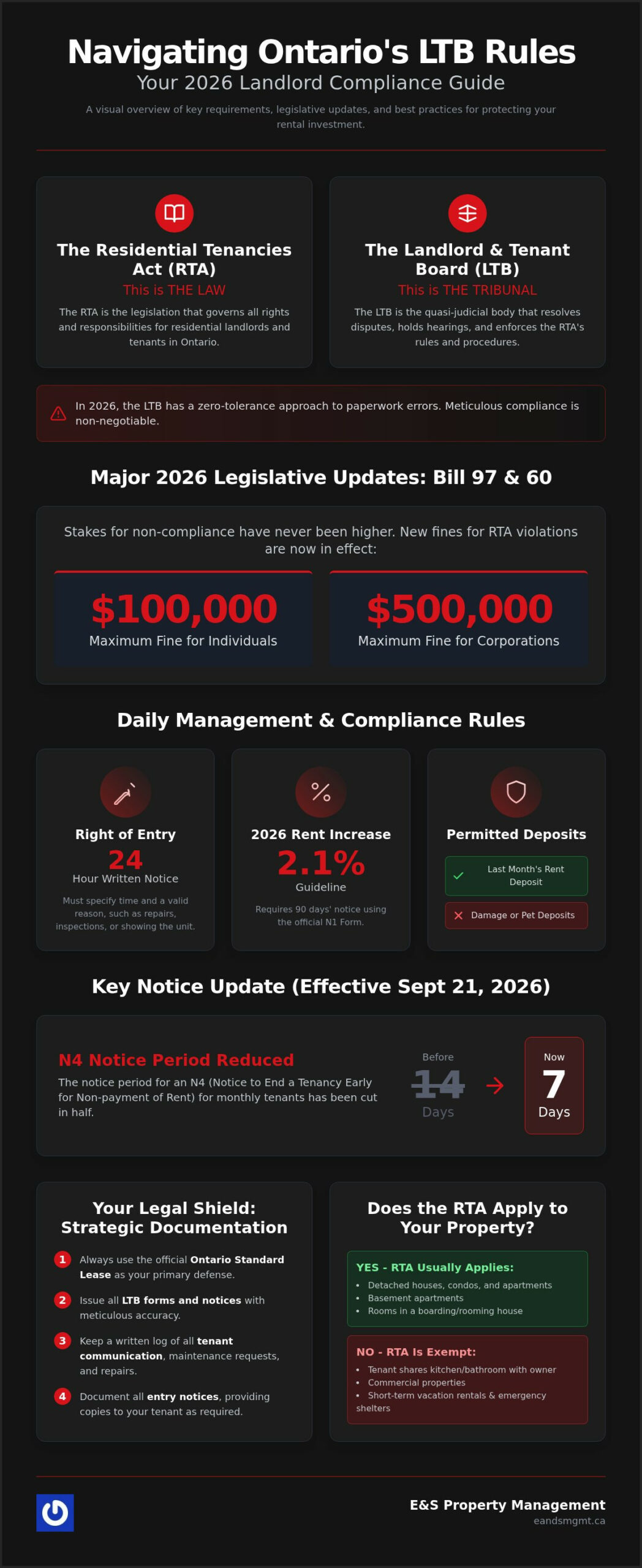
The Landlord and Tenant Board (LTB) is the quasi-judicial body responsible for resolving disputes between residential landlords and tenants and providing information about their respective rights and responsibilities. While the Residential Tenancies Act (RTA) serves as the actual law governing these relationships, the LTB’s Rules of Procedure dictate the specific administrative steps and deadlines required to enforce that law. In 2026, the landscape of the landlord tenant board ontario rules for landlords has shifted toward a zero-tolerance approach for paperwork errors. This makes using the Ontario Standard Lease more than just a suggestion; it’s your primary defense against costly delays. While some owners feel the system is weighted against them, the reality is that the LTB rewards landlords who demonstrate meticulous, professional compliance with every statutory requirement.
Who is Covered Under Ontario Rental Rules?
Not every living arrangement falls under these regulations. Understanding where your property sits is the first step in protecting your investment. For most Ottawa landlords renting out detached houses or condos, the rules are firm. However, there are specific exemptions where the RTA does not apply:
- Situations where the tenant shares a kitchen or bathroom with the owner or the owner’s immediate family.
- Commercial properties that don’t include a residential living component.
- Short-term vacation rentals or emergency shelters that fall outside standard residential tenancies.
Owners of condos must also balance RTA requirements with their specific Condominium Corporation bylaws. For our clients in the Foreign Service who rent out their primary residences while posted abroad, your home is subject to these same provincial rules. Your status as a non-resident doesn’t exempt you from the landlord tenant board ontario rules for landlords, which is why having a seasoned hand to manage these details provides such essential relief.
Key Legislative Changes in 2026
Legislative updates from Bill 97 and Bill 60 have fundamentally altered the pace and penalties of the rental industry. Bill 97, known as the Helping Homebuyers, Protecting Tenants Act, introduced stricter requirements for “own use” evictions and significantly increased the financial stakes for non-compliance. As of July 1, 2026, individual fines for RTA violations have reached $100,000, while corporations face up to $500,000.
Bill 60 has provided the LTB with additional resources to finally address the backlog of hearing delays that caused so much anxiety for owners in previous years. These changes aim for a more efficient system, but they also mean that “bad faith” actions are identified and penalized more swiftly than ever before. Staying ahead of these changes isn’t just about following the law; it’s about maintaining the stability of your financial future.
The Rules of the Road: Daily Management and Compliance
Daily management requires a delicate balance between respecting a tenant’s home and protecting your property. One of the most common pitfalls involves entry rights. Under the LTB Rules of Procedure, you must provide a written 24-hour notice that specifies the time and reason for entry. Mastering these landlord tenant board ontario rules for landlords is essential for maintaining a professional relationship with your tenants. Valid reasons include repairs, inspections, or showing the unit to prospective buyers. Maintenance is another area where the law is uncompromising; you are responsible for keeping the unit in a good state of repair even if the tenant signed a lease saying otherwise.
For 2026, the rent increase guideline is capped at 2.1%. To implement this, you must use the N1 form and provide 90 days’ notice. Keep in mind that Ontario strictly prohibits “damage deposits” or “pet deposits.” You can only collect a rent deposit for the last month’s rent. If these administrative hurdles feel heavy, a full-service property management team can handle these notices with surgical precision.
Rent Collection and the N4 Process
Collecting rent is the heartbeat of your investment, but when payments are missed, it creates immediate anxiety. Effective September 21, 2026, the notice period for an N4 (Notice to End a Tenancy Early for Non-payment of Rent) has been reduced from 14 days to just 7 days for monthly tenants. This change allows for a faster resolution, but we always recommend a supportive first step. Reach out to the tenant immediately to understand the delay. Often, a simple conversation can resolve the issue without a formal hearing. Professional oversight ensures that these timelines are monitored daily, so rent never simply slips through the cracks.
Maintenance Standards and Ottawa Climate Factors
Ottawa’s harsh winters bring specific legal obligations. The city’s heat bylaw requires landlords to maintain a minimum temperature of 20°C from September 1 to June 15. Failing to meet this standard can lead to immediate LTB intervention. Snow removal is another critical duty; while you can contract a tenant to clear snow, the ultimate legal liability for slip-and-fall accidents remains with you. Our team performs regular property inspections to identify potential issues before they become emergencies. This proactive care is a cornerstone of the landlord tenant board ontario rules for landlords, as it prevents tenants from filing maintenance-related counterclaims during non-payment hearings.
Ending a Tenancy: Navigating Evictions and Notices
Ending a tenancy is often the most stressful part of property ownership. Whether you’re moving back into your home or selling your investment, the landlord tenant board ontario rules for landlords dictate a very specific path. For personal use evictions (N12), a significant change arrived on September 21, 2026. You’re no longer required to pay the standard one month rent compensation if you provide at least 120 days’ notice. This encourages longer transition periods, which often benefits both parties. If you’re selling a property in Ottawa and the buyer intends to move in, the process is similar but requires a signed Agreement of Purchase and Sale before the notice can be issued.
While formal notices are necessary tools, we often find that an N11 (Agreement to End the Tenancy) is the most empathetic and efficient solution. It represents a mutual decision, providing clarity for the tenant and security for you. Conversely, be extremely cautious with N13 “renoviction” notices. As of September 2026, you must provide tenants with regular progress updates on renovations. Failure to do so, or ignoring a tenant’s right of first refusal to move back in at the previous rent, can lead to substantial legal repercussions. For a clearer understanding of these dynamics, the official guide on Renting in Ontario: your rights is an excellent starting point.
The “Good Faith” Requirement in 2026
The LTB now applies a rigorous “good faith” test to every N12 application. To succeed, you must genuinely intend to occupy the unit for at least 12 months. For our Foreign Service clients returning to Ottawa, documenting your relocation orders is vital evidence of your intent. If the LTB finds an eviction was pursued in “bad faith”, such as re-listing the unit at a higher price shortly after the tenant leaves, the penalties are severe. Individual fines have climbed to $100,000, while corporations face up to $500,000. These figures underscore why following the landlord tenant board ontario rules for landlords with total precision is non-negotiable.
The LTB Hearing Process: What to Expect
If a tenant doesn’t vacate by the notice date, you’ll need to file an application through the Tribunals Ontario Portal. The process generally follows a set path: filing, serving the notice of hearing, and attending a virtual session. Mediation is almost always offered first. It’s a chance to reach a settlement with a neutral third party before a member makes a final Order. While Bill 60 has helped reduce the backlog, wait times for hearings in the Ottawa area as of late 2026 still average several months. Planning your timelines with this reality in mind is the best way to protect your cash flow and sanity.
The Landlord Paper Trail: Strategic Documentation
In the eyes of a tribunal member, a verbal agreement is often as invisible as the air around it. The golden rule for any successful rental operation is simple: if it isn’t in writing, it didn’t happen. Mastering the landlord tenant board ontario rules for landlords requires more than just knowing the law; it requires undeniable proof of your actions. When a tenant claims they never received a notice or that a repair was ignored, your documentation is the only shield that matters. Strategic record-keeping transforms a “he-said, she-said” dispute into a clear, factual narrative that the LTB can act upon.
To keep your investment secure, follow this five step framework for every tenant interaction:
- Initiate: Every request or notice starts with a formal, written document.
- Acknowledge: Send a brief confirmation when a tenant reaches out, even if the solution isn’t immediate.
- Execute: Document the date and time of any repairs or inspections.
- Verify: Obtain a written sign-off or follow-up email from the tenant confirming the issue is resolved.
- Archive: Store every photo, email, and invoice in a dedicated property folder.
Move-in and move-out inspection reports are perhaps the most vital pieces of this trail. By taking high-resolution photos and completing a detailed room-by-room checklist, you create a baseline for the property’s condition. This prevents “rent abatement” claims where tenants argue the unit was in disrepair from the start. If you’re ready to trade the stress of record-keeping for the peace of professional oversight, our full-service property management ensures every detail is captured with surgical precision.
Standardizing Communication
While a quick text might seem convenient, email is the preferred standard for LTB evidence. It provides a clear timestamp and is easily searchable. For every formal notice served, you must also complete a “Certificate of Service.” This document is your sworn statement of how and when the notice was delivered. Without it, your application might be dismissed before the hearing even begins. We utilize digital management portals that automatically track these communications, creating an airtight audit trail that protects you from administrative errors.
Financial Record Keeping and CRA Compliance
Your paper trail extends deep into your financial reporting. You must maintain a precise ledger of every rent payment received and provide receipts to tenants upon request. For our clients living abroad, these records are doubly important for NR6 and NR4 tax filings. Linking maintenance invoices to specific LTB-mandated repairs is also a smart strategy. If you ever need to justify a capital expenditure or prove you fulfilled your maintenance duties, having an organized file of contractor invoices and corresponding tenant requests makes the process effortless. It’s this level of meticulous care that separates a vulnerable landlord from a protected investor.
Professional Management: Your Shield Against LTB Stress
Managing a rental property in Ottawa often feels like a balancing act where the stakes are your financial security and personal time. The complexities of the landlord tenant board ontario rules for landlords are designed to be thorough, but for an individual owner, they can quickly become overwhelming. This is where E&S Property Management steps in as a stabilizing force. We act as your dedicated steward, navigating every administrative hurdle and legal requirement so you don’t have to carry that burden alone. With over 40 years of experience in the Ottawa market, we understand the local nuances of the LTB that purely digital or less experienced services might miss.
Professional tenant screening is your most effective LTB defense. By conducting rigorous credit checks, background verifications, and reference reviews, we identify reliable tenants who respect the lease and the law. This proactive approach significantly reduces the likelihood of non-payment or behavioral issues that lead to hearing delays. When maintenance needs arise, our emergency 24/7 maintenance response ensures that your property always meets the heat and safety standards required by the RTA, protecting you from liability and tenant counterclaims.
The E&S Advantage for Foreign Service Landlords
For owners posted abroad, the distance can magnify the anxiety of the unknown. We specialize in providing peace of mind for Foreign Service members, ensuring your home remains RTA-compliant while you are away. Beyond the landlord tenant board ontario rules for landlords, we seamlessly handle specialized requirements like NR6 and NR4 tax filing support. You can delegate the logistical weight of your investment to a seasoned hand, knowing that your property is being cared for by a partner who understands both the technical and emotional value of your asset. This transition from stress to relief is at the heart of what we do.
Next Steps: Securing Your Ottawa Investment
Protecting your investment starts with a clear understanding of where you stand today. We encourage a proactive assessment of your rental practices to identify any potential compliance gaps before they become costly problems. You don’t have to navigate the LTB alone. Our methodical approach and end-to-end support transform the stress of property ownership into a sense of order and reliability. Protect your investment with E&S Full-Service Management and experience the relief of professional oversight.
Securing Your Rental Legacy in 2026 and Beyond
Mastering the landlord tenant board ontario rules for landlords is about transforming a complex legal landscape into a predictable, manageable framework. Success in today’s market relies on more than just intuition. It requires meticulous documentation, a deep understanding of the 2026 legislative updates, and a proactive approach to property maintenance. Whether you’re navigating the new N4 notice timelines or ensuring your Ottawa rental meets strict winter heat standards, the goal remains the same: protecting your investment while maintaining professional tenant relationships.
You don’t have to carry the weight of these administrative burdens alone. With over 40 years of residential expertise in Ottawa, we specialize in the unique needs of Foreign Service members and non-resident landlords. Our team provides comprehensive digital audit trails for every property, ensuring you remain fully compliant even when you’re posted thousands of miles away. It’s time to trade the anxiety of the unknown for the steady hand of a dedicated partner.
Delegate your LTB compliance to Ottawa’s seasoned property experts at E&S. Your peace of mind is our priority, and we’re here to ensure your rental journey remains both profitable and stress-free.
Frequently Asked Questions
Can I evict a tenant in Ontario if I want to sell my house?
You cannot evict a tenant simply because you intend to list your property for sale. However, if you have a signed Agreement of Purchase and Sale and the buyer genuinely requires the unit for their own use, you can serve an N12 notice on their behalf. It’s often more effective to negotiate an N11 agreement to ensure the property is vacant for a smooth closing, as this provides certainty for both parties.
How much can a landlord increase rent in Ontario for 2026?
The maximum allowable rent increase for most residential units in Ontario is 2.1% for the 2026 calendar year. This guideline applies to any rent increase taking effect between January 1 and December 31, 2026. You must provide your tenant with at least 90 days’ written notice using the official N1 form. This predictable cap helps maintain stability for the 1.4 million rental households across the province while protecting your investment’s value.
What happens if a tenant refuses to leave after an N12 notice?
If a tenant remains in the property past the termination date on an N12 notice, you must file an L2 application with the Landlord and Tenant Board to obtain an eviction order. A notice itself does not end a tenancy; only the board has the authority to do so. Because hearing delays can be significant, ensuring your initial paperwork is flawless is the best way to prevent further setbacks in regaining possession of your home.
Is a landlord responsible for snow removal in Ottawa?
Yes, the landlord is ultimately responsible for snow removal and ensuring the property remains safe under Ontario’s maintenance standards. While you can enter into a separate contract with a tenant to perform these duties, you cannot simply include a clause in the standard lease that shifts this liability. In Ottawa’s climate, failing to clear snow properly can lead to serious legal consequences, which is why we coordinate reliable contractors for our clients.
How long does it currently take to get an LTB hearing in 2026?
As of late 2026, wait times for hearings in the Ottawa area typically range between five and seven months. While Bill 60 has provided more resources to address the backlog, the volume of applications remains high. This timeline underscores why following the landlord tenant board ontario rules for landlords is so critical. Avoiding disputes through professional tenant screening is far more efficient than waiting half a year for a resolution at a hearing.
Can I charge a pet deposit or a cleaning fee in Ontario?
No, you cannot legally charge a pet deposit, damage deposit, or cleaning fee under the landlord tenant board ontario rules for landlords. The only deposits permitted are for the last month’s rent and a refundable key deposit that does not exceed the actual replacement cost. Any lease clause requiring additional fees is void. Staying compliant with these rules helps you maintain a professional relationship with your tenants while avoiding potential fines from the board.
What is the “Right of First Refusal” for tenants during renovations?
The Right of First Refusal allows a tenant to move back into their unit after extensive renovations are finished, provided they gave written notice of their intent before moving out. They must be allowed to return at the same rent they were paying previously. Under the 2026 updates, you are now required to provide tenants with regular progress reports. Failing to honor this right can lead to the board awarding substantial compensation to the tenant.
How do I serve an N4 notice for non-payment of rent correctly?
To serve an N4 notice correctly, you must provide at least seven days’ notice for monthly tenants, following the legislative changes that took effect on September 21, 2026. The notice must clearly state the exact amount of rent owed and the deadline for payment. You can serve it in person, via mail, or by email if your lease agreement explicitly permits electronic service. Always complete a Certificate of Service to document exactly when and how the notice was delivered.