
Imagine receiving a notice that your tenant hasn’t paid rent, only to realize the rules for eviction notices changed just last week. For many property owners, the reality of managing a rental in 2026 feels like a constant race against shifting regulations and the looming shadow of the Landlord and Tenant Board backlog. Understanding your landlord rights ottawa is no longer just about knowing the basics of a lease; it’s about staying ahead of provincial updates and specific municipal bylaws that can make or break your investment’s stability.
We know how heavy the burden of property ownership can feel when you’re balancing the fear of property damage with the complexity of Ontario’s legal system. It’s perfectly normal to feel overwhelmed by the 2.1% rent increase cap or the new Rental Renovation Licence requirements starting in Ottawa. This guide promises to transform that anxiety into professional clarity, giving you a reliable framework to handle disputes and protect your equity with confidence. We will explore the shortened 7-day N4 notice period, the mandatory use of the Ontario Standard Lease, and the essential steps to ensure your property remains a source of relief rather than a source of stress.
Key Takeaways
- Gain clarity on how the Ontario Residential Tenancies Act interacts with specific municipal standards to ensure your property stays on the right side of the law.
- Learn to exercise your landlord rights ottawa with confidence, from securing full rent payments to accessing your unit for essential maintenance.
- Navigate the complexities of the Ottawa Rental Housing Property Management Bylaw and understand your right to pass through fines caused by tenant negligence.
- Master the specific legal forms and procedures required to resolve disputes, helping you move from the stress of uncertainty to the relief of a clear resolution.
- Discover how a structured approach to tenant screening and regular inspections acts as a stabilizing force for your residential investment.
Navigating the Legal Landscape: Landlord Rights in Ottawa
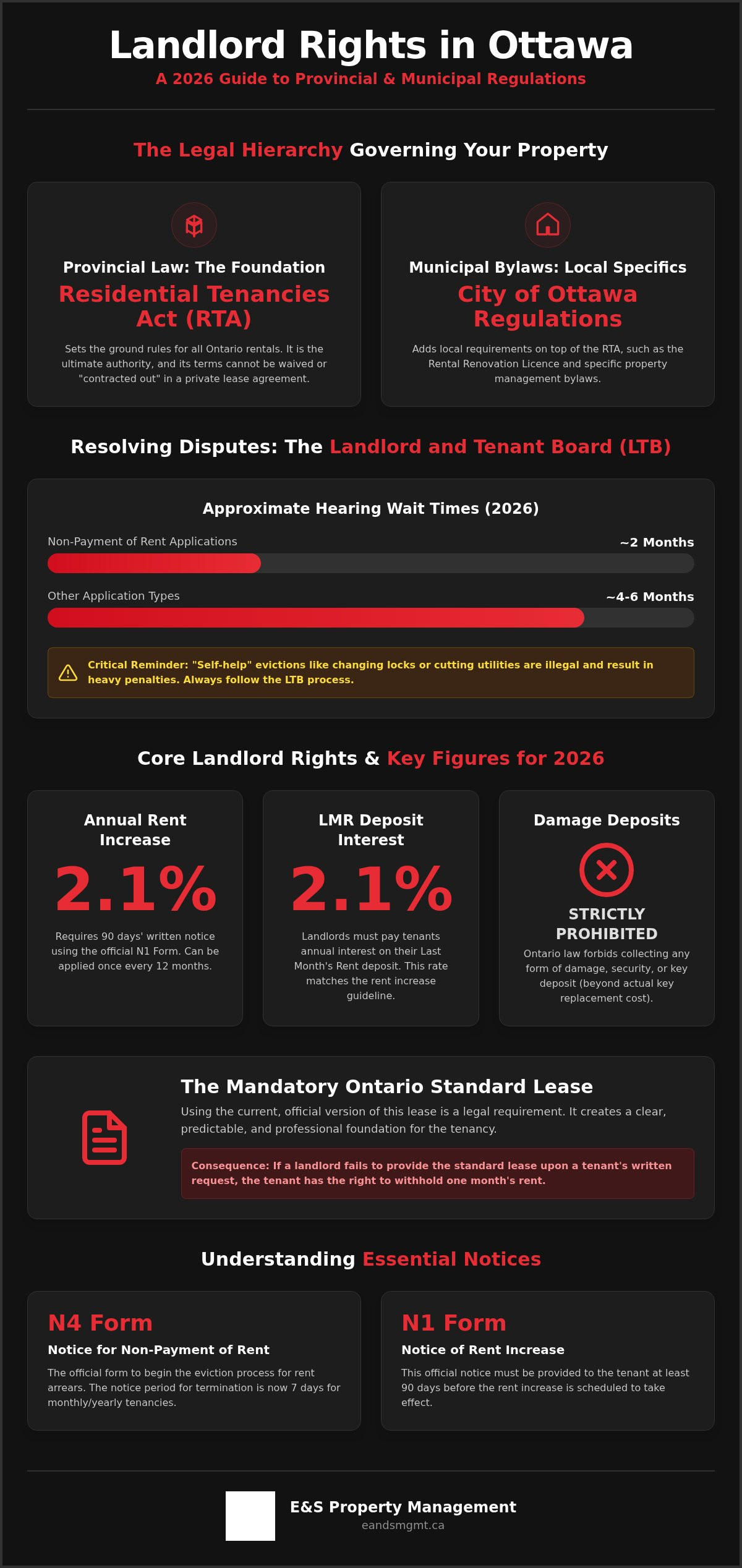
Owning property in the nation’s capital involves more than just handing over keys. It requires a clear understanding of the legal hierarchy that governs your investment. Your landlord rights ottawa are built on a foundation of provincial law, primarily the Residential Tenancies Act (RTA), which sets the ground rules for almost every residential interaction. While provincial law provides the broad strokes, Ottawa municipal bylaws add specific local requirements, such as the Rental Renovation Licence By-law. These layers of regulation might feel complex, but they serve a vital purpose: maintaining a high standard of housing for our community while protecting the financial health of your asset.
The Residential Tenancies Act (RTA) Explained
The RTA is the ultimate authority for residential rentals in Ontario. It’s designed to create a fair balance between owner and occupant. One crucial thing to remember is that you can’t “contract out” of the RTA. Even if a tenant signs a private agreement that says they waive certain rights, the RTA overrides those terms. This provincial framework applies to nearly all traditional rentals in Ottawa. It ensures both parties have a predictable set of rules to follow; this is the first step in moving from the stress of the unknown to the relief of a structured partnership.
The Role of the Landlord and Tenant Board (LTB)
When disagreements arise, the Landlord and Tenant Board acts as the primary adjudicator. Think of the LTB as a quasi-judicial body that resolves disputes through mediation or formal hearings. In 2026, we are seeing hearing wait times of approximately two months for non-payment of rent, while other applications generally take four to six months. While these delays can be frustrating, it’s essential to follow the formal process. Ontario law is very strict: landlords cannot take the law into their own hands by changing locks or cutting off utilities. Doing so can lead to heavy penalties and legal setbacks that far outweigh the temporary satisfaction of a “self-help” eviction.
A Professional Lease as Your Foundation
Exercising your landlord rights ottawa effectively starts with the Mandatory Ontario Standard Lease. Using the current version isn’t just a suggestion; it’s a requirement. If a landlord fails to provide the standard lease upon a tenant’s written request, the tenant may legally withhold one month’s rent. A professionally prepared lease acts as a protective shield. It clearly outlines expectations for rent collection, property access, and maintenance. By starting with professional clarity, you set a tone of mutual respect that often prevents disputes before they ever reach the LTB.
Core Landlord Rights: Rent, Access, and Maintenance
Protecting your financial interest starts with the fundamental right to receive rent in full and on time. While Ontario law is protective of tenants, it’s equally clear about your entitlement to the income your property generates. Exercising these landlord rights ottawa is not about being adversarial; it’s about maintaining a professional business relationship that ensures the property remains viable for everyone involved. Beyond rent, you have the right to expect that your tenants maintain a reasonable standard of ordinary cleanliness, which is a key factor in preserving the long-term value of your investment.
Rent Collection and Annual Increases
For 2026, the Ontario rent increase guideline is set at 2.1%. This means you can raise the rent by this percentage once every 12 months, provided you give your tenant at least 90 days’ written notice using the official N1 form. It’s also your right to collect a last month’s rent (LMR) deposit at the start of the tenancy. However, you must pay the tenant interest on this deposit annually, which for 2026 is also 2.1%. You can find more detailed guidance on these administrative duties through the City of Ottawa Landlord Resources. Keep in mind that Ontario law strictly prohibits damage deposits, so thorough vetting and regular oversight are your best defenses against property wear.
Right of Entry and Property Inspections
Maintaining your property requires regular access, and the law supports this through a structured notice system. You have the right to enter the rental unit for repairs, inspections, or to show the property to prospective buyers or tenants, provided you give 24 hours’ written notice. This entry must occur between 8:00 AM and 8:00 PM. In the case of a true emergency, such as a fire or a major flood, you have the right to enter immediately without notice to prevent further damage. These inspections are not just a right; they’re a vital part of proactive stewardship, allowing you to catch small maintenance issues before they become expensive repairs.
Many owners find that managing these schedules and notices becomes a heavy logistical burden. If the stress of coordinating inspections or serving legal notices feels overwhelming, you might consider delegating these tasks to a professional property management team. This allows you to exercise your rights with total confidence, ensuring your investment is cared for with a steady, experienced hand while you focus on your other priorities.
Ottawa-Specific Regulations: Bylaws and Municipal Standards
While provincial law provides the broad framework for tenancies, Ottawa’s municipal government adds specific layers of responsibility that every owner must master. These local bylaws cover the practical, day-to-day realities of living in the capital, from managing heavy snowfalls to maintaining interior temperatures during a deep freeze. Effectively exercising your landlord rights ottawa means knowing exactly where city rules intersect with your provincial obligations. This local knowledge is what separates a stressed property owner from a confident, professional landlord.
Ottawa’s Rental Housing Property Management Bylaw
The city has implemented a robust Property Management Bylaw that requires landlords to be more than just rent collectors. You’re expected to be a proactive manager. This includes maintaining a capital management plan for the property and keeping accessible maintenance logs that track repairs and inspections. You must also provide your tenants with a dedicated point of contact for emergency repairs and a copy of the city’s official tenant information sheet at the start of every lease.
If a municipal inspector issues a fine due to a tenant’s actions, such as ignoring waste sorting rules or blocking fire exits, you have the legal grounds to address this. While you’re initially responsible for the fine to the city, you can seek to recover these costs from the tenant. This process typically involves the Landlord and Tenant Board (LTB), where you can present evidence of the tenant’s negligence. Having a professional management team handle these logs and inspections can turn this complex administrative cycle into a simple, orderly process that protects your bottom line.
Vital Services and Maintenance Obligations
Ottawa’s specific climate means that “vital services” are a matter of safety. The city’s heat bylaw is precise: you must maintain a minimum temperature of 20°C in all residential units from September 1 until June 15. This is a non-negotiable duty, and you cannot cut off or interfere with the supply of heat, water, or electricity, even if rent is unpaid. However, your right to property oversight remains intact. You have the right to enter the unit, with the standard 24-hour notice, to inspect heating systems, check for water leaks, or ensure that municipal property standards are being met.
Waste management and exterior maintenance also fall under municipal scrutiny. In Ottawa, landlords are responsible for ensuring that garbage is properly stored and that snow is cleared from shared walkways and emergency exits. If your lease agreement includes specific tenant responsibilities for these tasks, ensure they align with the Mandatory Ontario Standard Lease to remain enforceable. By aligning your local maintenance schedule with provincial law, you create a stabilizing force that protects your property value and provides peace of mind for both you and your tenants.
Handling Challenges: Evictions, Damages, and Lease Violations
Facing a difficult tenant is one of the most taxing experiences for any property owner. Whether it’s persistent non-payment or concerns about property care, your landlord rights ottawa provide a clear, legal path to resolution. The key is moving away from emotional reactions toward a methodical, evidence-based approach. By following the specific procedures set by the province, you protect your investment while maintaining your professional reputation. This transition from conflict to clarity is where many landlords find the greatest relief.
The Legal Process for Eviction in Ontario
Ending a tenancy is a structured four-step process that requires absolute precision. Any error in dates or form selection can lead to a dismissal at the Landlord and Tenant Board, forcing you to start over from the beginning.
- Step 1: Serving Notice. You must use the correct N-form. Use an N4 for non-payment, an N5 for damage or interference, or an N8 for persistent late payments. It’s vital to note that as of September 21, 2026, the notice period for an N4 has been reduced from 14 days to 7 days.
- Step 2: Filing the Application. Once the notice period expires and the issue isn’t resolved, you file the corresponding L-form with the LTB to request a formal hearing.
- Step 3: The Hearing. You’ll present your evidence to an adjudicator. Given current 2026 wait times of two to six months, having a complete, organized evidence package is essential to avoid further delays.
- Step 4: Enforcement. If you receive an eviction order and the tenant doesn’t move, only the Court Enforcement Office (the Sheriff) has the authority to change the locks.
Dealing with Property Damage and Illegal Acts
Distinguishing between “reasonable wear and tear” and “undue damage” is a frequent point of confusion. Scuffed floors from years of walking are typically considered wear and tear; however, large holes in drywall or significant pet damage are undue damage. You have the right to seek compensation for these repairs through an L2 application. If a tenant is involved in illegal activity on the premises, your rights are even more robust, allowing for an expedited hearing process to protect the safety of the neighborhood and the integrity of your asset. Documentation, such as date-stamped photos and repair quotes, is your best tool in these scenarios.
Managing these high-stakes situations requires a level of documentation and legal knowledge that can be exhausting for individual owners. If you’re tired of the paperwork and the anxiety of potential hearings, our full-service property management provides the seasoned guardianship you need to handle disputes professionally and effectively. We act as your stabilizing force, ensuring every notice is served correctly and every right is fully exercised so you can enjoy true peace of mind.
Protecting Your Investment: Professional Management as a Legal Shield
The complexities of the Ontario Residential Tenancies Act and local municipal bylaws can turn a rewarding residential investment into a source of constant worry. Exercising your landlord rights ottawa doesn’t have to mean spending your evenings reading tribunal decisions or your weekends coordinating emergency repairs. Professional management serves as a stabilizing force, acting as a seasoned guardian that stands between you and the logistical burdens of property ownership. This approach transforms the management of your asset from a series of stressful events into an orderly, predictable process that prioritizes your peace of mind.
Mitigating Legal Risks with Expert Oversight
E&S Property Management acts as a vital buffer between you and your tenants, ensuring all communications and actions remain within the strict boundaries of Ontario law. By providing a 24/7 emergency maintenance response, we fulfill your legal obligation to provide vital services without requiring your personal presence during a crisis. Our team conducts meticulous move-in and move-out inspections, creating a comprehensive paper trail that is essential if you ever need to file a claim for damages. This level of thoroughness provides the relief that comes from knowing every administrative duty is handled with the precision of a firm founded in 1981.
The Value of Professional Tenant Placement
The most effective way to protect your rights is to choose a tenant who respects the property and the lease agreement from the very beginning. Our tenant placement service includes rigorous credit checks, employment verification, and deep-dive landlord references to ensure a reliable match. When you place a high-quality tenant, the need to exercise “eviction rights” drops significantly, saving you from the stress of the Landlord and Tenant Board backlog. We understand that a well-vetted tenant is the best defense against property damage and non-payment issues.
For our clients in the Foreign Service or those living abroad, we offer specialized support that extends beyond simple property care. We handle the complex CRA tax compliance requirements, including NR6 and NR4 filings, ensuring you remain fully compliant with Canadian regulations while you’re away. This end-to-end support ensures your interests are protected by a partner who is both technically proficient and emotionally intelligent. If you’re ready to secure your property’s future with a steady, experienced hand, you can protect your Ottawa investment with E&S Property Management and experience the transition from burden to balance.
Securing Your Rental Future with Confidence
Mastering the landscape of landlord rights ottawa is about more than just legal compliance; it’s about protecting the long-term value of your investment while maintaining your own peace of mind. We’ve explored how a clear understanding of the Ontario Residential Tenancies Act, combined with a proactive approach to Ottawa’s municipal bylaws, creates a stable foundation for any residential property. By prioritizing meticulous documentation and professional tenant screening, you move away from the anxiety of potential disputes and toward a predictable, rewarding ownership experience.
If the logistical weight of 24/7 maintenance coordination or the complexity of NR6 and NR4 tax filings for non-residents feels overwhelming, you don’t have to carry that burden alone. With over 40 years of local expertise since our founding in 1981, we act as a seasoned guardian for your interests. We provide the steady hand needed to navigate the Landlord and Tenant Board and everyday property management. Delegate the stress-Contact E&S Property Management today. You deserve a partner who understands the personal value of your asset and is dedicated to its active protection.
Frequently Asked Questions
Can I evict a tenant in Ottawa if I want to move back into my house?
Yes, you can serve an N12 notice if you or an immediate family member intends to move back into the unit. You must provide at least 60 days’ notice and compensate the tenant with an amount equal to one month’s rent. It’s a fundamental part of landlord rights ottawa, but it must be done in good faith. If the property is re-rented within a year, the LTB may view the eviction as bad faith.
How much notice do I need to give a tenant before entering the property?
You must provide at least 24 hours’ written notice before entering a rental unit for non-emergency reasons. This notice must specify the reason for entry and a time window between 8:00 AM and 8:00 PM. Common reasons include routine inspections or showing the unit to prospective buyers. In a true emergency, like a burst pipe or fire, you have the right to enter immediately without any prior notice.
What is the maximum rent increase allowed in Ottawa for 2026?
The maximum allowable rent increase for most residential properties in Ontario for 2026 is 2.1%. This guideline applies to units first occupied before November 15, 2018. You must provide your tenant with at least 90 days’ written notice using the official N1 form before the increase takes effect. Remember, you can only increase the rent once every 12 months to maintain compliance with provincial regulations.
Am I responsible for snow removal at my Ottawa rental property?
Legally, the landlord is responsible for snow removal and keeping the property safe under the Residential Tenancies Act and Ottawa’s municipal property standards. While you can sign a separate agreement with a tenant to handle snow clearing for compensation, it shouldn’t be a condition of the lease itself. Ensuring clear pathways is a vital duty that protects you from liability and potential municipal fines during our long winters.
Can I charge a security or damage deposit in Ontario?
No, you cannot legally charge a security or damage deposit in Ontario. The only deposits permitted are the last month’s rent (LMR) and a refundable key deposit that doesn’t exceed the actual replacement cost. If a tenant causes undue damage, you must seek compensation through the Landlord and Tenant Board rather than withholding funds from a deposit you aren’t legally allowed to collect or hold.
What happens if my tenant stops paying rent?
If a tenant stops paying rent, you should serve an N4 notice as soon as the rent is late. Starting September 21, 2026, the notice period for the tenant to pay or move out is 7 days. If they don’t pay within that timeframe, you can file an L1 application with the LTB for an eviction hearing. Prompt action is the best way to exercise your landlord rights ottawa and stabilize your cash flow.
Do Ottawa landlords need a specific license to rent out their property?
Ottawa doesn’t currently require a general license for all residential properties, but you must comply with the Rental Housing Property Management Bylaw. Additionally, starting January 1, 2027, landlords will need a Rental Renovation Licence to evict for the purpose of major repairs. Staying informed about these local shifts ensures you manage your property without running into unexpected municipal roadblocks or expensive administrative fines.
How does being a non-resident landlord affect my rights and taxes?
Your legal rights as a landlord remain the same, but your tax obligations change significantly. The CRA requires a 25% withholding tax on gross rent unless you file an NR6 form to pay tax on net income instead. We specialize in managing these NR6 and NR4 filings, providing a stabilizing force for Foreign Service members and expats who need professional oversight and tax compliance support while living abroad.


