
Imagine receiving a notice from the Landlord and Tenant Board because of a minor clerical error on a lease you believed was perfectly compliant. For many property owners in Ottawa and beyond, the weight of staying current with evolving legislation feels like a demanding second career. It’s completely natural to feel overwhelmed by the shifting landscape of landlord responsibilities ontario requires, especially with the 2026 rent increase guideline set at 2.1% and the significant procedural shifts introduced by Bill 60. You want to provide a safe, high-quality home while protecting your financial future, but the fear of a costly legal misstep can make the process feel heavy.
We’re here to help you trade that stress for lasting relief. This guide is designed to replace your anxiety with a clear, actionable roadmap, ensuring you navigate the Residential Tenancies Act with confidence and keep your rental investment both compliant and profitable. We’ll provide a definitive checklist of your mandatory duties, explain the difference between essential and elective maintenance, and break down exactly how the latest legislative updates impact your daily operations as a dedicated steward of your property.
Key Takeaways
- Understand how the Residential Tenancies Act serves as the legal foundation for every interaction and agreement with your tenants.
- Learn how to maintain a “fit” home and handle repairs effectively to meet the specific landlord responsibilities ontario mandates.
- Discover the precise notice requirements and privacy standards that ensure your tenants enjoy their space while you protect your long-term asset.
- Clarify the strict rules surrounding rent deposits, annual interest payments, and the essential tax filing obligations for non-resident owners.
- Identify how transitioning to professional stewardship can shield you from Landlord and Tenant Board disputes and simplify your journey as an investor.
The Residential Tenancies Act (RTA): The Foundation of Landlord Duties
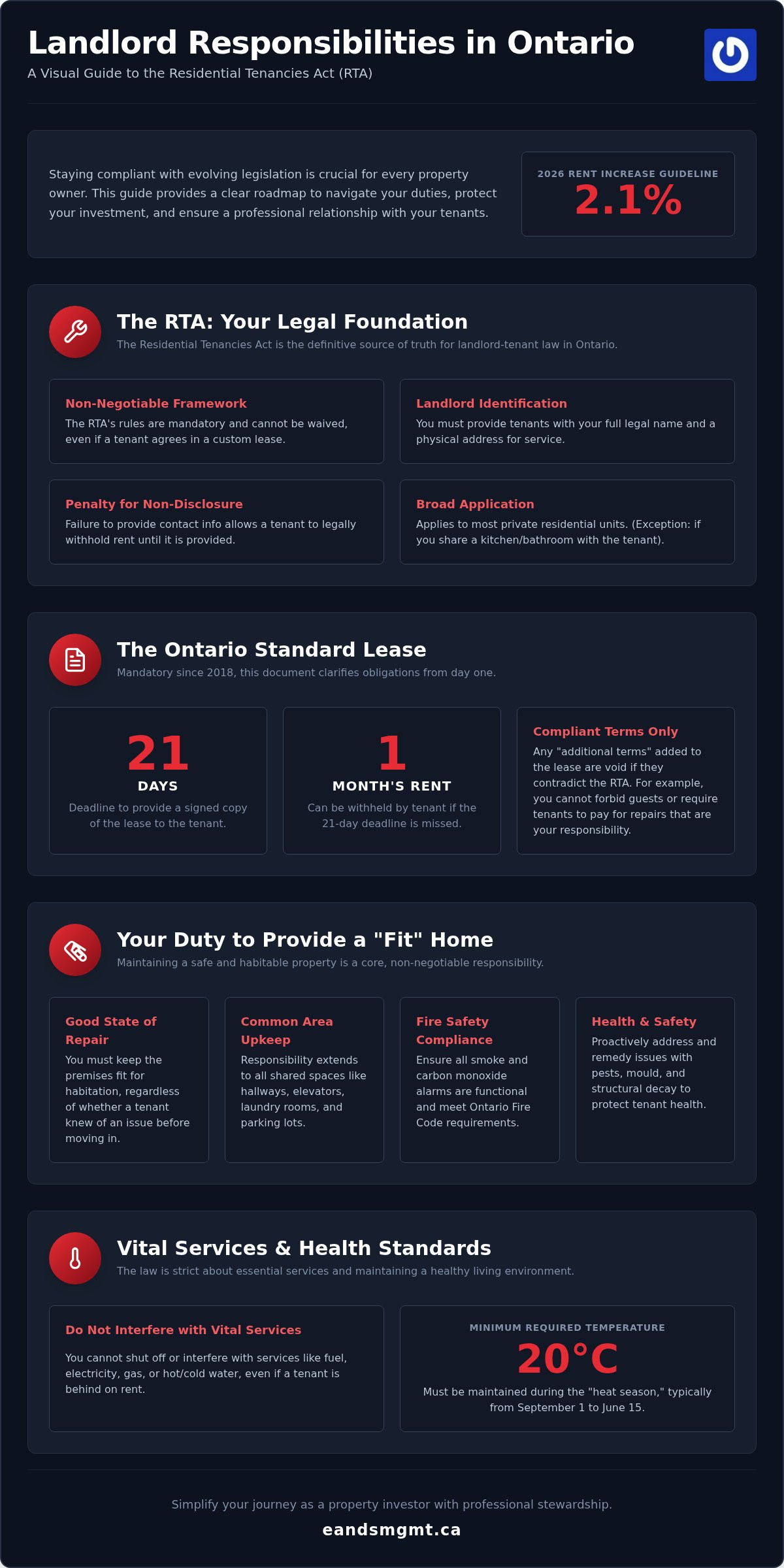
The foundation of every successful rental investment in this province is a deep understanding of the Residential Tenancies Act, 2006. This legislation isn’t merely a set of rules; it’s a comprehensive framework designed to balance the rights of property owners with the protections of those who call your property home. For anyone looking to master landlord responsibilities ontario, this act is the definitive source of truth. It governs everything from how you select a tenant to how you eventually end a tenancy.
Most private residential units in Ontario fall under this act. However, you should recognize that the RTA does not apply if you share a kitchen or bathroom with your tenant. In almost every other scenario, the law is the final word. You can’t “contract out” of these regulations. Even if a tenant signs a custom agreement agreeing to waive their rights to maintenance or notice, the Landlord and Tenant Board will view those clauses as void. The law exists to protect both parties, and it cannot be bypassed by a handshake or a private deal.
Understanding Your Legal Standing
Under the law, a landlord is defined broadly as anyone who permits a person to occupy a rental unit in exchange for rent. This role comes with immediate administrative duties. You’re legally required to provide your tenant with your full legal name and a physical address for service. This ensures there’s a clear line of communication and accountability. If you fail to provide this information, the law allows tenants to withhold rent until the details are shared. It’s a simple step that prevents significant friction later.
The Ontario Standard Lease
Since 2018, the Ontario Standard Lease has been mandatory for most new residential tenancies. This document was created to simplify the rental process and ensure everyone understands their obligations from day one. It covers essential details like rent amounts, utility responsibilities, and rules for smoking or pets. It’s a tool for clarity.
When you sign a lease, you must provide a fully executed copy to your tenant within 21 days. If you miss this deadline, the tenant has the right to withhold one month’s rent. While you can add “additional terms” to the lease, they must remain compliant with the RTA. For instance, you cannot include a clause that forbids guests or requires a tenant to pay for repairs that are legally your responsibility. Keeping your lease standard and transparent is the first step toward a peaceful, professional relationship.
Maintenance and Safety: Your Duty to Provide a “Fit” Home
Maintaining a rental property is about more than just preserving a financial asset; it’s about providing a safe sanctuary for the people living inside. Under the law, you’re required to keep the premises in a good state of repair and fit for habitation. This obligation doesn’t waver even if a tenant was aware of a maintenance issue before they signed the lease. Whether it’s a flickering light in a shared hallway or a structural concern in the basement, the burden of repair sits squarely with the owner. According to the official LTB Maintenance and Repairs brochure, you must also comply with all local health, safety, and municipal property standards.
Meeting the full scope of landlord responsibilities ontario requires a proactive approach to property health. You are responsible for the upkeep of all common areas in multi-unit dwellings, including parking lots, elevators, and laundry rooms. Fire safety is equally critical. You must ensure that smoke alarms and carbon monoxide detectors are functional and meet the specific requirements of the Ontario Fire Code. Neglecting these duties doesn’t just lead to friction with tenants; it opens the door to significant legal liability and potential fines from the Landlord and Tenant Board.
Vital Services and Health Standards
The law is very protective when it involves vital services. These include fuel, electricity, gas, and both hot and cold water. You cannot shut these off or interfere with them, even if a tenant is behind on rent payments. In Ottawa, the “heat season” typically runs from September 1 to June 15. During this window, landlords must ensure the temperature in residential units stays at a minimum of 20 degrees Celsius. Beyond temperature, you’re also the guardian against mould, pests, and structural decay. Addressing a small pest issue or a minor leak immediately is far more cost-effective than dealing with a full-blown infestation or structural rot later.
Maintenance Coordination in Ottawa
Living in Ottawa brings specific seasonal challenges, especially when the temperature drops. Furnace inspections aren’t just a suggestion; they’re a necessity to prevent catastrophic failures in the middle of January. Snow removal is another area where landlord responsibilities ontario can become physically and legally taxing. While you might feel the urge to handle every leaky faucet or shovel every walkway yourself, the complexity of modern building codes and the unpredictability of emergencies often make professional maintenance coordination the more sustainable choice. Having a seasoned hand oversee routine preventative care ensures that minor repairs don’t transform into midnight crises while you’re trying to focus on your own life or career abroad.
Navigating Tenant Rights: Privacy, Notice, and Human Rights
Respecting a tenant’s privacy is a cornerstone of the landlord responsibilities ontario requires you to uphold. While you own the physical structure, the law grants your tenant the right to “quiet enjoyment.” This isn’t just about noise levels; it’s the right to live in the home without unreasonable interference or intrusion. Shifting your mindset to see the property as a tenant’s sanctuary helps prevent the friction that often leads to LTB disputes. When you respect these boundaries, you aren’t just following the law; you’re building a foundation of trust that protects your long-term investment.
Lawful Entry and 24-Hour Notice
You can’t simply stop by because you’re in the area. Unless there is a dire emergency, like a burst pipe or a fire, you must provide at least 24 hours’ written notice before stepping inside. This notice has to be specific. It must state the reason for the visit and provide a time window between 8:00 a.m. and 8:00 p.m. Common reasons include making repairs, performing a scheduled inspection, or showing the unit to prospective tenants or buyers. As outlined in A Guide to the Residential Tenancies Act, adhering to these windows is mandatory. If you enter without proper notice or outside these hours, you risk claims of harassment. It’s a simple administrative step that provides peace of mind for both you and your tenant.
Fair Housing and Anti-Discrimination
The Ontario Human Rights Code protects tenants from discrimination based on 16 prohibited grounds, including family status, age, and disability. This protection begins the moment you screen a potential applicant and continues until the day they move out. For instance, many owners are surprised to learn that “no pets” clauses are generally void under the RTA, unless the animal is dangerous or causes a severe allergic reaction for another resident. Your role involves more than just collecting rent; it includes a duty to accommodate reasonable requests, such as allowing a service animal or making minor modifications for accessibility. Using a professional, standardized screening process ensures you find the right fit for your property while staying firmly on the right side of the law. Treating every applicant with dignity is not only the right thing to do, it’s a vital part of being a sophisticated property owner.
Financial Responsibilities: Rent, Deposits, and Non-Resident Tax
Financial clarity is the backbone of a successful rental experience. In Ontario, the rules for handling money are strict and leave little room for error. One of the most common landlord responsibilities ontario involves the proper handling of deposits. You’re permitted to collect a rent deposit, but it can only be used for the last month’s rent. It’s illegal to collect damage deposits or “security” funds for cleaning. Additionally, you must pay your tenant interest on that deposit every year. For 2026, the interest rate is 2.1%, matching the provincial rent increase guideline. Providing a rent receipt is also a mandatory duty if a tenant requests one. It’s a simple administrative task that provides your tenant with the documentation they need for their own records or tax filings.
Rent Increases and the 2026 Guidelines
For 2026, the Ontario government has set the rent increase guideline at 2.1%. This is the maximum amount you can increase rent for most tenants without seeking special approval from the Landlord and Tenant Board. You must provide a minimum of 90 days’ written notice using the correct N1 or N2 form. If your property was first occupied for residential purposes after November 15, 2018, it’s exempt from this specific cap. However, the 90-day notice and 12-month frequency rules still apply to those units. Failing to use the proper form or providing insufficient notice can result in the LTB ordering you to refund the entire increase to the tenant. Precision in these filings isn’t just about paperwork; it’s about protecting your revenue stream.
Specialized Duties for Non-Resident Owners
If you’re a landlord living outside of Canada, your financial duties become significantly more complex. Mastering the specialized landlord responsibilities ontario demands of non-residents is vital for protecting your investment. The Canada Revenue Agency (CRA) generally requires a 25% withholding tax on gross rental income. This can be a heavy burden on your monthly cash flow. By filing an NR6 form, you can apply to withhold tax on your net income instead, which often provides much-needed relief. You’re also responsible for issuing NR4 slips by the end of March each year. Managing these filings requires meticulous attention to detail to avoid steep penalties and interest. We provide dedicated NR6 and NR4 tax filing support to ensure you remain fully compliant with the CRA while you’re posted abroad, giving you one less thing to worry about.
Managing the Burden: The Case for Professional Stewardship
After reviewing the legal and financial layers of landlord responsibilities ontario requires, it’s easy to see how a single investment can feel like a demanding second career. The mental weight of staying compliant with the Residential Tenancies Act, while also responding to midnight maintenance calls, creates a cycle of stress that many property owners find unsustainable. For many, the DIY approach eventually leads to a crossroads where the risk of a costly LTB mistake outweighs the benefits of self-management. This is where professional stewardship transforms a burdensome task into a secure, passive asset.
The Risk of Non-Compliance
Administrative errors are the most common reason landlords lose cases at the Landlord and Tenant Board. A simple typo on an eviction notice or a misunderstood rent increase guideline can lead to months of lost income and significant legal fees. Beyond the paperwork, poor tenant screening often results in difficult tenancies that drain your time and resources. We’ve spent over 40 years refining our Tenant Placement Service to identify reliable residents from the start. By acting as a protective barrier, we ensure your property remains compliant with every provincial regulation, shielding you from the unintentional RTA violations that catch many well-meaning owners off guard.
A Stabilizing Force for Your Investment
Since 1981, E&S Property Management has served as a stabilizing force for Ottawa owners, particularly those in the Foreign Service who are managing assets from across the globe. We understand the specific anxiety of being miles away when a furnace fails or a tenant has a dispute. Our Full-Service Property Management replaces that worry with a methodical, professional rhythm. We don’t just react to problems; we prevent them through Regular Property Inspections and a vetted network of contractors who deliver quality work without the “emergency” price tag. This proactive care preserves the long-term value of your home while keeping your tenants satisfied.
Choosing delegation isn’t about giving up control; it’s about inviting a seasoned expert to act as your dedicated steward. Whether you’re a busy local investor or a Foreign Service officer posted abroad, you deserve the peace of mind that comes from knowing your home is in capable hands. Our Financial Reporting and Accounting and Emergency 24/7 Maintenance Response provide the end-to-end support needed to keep your investment profitable and your life stress-free. If you’re ready to move from overwhelmed to relieved, we invite you to reach out for a professional rental assessment today.
Securing Your Legacy with Confidence
Owning property in Ottawa is a significant achievement, but the weight of landlord responsibilities ontario demands can often cloud the joy of your investment. We have explored how the Residential Tenancies Act serves as your legal compass, why maintaining a “fit” home is a non-negotiable duty, and the intricate financial filings required for non-resident owners. These complexities don’t have to be a source of constant anxiety. Since 1981, we’ve acted as a protective guardian for local homeowners and expats alike, providing the steady hand needed to navigate everything from 24/7 emergency maintenance to specialized NR6 and NR4 tax administration.
You don’t have to carry this burden alone. By delegating the daily logistical and legal hurdles to seasoned experts, you can return to focusing on your career and family with total confidence. We invite you to explore our Full-Service Property Management and discover the relief that comes with professional stewardship. Your property is a valuable asset; let’s work together to ensure it remains a source of prosperity and peace of mind for years to come.
Frequently Asked Questions
Can a landlord in Ontario refuse a tenant with a pet?
In Ontario, you generally cannot refuse a tenant simply because they have a pet. While you can choose not to rent to an applicant with a pet during the screening process, any “no pets” clause in a signed lease is considered void under the law. Exceptions only exist if the animal is dangerous, causes severe allergic reactions for other residents, or significantly interferes with the reasonable enjoyment of the premises.
How much notice must a landlord give to enter a unit in Ontario?
You must provide a minimum of 24 hours’ written notice before entering a rental unit for non-emergency reasons. This includes routine property inspections, repairs, or showing the home to prospective buyers. The entry must take place between 8:00 a.m. and 8:00 p.m., and your notice must specify the reason for the visit. Notice is not required if there is a genuine emergency, such as a fire or a flood.
What is the maximum rent increase allowed in Ontario for 2026?
The maximum rent increase guideline for 2026 is 2.1%. This cap applies to the majority of residential tenancies across the province. You’re required to provide your tenant with at least 90 days’ written notice using the official N1 or N2 forms. Remember that rent can only be increased once every 12 months, and units first occupied for residential purposes after November 15, 2018, are currently exempt from this cap.
Is a landlord responsible for snow removal in Ontario?
Yes, the landlord is legally responsible for snow removal and keeping the property’s exterior safe and clear of hazards. This is a core part of landlord responsibilities ontario mandates for property maintenance. While you can enter into a separate service contract with a tenant to handle these tasks, you cannot simply include a clause in the lease that shifts this responsibility to them without a distinct agreement and separate compensation.
What happens if a landlord does not use the Ontario Standard Lease?
If you don’t use the mandatory Ontario Standard Lease, your tenant has the right to demand one in writing. You then have 21 days to provide the document. If you fail to do so, the tenant can legally withhold one month’s rent. If you still haven’t provided the lease within 30 days after they start withholding, they don’t have to pay that month’s rent back, which can cause significant financial friction.
What are the tax responsibilities for a non-resident landlord in Canada?
Non-resident landlords must ensure that 25% of their gross rental income is remitted to the CRA every month. To manage this more effectively, you can file an NR6 form to apply for withholding tax based on your net income instead. You’re also required to issue NR4 slips by the end of March each year. Managing these filings requires meticulous attention to detail to avoid steep penalties and interest from the CRA.
Can a landlord ask for a security deposit or damage deposit in Ontario?
You cannot legally ask for a security or damage deposit in Ontario. The only permitted deposit is for the last month’s rent, which must be used solely for that purpose. You may also collect a small, refundable key deposit, but it must not exceed the actual replacement cost of the keys. Requiring funds for potential damages or professional cleaning is a violation of the Residential Tenancies Act and can lead to LTB disputes.
How do I handle emergency repairs if I am out of the country?
Handling emergencies from another country requires a reliable local representative or a professional management team. Attempting to coordinate repairs across time zones often leads to delays and potential legal liability. A management partner provides a 24/7 emergency response and a vetted contractor network, ensuring your property is protected and your landlord responsibilities ontario are fully met even when you are thousands of miles away from your investment.


