
To screen a tenant in Ottawa, assess credit history, rental references, employment and income, and relevant background information using consistent criteria. Obtain the applicant’s written consent before a credit or background check. Advanced background checks for tenants in Ottawa should help you weigh these details together, not rely on a single result.
Choosing a tenant is an important decision, and it’s understandable to want confidence that an application reflects the person’s ability and history as a renter. Screening should also be fair, focused on relevant information, and handled carefully.
This guide explains what credit and rental checks can reveal, how to approach criminal-record and employment verification, and what to keep in mind under Ontario rental and human rights rules. You’ll also learn how to document decisions and apply a consistent process from application to final review.
Key Takeaways
- Ask previous landlords about rent payments, care of the unit, lease compliance, and whether they’d rent to the applicant again.
- Get written consent before requesting a credit or background check, then consider the report alongside references and the rest of the application.
- Verify employment and income using documents such as recent pay stubs or an employment letter, and assess whether the rent is manageable for the applicant.
- Apply the same screening criteria to every applicant, focus on relevant rental and financial information, and document your decisions.
- Use screening results to guide a consistent decision, while treating criminal-record information carefully and in context.
What Do Landlords See on a Tenant Credit Check?
Ontario landlords can consider credit history when making rental decisions. Applications may also include relevant personal information, rental history, employment and income details, references, and consent for checks. Collect information relevant to assessing the tenancy, then retain application documents and screening notes as a record of your decision. A consistent approach to advanced background checks for tenants in Ottawa keeps the assessment focused on relevant qualifications.
Previous landlords can explain how an applicant handled a tenancy. Ask about rent payment history, care of the unit, lease compliance, and whether the landlord would rent to the applicant again. These details add context to a credit report. For example, a reference might confirm regular rent payments while noting a resolved concern about the unit’s condition.
Use the same focused questions for each landlord reference:
- Confirm the reference’s name and relationship to the applicant.
- Ask about rent payments and any reported arrears.
- Discuss the unit’s condition and lease compliance.
- Ask whether the landlord would rent to the applicant again, and why.
Employment references can clarify details in an application. Ask the applicant for an employer contact, then verify relevant information such as their stated role or employment status. Compare the response with income documents and record factual notes. If the details differ, invite the applicant to explain before weighing the discrepancy.
An incomplete application calls for a clear follow-up, not an assumption. Identify the missing item, such as a landlord contact or tenancy dates, and give the applicant a chance to provide it. If a previous landlord can’t be reached, record your attempts and consider other relevant references. Applicants without rental history may provide references from employers or professors.
References can be unreliable or difficult to verify. Check a landlord’s identity and connection to the property, then compare dates with the application. Treat personal references as context, not as a substitute for a former landlord’s account. If details conflict, ask the applicant to clarify and document the explanation. In advanced background checks for tenants in Ottawa, weigh relevant rental and financial qualifications, not personal characteristics.
Ontario’s Residential Tenancies Act and Human Rights Code apply to tenant screening. The Code prohibits discrimination in rental decisions based on grounds including race, religion, gender, disability, and family status. Apply consistent screening criteria, keep interview and reference notes factual, and avoid questions about protected personal characteristics. This keeps the record clear and the decision tied to the tenancy.
Tenant credit checks
Ontario landlords may consider credit history when deciding on a rental application. Get written consent before conducting a credit check through a credit bureau or tenant-screening service.
Credit Reports and Scores
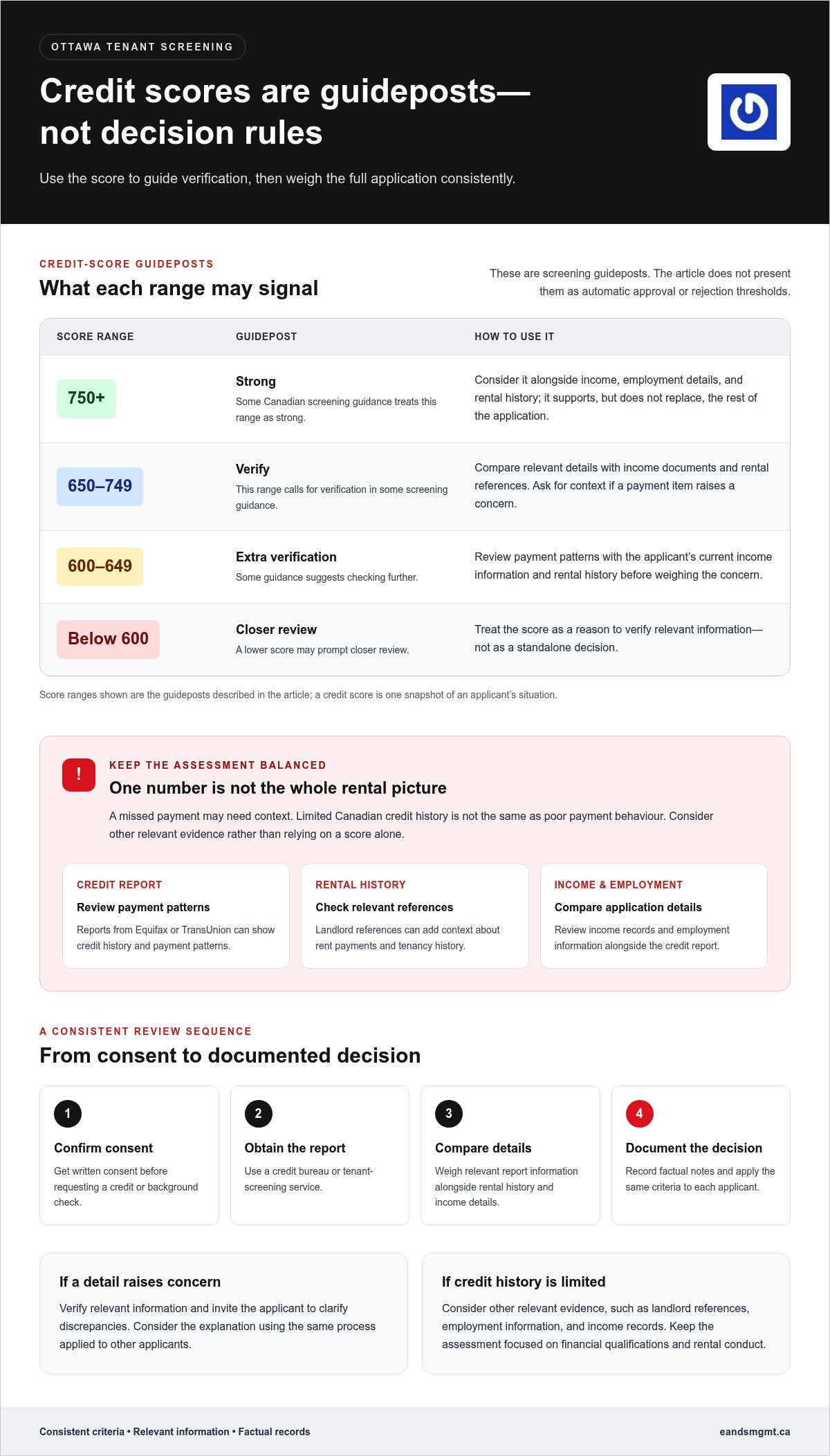
In Canada, credit reports from Equifax or TransUnion can show credit history and payment patterns. A score is one snapshot, not a complete picture of someone’s rental ability. Review the report alongside the applicant’s income, employment details, and rental history. A missed payment may need context, while a strong record can support other application information.
Some Canadian screening guidance treats scores of 750 or higher as strong, while scores from 650 to 749 call for verification. Scores from 600 to 649 suggest extra verification, and a score below 600 may prompt closer review. These are screening guideposts, not automatic approval or rejection rules. Consider the full application and apply the same criteria to each applicant.
Consent, Concerns, and Credit Errors
Get written consent before requesting a credit or background check. A rental application can collect relevant personal information, rental history, employment and income details, references, and consent. Keep questions connected to assessing the tenancy, and handle application records carefully.
If an Ottawa tenant is asked to undergo screening, they can ask which service was used and request a copy of the report. If it contains an error, they can review it and contact the reporting credit bureau to dispute inaccurate information. Tenants can also provide the landlord with relevant context or corrected details.
A credit concern calls for verification, not a decision based on one number alone. For example, compare reported payment patterns with the applicant’s rental references and current income documents. If employment details differ between the application and a reference, ask the applicant to clarify. Record the explanation and assess it using the same process as for other applicants.
Limited credit history isn’t the same as poor payment behaviour. A newcomer to Canada or a first-time renter may have little Canadian credit history to review. Consider other relevant evidence in the application, such as landlord references, employment information, and income records. Keep the assessment focused on financial qualifications and rental conduct, not personal characteristics.
Use a consistent review sequence: confirm consent, obtain the report, compare relevant details, and document the decision. A credit score should inform the assessment, not replace it. If a score raises a concern, further verification can help distinguish a temporary issue from a broader pattern of missed payments. This creates a clearer, more balanced basis for a rental decision.
What Is a Rental Background Check?
Tenant screening brings relevant records and application details together to inform a rental decision. In Ottawa, results can help assess an applicant’s financial qualifications, rental conduct, and consistency of information.
Screening Packages and Online Services
Screening services can combine credit checks with reviews of public records, relevant criminal history, and eviction records. Online screening software can organize applications and reports, making it easier to track documents and follow a consistent process.
Which tenant-screening services operate in Ottawa, and how do they compare? Services differ in the checks included, how reports are delivered, and whether the software also manages applications. Compare each package’s scope with the information your rental decision requires.
What do tenant background-check services cost in Ottawa and Canada? The price depends on the case and is provided after a quote request. The checks included, report depth, and service arrangement all affect the cost.
Before using a report, confirm that it relates to the applicant and the rental decision. A package combining credit, reference, and employment checks may provide different information from one focused on public records. Review the report contents and supporting application documents rather than assuming every package covers the same areas.
Screening Results and Rental Decisions
Results can support approval, denial, or a request for more information. A landlord may also consider a co-signer, a higher deposit, or lease conditions such as updated proof of income. Assess each result alongside the applicant’s financial qualifications and rental history.
A thorough screening process looks for patterns and discrepancies. For example, an employment detail that differs between an application and a reference may need clarification. Consider an eviction record or credit concern in context, rather than treating it as a complete account of the applicant’s ability to meet tenancy obligations.
Apply the same criteria to every applicant, then record the outcome and reasons. Note which reports informed the decision, what information needed follow-up, and how the applicant responded. This creates a clear record and helps distinguish a verified concern from missing or conflicting information.
Screening results don’t make the decision on their own. Weigh verified details against the rental requirements, including the applicant’s income, employment, and past rental behaviour. If information remains incomplete, identify the specific gap and request relevant clarification before deciding. Consistent documentation keeps the process fair and focused on the tenancy.
Criminal record checks
Criminal records can be one part of tenant screening in Ottawa, alongside financial and rental information. Consider what a check covers and how any result relates to the tenancy.
Canadian and Quebec Court Checks
Can landlords in Ontario use criminal background checks for tenants? A landlord may request a criminal record check as part of screening. In Ottawa, obtain written consent before conducting one, then assess any relevant findings carefully. A check generally focuses on convictions rather than minor infractions.
For an applicant with a Quebec history, clarify whether the requested search covers criminal court records, municipal court records, or both. These labels describe different record categories, so don’t assume one search covers every relevant record. Keep the search scope connected to the rental assessment, and don’t treat a record entry alone as a complete account of conduct.
Before relying on a result, match the report to the applicant and review the details in context. A name match alone may not explain the circumstances, relevance, or outcome of a record. If an entry raises a question, ask the applicant for relevant clarification and document both the information reviewed and the response.
Check Timing and Rental Decisions
The time required for a criminal background check depends on the search scope and whether records can be matched clearly to the applicant. A search involving more than one jurisdiction, such as Ontario and Quebec, may require different record checks. Allow time in your screening process, and don’t promise a fixed completion date based on a single type of search.
Results should inform a rental decision, not replace a review of the full application. Consider whether a finding relates to the tenancy, then weigh it alongside rental history, employment, and income information. For example, an unrelated minor infraction should not be treated as equivalent to a relevant conviction.
Use the same approach for every applicant. Record when consent was obtained, what type of check was requested, and how the result affected the decision. If a report contains unclear or conflicting information, seek an explanation before drawing conclusions. This creates a consistent record of the screening process.
Handle criminal information with care. Keep screening notes focused on relevant facts, such as the record category and its connection to rental responsibilities. Avoid assumptions about a person’s character based solely on a criminal record. A measured review helps landlords assess conduct while keeping the decision tied to the tenancy.
Employment and income verification
Employment and income checks help Ottawa landlords assess whether rent fits an applicant’s finances. Compare stated income with recent documents, then consider employment history and rental references together. A rent-to-gross-income guideline of 30 to 40 percent can help assess affordability. Another screening guideline recommends income of at least three times the monthly rent. Use these as assessment tools, not substitutes for reviewing the full application.
Ask applicants for evidence that fits their work arrangement. Recent pay stubs, an employment letter, or bank statements can help verify income. For employed applicants, compare the employer name and income details across documents. If information differs, ask for clarification and note the response. Confirm employment details through the employer contact provided by the applicant, keeping questions focused on relevant facts.
For self-employed applicants, pay stubs may not reflect how they earn income. Bank statements can help show deposits and income patterns over time. Compare those records with the applicant’s stated earnings and rental obligations. If deposits vary, consider the overall pattern rather than relying on one unusually high or low month.
Use a consistent document review for each applicant:
- Compare income documents with the monthly rent and application details.
- Review the most recent two to three months of pay stubs when available.
- Use an employment letter or bank statements to support verification.
- Record discrepancies and give applicants a chance to explain them.
Employment history can add context to current income. Consider the applicant’s stated work history and financial stability over time, rather than treating a recent job change as an automatic concern. For example, an applicant may have moved to a new role while maintaining regular income. Assess the evidence consistently alongside rental history and past rental behaviour.
Rental history verification helps establish whether the application reflects prior tenancy experience. Contact previous landlords about rent payments and lease compliance, then compare dates with the applicant’s stated employment and residence history. If a landlord can’t be reached, record the attempt and assess other available evidence. Don’t treat an unanswered call as proof of a problem.
Keep requests relevant and consistent to respect applicants’ rights. Ontario’s Human Rights Code prohibits discrimination in rental decisions based on grounds including disability and family status. Focus income and employment questions on ability to meet the rent, not personal characteristics. A clear record of documents reviewed, follow-up questions, and explanations supports a consistent decision for your rental property.
E&S Property Management: Full-Service Property Management
E&S Property Management supports Ottawa landlords with coordinated tenant placement and ongoing oversight. Its Tenant Placement Service helps find a tenant, while Full-Service Property Management provides broader oversight of the property.
Once a tenancy begins, Regular Property Inspections help landlords stay informed about the property’s condition. Financial Reporting and Accounting support clear rental-finance records. These services can ease the administrative load for owners who want professional support managing a rental home.
If you’d like support with tenant placement or managing your rental property, contact E&S Property Management.
Make Your Next Rental Decision With a Steady Plan
A well-organized screening process can set the tone for the entire tenancy. Treat advanced background checks for tenants in Ottawa as one part of a broader plan: define your rental criteria, apply them consistently, and keep clear records of each decision. This structure makes future applications easier to assess and helps you stay focused on your responsibilities as a landlord.
If you want support managing the process, E&S Property Management offers Tenant Placement Service and Full-Service Property Management. Regular Property Inspections can also help you stay informed once a tenancy begins. The right level of support depends on how much of the rental process you want to manage yourself.
Take the next step at a pace that feels right for your property. Contact E&S Property Management to discuss support with tenant placement or ongoing property management, and move toward your next rental decision with greater confidence.
Frequently Asked Questions
How do you screen a tenant in Ottawa?
Start with written screening criteria and apply them consistently to every complete application. Compare the applicant’s stated rental needs with relevant documents, references, and screening results. Keep a decision record explaining how the information relates to the tenancy. For example, if two applications show similar income but different rental histories, assess each history using the same questions and standards rather than relying on instinct.
How does it work?
Tenant screening typically moves from application to verification, review, and a documented decision. The applicant provides relevant details and written consent for requested checks. The landlord gathers permitted reports and references, follows up on gaps, and considers the information together. If an application lists a previous address without a landlord contact, request that reference before completing the assessment.
What Information Do You Need to Provide?
Applicants are commonly asked for personal and contact information, previous tenancy details, employment and income information, references, and written consent for credit or background checks. Provide accurate dates and reference details so the landlord can compare information across documents. If you’re a first-time renter, explain that you have no rental references and provide relevant employer or professor references instead.
Why Do Landlords and Property Managers Use Background Screening?
Screening helps landlords assess an application against rental criteria using relevant information rather than assumptions. Credit, income, employment, and rental details can reveal gaps to clarify before a decision. A consistent process also records the factors considered. For example, confirming a discrepancy in tenancy dates can prevent an incomplete application from being mistaken for inaccurate information.
What tenant background checks are legally allowed in Ontario?
Ontario landlords can assess relevant credit, rental, employment, income, and background information while complying with the Residential Tenancies Act and Human Rights Code. Screening decisions must not discriminate based on protected grounds, including race, religion, disability, or family status. Keep checks connected to rental qualifications, and avoid questions about personal characteristics that don’t relate to the tenancy.
What consent must Ottawa landlords obtain before screening a tenant?
Obtain the applicant’s written consent before conducting a credit or background check. Make the request before ordering the report, and retain the consent with the application records. Applicants can ask which screening service was used and request a copy of their report. If it contains an error, they can review it and seek a correction from the reporting bureau.
How can Ottawa landlords verify rental history, employment, and income?
Contact previous landlords and employers using the references supplied in the application, then compare their information with the applicant’s documents. Recent pay stubs, employment letters, or bank statements can support income verification. A rent-to-gross-income guideline of 30 to 40 percent can help assess affordability; another guideline suggests income of at least three times monthly rent. Consider these alongside rental history and the full application.
What steps should Ottawa landlords follow to screen applicants fairly and consistently?
Set relevant criteria before reviewing applications, request the same categories of information from each applicant, and obtain written consent before checks. Use consistent reference questions, verify discrepancies, and retain application documents and screening notes. Interview applicants in person or virtually if that helps clarify relevant details. Record how each decision relates to financial qualifications and rental behaviour, while avoiding questions about protected personal characteristics.


