
A clear conversation is not always a useful record. In Ontario, documenting communication with tenants legally means putting important matters in writing, keeping a dated log, and using the required format and delivery method for formal notices; rent-increase notices require at least 90 days’ notice.
A repair update, payment arrangement, or phone conversation can easily get lost in a busy day. A consistent record helps everyone confirm what was discussed, what was agreed, and what still needs follow-up.
This guide explains how to organize tenant communications, what to include in a communication log, and how to approach witnesses and recording permission. It also covers why formal notices need special care, so routine conversations and important documents are easier to find and refer to.
Key Takeaways
- Keep lease discussions, repair updates, complaints, and notices in an organized written record so key details are easier to retrieve.
- For a potential dispute or Landlord and Tenant Board hearing, arrange records by issue and preserve the documents that show what happened and when.
- When another person witnesses a conversation, record their role and what they observed; consider recording only after addressing permission and privacy concerns.
- Use a consistent communication log with dates, participants, brief summaries, and follow-up actions, then store it securely and keep it current.
What are the legal procedures for documenting tenant communications in Ontario?
Ontario landlords should keep important rental discussions in writing and use the required service method for formal notices. Document entry notices, repair updates, and inspection communications, including what notice was given, its purpose, and any follow-up.
Recording Lease Terms, Repairs, and Complaints
A written record captures what the parties discussed about lease terms, repairs, or complaints, and why. For a repair request, record the date received, the reported problem, any response, and the work completed. For a rent-payment arrangement, write down the agreed terms and share them with the tenant. This creates a clearer account if a disagreement later leads to an application to the Landlord and Tenant Board.
Required Written Notices During a Tenancy
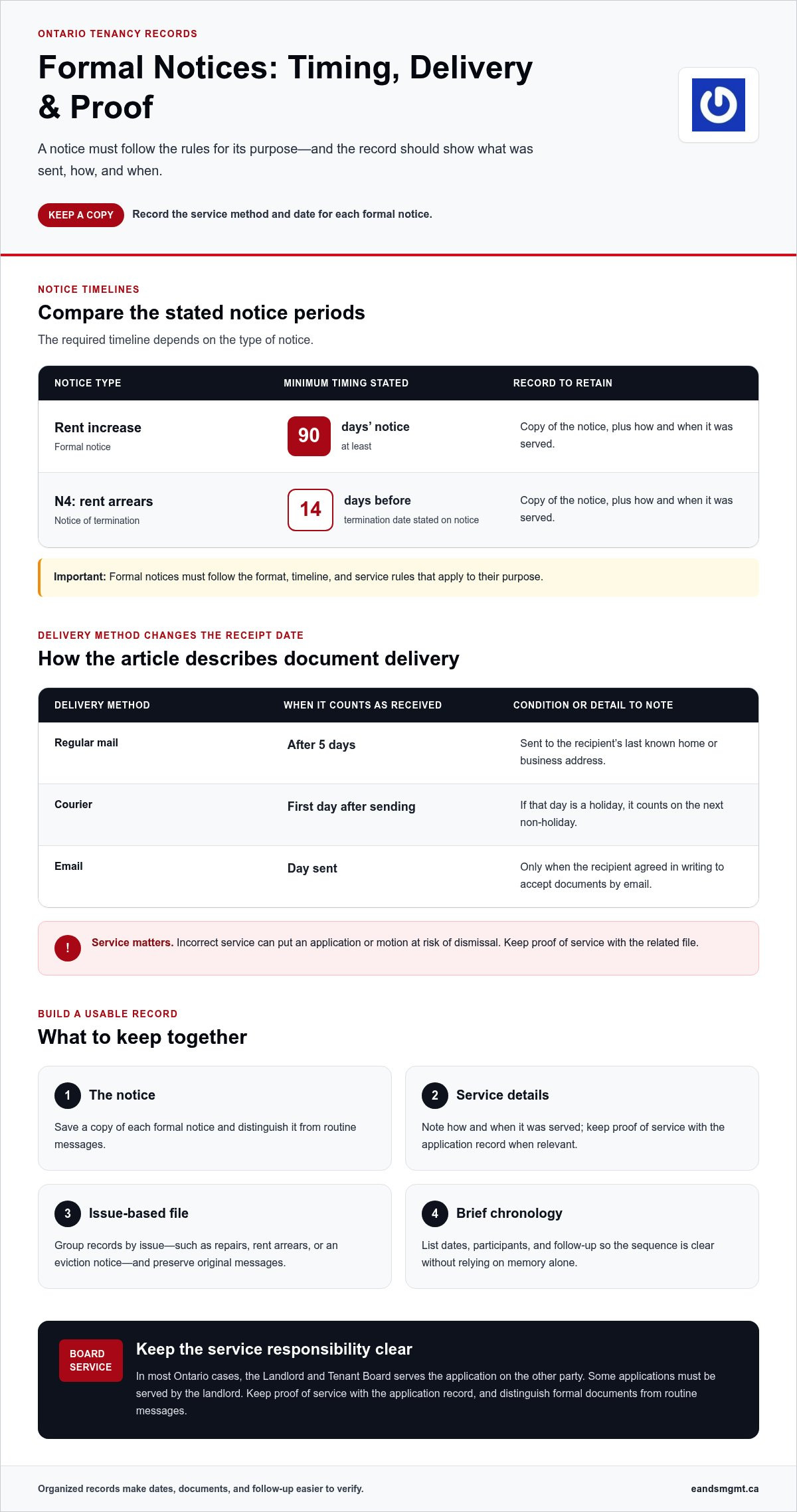
Formal notices must follow the format, timeline, and service rules that apply to their purpose. Ontario rent-increase notices require at least 90 days’ notice. An N4 notice for rent arrears must usually give the tenant at least 14 days before the termination date stated on the notice. Keep a copy of each notice and a record of how and when it was served.
Delivery affects when a document is considered received: regular mail to the last known home or business address counts after 5 days, while courier counts on the first day after sending, or the next non-holiday if that day is a holiday. Email counts on the day sent only when the recipient agreed in writing to accept documents by email. Incorrect service can put an application or motion at risk of dismissal.
Entry Notices and Repair Communications
Keep each written notice of entry with its purpose and delivery details, then retain related inspection notes and repair updates. For example, link an inspection notice to the visit date and any maintenance issue reported. This clarifies what the tenant was told and what action followed.
For video surveillance, record which areas are monitored, the purpose, and how tenants are informed. Handle footage and tenant details carefully, limiting access to people who need them for property management. These records help distinguish routine property oversight from a tenant complaint or repair request.
How To Organizing and Document Communication Properly?
Keep communications clear, dated, and grouped by rental issue so the record is coherent if a dispute arises. Improper service of a required document may lead to an application or motion being dismissed, while incomplete records can make it harder to explain what happened.
Documentation for Disputes and Board Hearings
Organized evidence links each concern to the communication and action that followed. For a Landlord and Tenant Board hearing, group records by issue, such as repairs, rent arrears, or an eviction notice. Preserve original messages and related documents, and prepare a brief chronology with dates, participants, and follow-up. This makes the sequence easier to understand without relying on memory alone.
Service responsibilities vary by application: in most Ontario cases, the Board serves the application on the other party, but some applications must be served by the landlord. Keep proof of service with the application record, and distinguish formal documents from routine messages. Ontario’s Residential Tenancies Act and Rule 3 of the Landlord and Tenant Board Rules of Procedure are relevant references for service.
Benefits of Documented and Organized Communication
A consistent record helps landlords and tenants confirm agreements, identify unfinished actions, and address misunderstandings early. For example, a written follow-up after a call can clarify who will arrange a repair and what remains outstanding. This is especially useful during an emergency, when updates may arrive through different channels.
Keep records focused on the tenancy and protect personal information. Alberta’s Personal Information Protection Act (PIPA) requires covered landlords to safeguard personal information against unauthorized access and use it only for disclosed purposes. These Alberta rules are not Ontario tenancy requirements. In either location, organize records so only appropriate people can access sensitive housing details.
Using witnesses or requesting permission to record
A witness or recording can add context to a residential tenancy record, but neither replaces clear written communication. Before recording a conversation, ask the other parties for permission and explain why you want to record it. Note their response and the date in your file. If they do not give permission, write a factual summary soon afterward and share it with them for clarification.
A witness should record what they personally observed, not draw conclusions about either party’s interests or intentions. After a discussion about repairs, for example, a witness can note who attended, what was discussed, and any agreed follow-up. Date the note and identify its author. Separate direct observations from information heard later to keep the record easy to interpret.
Group written communications by issue, such as maintenance, lease questions, or complaints. Save emails and messages in their original form, and add brief notes about related calls or in-person discussions. A follow-up message can help both parties confirm what was agreed and identify outstanding actions. This creates a practical record without relying on memory.
Review the file when new information arrives or an agreement changes. Add the update with its date, preserve earlier messages, and mark completed repairs or follow-ups without deleting the history. Regular reviews can reveal unanswered questions before they become larger misunderstandings.
Store tenant records securely, limit access to people who need them for residential property responsibilities, and keep a backup. Landlords should retain tenant communication records for at least one year after the tenancy ends. Organize files to prevent personal details from being exposed during routine sharing. Clear retention and access practices help protect sensitive information while keeping relevant records available.
Maintaining a communication log
A written log should state when a conversation took place, who participated, what they discussed, and what actions followed. Include the reason for contact and any agreement, so the landlord and tenant can trace how the situation developed.
Create one entry for each interaction, then link related entries by topic, such as a repair or payment arrangement. Record the communication channel and distinguish direct quotes from your summary. For example, write “tenant reported a leaking tap by email” rather than labelling the tenant difficult. Factual descriptions keep the record focused on events and decisions.
- Date and time: When the call, message, meeting, or visit occurred.
- People involved: Names and roles of the parties who communicated.
- Topic and reason: The rental issue raised and why contact took place.
- Summary and agreement: What each party said and any terms agreed in writing.
- Actions and status: Who will follow up, what remains open, and when the log was updated.
Keep the original email or message with its log entry instead of relying only on a copied summary. If a phone conversation leads to an agreement, send a written recap and record the follow-up. If details are disputed, add each party’s clarification as a separate, dated update. Do not erase earlier entries; preserve the sequence and explain any correction.
Review the log when new information arrives, an agreement changes, or an action is completed. A simple status such as “open,” “waiting for response,” or “completed” helps identify the next step. Store the file securely and keep a backup so it remains available if a device fails.
If keeping rental records alongside ongoing property tasks feels difficult, get support managing your rental records.
E&S Property Management: Full-Service Property Management
E&S Property Management provides Full-Service Property Management for rental owners who want support coordinating ongoing property responsibilities. Managing tenant communication, property oversight, and records takes consistent attention, especially when several issues need follow-up.
Regular Property Inspections provide a structured way to monitor a rental property, while Financial Reporting and Accounting helps owners keep financial records in order. For owners preparing for a new tenant, the Tenant Placement Service supports the placement process. These services complement a consistent communication log by helping keep property responsibilities organized.
If you’d like support with your rental property, contact E&S Property Management.
Make clear communication part of your management routine
A useful record supports consistent decisions over time. Set a regular time to review open matters, note who is responsible for each next action, and carry unresolved items forward rather than letting them disappear into old messages. This simple habit makes documenting communication with tenants legally part of ongoing property care.
For owners who want help coordinating property care, E&S Property Management provides Full-Service Property Management, Tenant Placement Service, and Regular Property Inspections. These services support different stages of rental ownership, from preparing for a tenancy to maintaining oversight as responsibilities continue. The next step depends on which tasks you want handled and how involved you prefer to be.
Contact E&S Property Management to discuss support for your rental property. A more organized approach can begin with one clear conversation.
Frequently Asked Questions
Why is Documentation Important?
Documentation gives both parties a reliable account of decisions, concerns, and follow-up. If a tenant reports a recurring leak, for example, dated messages can show when it was reported and what response followed. Clear records can also help landlords identify patterns, such as repeated repair requests, and plan appropriate next steps. Keep notes factual and distinguish observed details from personal opinions.
What are the legal requirements for communicating with tenants in Canada?
Requirements vary by province or territory and by communication type. In Ontario, the Residential Tenancies Act sets rules for formal notices, including prescribed formats and timelines for rent increases and eviction notices. Routine repair updates may be handled differently from notices that affect tenancy rights. Identify the communication’s purpose first, then apply the relevant provincial or territorial requirements.
Do Canadian provinces require landlords to give notices in writing?
Formal tenancy notices commonly need to follow written requirements, but the applicable rules depend on the jurisdiction and notice type. In Ontario, landlords must use the prescribed process for formal notices, and rent increases require at least 90 days’ notice. A text or email about a routine repair should not be treated as a substitute for a formal notice when the required procedure calls for something else.
Which methods of serving tenant notices are legally valid in each province?
There is no single service method that applies across Canada; each province and territory sets its own rules. In Ontario, documents may be handed directly to a party, mailed to their last known home or business address, or delivered by courier. Email is permitted for service only if the recipient has agreed in writing. Follow the specific notice rules for the province where the rental property is located.
How can landlords prove a tenant received a notice or communication?
Keep the notice and evidence of how and when it was delivered together. In Ontario, retain a mailing receipt, courier record, fax confirmation, or written email-service agreement, as applicable. For an in-person handoff, make a dated note identifying who delivered and received the document. File this proof with the related tenancy records, not in a separate, unlabelled folder.
How long should landlords retain tenant communications and records?
Landlords should retain tenant communication records for at least one year after the tenancy ends. Keep relevant messages, notices, repair records, and agreements together so they remain understandable after move-out. Protect access to personal details, and securely dispose of records when they are no longer needed for legal or business purposes. Alberta’s PIPA also requires covered landlords to retain personal information only as long as reasonably required.


