
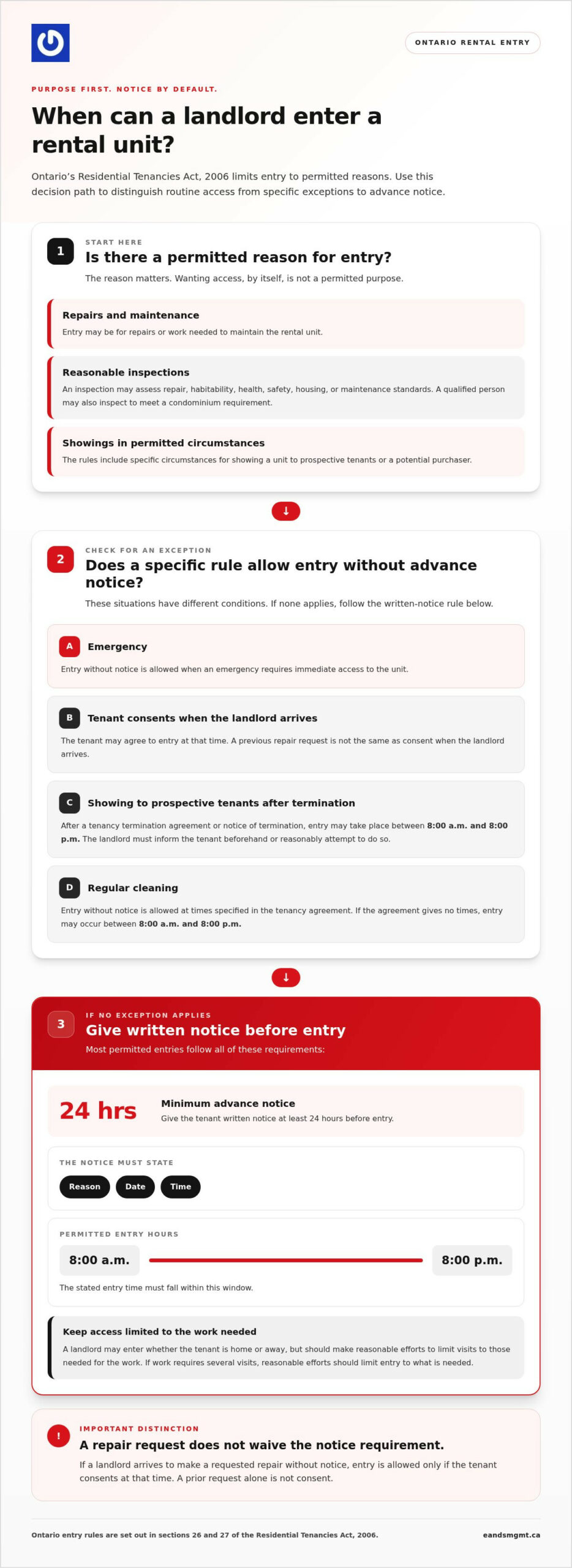
In Ontario, a landlord may enter a rental unit only for reasons allowed under the Residential Tenancies Act, 2006. For most permitted entries, the landlord must give at least 24 hours’ written notice stating the reason, date and time, with entry scheduled between 8:00 a.m. and 8:00 p.m. If you’re asking what a landlord’s right to entry in Ontario is, the key is knowing when that notice rule applies and which exceptions allow entry without notice.
It’s understandable to want clear boundaries, whether you’re arranging repairs, preparing to show a unit, or trying to understand what happens when a home appears to have been abandoned. The details matter: a tenant’s repair request does not, by itself, remove the notice requirement, while specific situations follow different rules.
This guide explains the permitted reasons for entry, the main exceptions to notice, and how written notice can be delivered. It also addresses apparent abandonment, helping you distinguish a vacant-looking home from the legal rules that govern access.
Key Takeaways
- For entry that requires notice, allow at least 24 hours and make sure the written notice includes the required details.
- Distinguish emergencies and other specific exceptions from routine visits, which generally follow the notice rules.
- Learn which legal service methods may be used to deliver written notice beyond handing it to the tenant.
- Understand why an apparently empty rental unit calls for careful consideration before treating it as abandoned.
When can a landlord enter the rental unit?
Ontario’s Residential Tenancies Act, 2006 sets the entry rules in sections 26 and 27. The reason for entry and the notice given determine whether access is permitted.
Permitted Reasons for Entry
An Ontario landlord may enter only for reasons allowed under the Act, such as repairs, a reasonable inspection, or showing the unit in permitted circumstances. These limits balance the landlord’s maintenance responsibilities with the tenant’s privacy. An inspection may assess repair, habitability, health, safety, housing, or maintenance standards. A qualified person may also inspect to meet a condominium requirement. The reason matters: wanting access alone is not a permitted purpose.
Notice Details and Entry Hours
For entries requiring notice, according to Ontario, the landlord must give the tenant written notice at least 24 hours before entry. The notice must state the reason, date, and time, and the stated entry time must fall between 8:00 a.m. and 8:00 p.m. For example, a notice for repairs should identify the repair and the planned visit time. A landlord may enter whether the tenant is home or away, but should make reasonable efforts to limit visits to those needed for the work. Clear details help both landlord and tenant understand what access is being requested.
Entry With Tenant Permission
A tenant may consent to entry without advance notice when the landlord arrives. The tenant may also agree to entry at another time or for another reason. Consent is different from the landlord’s usual notice rights, so a prior repair request alone does not remove the notice requirement. If the landlord arrives to make that repair without notice, entry is allowed only if the tenant consents at that time. Agreeing to access can help coordinate practical needs, but the tenant’s choice remains central.
Circumstances allowing entry without notice
Ontario’s entry rules provide specific exceptions to advance written notice. These exceptions apply when urgent access is needed or the Act recognizes another basis for entry.
When notice isn’t required
A landlord may enter without notice during an emergency requiring immediate access to the unit. Entry without notice is also allowed if the tenant consents when the landlord arrives. A previous repair request is not the same as consent at the time of entry, so the tenant’s response then matters.
There is also a specific exception for showing a unit to prospective tenants. After a tenancy termination agreement or notice of termination, the landlord may enter between 8 a.m. and 8 p.m., provided they inform the tenant beforehand or reasonably attempt to do so. For regular cleaning, entry without notice is allowed at times specified in the tenancy agreement. If it gives no times, entry may occur between 8:00 a.m. and 8:00 p.m.
When written notice applies
Outside an exception, a notice to enter tells the tenant why access is needed and when it is planned. For entries requiring notice, Ontario landlords must give tenants written notice at least 24 hours before entry. It must state the reason, date, and time, with the stated time falling between 8:00 a.m. and 8:00 p.m.
For a routine repair, for example, the landlord can explain the work and set a permitted entry time. Notice lets the tenant understand the purpose and timing while keeping access within the legal rules. If the work requires several visits, reasonable efforts should limit entry to what is needed.
Emergencies can demand prompt attention, while planned maintenance still requires careful coordination. Emergency maintenance response can help landlords manage urgent property issues while keeping tenant responsibilities and entry rules in view.
Other than handing a notice to the tenant, how can a landlord deliver the written notice to enter the premises?
Ontario’s Residential Tenancies Act and Landlord and Tenant Board rules provide ways to serve written entry notices beyond handing them directly to a tenant. Section 191 of the Act and Rule 3 of the Board’s Rules of Practice set out the permitted methods. For notice-required entry, the landlord must still allow at least 24 hours and state the reason, date, and time.
These rules concern residential rental units. A condominium rental remains subject to residential entry rules, including an exception for a qualified person’s inspection to meet subsection 9 (4) of the Condominium Act, 1998. Shared housing arrangements depend on the tenancy and unit involved; non-residential rentals aren’t the residential units addressed by these rules.
For a potential purchaser’s viewing, the landlord or an authorized real estate broker or salesperson may enter after giving at least 24 hours’ written notice. A landlord may show a unit to prospective tenants between 8:00 a.m. and 8:00 p.m. after a tenancy termination agreement or notice of termination, if the tenant is informed beforehand or the landlord reasonably attempts to inform them. A tenant may remain present, though entry can occur while they’re away.
If a landlord enters unlawfully or repeatedly ignores entry requirements, the tenant can complain to Ontario’s Rental Housing Enforcement Unit or apply to the Landlord and Tenant Board for an order stopping the conduct. The Board may grant a rent abatement or order a fine if it finds illegal entry. A tenant can apply for an order to stop illegal entry and describe the visits and notice concerns. Copies of notices and a record of entry dates can help explain the concern. Tenants and landlords should communicate about access and follow the applicable entry requirements.
Entry after property abandonment
An apparently empty unit doesn’t, by itself, establish that a tenancy has ended or authorize entry without notice. Ontario’s Residential Tenancies Act sets entry rules in sections 26 and 27, including specific exceptions; suspected abandonment isn’t identified as a general exception. A tenant’s absence, quiet unit, or missed rent may raise concern, but don’t treat any single sign as proof that you can enter the rental without following the usual rules.
Start by documenting observable details, such as unanswered messages, a vacant-looking unit, or repair concerns. Record dates and keep relevant communications together. Then consider the basis for access: the Act allows entry without notice in an emergency; for a planned inspection or repair, follow the applicable notice requirements unless the tenant consents when the landlord arrives. A condominium’s access arrangements do not, on their own, let a residential landlord bypass tenant-entry rules.
Treat access and possible abandonment as separate questions. If the tenant’s status is unclear, do not treat belongings left inside as consent or proof that the rental is vacant. Use the appropriate notice process for permitted entry, and make the purpose, date, and time clear. For example, a landlord concerned about a leak can arrange the repair under the applicable entry rules rather than assume the tenant has abandoned the home.
Once a tenancy has ended, the circumstances differ from an occupied rental, but apparent abandonment alone shouldn’t be treated as confirmation. Careful records help clarify what happened and support orderly decisions about housing, maintenance, and next steps. For ongoing oversight, arrange regular property inspections to help identify repair concerns and document a unit’s condition.
E&S Property Management: Full-Service Property Management
E&S Property Management helps Ottawa landlords manage the ongoing responsibilities of residential rentals, from tenant placement to property oversight. Its Full-Service Property Management includes Regular Property Inspections and Financial Reporting and Accounting, helping owners keep property condition and records organized. The Tenant Placement Service can also support transitions between tenancies, when showings and access arrangements require careful attention to Ontario’s entry rules.
For landlords balancing tenant communication, inspections, maintenance coordination, and rental administration, professional management can bring these tasks together under one service. It’s a practical next step when overseeing the property has become difficult to manage alongside other responsibilities. Contact E&S Property Management to discuss your property management needs.
Build a Steady Plan for Your Property
Understanding what a landlord’s right to entry in Ontario allows is only one part of managing a rental. Build a steady routine for communication, documentation, and follow-up as circumstances change. Clear processes connect day-to-day responsibilities to the home’s ongoing care, instead of leaving decisions to be made in a rush.
E&S Property Management offers Full-Service Property Management, including Regular Property Inspections, and a Tenant Placement Service for landlords managing changes between tenancies. These services can help bring property oversight and tenant transitions into a more organized process. Consider what you’d like to manage yourself and where structured support would be useful. Contact E&S Property Management to discuss your property management needs and take a considered next step.
E&S Property Management and Landlord Support
E&S Property Management offers Full-Service Property Management, Tenant Placement Service, Regular Property Inspections, Financial Reporting and Accounting, Emergency Maintenance Response, and NR6 and NR4 Tax Filing Support. If you need help managing property responsibilities alongside understanding when entry may be appropriate, consider whether its services fit your needs.
For non-resident tax support, its service includes processing NR6 forms, monthly tax withholdings, and issuing annual NR4 slips.
Frequently Asked Questions
What can a landlord do if after the required notice to enter has been given the tenant refuses?
A tenant’s refusal after proper notice may lead to an entry-related dispute. The landlord should keep a copy of the notice and record the attempted visit and refusal. That refusal does not grant permission to enter at another time or for a different reason. If the dispute continues, the Landlord and Tenant Board can address entry-related concerns.
What does Ontario’s Residential Tenancies Act say about a landlord’s right to enter a rental unit?
The question “what is a landlord’s right to entry in Ontario” is answered by the Residential Tenancies Act, 2006, which sets out entry rules in sections 26 and 27. It allows entry only in specified circumstances, with notice required for many planned visits and exceptions applying in defined situations. The rules balance legitimate property access with tenant privacy; ownership alone doesn’t give a landlord unrestricted access.
What are the permitted reasons for a landlord to enter a rental unit in Ontario?
Permitted purposes include carrying out repairs, conducting a reasonable inspection, and showing the unit to potential purchasers or prospective tenants in the circumstances allowed by law. Entry can also be needed for a qualified person to complete a condominium inspection required under the Condominium Act, 1998. An inspection of a tenant-installed air conditioner for safety, damage, and legal compliance is another recognized reason.
Can an Ontario landlord enter without notice in an emergency or with tenant consent?
Yes. An Ontario landlord may enter without notice in an emergency or if the tenant consents when the landlord arrives. Earlier consent, such as a request for a repair, does not by itself remove the notice requirement. The tenant can agree to access at the time, but without that consent, a planned repair visit must follow the applicable entry rules.
What hours may a landlord enter a rental unit in Ontario?
For entry requiring notice, the stated entry time must fall between 8:00 a.m. and 8:00 p.m. The same hours apply to showings for prospective tenants under the applicable entry rules. A tenancy agreement may specify times for regular cleaning; otherwise, landlords should follow the applicable entry rules.
What rules apply to landlord entry for showings to prospective tenants or buyers in Ontario?
A practical answer to “what is a landlord’s right to entry in Ontario” depends on why the unit is being shown. After a tenant gives notice to move out, or after a tenancy termination agreement or notice of termination, a landlord may show the unit to prospective tenants between 8:00 a.m. and 8:00 p.m., while informing the tenant or reasonably attempting to do so. For a potential purchaser’s viewing, the landlord or an authorized real estate broker or salesperson must give at least 24 hours’ written notice.


