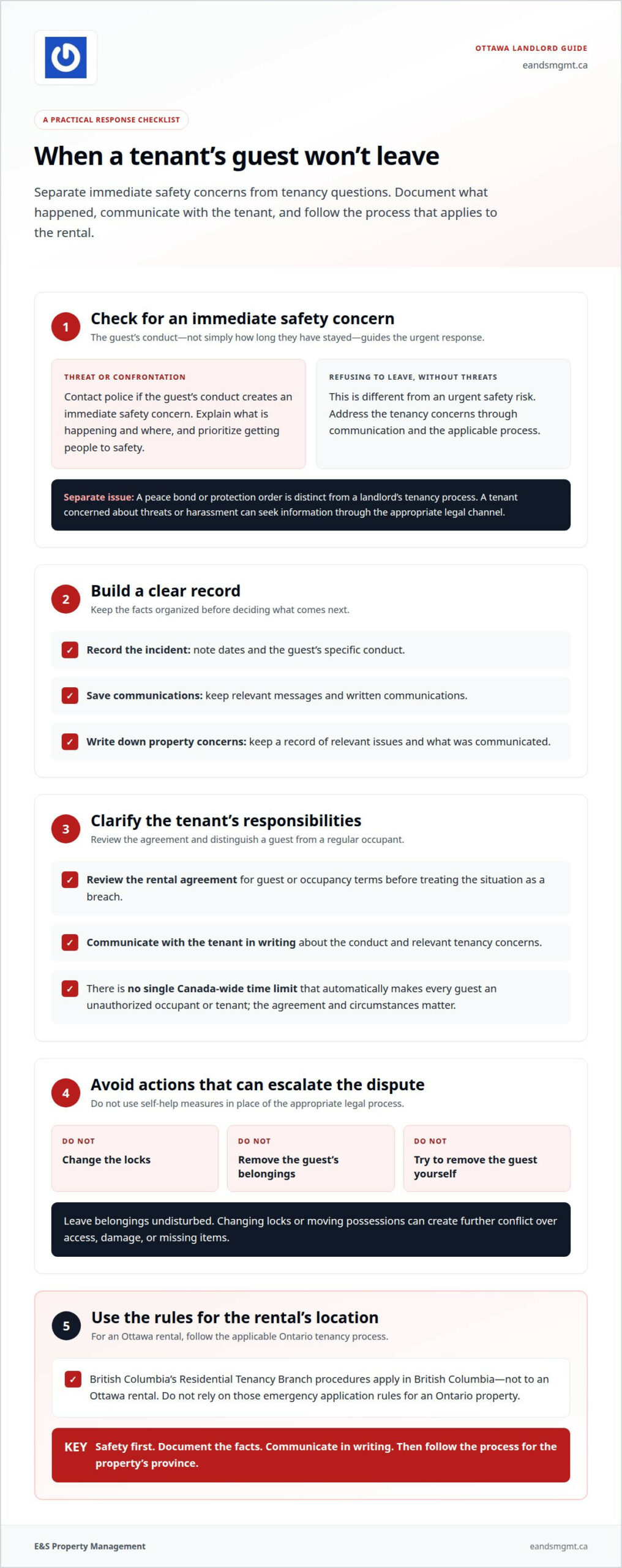
For an Ottawa landlord wondering what to do if a tenant’s guest won’t leave, first distinguish the guest’s behaviour from the tenant’s responsibilities under the rental agreement. Document what happened, communicate with the tenant in writing, and follow the Ontario process that applies to the rental. Do not try to remove the guest yourself.
A guest refusing to leave can put a tenant, landlord, and other residents under strain, especially when the next step is unclear. Documenting the situation and distinguishing a guest from an occupant can help keep decisions grounded in the facts.
This guide explains how to assess the situation in Ottawa, what to consider before serving a notice, and how to handle safety concerns and ongoing property oversight. Learn what details to record and how to respond thoughtfully while determining the appropriate next step.
Key Takeaways
- Document the guest’s conduct and communications, then review the rental agreement to understand the tenant’s responsibilities.
- For an Ottawa rental, use the applicable Ontario tenancy process and make sure any notice is appropriate to the circumstances.
- Keep records of relevant messages, incidents, and property concerns to support clear communication about next steps.
- Regular inspections and full-service property management can help landlords maintain organized oversight of a rental property.
Emergency applications involving serious breaches by a tenant or guest
For Ottawa landlords, deciding what to do if a tenant’s guest won’t leave starts with checking for an immediate safety concern and documenting the situation. British Columbia’s Residential Tenancy Branch process applies there, not to a rental home in Ontario. Do not use its emergency application rules for an Ottawa property.
Calling Police About an Unwanted Guest
Contact police if a guest’s conduct creates an immediate safety concern, such as a threat or confrontation. Explain what is happening and where, and prioritize getting people to safety. A guest refusing to leave without threatening behaviour is different from an urgent safety risk. Once the immediate situation is addressed, record the incident and tell the landlord about relevant tenancy concerns.
Court Orders Against a Guest
A peace bond or protection order is separate from a landlord’s tenancy process. A tenant concerned about threats or harassment can seek information about protective measures through the appropriate legal channel. The relevant facts are the guest’s conduct and the safety concern, not simply how long the guest has stayed. Save messages and record incidents so the tenant can describe what happened clearly.
Changing Locks and Removing Belongings
Changing locks or removing a guest’s belongings can escalate a dispute and create further conflict over access or possessions. Neither action is a substitute for the appropriate legal process. For example, moving bags outside can lead to disagreements about damage or missing items. Leave belongings undisturbed, document the situation, and communicate with the tenant in writing while considering the next step.
For Ottawa landlords deciding what to do if a tenant’s guest won’t leave, separate immediate safety needs from tenancy questions. Record dates, messages, and specific conduct, then follow the Ontario rules that apply to the rental rather than relying on British Columbia procedures.
Legal grounds for eviction in British Columbia
British Columbia’s tenancy process is specific to that province; rules for guests and eviction can differ across provinces and territories. While E&S Property Management specializes in local property oversight, understanding regional frameworks is crucial if managing properties across jurisdictions. Treat the Residential Tenancy Branch (RTB) process strictly as a British Columbia procedure, not a Canada-wide rule. The rental unit’s exact location determines the relevant provincial or territorial tenancy framework.
In British Columbia, unpaid rent is a clearly stated ground: a landlord must give 10 days’ notice. A different route applies when a tenant or guest commits a very serious breach of the Residential Tenancy Act. In that situation, the landlord may apply to the RTB to end the tenancy early without first serving a traditional eviction notice. A guest’s refusal to leave, on its own, is not identified as an automatic standalone ground for eviction.
A tenant can clearly ask an unwanted guest to leave, preferably in writing, and keep a copy of the message. For example, the tenant can state that permission to visit has officially ended and demand that the guest vacate the home immediately. A written record helps distinguish a direct request from a later disagreement about what was said. If the guest’s conduct creates an immediate safety concern, landlords and tenants must address that separately from the standard tenancy process.
There is no single Canada-wide time limit in these facts that automatically turns every guest into an unauthorized occupant or tenant. In British Columbia, the relevant distinction depends on the specific tenancy arrangement and circumstances, rather than a fixed number of visits stated here. A brief visit differs from someone staying as a regular occupant, but the tenant should review the agreement’s guest or occupancy terms before treating the situation as a breach. Ultimately, the landlord’s next step depends on the applicable legal ground: the 10-day unpaid-rent notice or, for a very serious breach, an RTB application for early termination.
Rules for serving an eviction notice
In British Columbia, an eviction notice must be written, signed, and dated. It must identify the rental unit’s address, give its effective date, and state the reason. Missing details can make it harder for a tenant to understand the claim and respond. Before serving a notice, compare its details with the tenancy records and the specific reason for ending the tenancy.
Permitted service methods include:
- Handing the notice to the tenant in person.
- Sending it by mail.
- Leaving it in the tenant’s mailbox or mail slot.
- Attaching it to the door of the tenant’s home address.
- Emailing it only if the tenant provided an email address for service.
Text messages are not an allowed service method. Sending a notice by text does not replace delivery through a permitted method, even if the tenant replies. Keep a copy of the signed notice and record how it was delivered. This helps clarify which document was served and how it reached the tenant.
After receiving an unpaid-rent eviction notice, a tenant has 5 days to dispute it. If a tenant disputes an eviction notice with the Residential Tenancy Branch (RTB), the notice is suspended until the hearing. A landlord must share eviction evidence with the tenant at least 7 days before the hearing. Organize relevant records, such as rent statements or written communications, around the reason named in the notice.
If the tenant doesn’t dispute the notice, they must leave the rental unit by 1 p.m. on the day the tenancy ends. A landlord can’t treat the notice alone as authority to remove a tenant or belongings. For an overholding tenant, the landlord must obtain an Order of Possession and a Writ of Possession, then use a court-approved bailiff for removal. Following the required notice and enforcement steps keeps service separate from physical removal.
What are a tenant’s rights and responsibilities when a guest refuses to leave in Canada?
Tenancy rules are provincial and territorial, so a guest dispute in British Columbia follows a different framework from one in Ottawa. In British Columbia, police cannot evict tenants on their own. Separate immediate safety concerns from disagreements about who may stay in the rental home.
Start with a clear, direct request for the guest to leave. A written message can record when the tenant withdrew permission to visit and what happened next. Keep relevant texts and note specific incidents, such as the guest refusing to return a key or disrupting other occupants. These records can help explain the situation if the tenant later discusses it with the landlord or seeks help.
Tenants should review their rental agreement for any guest or occupancy terms. A guest’s continued presence may raise questions about the arrangement, but there is no universal stay-length threshold for all of Canada. Occasional visits and someone regularly treating the unit as their home may point to different circumstances. Do not assume a guest automatically becomes a tenant after a particular number of days.
If a guest’s behaviour creates an immediate safety risk, the tenant can contact police for help with that concern. In British Columbia, police cannot independently evict tenants, so calling them does not replace the tenancy process. Preserve messages, describe specific conduct, and tell the landlord about the issue rather than trying to resolve a serious confrontation alone.
For landlords handling ongoing property concerns alongside guest-related disruption, rental property management support can help keep communications and maintenance matters organized. Keep the focus on the tenant’s conduct, the guest’s specific actions, and the rental agreement, rather than assumptions about a guest’s legal status.
E&S Property Management: Full-Service Property Management
E&S Property Management helps Ottawa landlords organize the broader responsibilities of rental ownership. Full-Service Property Management provides ongoing oversight, while Regular Property Inspections help document property conditions and identify concerns that need attention. Financial Reporting and Accounting supports clear rental records for tracking communications, maintenance, and tenancy matters.
For a guest-related dispute, property management can help keep routine oversight and documentation in order, while eviction decisions still need to follow the rules that apply where the rental is located. If you’d like support managing a rental property, contact E&S Property Management.
Set Up Your Next Rental Decision with Confidence
Knowing what to do if a tenant’s guest won’t leave is only one part of protecting a rental property. Keep tenancy records, communication practices, and ongoing oversight organized so you are prepared for difficult situations. Clear records can help distinguish an isolated disagreement from a recurring concern and support a considered response.
E&S Property Management offers Full-Service Property Management, Tenant Placement Service, and Regular Property Inspections to support landlords with ongoing rental responsibilities. If you’d like help keeping those responsibilities on track, contact E&S Property Management to discuss your property.
A steady, well-documented approach gives you a clearer footing when concerns arise. Organize your records and seek support that fits your property and circumstances.
Frequently Asked Questions
Can a landlord remove a tenant’s guest, or must the tenant handle it?
A tenant who invited a guest should ask them to leave; a landlord should address tenancy concerns through the tenant and the appropriate process. In British Columbia, police cannot evict tenants on their own. If a guest’s serious conduct affects the tenancy, the landlord can consider the Residential Tenancy Branch process rather than trying to remove the guest personally.
What steps can a tenant take if a guest refuses to leave after being asked?
Make the request clear in writing, keep a copy, and record what happens next. For example, note whether the guest still has a key or continues entering after permission was withdrawn. Tell the landlord about tenancy-related concerns. If the guest creates an immediate safety threat, contact police; their attendance does not itself resolve the tenancy issue.
Could an unwanted long-term guest put the tenant at risk of eviction or extra charges?
A long stay does not automatically determine whether someone is a guest or occupant, or establish grounds for eviction. In British Columbia, a landlord may apply to end a tenancy early without an eviction notice when a tenant or guest commits a very serious breach of the Residential Tenancy Act. Review the rental agreement’s occupancy terms, and do not assume a separate charge applies solely because a guest stayed.
When does a guest become an unauthorized occupant or tenant under Canadian law?
There is no Canada-wide time limit that automatically makes a guest an unauthorized occupant or tenant. The distinction depends on the rental agreement and circumstances: a brief visit may differ from someone regularly treating the unit as their home.