
A landlord’s repair responsibilities continue when a property is rented out. In Ontario, landlords must keep rental properties in a good state of repair and meet applicable health, safety, housing, and maintenance standards. When managing capital repairs on a tenanted property, plan necessary work while reviewing the lease to understand responsibility for costs and tenant-caused damage.
A major repair can put pressure on a landlord, especially when tenant needs and other property expenses also require attention. A clear process helps: identify the repair responsibility, assess the property’s condition, plan the work, and keep records to manage costs and limit avoidable damage.
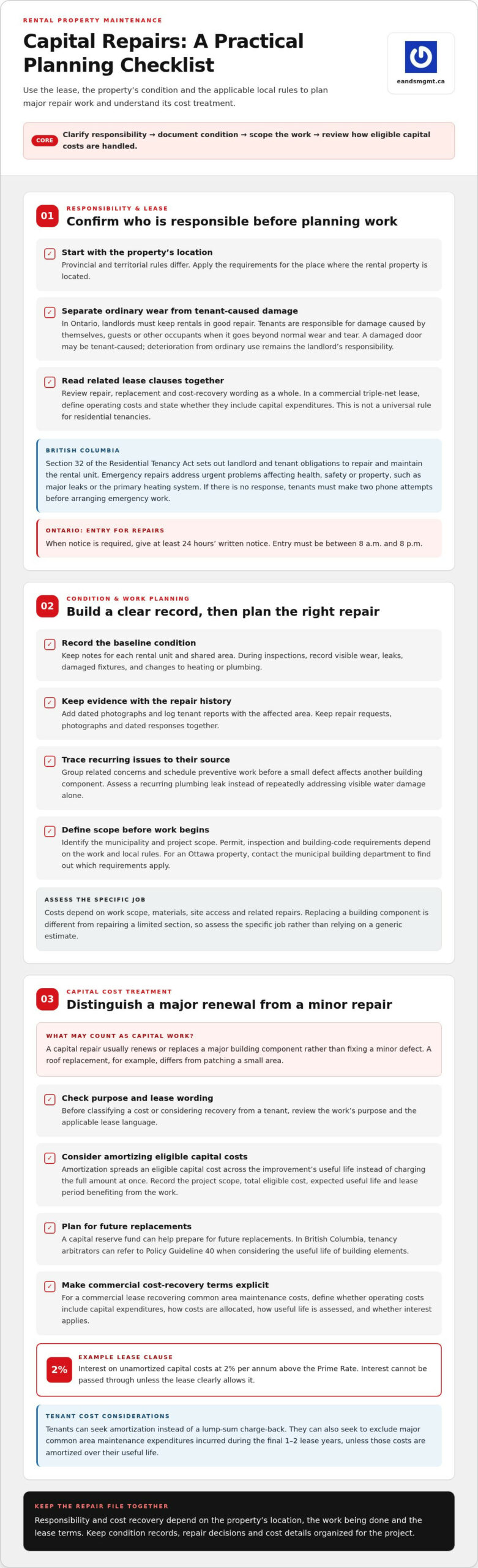
This article covers four practical steps for managing capital repairs in a Canadian rental property: clarify landlord and tenant responsibilities, plan work around the property’s condition, understand how capital costs may be treated, and act promptly to limit further damage. Together, these steps provide a framework for making repair decisions and tracking their financial impact.
Key Takeaways
- Read the lease carefully to understand how it treats capital work, repair responsibilities and cost recovery.
- In British Columbia, section 32 of the Residential Tenancy Act sets out landlord and tenant obligations to repair and maintain the rental unit, according to the Government of British Columbia.
- Plan for major replacements and consider spreading eligible capital costs over their useful life instead of charging them as a lump sum.
- Respond promptly to repair issues, document decisions and take practical steps to limit further property damage and avoidable losses.
1. Landlord responsibility for repairs
In Ontario, landlords must keep rental properties in good repair and meet applicable maintenance standards. Tenants are responsible for damage caused by themselves, their guests, or other occupants when it goes beyond normal wear and tear. For example, a tenant may be responsible for damage to a door, while the landlord remains responsible for deterioration from ordinary use.
Provincial and territorial rules differ, so a landlord must apply the rules for the property’s location. In Ontario, a landlord needs at least 24 hours’ written notice to enter for repairs, and entry must be between 8 a.m. and 8 p.m. In British Columbia, emergency repairs must address urgent problems affecting health, safety, or property, such as major leaks or the primary heating system. If there’s no response, tenants must make two phone attempts before arranging emergency work.
For a commercial triple-net lease, the lease language matters: define operating costs and state whether they include capital expenditures. That example isn’t a universal rule for residential tenancies. The 2012 Ontario Superior Court of Justice decision in Parsons Precast Inc. v. Sbrissa considered whether a landlord could recover parking-lot repaving costs from a commercial tenant. The practical step is to read the lease’s repair, replacement, and cost-recovery clauses together.
Before planning major work, identify the municipality and define the project’s scope. Permit, inspection, and building-code requirements depend on the work and applicable local rules. For an Ottawa property, contact the municipal building department to find out which requirements apply before work begins.
Capital-repair costs depend on the scope of work, materials, site access, and any related repairs. Replacing a building component, for example, involves different work from repairing a limited section, so assess the specific job rather than relying on a generic estimate. In a triple-net arrangement, distinguish the repair cost from any administration or management fee, and recover costs only as the lease permits.
2. Property condition and maintenance planning
In British Columbia, section 32 of the Residential Tenancy Act sets out landlord and tenant obligations to repair and maintain the rental unit, according to the Government of British Columbia. Landlords are responsible for most repairs, including major heating and plumbing problems, common-area repairs, and damage from normal wear and tear. Tenants should report maintenance issues promptly. In Ontario, tenants are responsible for damage caused by themselves, their guests, or other occupants when it exceeds normal wear and tear.
Turn inspection notes into a work plan. Group related concerns, identify the source of recurring damage, and schedule preventive work before a small defect affects another building component. For example, record a recurring plumbing leak and arrange an assessment rather than repeatedly addressing visible water damage alone. Dated findings from property inspection planning can help organize repair priorities and costs.
Notice requirements depend on the province or territory. In Ontario, landlords must give at least 24 hours’ written notice before entering to inspect, repair, or replace something. Entry must take place between 8 a.m. and 8 p.m. when this notice is required.
If an Ontario landlord doesn’t address a maintenance problem within a reasonable time after being informed, the tenant can report it to local government, apply to the Landlord and Tenant Board, or do both. Tenants shouldn’t withhold rent over poor maintenance or unfinished work. They can ask the Board to allow rent payments to go to the Board while it decides a maintenance application. Keep repair requests, photographs, and dated responses together to document the property’s condition and repair history.
3. Amortizing capital expenditures
A capital repair usually renews or replaces a major building component rather than fixing a minor defect. Compare replacing a roof with patching a small area: a replacement may provide service over several years. When managing capital repairs on a tenanted property, consider the work’s purpose and the lease wording before deciding how to classify a cost or whether it can be recovered from a tenant.
Amortization spreads an eligible capital cost across the improvement’s useful life instead of charging the full amount at once. Record the project scope, total eligible cost, expected useful life, and lease period benefiting from the work. In British Columbia, tenancy arbitrators can refer to Policy guideline 40 when considering the useful life of building elements. A capital reserve fund can also help prepare for future replacements.
For a commercial lease that recovers common area maintenance costs, define whether operating costs include capital expenditures. State clearly how the cost is allocated, how useful life is assessed, and whether interest applies. One example lease clause calculates interest on unamortized capital costs at 2% per annum above the Prime Rate. Interest cannot be passed through unless the lease clearly allows it.
Tenants can seek amortization rather than a lump-sum charge-back. They can also seek to exclude major common area maintenance expenditures incurred during the final 1-2 lease years, unless those costs are amortized over their useful life. This links payment to the period when the improvement benefits the property, rather than placing the entire expense on the current tenant.
For a single-tenant property, include a reimbursement formula if the repair’s useful life extends beyond the remaining lease term. The clause can explain how the landlord accounts for the portion that outlasts the tenancy. Before work begins, document the estimated useful life, allocation method, and supporting invoices. This creates a consistent basis for calculations under the lease.
4. Duty to minimize repair-related loss
Act promptly to prevent a repair from causing wider damage. If a pipe leaks, arrange to stop the water, protect nearby belongings, and record the affected areas. Keep dated photographs, tenant messages, invoices, and repair decisions together. This documentation shows what happened, which steps limited further damage, and why the work was necessary.
In British Columbia, tenancy arbitrators can refer to Policy guideline 5 on the duty to minimize loss. For a landlord, practical mitigation means responding to reported problems, arranging necessary work, and avoiding preventable damage. Tenants can help by reporting a leak promptly and keeping clear notes about when they noticed it and how it changed.
Whether tenants can remain during major repairs depends on the work and whether the home remains safe and usable. If repairs affect essential areas or make continued occupancy impractical, discuss temporary arrangements with tenants and document the plan, expected disruption, and access required.
Delaying a capital repair can let a contained defect damage other parts of the property. An unattended roof leak, for example, may cause ongoing water damage to interior finishes. Poorly planned work can also disrupt tenants, complicate access, and make coordination harder. Set a repair sequence, explain which areas will be affected, and record schedule changes.
Use a written response process: log the report, assess the problem, arrange appropriate repairs, and retain completion records. Regular property inspections can help identify developing issues before they worsen. If coordinating reports, inspections, and repair follow-up is taking time from your other responsibilities, get help managing rental property repairs.
E&S Property Management: Full-Service Property Management
E&S Property Management’s Full-Service Property Management helps landlords coordinate the ongoing responsibilities of a tenanted home, including maintenance and repairs. It can be useful when repair reports, contractor coordination, tenant communication, and property records are difficult to manage alongside other responsibilities.
Regular Property Inspections help landlords monitor a home’s condition and identify emerging maintenance needs. Financial Reporting and Accounting helps organize property records, making it easier to review repair expenses alongside other financial activity. When preparing a home for a new tenancy, Tenant Placement Service supports the separate task of finding tenants.
With these responsibilities organized, landlords can focus on repair priorities and lease obligations while day-to-day management receives professional oversight. Visit eandsmgmt.ca to learn more about E&S Property Management in Ottawa.
Build a steadier plan for your property
Each repair decision can also improve how you manage the property over time. Record the reasons for your decisions and use each project to refine future planning. This steady approach makes managing capital repairs on a tenanted property less reactive and keeps the home’s longer-term needs in view.
If coordinating repairs and other responsibilities is becoming difficult, E&S Property Management offers Full-Service Property Management, Regular Property Inspections, and Tenant Placement Service. These services support different aspects of residential property oversight, from monitoring condition to placing tenants. Choose the support that fits your responsibilities and the attention your Ottawa property needs.
For a conversation about support with your rental property, contact E&S Property Management. A more organized approach can help you move forward with greater confidence.
E&S Property Management and Capital Repairs
E&S Property Management can support the practical work around capital repairs through Full-Service Property Management, Regular Property Inspections, and Financial Reporting and Accounting. These services help coordinate property oversight and organize financial records while a tenant is in place.
For tenant-related tax administration, E&S Property Management offers NR6 and NR4 Tax Filing Support, including processing NR6 forms, monthly tax withholdings, and issuing annual NR4 slips.
Frequently Asked Questions
Who is responsible for capital repairs in a tenanted property under Canadian law?
For a residential rental, the landlord generally remains responsible for maintaining the property under the rules that apply in its province or territory. Tenants may be responsible for damage they or their guests cause beyond normal wear and tear. A lease can address how certain costs are allocated, but distinguish that financial arrangement from the landlord’s maintenance obligations.
Can landlords increase rent or apply for a rent increase after capital repairs?
A capital repair alone doesn’t establish whether rent can increase or determine the amount or timing of an increase. Rent changes depend on the rules that apply in the property’s province or territory and the tenancy’s circumstances. A repair invoice by itself isn’t a rent notice. Keep repair accounting separate from rent communications, and document the basis for any proposed increase.
Are capital repairs tax-deductible or depreciated for Canadian rental property owners?
Tax treatment depends on whether work is a current repair or a capital improvement, so don’t assume a major project is immediately deductible. The work’s scope and whether it replaces or improves a building component can affect its classification. Keep invoices, work descriptions, and condition records together to categorize the expense appropriately in your rental-property tax records.
How should landlords plan, document, and communicate capital repairs with tenants?
Create a written project record that identifies the affected area, reason for the work, planned sequence, and tenant access needs. Before scheduling, tell tenants which spaces may be affected and how you’ll share updates. After the work, retain invoices, photographs, work descriptions, and dated tenant communications. For example, a bathroom replacement plan should identify the room affected and explain when it will be available again.
What permits, inspections, and building-code requirements apply to major rental-property repairs?
Permit, inspection, and building-code requirements depend on the repair’s scope and applicable local rules. Identify the municipality and describe the work. For an Ottawa property, contact the municipal building department before work begins.


