
Inheriting a tenanted house in Ottawa does not end the tenancy: the lease and the tenant’s protections continue under the new ownership. If you’ve inherited a tenanted house in Ottawa, first establish who has legal authority over the property, review the lease and take responsibility for the landlord’s obligations. You cannot evict a tenant simply because the owner has died or the property has been inherited.
It’s understandable to feel unsure about what you can do with a home that comes with a tenant, especially while the estate is being settled. Separate the property transfer from the tenancy: the lease remains in place, and any attempt to end it must follow Ontario’s rules.
This article explains what to confirm in the lease, how to handle rent, repairs and tenant communication, and when a lawful eviction may be possible. It also covers the tenant’s protections and how to bring the property’s ongoing management into a more organized routine.
Key Takeaways
- Establish who has legal authority to manage the estate and confirm how the property is registered before making landlord decisions.
- Review the lease, rent records, deposits, repair history and insurance so you can take over the property’s obligations in an organized way.
- If you or an eligible family member plans to move in, learn which notice rules and tenant protections apply before pursuing a termination.
- For ongoing rent administration, inspections, maintenance coordination and financial reporting, consider whether E&S Property Management’s Full-Service Property Management fits your needs.
Can I evict an existing tenant when I inherit a rental?
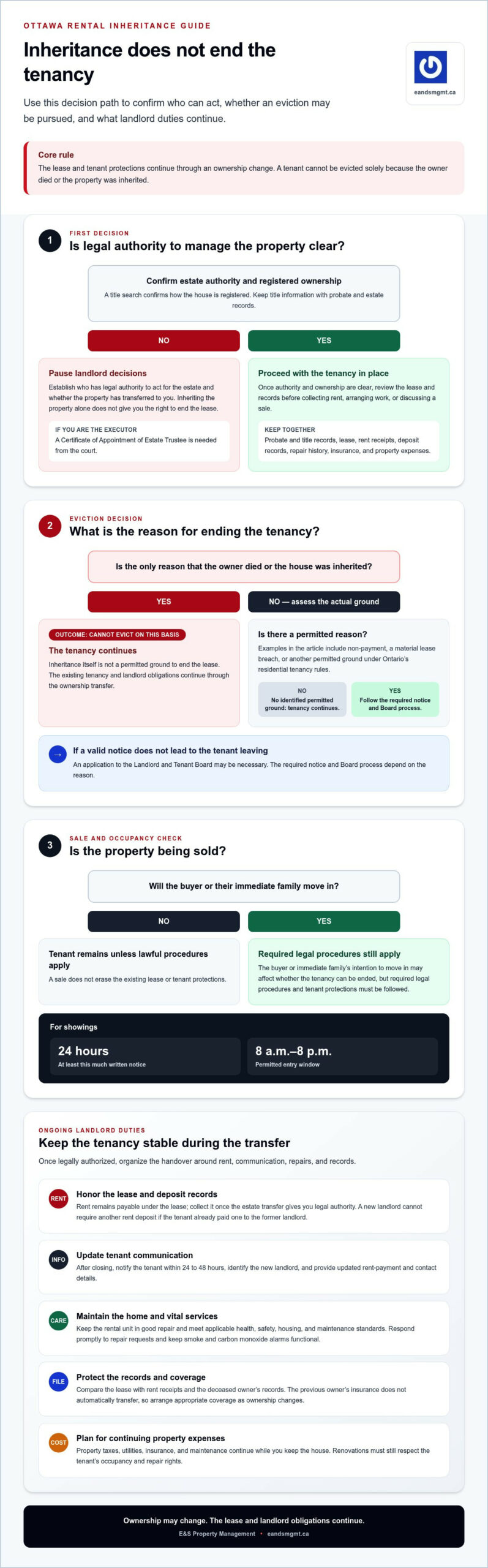
No. In Ontario, a tenant cannot be evicted solely because the owner died or the rental was inherited. Before making decisions about the tenancy, establish who has legal authority to act for the estate and whether the property has transferred to you. Inheriting the property alone does not give you the right to end the lease.
The executor is appointed in the will and administers the estate, including handling estate paperwork and informing beneficiaries of their rights. Under section 2 (1) of Ontario’s Estates Administration Act, a deceased person’s real and personal property vests in the personal representative as trustee for those beneficially entitled. If you are the executor, a Certificate of Appointment of Estate Trustee is needed from the court. While real property remains vested in the representative, section 22 (1) gives the representative power to lease it from year to year.
Probate is court approval of a will that allows an executor to transfer or sell property, and many Ontario estates go through it. Joint ownership with a right of survivorship can affect how a property passes after an owner dies, so confirm the title before treating it as part of the estate. A title search can confirm how the house is registered before you treat it as an estate asset or plan to buy another beneficiary’s share.
Joint ownership can still lead to disputes. For example, an adult child who claims a parent intended a jointly held house as a gift must prove that intention on a balance of probabilities. A lawyer can assist with probate, title transfer and ownership disputes; an accountant can assess tax implications. Canada has no inheritance tax, but the Canada Revenue Agency treats real estate as disposed of at fair market value immediately before death. The estate may owe capital gains tax unless the principal residence exemption applies, and a beneficiary’s adjusted cost base is usually the property’s fair market value at death.
Once authority and ownership are clear, assess whether there is a legal basis to end the tenancy. Non-payment, a material lease breach or another permitted ground may support a process under Ontario’s residential tenancy rules, but inheritance itself is not a ground. The required notice and Landlord and Tenant Board process depend on the reason. If the tenant does not leave after a valid notice, an application to the Board may be necessary.
Confirming the inherited property’s tenants, lease, and obligations
Start by matching the tenancy records to the registered ownership and the estate’s authority to manage the house. Keep rent, repair, insurance and property expense records together, especially if the home may be sold or renovated.
Tenant Rights and Ownership Records
Tenant rights generally continue when a rental changes ownership, so the transfer does not erase the existing lease. A title search confirms how the property is registered and helps establish who can act as landlord once ownership or estate authority is transferred. Keep the title information with the probate and estate records. It clarifies your position before you collect rent, arrange work or discuss a sale.
A tenant must be allowed to remain after a sale unless the buyer or their immediate family intends to move in and the required legal procedures are followed. For showings, provide at least 24 hours’ written notice, and schedule entry between 8 a.m. and 8 p.m.
Lease Terms and Rental Deposits
The lease records the tenant’s rent, payment terms, deposit and responsibilities. Compare it with rent receipts and the deceased owner’s records, then document what has been paid. Under section 106 (4) of Ontario’s Residential Tenancies Act, a new landlord cannot require another rent deposit if the tenant already paid one to the former landlord.
If the lease describes a payment as a security deposit, preserve the lease and payment records rather than requesting a duplicate. Rent remains payable under the lease; the new owner can collect it once the estate transfer gives them legal authority.
Ontario landlords must maintain rental units in good repair and meet applicable health, safety, housing and maintenance standards. Keep smoke and carbon monoxide alarms functional, respond promptly to repair requests and maintain vital services. The previous owner’s insurance does not automatically transfer, so arrange appropriate coverage as ownership changes.
Keeping the house means ongoing property taxes, utilities, insurance and maintenance; those costs continue until transfer or sale. Renovations still need to respect the tenant’s occupancy and repair rights. For a sale, showings require notice and permitted entry times. A practical management system can help coordinate records, inspections and repairs; full-service property management can support those ongoing rental responsibilities.
Does the tenancy survive the owner’s death?
Yes. The existing tenancy and landlord obligations continue through the ownership transfer. The priority is to identify who can act and keep the tenant’s arrangements stable.
The Existing Tenancy After Ownership Changes
An inheritance changes ownership, but doesn’t end the lease or alter its terms. Ontario’s Residential Tenancies Act, 2006 includes heirs, personal representatives and successors in title in the definition of landlord. That matters because the person legally entitled to act must honour the lease, not treat the house as vacant. After closing, notify the tenant within 24 to 48 hours, identify the new landlord, and provide updated rent-payment and contact details.
Landlord Responsibilities During the Transfer
During the transfer, the landlord remains responsible for repairs, vital services and required property standards. The deceased owner’s insurance does not automatically transfer, so arrange suitable coverage for a tenanted home and keep utilities active and paid. You can manage rent, maintenance and records yourself or delegate residential property management.
Changing sole ownership to joint tenancy is a disposition for tax purposes and must be reported. A joint tenant is deemed to dispose of their real estate interest at fair market value when they die, subject to a possible rollover. This tax treatment can affect estate decisions.
Ending a Tenancy or Moving In
An owner or close family member who genuinely plans to occupy the unit may use an N12 notice, subject to tenant protections. The notice must provide at least 60 days and end on the last day of a rental period. For qualifying N12 notices under rules effective September 21, 2026, at least 120 days’ notice removes the compensation requirement; shorter notice, but at least 60 days, requires one month’s rent before termination.
A tenant who doesn’t leave by the N12 termination date cannot be removed without the Landlord and Tenant Board process. Other grounds require the applicable notice and legal procedure; inheritance alone isn’t a reason to end the tenancy.
Ontario tenancy protections and security of tenure
Ontario’s security-of-tenure rules generally mean a tenant can remain in the rental unless the landlord follows a lawful process to end the tenancy. Inherited ownership does not remove those protections. Assess the specific reason for any proposed termination, then follow the procedure that applies.
The Residential Tenancies Act excludes some living arrangements where an occupant shares a kitchen or bathroom with an owner, or the owner’s specified family member, who lives in the building. This exception is specific; it does not apply simply because a landlord hopes to occupy the property. If the tenancy is covered, the landlord must use a valid legal ground and process. A tenant who disputes a notice can bring the matter before the Landlord and Tenant Board.
Bad-faith eviction claims can also affect an owner after a tenant leaves. Ontario’s Act presumes bad faith in specified circumstances if the landlord takes listed actions after giving notice and within one year after the tenant vacates. Keep records of the reason for the notice and what happened afterward. For example, a major change in plans after an intended personal-use termination may raise questions. Get legal advice before acting if estate disputes or the intended use are contested.
Rent administration has separate protections. A landlord must give at least 90 days’ written notice of an intended increase, and the annual guideline cannot exceed 2.5 per cent for a calendar year. Rent increases outside the guideline may be subject to additional requirements. Under section 116 (4), an increase is void if required notice wasn’t given. The unit’s history can affect which rent-control rules apply. Keep rent and rental-income records distinct from estate expenses.
If a lawful vacancy later requires a new renter, E&S Property Management’s Tenant Placement Service can support the placement process. For disputes about a notice, ownership or the tenant’s rights, a lawyer can help assess the legal issues before you proceed.
E&S Property Management: Full-Service Property Management
E&S Property Management can manage the ongoing responsibilities of an inherited rental once your authority to act is clear. Full-Service Property Management brings rent administration, maintenance coordination and tenant communication into an organized routine. Regular Property Inspections help you track the home’s condition, while Financial Reporting and Accounting help you monitor rental income and property expenses.
If the tenancy ends lawfully and you need to find a new renter, a Tenant Placement Service can support that next stage. For an inherited property you plan to keep, professional oversight can reduce the day-to-day administrative load while you remain responsible for estate and ownership decisions. Contact E&S Property Management to discuss your property management needs, or visit eandsmgmt.ca.
Set a Steady Course for the Property
If you’ve inherited a tenanted house in Ottawa, focus on making the property’s future manageable rather than resolving every estate decision at once. A clear record of who is responsible for each decision helps keep estate administration and day-to-day rental operations from becoming tangled.
Choose a practical direction for the home, then organize the work around it. If you plan to keep it as a rental, establish a consistent approach to communication, maintenance records and financial tracking. If your plans change, revisit the tenancy and ownership implications before making commitments. A deliberate process helps protect the property while respecting the people who live there.
When you’re ready to discuss ongoing rental management, connect with E&S Property Management about support suited to the property. You can move forward one decision at a time, with a clearer plan for the home and its tenancy.
Frequently Asked Questions
When can you raise the rent, and by how much?
For a unit covered by Ontario’s rent increase guideline, give at least 90 days’ written notice and keep an increase within the 2.5 per cent annual guideline. An increase above that limit needs Landlord and Tenant Board approval. Before preparing a notice, compare the proposed amount with the tenant’s current rent and review whether the unit is subject to the guideline. A notice that misses required rules may be void.
Can I sell a home in Ottawa while a tenant is living there?
Yes, you can sell an occupied rental in Ottawa, but the tenant’s lease remains relevant to the sale. A buyer may purchase the property with the tenancy continuing, which can affect possession plans and the terms negotiated between buyer and seller. Give prospective buyers accurate lease information and coordinate viewings lawfully. Do not describe the home as vacant unless the tenant has legally vacated.
Can the buyer evict my tenant after the sale closes?
A buyer can’t end the tenancy simply because the sale has closed. If the buyer genuinely intends to move into the unit, Ontario’s personal-use process may apply, with an N12 notice and tenant protections. The buyer must follow the required steps, and a tenant who remains after the termination date can’t be removed without the Landlord and Tenant Board process. A sale agreement alone doesn’t replace those requirements.
Does a Tenant’s Lease Survive When the Landlord Dies?
Yes. The landlord’s death does not by itself cancel the tenant’s lease or erase its terms. The estate representative or successor with legal authority must handle the tenancy during the transition. For example, the tenant’s agreed rent and payment arrangements do not become optional because the named landlord has died. Keep communications consistent and document who is authorized to receive payments or respond to tenancy matters.
What should I do first after inheriting a tenanted house in Ottawa?
If you’ve inherited a tenanted house in Ottawa, first establish who has authority to manage it and review the estate’s ownership records. Then assemble the lease, payment information, deposit records, insurance details and outstanding repair issues. This gives you a practical picture of the property before deciding whether to keep or sell it. If beneficiaries disagree about ownership or decisions, hold disputed actions until responsibilities are clear.
How do I obtain the lease, rent records, deposits, and maintenance history from the estate or previous landlord?
Ask the estate trustee or the person who managed the rental for a written transfer of the property file. Request the signed lease and amendments, rent ledger, deposit receipts, tenant correspondence, invoices, inspection notes and open repair requests. Compare the ledger with available bank or accounting records, and note any gaps separately rather than assuming a payment was missed. Keep a dated inventory of documents received and follow up on outstanding items.


