
A tenant in Ontario can ask the Landlord and Tenant Board to address a landlord’s maintenance failure, including mould that hasn’t been properly dealt with. Sections 29 and 30 of the Residential Tenancies Act provide ways to seek a remedy, and a current or former tenant generally must apply within one year of the alleged breach. Clear written records can help show what was reported, when the landlord was notified, and how the problem was handled.
It’s understandable to feel unsettled when mould appears at home, especially if you’re unsure who should arrange or pay for the work. Landlord obligations for mould remediation in Ontario depend on the cause and circumstances, but tenants shouldn’t have to guess what to do next or rely on a conversation they can’t document.
This guide explains when a landlord may be responsible, how to record the issue and communicate in writing, what to know about remediation costs, and when an application to the Board may be an option. It also covers practical steps to keep the response organized while the source of moisture is addressed.
Key Takeaways
- Trace the mould to its moisture source, since responsibility can depend on what caused the growth and whether a maintenance issue was left unresolved.
- Record what you see, when you noticed it, and how you reported it so there’s a clear timeline of the concern and response.
- Understand the remedies a tenant may seek through the Landlord and Tenant Board, including an order to address maintenance problems.
- Keep communication organized and allow access for inspection so the issue can be assessed and the next steps can be documented.
Can a Tenant Sue Their Landlord for Mold in Ontario?
A tenant can apply to Ontario’s Landlord and Tenant Board over a landlord’s failure to maintain a rental unit. The Residential Tenancies Act sets out landlords’ duties and possible remedies.
-
Reviewing Landlord Maintenance Duties
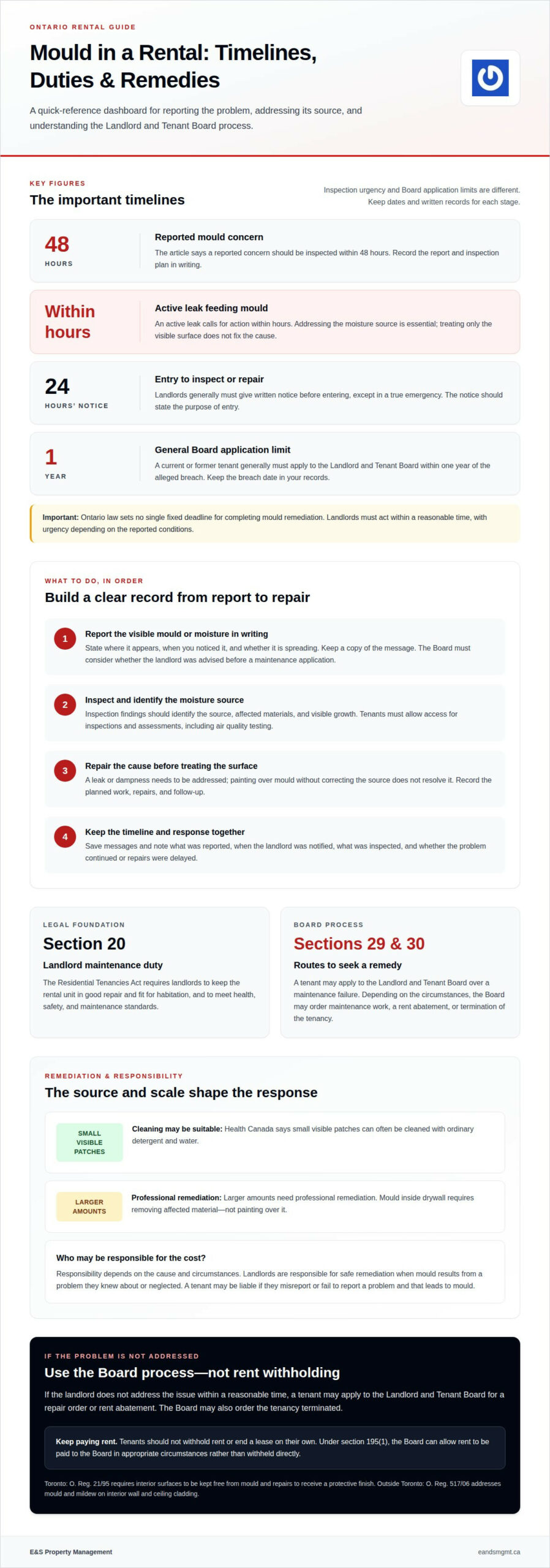
Compare the mould problem with the landlord’s duty under section 20 of the Residential Tenancies Act. The landlord must keep the residential unit in good repair and fit for habitation, and meet health, safety, and maintenance standards. Look for a building problem, such as a roof leak, that could let moisture enter. The surface mark may be visible, but the underlying repair matters too.
-
Reporting Mould and Maintaining the Property
Tell the landlord about visible mould or a moisture problem in writing, and keep a copy. Include where it appears, when you noticed it, and whether it is spreading. Tenants should report problems and keep the rental property clean and sanitary. For example, report a persistent damp patch rather than leaving it unmentioned. The Board must consider whether the tenant advised the landlord before filing a maintenance application.
-
Seeking Remedies at the Landlord and Tenant Board
Keep the date the mould or maintenance breach occurred in your records. A current or former tenant generally must apply to the Landlord and Tenant Board within one year of the alleged breach. Sections 29 and 30 of the Residential Tenancies Act provide routes to seek action. The Board may order maintenance work, a rent abatement, or termination of the tenancy. Don’t withhold rent; in appropriate circumstances, the Board can allow rent payments to be made to it.
-
Allocating Remediation Costs
Separate the question of cost from the visible mould: identify its source and review the maintenance history. Landlords are responsible for safe remediation when mould results from a problem they knew about or neglected. A tenant may be liable if they misreport or fail to report a problem and that leads to mould. Save messages and note what you reported; that timeline can help explain how the moisture developed and whether repairs were delayed.
Who Pays for Mold Remediation in an Ontario Rental?
Ontario’s landlord obligations for mould remediation include keeping rental units in good repair and fit for habitation. Tenants should continue paying rent and use the Landlord and Tenant Board process to seek remedies rather than withholding rent or ending a lease on their own.
-
Assessing Repair and Habitability Duties
Compare the reported condition with section 20 of the Residential Tenancies Act. It requires landlords to keep rental units in good repair and fit for habitation. Look beyond the visible patch: a damp wall or recurring stain may point to an unresolved repair. Understanding landlord obligations for mould remediation in Ontario means considering the building condition and what work is needed, not only the mould’s appearance.
-
Repairing the Moisture Source
Identify and fix the moisture source before treating the visible surface. Painting over mould without correcting a leak or dampness doesn’t address the cause. A tenant can report recurring growth and ask what repair will prevent it from returning. Landlords can keep a record of the moisture source, repairs, and any follow-up.
-
Arranging Professional Remediation
Choose a response suited to the location and amount of mould. Health Canada says small visible patches can often be cleaned with ordinary detergent and water, while larger amounts need professional remediation. Mould inside drywall requires removing affected material, not painting over it. Toronto’s O. Reg. 21/95 requires interior surfaces to be kept free from mould and repairs to receive a protective finish. Outside Toronto, O. Reg. 517/06 addresses mould and mildew on interior wall and ceiling cladding.
-
Pursuing Available Remedies
Keep a record of reports, inspection findings, repair work, and any continuing effects. If the landlord doesn’t address the problem within a reasonable time, a tenant may apply to the Landlord and Tenant Board for a repair order or rent abatement. The Board may also order the tenancy terminated. Under section 195(1), it can allow rent to be paid into the Board in appropriate circumstances, rather than withheld directly.
Are you responsible for mould in your rental unit?
Responsibility depends on the source, urgency, and condition of the rental. Use these steps to arrange an inspection, document the response, and understand your rights.
-
Arranging a Mould Inspection
Arrange an inspection when a tenant reports mould or a known moisture source. Landlords are responsible for testing and remediation costs once mould is found or reasonably suspected. Ask the inspector to identify the moisture source, affected materials, and any visible growth. Tenants must allow access for inspections and assessments, including air quality testing. Keep the findings with the maintenance record.
-
Setting a Reasonable Response Timeline
Assess urgency from the reported conditions, then record the inspection and repair plan in writing. Ontario law sets no single fixed deadline for completing mould remediation; landlords must act within a reasonable time. A reported concern should be inspected within 48 hours. An active leak feeding mould calls for action within hours. Extensive growth, mould in HVAC systems, or reported health symptoms also require immediate inspection.
- Give proper notice before entering to inspect or repair. Ontario landlords generally must provide 24 hours’ written notice, except in a true emergency. Include the entry’s purpose and time in the notice, and keep a copy. For an active water emergency, act promptly and document why entry was necessary. This protects the tenant’s rights while allowing the landlord to investigate a condition affecting habitation.
- Check the applicable maintenance standard and municipal process. O. Reg. 517/06 requires interior wall and ceiling cladding to remain free from mould and mildew in most of Ontario outside Toronto. Municipal property standards bylaws may add requirements and allow work orders. A tenant can contact municipal By-Law Enforcement or Property Standards through 311 to request an inspection. Local public health units can inspect rental units and issue orders where mould poses a health risk.
Documenting mould and communicating in writing
- Create a dated incident log. Record when you first noticed mould, the room, and its exact location in the rental unit. Describe its severity, colour, approximate spread, and any nearby moisture or leak. For example, note whether growth appears beside a window or below a ceiling stain. Add each change to the same timeline so the condition’s progression is easy to follow.
- Take clear, dated photographs. Capture a wide view showing where the affected area is, then take closer images of the surface. Include a window frame, wall corner, or other reference point where possible. Keep the original files and avoid editing them. If the patch changes after a repair or cleaning, photograph the later condition separately and record when you took the image.
- Send a specific written report. Identify the affected room, visible mould, any moisture source, and when you noticed it. Ask the landlord to confirm receipt and describe the next inspection or repair step. Landlords should acknowledge a mould complaint in writing the same day. Keep the sent message and reply together rather than relying only on a phone conversation.
- Keep inspection and repair records together. Save entry notices, inspection notes, contractor findings, testing results, and messages about completed work. Record whether a repair addressed the moisture source or only the visible surface. Maintenance standards differ by location: O. Reg. 517/06 applies in most of Ontario outside Toronto, while Toronto has O. Reg. 21/95. Note the municipality when organizing records.
- Update the timeline after each response. Record the date of an inspection, what was found, and any work still outstanding. If mould returns near the same window after a repair, add a fresh photograph and report the recurrence in writing. A clear sequence helps explain the rental unit’s state of repair. Property owners can coordinate emergency maintenance response when a reported issue needs prompt attention.
E&S Property Management: Full-Service Property Management
E&S Property Management can help landlords organize the responsibilities that follow a mould report. Its Full-Service Property Management includes coordinating necessary maintenance and repairs, while Regular Property Inspections help landlords monitor a home’s condition and identify concerns that need follow-up.
For an owner balancing tenant communication, repair records, and property oversight, this support can bring those tasks into a consistent process. E&S also offers Tenant Placement Service and Financial Reporting and Accounting, supporting other aspects of residential property management. Clear reporting and organized oversight help landlords keep maintenance information accessible as they respond to issues.
If you’d like support managing a residential rental, contact E&S Property Management to discuss your property management needs.
Build a Clearer Plan for Your Rental
A mould concern can put pressure on both a tenant and a property owner. A practical next step is to make maintenance communication part of your regular rental management process, so reports, decisions, and follow-up stay connected rather than scattered across messages and memory. Understanding landlord obligations for mould remediation in Ontario is one part of the work; a consistent approach to property management helps you respond thoughtfully when an issue arises.
Consider what would make the next maintenance concern easier to handle: a clear point of contact, organized records, and steady oversight of the home. E&S Property Management supports residential landlords with property management tailored to the responsibilities of overseeing a rental.
Contact E&S Property Management to discuss support for your rental property. A more organized approach can help you move forward with greater confidence.
E&S Property Management and Mould Remediation Support
E&S Property Management can be a natural next step if you need help managing a rental after reviewing your responsibilities for mould remediation in Ontario. Its services include full-service property management, tenant placement, regular property inspections, financial reporting and accounting, and emergency maintenance response.
For landlords who also need tax filing support, E&S Property Management handles NR6 forms, monthly tax withholdings, and annual NR4 slips.
Frequently Asked Questions
Can I withhold rent because of mould?
No. Continue paying rent while pursuing a mould remedy; withholding it yourself can create a separate rent dispute. Under section 195(1) of Ontario’s Residential Tenancies Act, the Landlord and Tenant Board can, in appropriate circumstances, allow you to pay some or all rent into the Board. Request that arrangement through the Board rather than redirecting rent on your own.
Am I liable if my tenant says the mould made them sick?
A tenant’s report of illness doesn’t, on its own, establish who is responsible. Take the report seriously, arrange an inspection, and document what the investigation finds about mould and its moisture source. Responsibility can depend on whether the growth arose from a maintenance problem the landlord knew about or neglected, or from a tenant’s failure to report a problem that led to mould. Record the response and repair steps.
Can my landlord blame me for mould from showering or cooking?
Bathing and cooking can add moisture, but those activities alone don’t establish tenant fault. The cause and circumstances matter, including whether ventilation or a building repair issue contributed to persistent dampness. Report visible growth and ongoing moisture promptly, and keep the rental clean and sanitary. A clear record of when you noticed the problem and notified the landlord can help explain how it developed.
Can my tenant refuse to pay rent while the unit is being remediated?
No. A tenant shouldn’t unilaterally stop paying rent because remediation is underway. The Board can consider maintenance-related remedies and, in appropriate circumstances, may allow rent payments to be paid into the Board. That differs from a tenant deciding independently to withhold rent. Keep rent records current and document the repair schedule, access arrangements, and any effect the work has on use of the unit.
Can public health order me to fix mould in Ontario?
Yes. Local public health units can inspect rental units and issue orders where mould poses a health risk. A tenant can also ask municipal By-Law Enforcement or Property Standards to inspect through 311; municipalities may issue work orders under local property standards bylaws. Keep inspection findings and notices with the maintenance file, and document how you respond to each identified repair concern.
What are Ontario landlords legally required to do about mould in a rental unit?
Ontario landlords must maintain rental properties in compliance with health, safety, and maintenance standards. Section 20 of the Residential Tenancies Act requires rental units to remain in good repair and fit for habitation. In practice, investigate reported mould, address the moisture source, and arrange appropriate remediation rather than simply covering visible growth. Keep records of tenant reports, inspection findings, and repairs to show how the concern was handled.


