Doubt during a management change doesn’t automatically mean you’re making the wrong decision. Learning how to transition from self-managed to professional management starts with recognizing four signs: routine tasks are taking too much time, your systems can’t keep pace, it’s hard to step back from daily decisions, or uncertainty is drawing you toward the old arrangement. These pressures may indicate that professional oversight could better support your property and free up your time.
It’s natural to feel protective of a property you’ve managed yourself and wonder whether handing over responsibilities will create more work instead of less. This guide explains who may benefit from professional property management and how to prepare for changes to everyday processes, decisions, and communication. It also considers the limits of founder-led management and the self-doubt that can arise during a transition, helping you assess your situation and identify what needs to change.
Key Takeaways
- Consider professional management when property tasks are taking time away from other responsibilities or resident needs are difficult to address consistently.
- Prepare for the change by organizing core processes for maintenance, communication, finances, and decision-making.
- Set clear boundaries for the owner’s ongoing role so professional managers can carry out agreed responsibilities without losing valuable context.
- Expect some uncertainty during the transition; assess whether the new approach is addressing the pressures that prompted the change before returning to the old arrangement.
1. Who Should Consider Professional Property Management?
Professional management may suit owners whose rental responsibilities regularly disrupt other parts of life. Missed repair updates, repeated tenant calls, or difficulty arranging inspections can signal that your available time no longer matches the property’s needs. The decision is not about giving up control, but about establishing reliable coverage for recurring work.
Understanding how to transition from self-managed to professional management starts with identifying what needs attention. List recurring tasks, note which require your direct involvement, and consider whether tenant communication, maintenance coordination, or financial records are becoming difficult to manage consistently. An owner living away from a property, for example, may value having a local manager coordinate inspections and repairs.
When choosing a property management company in Canada, compare its written scope with the work you need handled, such as tenant placement, inspections, maintenance coordination, and financial reporting. Clarify how responsibilities, approvals, and updates are organized, then choose an arrangement that matches your priorities.
To compare costs, estimate the time you spend on calls, rent administration, repairs, and recordkeeping, along with your direct self-management expenses. Compare that total with the management fee, then consider whether less day-to-day work and more consistent processes justify the difference.
Hiring a manager doesn’t mean you stop making decisions. You still set priorities, approve major spending where your agreement requires it, provide funding, and make decisions reserved to you. Document delegated authority clearly so routine work can move forward without confusion.
Rental housing rules vary by province and territory, and municipal requirements may also apply. In Ottawa, owners should account for relevant provincial tenancy rules and local property requirements when setting management procedures.
Before hiring a manager, ask which duties are included, how maintenance requests are handled, what reports you’ll receive, and how spending approvals work. Prepare the management agreement, tenant and lease records, payment history, maintenance records, inspection notes, and relevant property details to support an orderly handover.
Consider the trade-offs: management fees affect cash flow, and delegating work means less direct control over daily decisions. A clear agreement and regular reporting can keep you informed while reducing the burden of handling every operational detail yourself.
2. Operational systems and process improvements
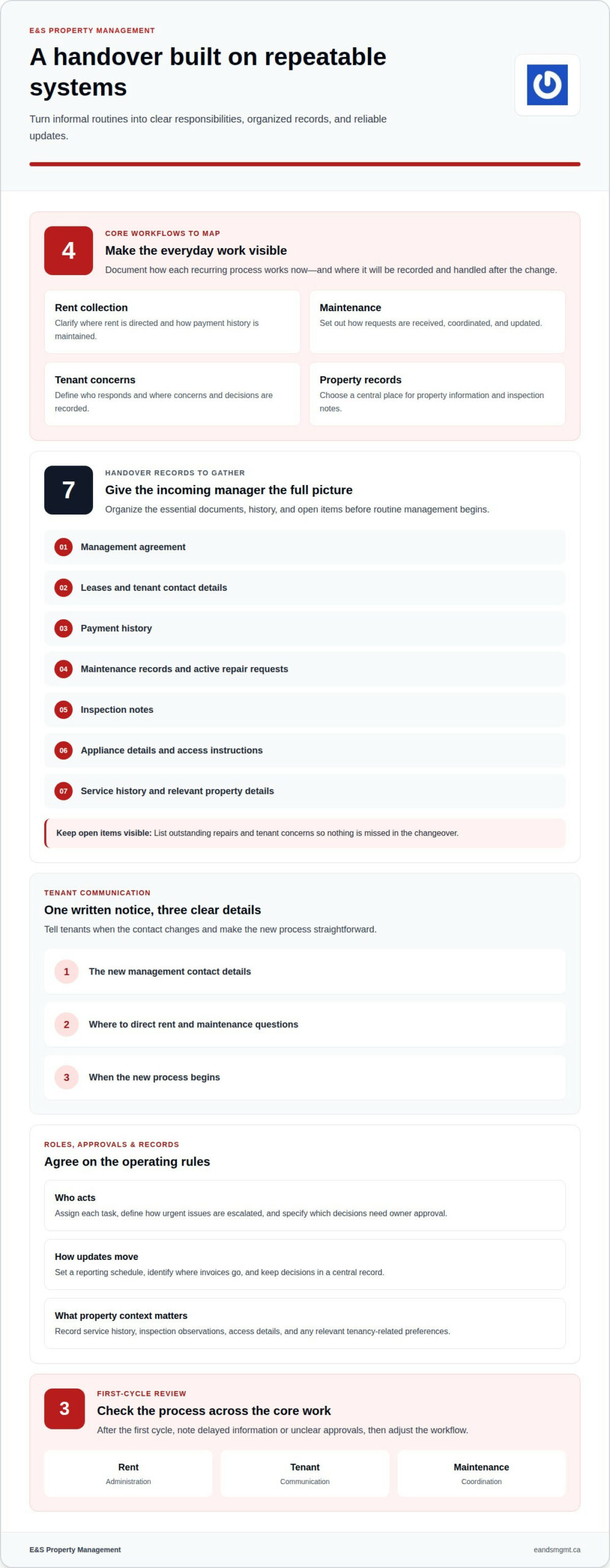
A successful handover replaces informal habits with clear, repeatable processes. Map how rent is collected, maintenance is arranged, tenant concerns are answered, and property records are stored. For example, if repair requests currently arrive by text, decide where each request, decision, and completion update will be recorded after the change.
To hand over a rental property, organize the management agreement, leases, tenant contact details, payment history, maintenance records, inspection notes, and active repair requests. Then agree who handles each task, how urgent issues are escalated, and how information is transferred securely. A list of outstanding items helps ensure an open repair or tenant concern isn’t missed during the changeover.
Notify tenants in writing when the management contact changes. Provide the new contact details, explain where to direct rent and maintenance questions, and state when the new process begins. A clear message helps tenants know whom to contact, while consistent communication from you and the incoming manager reduces uncertainty.
Next, document approval steps. Specify who authorizes routine repairs, where invoices go, and how you’ll receive financial updates. Agree on a regular reporting schedule and a central record for decisions. If you previously handled every request personally, this structure makes responsibilities visible without repeated messages about the same issue.
Set up property records before routine management begins. Include appliance details, access instructions, service history, tenancy-related preferences, and inspection observations. Consistent inspection records can help identify a recurring leak or maintenance concern earlier than scattered notes. Keep communication practical by recording the issue, action taken, and any follow-up needed.
Finally, review the process after the first cycle of rent administration, tenant communication, and maintenance coordination. Note where information was delayed or approvals were unclear, then adjust the workflow. Owners preparing for a structured handover can explore property management transition support as they clarify responsibilities and operational needs.
3. Acknowledging founders’ management limitations
A founder who personally handles every tenant call, repair decision, and payment can become a bottleneck. Hiring a manager changes more than the task list: it changes who has authority to act. If you delegate work but continue approving every routine decision, the new arrangement may add another layer instead of freeing up time.
Set boundaries before the handover. Write down which decisions the manager can make, which require your approval, and what information you’ll receive. You can remain involved as an adviser without retaining direct control of daily tasks. For example, share a property’s maintenance history while leaving routine coordination to the manager.
A meeting can give employees and others involved a clear account of the change. Explain what is changing, why the new arrangement is being introduced, and how people can raise concerns. A town hall with the owner and management team can connect operational changes to shared goals, while a designated feedback channel makes concerns easier to raise.
Listen to concerns as well as questions. Repeated references to “how it used to be” or “the good old days” may signal discomfort with changed routines. Long-serving employees may also feel strong loyalty to the family or founder. Acknowledge their contributions, explain new decision-making paths, and don’t treat every concern as opposition to progress.
Bill Gates’s handover to Steve Ballmer offers a leadership example: clearly defined roles helped the founder stay within agreed boundaries while transferring power. For a property owner, the principle is practical. Agree on the manager’s authority, preserve useful knowledge about the property, and avoid reversing decisions through informal instructions after the handover.
Review the arrangement against your original reasons for hiring help. If you still handle every tenant issue or override routine processes, revisit the boundaries. An intentional advisory role can preserve your insight without making day-to-day management dependent on one person.
4. Self-doubt during a management transition
Self-doubt often grows when familiar routines change. If you once answered every tenant message, you may feel uneasy when a manager takes over communication. That discomfort can reflect a shift in responsibility, not proof that the decision was wrong. Separate the feeling from the facts by identifying what prompted the change, such as missed follow-ups or repair coordination taking time away from other work.
Use your original concerns as a reference point. If you wanted clearer maintenance oversight, review whether repair requests are recorded, assigned, and followed through. If tenant communication was difficult to manage, consider whether residents now know where to direct questions. These practical indicators are more useful than judging the transition by one unfamiliar interaction.
A transition can bring friction. A tenant may contact you out of habit, or a manager may need context about an older repair. Treat each event as a specific handover issue: share relevant property details, clarify who responds, and agree how to handle similar matters next time. This addresses gaps without sending every decision back to you.
When doubt surfaces, pause before reversing the arrangement. Write down the concern, what triggered it, and whether it relates to the original reason for changing management. Then discuss the issue with the manager and agree on a practical adjustment. A difficult moment deserves attention, but it doesn’t automatically justify abandoning the transition.
Keep the agreed responsibilities in place while you assess whether the new process is working. If you’re ready to delegate ongoing oversight, explore full-service property management and consider how professional support can fit your property’s needs.
When a change becomes difficult, continue the transition rather than immediately returning to the old arrangement. That doesn’t mean ignoring problems or accepting unclear responsibilities. Keep the original purpose in view, raise specific concerns with the manager, and make focused adjustments while the agreed arrangement remains in place. A measured review gives new processes room to settle and prevents one difficult moment from becoming the sole reason to reverse the decision.
E&S Property Management
E&S Property Management helps residential owners move from self-management to a more organized approach in Ottawa. Its Full-Service Property Management brings together tenant placement, regular property inspections, and financial reporting and accounting. This can suit owners who want support with recurring responsibilities while staying informed about their property.
A practical next step is to identify which tasks you want handled and which decisions you prefer to retain. Clear expectations support a workable relationship and an orderly handover of property information, tenant records, and ongoing concerns. If you’re seeking help with a rental property in Ottawa, contact E&S Property Management to discuss your management needs.
Make the Next Step a Deliberate One
A management change doesn’t need to happen all at once. Start by deciding which responsibilities you’re ready to delegate, which decisions you want to retain, and what information will help you stay involved without managing every detail. That clarity can turn uncertainty into a practical plan.
Thinking through how to transition from self-managed to professional management is also an opportunity to define effective oversight for your property. You might prioritize dependable communication, organized records, or a clearer process for maintenance decisions. Naming those priorities gives you a useful starting point for discussing an arrangement that fits your circumstances.
If you’re ready to explore professional support, contact E&S Property Management to discuss your property management needs. A thoughtful conversation can help you take the next step with greater confidence and a clearer sense of what to delegate.
Frequently Asked Questions
Who Should Consider Professional Property Management?
Consider professional management when distance, work schedules, or tenant needs make consistent oversight difficult. For example, an owner living outside Ottawa may find it hard to coordinate access for repairs or respond promptly to property concerns. Management can also suit owners who want to retain important decisions while assigning routine administration to a manager. The right fit depends on which responsibilities are creating the most pressure.
What does transitioning from self-managed to professional property management involve?
Transitioning means agreeing on delegated duties, decision-making authority, and how ongoing issues will be handled. Before the new arrangement begins, clarify who can authorize work, how existing commitments will be managed, and how you’ll receive updates. Settling responsibility for a repair already underway, for example, can prevent duplicate instructions. A clear start date and shared understanding of roles help the new manager take over smoothly.