
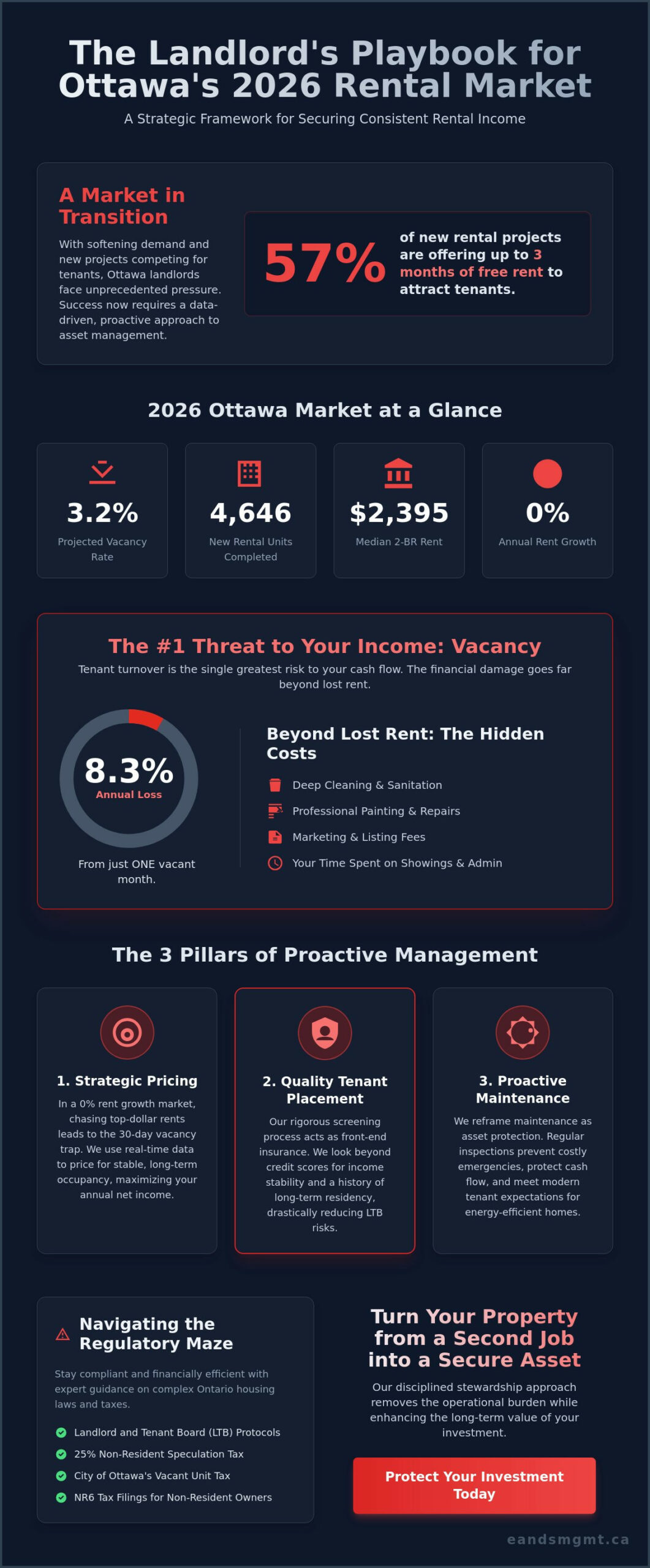
Can your investment survive a market where 57% of new rental projects are now forced to offer up to three months of free rent just to attract tenants? With Ottawa’s vacancy rate climbing to 3.2% in early 2026, ensuring consistent rental income Ottawa landlords need is no longer a matter of luck. You’ve likely felt the weight of softening demand and the administrative burden of the Landlord and Tenant Board’s shifting protocols. It’s a challenge to maintain high standards when the federal workforce is downsizing and international migration has slowed.
We understand that owning property should provide security, not a second full-time job. This guide offers a strategic framework for eliminating vacancy gaps, navigating the 25% Non-Resident Speculation Tax, and securing stable cash flow. You’ll discover how to implement a disciplined approach to tenant selection and asset maintenance that protects your investment against market volatility. We will examine the specific steps required to remain compliant with the latest Ontario housing laws while maintaining the predictable monthly revenue your portfolio deserves.
Key Takeaways
- Understand the 2026 Ottawa economic landscape and how shifting vacancy rates in neighborhoods like Barrhaven and Kanata impact your revenue.
- Learn the mathematical reality of tenant turnover and the specific strategies for ensuring consistent rental income Ottawa property owners need to maintain occupancy.
- Reframe maintenance as an asset protection strategy by using regular inspections to prevent expensive emergency repairs and protect your cash flow.
- Manage the complexities of the Landlord and Tenant Board and NR6 tax filings to keep your operations legally sound and financially efficient.
- Discover how a disciplined stewardship approach removes the operational burden of property oversight while enhancing the long-term value of your asset.
The Ottawa Rental Market in 2026: Stability Amidst Change
The Ottawa rental market is currently navigating a period of significant transition. While the city has long been insulated by the stability of the federal government, 2026 has introduced new variables. Federal downsizing has tempered demand in central areas, yet tech hubs like Kanata remain robust. For property owners, ensuring consistent rental income Ottawa requires moving beyond passive management and adopting a more strategic, data-driven approach. Success now depends on understanding how localized supply affects your specific neighborhood.
Economic Anchors and Rental Demand
Ottawa’s employment base remains its greatest asset. The public service still provides a reliable floor for rental demand, even as the sector undergoes structural changes. Simultaneously, Kanata’s tech expansion continues to attract high-income professionals who prioritize proximity to work and modern amenities. These hybrid workers and international newcomers are the primary demographics driving demand in 2026. Market resilience in our city is defined by this diverse employment base that prevents a total market stall when one sector slows down. Landlords who cater to these professionals with dedicated home office spaces see significantly lower turnover rates.
Pricing Strategies for 2026
In a softening market, pricing is no longer a “set it and forget it” task. Many landlords fall into the 30-day vacancy trap by chasing top-of-market rents that don’t align with current data. In early 2026, Ottawa’s vacancy rate reached 3.2%. Neighborhoods like Barrhaven and Orleans are seeing increased competition from the 4,646 new rental units completed last year. Stittsville has also seen a surge in supply, which has flattened rent growth. With the median asking rent for a two-bedroom unit at $2,395 showing 0% change over the past year, stable-occupancy pricing is now more effective than aggressive hikes.
A unit that sits vacant for just one month represents an 8.3% loss in annual gross income. This loss often outweighs any potential gains from a higher monthly rent. Landlords must also account for the City of Ottawa’s Vacant Unit Tax, which penalizes properties left unoccupied for extended periods. When drafting agreements under Ontario’s Residential Tenancies Act, 2006, focus on long-term retention from the start. Modern tenants expect energy-efficient appliances to manage rising utility costs. Meeting these expectations isn’t an optional upgrade; it’s a requirement for maintaining the asset’s competitive edge and protecting your cash flow.
The True Cost of Vacancy: Why Retention is Your Primary Revenue Driver
Many property owners prioritize marketing to fill empty units. They often overlook the financial damage of turnover itself. The math is unforgiving. A single month of vacancy results in an 8.3% loss in annual gross income. This figure doesn’t account for the hidden costs of deep cleaning, professional painting, and marketing fees that accumulate every time a tenant departs. Turnover is the greatest threat to ensuring consistent rental income Ottawa investors rely on for long-term stability.
The “Tenant Lifecycle” begins long before the move-in date. The first 90 days are critical for establishing a professional relationship. This period sets the tone for the entire residency. Professional tenant placement acts as a front-end insurance policy, significantly reducing the risk of non-payment and the administrative burden of Landlord and Tenant Board (LTB) disputes. When you secure a resident who views the property as a long-term home, you eliminate the repetitive costs of the “find and fill” cycle.
The Anatomy of a High-Quality Tenant
A high-quality tenant in 2026 is defined by more than just a credit score. We look for income stability and a history of long-term residency. Employment verification is vital in a shifting labor market where hybrid work and federal downsizing have changed traditional career paths. For owners managing properties from abroad, understanding non-resident tax obligations is part of this broader financial vetting process. Ensuring the tenant’s budget can handle both rent and current utility fluctuations protects your net cash flow. Utilizing a professional Tenant Placement Service ensures that your property is occupied by individuals who value the asset as much as you do.
Retention Strategies That Work
Retention is a proactive discipline. Responsive communication prevents “frustration moves” where tenants leave simply because a minor repair was ignored. Small, strategic property upgrades like modern lighting or smart thermostats go a long way in securing lease renewals. These improvements make the property more competitive in a market where 57% of new projects are offering incentives. Tenant satisfaction is the primary driver of landlord ROI. When residents feel their home is professionally managed and maintained, they’re less likely to shop around. This stability is the foundation for ensuring consistent rental income Ottawa landlords need to protect their portfolios.
Proactive Maintenance as an Income Protection Strategy
Maintenance shouldn’t be viewed as a drain on your bank account. It is a calculated strategy for ensuring consistent rental income Ottawa landlords use to hedge against catastrophic systems failure. A neglected $500 repair today often evolves into a $10,000 emergency intervention that halts cash flow and damages tenant relations. By treating your property with the discipline of a managed asset, you preserve its longevity and market value. High-level consulting on asset health allows owners to move from reactive panic to strategic oversight.
Leveraging a network of vetted contractors is essential for quality and cost control. These relationships ensure that repairs aren’t just patches but long-term resolutions. In the Ottawa market, where labor costs for specialized trades remain high, having a steady hand to manage these interactions prevents budget overruns. This professional approach to maintenance reinforces the ethical positioning of your investment, signaling to tenants that their home is a priority.
The Preventive Maintenance Schedule
Ottawa’s climate is notoriously harsh on building envelopes and mechanical systems. Seasonal inspections are non-negotiable for any disciplined steward. We focus on a methodical checklist that includes:
- HVAC Systems: Bi-annual servicing to prevent mid-winter furnace failures when temperatures drop below minus 20.
- Roofing and Gutters: Clearing debris and checking for ice damming vulnerabilities before the freeze-thaw cycle begins.
- Drainage and Sump Pumps: Testing systems before the spring thaw to avoid basement flooding and mold issues.
Documenting these regular property inspections is equally vital. Detailed reports protect you against damage claims and simplify Canada Revenue Agency non-resident tax compliance when deducting legitimate business expenses. Fixing issues once with licensed professionals ensures the job is done right, preventing the “revolving door” of temporary patches that ultimately cost more in the long run.
Emergency Response and Liability
A burst pipe at 2:00 AM is more than an inconvenience. It is a direct threat to your passive income and your legal standing. Under Ontario law, landlords have a strict obligation to provide a habitable environment. Delays in emergency handling can lead to rent abatements or costly Landlord and Tenant Board filings. Our emergency 24/7 maintenance response is designed to provide immediate resolution, minimizing both the resident’s disruption and the owner’s financial exposure.
Managing these crises from a distance is nearly impossible without professional support. By having a reliable partner on the ground, you remove the operational burden of middle-of-the-night coordination. This level of oversight ensures that ensuring consistent rental income Ottawa remains a reality even during operational crises. Prompt, professional resolution reinforces the tenant’s trust, directly supporting the retention goals that keep your portfolio profitable.
Navigating Ontario Regulations and Non-Resident Tax Compliance
Compliance isn’t just a legal obligation; it’s a financial necessity. In the complex environment of 2026, administrative errors often lead to months of lost revenue. Ensuring consistent rental income Ottawa property owners expect requires a meticulous approach to the Residential Tenancies Act and Canada Revenue Agency mandates. A single mistake on a notice form can reset a months-long legal process, making professional oversight the only viable path for serious investors. Using the Ontario Standard Lease is your primary tool for enforcing rights, as it provides a clear framework that protects your asset from the start of every tenancy.
For 2026, the maximum allowable rent increase is capped at 2.1%. Navigating these limits while maintaining property profitability is a delicate balance that requires foresight. Landlords must provide tenants with 90 days of written notice before any increase takes effect. Failure to follow these timelines doesn’t just delay your revenue growth; it can invalidate the increase entirely, forcing you to wait another year to adjust your cash flow to market realities.
The LTB Reality in 2026
The Landlord and Tenant Board (LTB) continues to face significant hearing delays, which makes getting your paperwork right the first time mandatory. Under Bill 97, new rules have altered the landscape. As of September 21, 2026, the notice period for non-payment of rent evictions is shortened from 14 to 7 days. While this change allows for faster resolution, it requires immediate action the moment a payment is missed to be effective. Proper notice forms, such as the N1, N4, and N12, are the legal foundation of your business operations and the only way to protect your interests during a dispute.
Any attempt at “self-help” evictions, such as changing locks or cutting off utilities, is financially devastating. Fines are steep and can easily wipe out several years of profit. A disciplined steward understands that the legal process, while slow, is the only path to a permanent resolution. Professional administration prevents these costly missteps by ensuring every communication with the tenant is documented and legally sound.
Non-Resident Landlord Tax (NR6 & NR4)
For landlords posted abroad, such as foreign service officers or expats, tax compliance is exceptionally complex. The CRA requires a 25% gross withholding tax on rental income for non-residents. This can severely restrict your monthly cash flow if managed incorrectly. By filing an NR6 form, you can apply to withhold tax on your net income instead. This accounts for legitimate expenses like maintenance and management fees, preserving more of your capital for property reinvestment.
Failing to provide an annual NR4 slip or missing filing deadlines can lead to significant CRA penalties and interest charges. Professional administration ensures that these filings are submitted accurately and on time, shielding you from unnecessary audits. If you are managing an investment from outside Canada, securing professional NR6 and NR4 Tax Filing Support is the most effective way to preserve your cash flow. Ensuring consistent rental income Ottawa investors deserve means keeping your financial reporting as disciplined as your property maintenance.
Professional Stewardship: The E&S Approach to Ottawa Property Management
E&S Property Management operates on the principle of disciplined stewardship. We manage every property as if it were our own, focusing on long-term asset health rather than short-term convenience. With a 40-year legacy in the Ottawa market, our approach is built on four decades of localized data and community connection. This history is the foundation for ensuring consistent rental income Ottawa investors require in a shifting economy. We provide a steady hand to navigate the complexities of property oversight, allowing you to focus on your professional life while we handle the operational details.
Our methodology combines high-level consulting with tangible action. We don’t just identify problems; we provide resolutions. By integrating sophisticated digital accounting with personalized, local oversight, we offer a transparent view of your asset’s performance. This balance of technology and human expertise ensures that your property remains a high-performing financial instrument. We present ourselves as a partner dedicated to removing the operational burdens that often accompany property ownership.
A Legacy of Local Expertise
Four decades of data allows us to approach tenant screening and pricing with a level of precision that newer firms can’t match. We understand the historical cycles of neighborhoods like Kanata and Barrhaven, which enables us to price for both speed and longevity. This foresight is critical for ensuring consistent rental income Ottawa landlords need when market conditions soften. Our established contractor network is another significant advantage. These vetted professionals prioritize E&S clients, ensuring repairs are conducted with high-quality materials and cost-control measures that protect your bottom line. We use our regional knowledge to turn market fluctuations into opportunities for stability.
Tailored Solutions for Global and Local Landlords
We specialize in supporting clients with unique administrative needs, particularly those in the Foreign Service, Global Affairs, or the Department of National Defence (DND). Managing a property while posted abroad requires a partner who understands the nuances of non-resident tax filings and the necessity of 24/7 emergency response. Our monthly financial reporting and accounting provide total transparency, offering peace of mind regardless of your time zone. We remove the stress of managing maintenance from a distance by acting as the primary point of contact for all stakeholder needs. Our system is designed to provide order and predictability in a sector where uncertainty is common.
Protect your Ottawa investment with E&S Property Management
Securing Your Property’s Financial Future in 2026
Success in the current Ottawa market requires a shift from passive ownership to active, disciplined stewardship. By prioritizing tenant retention over constant turnover and implementing a rigorous preventive maintenance schedule, you protect your asset against the rising vacancy rates observed in early 2026. Navigating the complexities of the Landlord and Tenant Board and managing non-resident tax obligations shouldn’t be a source of stress. This disciplined approach is the most reliable method for ensuring consistent rental income Ottawa landlords can achieve in a changing economic landscape.
E&S Property Management brings over 40 years of local expertise to your portfolio. We provide specialized NR6 and NR4 tax support for those posted abroad and coordinate emergency maintenance 24/7 to keep your operations running smoothly. Our team acts as the steady hand, removing operational burdens while enhancing your property’s long-term value. Get a Professional Rental Assessment for Your Ottawa Property today. Your investment deserves the security of a professional partner who values order and results as much as you do.
Frequently Asked Questions
How does E&S ensure I get paid on time every month?
We utilize a rigorous tenant selection process and electronic payment systems to streamline rent collection. By vetting for income stability and long-term residency history, we minimize the risk of late payments from the start. Our financial reporting and accounting systems provide you with a clear audit trail of all transactions, ensuring your revenue is tracked and distributed with professional precision.
What happens if a tenant in my Ottawa rental stops paying rent?
We take immediate action by issuing the appropriate legal notices under the Residential Tenancies Act the moment a payment is missed. Following the legislative changes in 2026, we utilize the shortened seven-day notice period for non-payment evictions to protect your cash flow. Our team manages the entire Landlord and Tenant Board process, providing the disciplined oversight needed to reach a permanent resolution.
I am moving abroad for a posting; how do you handle my non-resident taxes?
We provide comprehensive NR6 and NR4 tax filing support to ensure full compliance with Canada Revenue Agency mandates. By filing an NR6 form on your behalf, we can withhold tax based on your net rental income rather than the 25% gross requirement. This proactive administration preserves your monthly cash flow and prevents costly penalties while you are stationed outside the country.
How often do you perform inspections on my Ottawa property?
We conduct regular property inspections on a seasonal basis to address Ottawa’s specific environmental challenges. These visits focus on critical systems such as HVAC, roofing, and drainage to identify maintenance needs before they evolve into expensive emergencies. Each inspection is documented with a detailed report, providing a clear record of your asset’s condition and protecting you against future damage claims.
Do I need to find my own contractors for repairs and maintenance?
No, we provide access to an established network of vetted local contractors for all required work. Our team coordinates every aspect of the process, from routine seasonal tasks to our emergency 24/7 maintenance response. This established system ensures that all repairs are conducted by licensed professionals who prioritize quality and cost control, removing the operational burden from your shoulders.
How do you determine the best rental price for my house in Ottawa?
We use four decades of localized market data and real-time vacancy trends to establish a competitive rental price for your property. Our analysis considers neighborhood-specific supply in areas like Kanata or Barrhaven and current tenant expectations for energy efficiency. This data-driven approach is essential for ensuring consistent rental income Ottawa investors expect in a softening labor market.
What are the management fees for a single-family home in Ottawa?
Our management fees are structured according to the specific level of oversight and administrative support your property requires. We offer tailored solutions ranging from tenant placement to full-service property management including tax compliance. To provide an accurate reflection of the costs for your asset, we recommend contacting our team for a professional assessment based on your property’s unique needs.
Can you help me transition from a DIY management approach to professional oversight?
We facilitate a seamless transition by conducting a comprehensive audit of your current lease agreements and property health. Our team assumes all communication with your tenants and integrates your financial records into our professional accounting systems. This methodical process establishes a disciplined management framework immediately, allowing you to move from reactive tasks to a strategy of long-term asset protection.


