
In the current Ontario rental market, your biggest risk isn’t just a late payment; it’s a single clerical error on an LTB form that costs you six months of progress. You’ve likely spent sleepless nights worrying about how to deal with difficult tenants legally in Ontario while watching the Landlord and Tenant Board backlogs stretch toward ten months. It’s exhausting to balance the need for steady rental income against the fear that a “bad faith” accusation or a technical mistake could lead to heavy fines, which doubled as of July 2026.
We understand that your property is more than just an investment; it’s a vital part of your financial future that deserves meticulous protection. This guide will help you regain control by managing the complexities of the Residential Tenancies Act with professional procedural clarity. You’ll find a clear breakdown of the latest legislative updates from Bill 60, including the shortened seven-day N4 notice period effective this September and the specific N-forms you need to secure your rights. By moving from emotional confrontation to professional distance, you can transform a high-stress dispute into a manageable, legally sound resolution that restores your peace of mind.
Key Takeaways
- Understand why the 2026 Residential Tenancies Act updates prioritize procedural perfection over intent when you’re managing a tenant dispute.
- Learn how to identify the specific LTB N-form required for your situation to ensure your application isn’t dismissed on a technicality.
- Master the art of documentation to discover how to deal with difficult tenants legally in Ontario by turning stressful confrontations into objective evidence.
- Navigate the complexities of managing a rental from outside Canada, specifically addressing document service and the Landlord and Tenant Board’s digital portal.
- Explore how full-service property management provides a stabilizing force that protects your assets while restoring your personal peace of mind.
Understanding the Ontario Residential Tenancies Act (RTA) in 2026
The journey of property ownership often begins with optimism, but it can quickly become weighed down by the complexities of provincial law. To understand how to deal with difficult tenants legally in Ontario, you must first ground yourself in the primary legislation that dictates every interaction: Ontario’s Residential Tenancies Act (RTA). This framework isn’t just a set of rules; it’s a rigid structure designed to protect the “security of tenure” for renters. This means that once a tenant moves in, the law presumes they have a right to stay indefinitely unless you can prove a specific, legal reason for them to leave. The Landlord and Tenant Board (LTB) serves as the sole adjudicator for these disputes, acting as a gatekeeper that requires meticulous evidence before granting any order for eviction or payment.
Difficult behavior generally falls into three clear categories: non-payment of rent, persistent interference with the reasonable enjoyment of the building, or illegal acts. While a tenant’s personality might be abrasive or frustrating, the law only recognizes actions that specifically breach the RTA. Identifying these behaviors early allows you to move from a state of anxiety to a position of informed action. Understanding this distinction is the first step toward finding relief from the stress of a strained relationship.
The Standard Lease and Your Legal Standing
Since 2018, the Ontario Standard Lease has been the mandatory foundation for most residential tenancies. It’s your most vital shield. A signed, current agreement clearly outlines the expectations for both parties, providing the LTB with the baseline it needs to assess a violation. Many owners fall into the trap of relying on verbal agreements or outdated hand-written notes. In 2026, these informal arrangements are significant legal risks that often lead to applications being dismissed. A professional approach requires a paper trail that begins the moment the keys are handed over, ensuring your rights are enforceable from day one.
Common Misconceptions About Tenant Rights
It’s natural to feel a sense of urgency when a tenant stops paying or causes damage, but acting on impulse can be devastating. One of the most dangerous myths is that a landlord can simply change the locks or cut off utilities to force a move. These are considered illegal lockouts and can result in massive fines, which doubled as of July 1, 2026. Similarly, you cannot evict someone simply because they are “difficult” to talk to. Legal grounds must be objective and documented. If you issue a notice for personal use without a genuine intent to move in, you face “bad faith” claims that the LTB now penalizes more severely than ever. Real relief comes from following the process exactly, not by taking shortcuts that invite legal retaliation.
The Procedural Path: Navigating LTB Notices and Forms
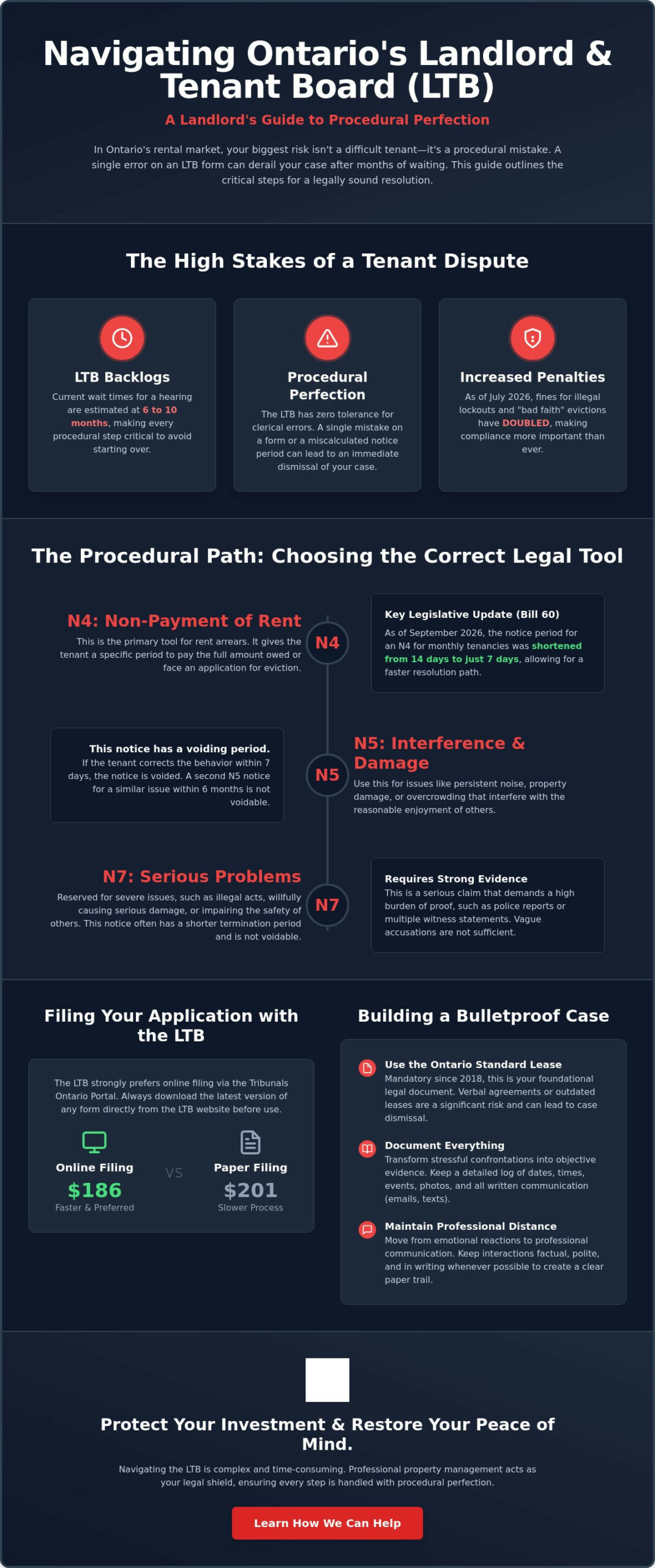
When you’re learning how to deal with difficult tenants legally in Ontario, your most powerful assets aren’t your arguments; they’re your forms. The Landlord and Tenant Board (LTB) operates with a zero-tolerance policy for clerical errors. Even a single day’s miscalculation in a notice period can lead to an application being dismissed after you’ve waited months for a hearing. With current wait times estimated at 6 to 10 months, a procedural mistake isn’t just a delay. It’s a significant financial setback that forces you to start the entire cycle from the beginning.
The LTB now strongly favors the Tribunals Ontario Portal for all applications. Filing online is more efficient and costs $186, compared to $201 for paper filings. Since the Tribunals Ontario Rules of Procedure were updated on January 1, 2026, staying current with the latest versions of every form is non-negotiable. Using an outdated form is one of the most common reasons for immediate dismissal, so it’s vital to download fresh documents directly from the portal for every new instance.
N4, N5, and N7: Choosing Your Legal Tool
Selecting the right notice is about matching the remedy to the behavior. For non-payment of rent, the N4 is your primary tool. A major shift occurred on September 21, 2026, when the notice period for an N4 was reduced from 14 days to just 7 days for monthly tenancies. This change offers a faster path to resolution, though tenants still retain the “right to pay and stay” if they clear arrears before the eviction is executed. For behavioral issues like noise or property damage, the N5 provides a warning and an opportunity for the tenant to correct the issue. If the situation involves serious illegal acts or immediate safety risks, the N7 allows for a much shorter notice period without the chance for the tenant to void the notice by changing their behavior.
The N12 and N13: When the Property Needs to Be Vacant
Sometimes, the difficulty arises from needing to regain the property for your own family or for major renovations. The N12 (Landlord’s Own Use) remains a highly scrutinized process. As of September 21, 2026, a new rule provides relief for owners: if you give at least 120 days’ notice, you’re no longer required to pay the standard one month’s rent as compensation. However, the risk of “bad faith” claims remains high if you re-list the unit too soon. If these administrative hurdles feel like a second full-time job, choosing full-service property management can ensure every notice is served with professional precision, shielding you from the stress of the LTB portal.
Building a Bulletproof Case: Documentation and Communication
When a tenancy becomes strained, your greatest asset isn’t your ability to argue; it’s your ability to remain objective. Many owners ask how to deal with difficult tenants legally in Ontario when they’re already at their breaking point. Moving from an emotional reaction to a procedural response creates a stabilizing force in a chaotic situation. Adjudicators at the Landlord and Tenant Board (LTB) aren’t looking for who is “right” in a moral sense. They’re looking for clear, admissible evidence that a breach of the RTA has occurred. By maintaining professional distance, you protect your mental health while building a foundation for a successful hearing.
Clear records are the backbone of any legal application. While a text message might feel convenient, it can be difficult to organize for a tribunal. Email provides a searchable, dated record that’s much easier for an adjudicator to follow. If you must have a verbal conversation, follow it up immediately with an email summarizing what was discussed. For serious matters, registered mail remains a gold standard for proving a document was received. A professional log is a chronological record of all tenant interactions. Resources from Community Legal Education Ontario (CLEO) can help you understand what specific details are most useful to record during these moments.
Using Inspections to Document Property Status
Regular property inspections are not just about maintenance; they’re a vital part of your legal defense. Under the RTA, you must provide a written 24-hour notice before entering the unit, specifying the date, time, and reason for entry. This notice carries significant legal weight. It demonstrates that you’re following the law while exercising your right to protect your investment. During the inspection, photos and videos serve as undeniable evidence of “undue damage” or maintenance neglect. This process is much more effective when you have a detailed Move-In Inspection report to use as a baseline. When you show a history of consistent, professional oversight, adjudicators see a responsible steward rather than a landlord in a personal feud.
This level of meticulous care is a core part of a professional management strategy. By implementing Regular Property Inspections and detailed Financial Reporting and Accounting, you create an objective history of the tenancy that stands up to scrutiny. This approach replaces the anxiety of “he-said, she-said” with a clear, documented narrative. It allows you to step back from the daily friction, knowing that every interaction is being handled with the precision required to protect your property and your peace of mind.
Managing Ontario Disputes from Abroad: The Expat Challenge
Living abroad while managing an Ontario rental property introduces a unique set of anxieties. For those in the Foreign Service or working as expats, the physical distance can make a tenant dispute feel insurmountable. You can’t simply drop by to verify a noise complaint or post a notice on a door. This distance often emboldens difficult tenants, who may feel that the lack of local oversight gives them more leeway to ignore lease terms or skip rent payments. Learning how to deal with difficult tenants legally in Ontario while residing in another country requires a shift from personal management to professional delegation.
The logistical hurdles are significant. Serving legal documents correctly is the foundation of any LTB case, yet doing so from outside Canada is fraught with risk. If a notice isn’t served according to the strict rules of the RTA, your entire case could be dismissed before it even starts. While the LTB’s digital portal and virtual hearings have made participation easier, time zone differences still present a major challenge. Attending a hearing at 3:00 AM while trying to maintain a professional career abroad is a burden no property owner should have to carry alone. Without a local presence, you’re also unable to conduct the regular property inspections that act as a deterrent for “difficult” behavior.
Legal Representation and the LTB
To navigate the Landlord and Tenant Board successfully from abroad, you need a local “Agent” or “Representative.” A licensed property manager acts as your eyes, ears, and legal proxy on the ground. They have the authority to sign N-forms and represent your interests during hearings, ensuring that every procedural step is followed to the letter. This is particularly important because being a non-resident landlord carries specific legal and tax implications. Failing to have a local representative can lead to delays in service and even administrative penalties if the LTB deems you unreachable or unable to maintain the property according to provincial standards.
The Peace of Mind Strategy for Remote Owners
The most effective way to protect your investment is to remove yourself from the daily friction of tenant interactions. By delegating these responsibilities, you ensure that a local expert is available for 24/7 emergency maintenance responses and regular property inspections. This professional oversight acts as a stabilizing force, signaling to the tenant that the property is being meticulously managed regardless of where the owner lives. For those managing the financial complexities of being a non-resident, seeking help with Non-Resident Tax Administration Fees and NR6 filings is just as vital as having a local agent for the LTB. If you’re struggling to manage a dispute from across an ocean, our full-service property management can act as your dedicated steward on the ground.
Why Professional Management is the Ultimate Legal Shield
Transitioning from a hands-on approach to professional oversight is often the moment a property owner finally breathes a sigh of relief. While the previous sections outlined the technical steps of how to deal with difficult tenants legally in Ontario, the reality is that managing these processes requires a level of emotional detachment and procedural precision that’s difficult to maintain alone. By placing your property under the care of a seasoned guardian, you move away from the DIY risks that lead to LTB delays and toward a model of active protection. This shift doesn’t just save time; it creates a buffer between your personal life and the logistical burdens of property ownership.
Professional management is a preventative strategy rather than a reactive one. Our Tenant Placement Service uses rigorous screening to identify reliable renters before they ever sign a lease, significantly reducing the likelihood of future disputes. With over 40 years of experience navigating the nuances of the Landlord and Tenant Board, we’ve seen nearly every scenario and developed the foresight to handle them with grace. This deep wisdom allows us to protect your interests while maintaining a high standard of care for the property, ensuring you remain in full compliance with both the RTA and CRA requirements, including NR6 and NR4 tax filings.
The E&S Approach: Meticulous Stewardship
Our method is rooted in meticulous stewardship. We handle rent collection and early intervention for arrears with a steady, methodical rhythm that prevents small issues from becoming legal crises. When a difficult conversation is necessary, our team steps in as the authoritative voice, removing the personal friction that often escalates tenant conflicts. You no longer have to worry about a “bad faith” claim or a missed filing deadline. We take the burden of these administrative duties so you can focus on your own life and career, transforming a source of anxiety back into a stable, quiet asset. This transition from stress to relief is the core of our commitment to you.
Protecting Your Asset Long-Term
Regular Property Inspections serve as a powerful deterrent for negligence and damage, ensuring your home remains in top condition throughout the tenancy. By catching maintenance needs early through our Emergency 24/7 Maintenance Response and our network of trusted contractors, we preserve the long-term value of your investment. This comprehensive support system is designed to provide a seamless experience from end to end, giving you the confidence that your property is in expert hands. Let us protect your Ottawa home while you serve abroad.
Restoring Your Peace of Mind and Property Control
Managing a rental property should be a path to financial security, not a source of constant anxiety. By grounding your actions in the latest 2026 RTA regulations and maintaining a meticulous paper trail, you move from a state of frustration to one of informed control. You’ve seen that the secret of how to deal with difficult tenants legally in Ontario lies in procedural accuracy and emotional distance, especially when navigating the shortened notice periods and digital filing requirements of the LTB. Whether you’re locally based or serving abroad, your property deserves the active protection of a seasoned hand.
With over 40 years of Ottawa property management experience, we specialize in the unique needs of Foreign Service members and non-resident landlords. We provide a meticulous, stress-free approach to tenant relations and RTA compliance, ensuring your investment remains a stable asset while you focus on your career and family. Discover how E&S Property Management protects your investment and your peace of mind. We’re here to act as your dedicated steward, turning the complexities of management into a seamless, reliable experience you can trust.
Frequently Asked Questions
Can I evict a tenant in Ontario for being “difficult” or rude?
No, you cannot evict a tenant simply for being rude or having a difficult personality. Under the Residential Tenancies Act, a landlord must provide evidence of specific legal grounds, such as non-payment of rent, illegal acts, or substantial interference with the reasonable enjoyment of the premises. While a strained relationship is stressful, the Landlord and Tenant Board requires objective proof of a breach before they’ll consider a termination order.
How long does it legally take to evict a tenant for non-payment in 2026?
Even with the N4 notice period reduced to 7 days as of September 2026, the total process often takes 6 to 10 months. This timeline includes the mandatory notice period, the time to file an application through the Tribunals Ontario Portal, and the wait for a scheduled hearing. Because backlogs remain significant, ensuring your paperwork is perfect from the start is the only way to avoid adding several more months to the wait.
What happens if a tenant refuses to leave after the termination date on an N-form?
If a tenant stays past the termination date, you must file an L1 or L2 application with the LTB to obtain an official eviction order. You cannot change the locks or physically remove the tenant yourself, as these actions are illegal. Once you receive an order from the Board, you must take it to the Court Enforcement Office, where a Sheriff will legally execute the eviction and restore possession of the property to you.
Can I legally enter my rental property if the tenant is being uncooperative?
Yes, you have a legal right to enter the unit provided you serve a written 24-hour notice of entry for a valid reason. These reasons include conducting a regular property inspection, making repairs, or showing the unit to prospective buyers. If the tenant still refuses entry after receiving proper notice, they’re in breach of the RTA. This is a critical moment to document the refusal as evidence for a potential LTB application.
Do I need a lawyer to represent me at the Landlord and Tenant Board?
You aren’t legally required to have a lawyer, but having a licensed representative is highly advisable given the complexity of the law. Many owners find that a professional property manager provides the necessary procedural expertise to navigate hearings successfully. Because the LTB now operates with a stricter compliance model, having a seasoned hand to manage the digital filing and evidence presentation often makes the difference between a successful order and a dismissed case.
What is the most common mistake landlords make when filing an N12 notice?
The most frequent error is failing to pay the mandatory one month’s compensation to the tenant by the termination date on the notice. However, as of September 21, 2026, this requirement is waived if you provide at least 120 days’ notice. Another common pitfall is failing to prove a “good faith” intent to occupy the unit for at least one year. If the Board suspects the notice was served to circumvent rent control, they’ll dismiss the application.
How does living outside of Canada affect my ability to deal with a tenant dispute?
Living abroad makes it much harder to learn how to deal with difficult tenants legally in Ontario because you cannot personally serve documents or inspect the property. Physical distance often leads to communication delays that tenants may exploit. You’ll need a local representative to act as your agent for legal service and to participate in virtual LTB hearings, which may occur at inconvenient times depending on your current time zone.
Can a property manager sign legal LTB notices on my behalf?
Yes, a property manager can sign and serve LTB notices as your authorized agent. This is a core benefit of full-service property management, as it ensures that every N-form is filled out and served with professional precision. By delegating this task, you ensure that your legal standing is protected by someone who understands the strict timelines and service requirements mandated by the Residential Tenancies Act.


