
Imagine waking up in a different time zone to a series of urgent notifications about a sudden pipe burst or a tenant dispute at your rental property in Ottawa. The weight of your investment can feel heavy when you aren’t there to walk the halls yourself, and the fear of an unexpected liability claim is a burden many owners carry. Truly understanding landlord responsibilities ottawa is about more than just collecting rent; it’s about creating a foundation of safety that protects both your financial future and your peace of mind.
You likely already know that being a landlord in Ontario comes with a unique set of pressures, from navigating the latest Landlord and Tenant Board wait times to ensuring your home meets strict municipal heat by-laws. We’re here to help you move from a place of uncertainty to one of complete confidence. In this guide, you’ll learn how to fulfill your legal and financial obligations by securing the precise insurance coverage your mortgage and the law require. We’ll walk through current 2026 market conditions, explain how to mitigate long-term risks, and show you how professional stewardship can keep your property secure while you focus on your life elsewhere.
Key Takeaways
- Understand why a standard homeowners policy is insufficient for rentals and how specialized landlord insurance protects your investment from unique residential risks.
- Identify the essential coverage limits required for Ottawa properties, including structural protection and recommended liability minimums of C$1M to C$2M.
- Fulfill your landlord responsibilities ottawa by mandating tenant insurance to transfer liability and prevent small claims from impacting your own policy.
- Learn the vital distinction between “vacant” and “unoccupied” status to ensure your property remains fully covered while you are living abroad or serving on a posting.
- Discover how professional management and regular inspections provide the “duty of care” documentation that insurance companies require to process claims smoothly.
Landlord Insurance: Why it is a Core Responsibility in Ottawa
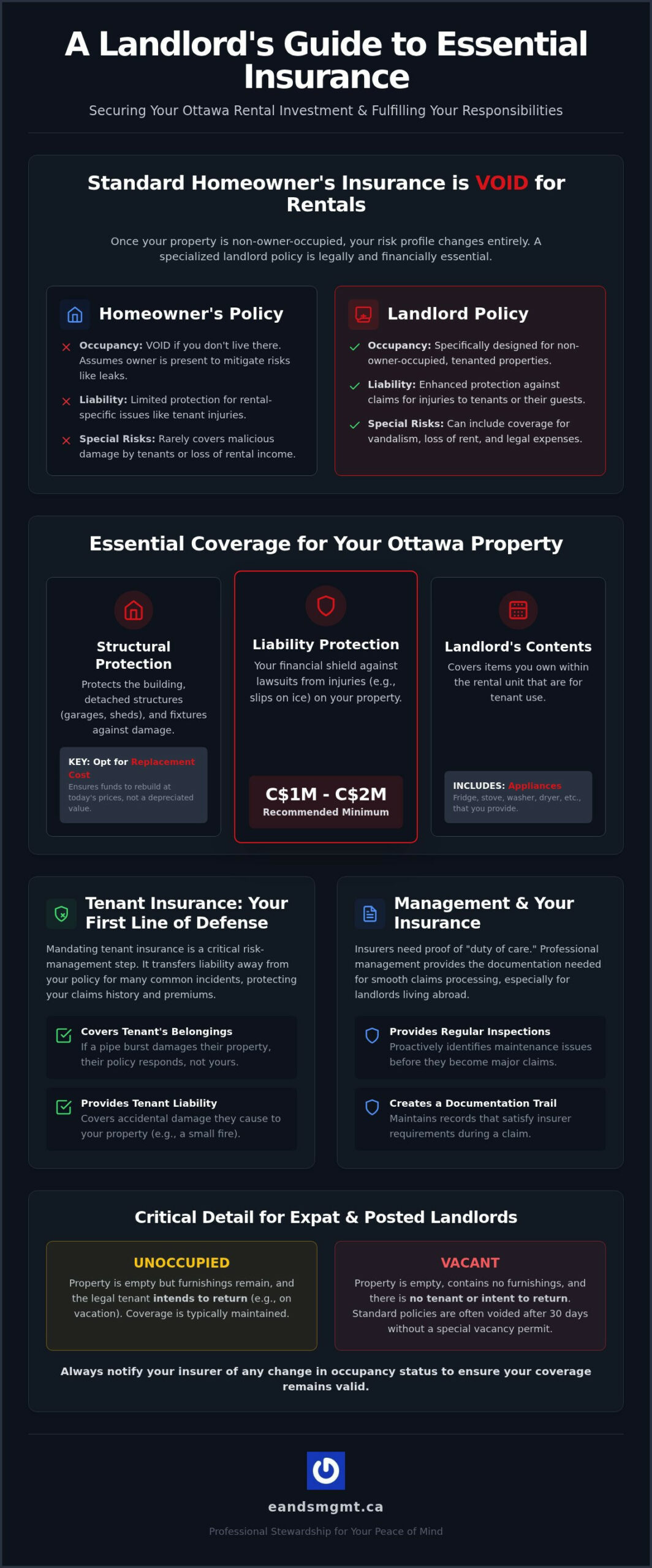
Transitioning your home into a rental property is a significant financial milestone, but it also fundamentally changes your legal standing. Many owners assume their existing homeowners policy will suffice; however, the reality is that most standard policies are automatically voided the moment a property becomes non-owner-occupied. Fulfilling your landlord responsibilities ottawa requires a proactive shift toward specialized insurance that recognizes the unique risks of the rental market. This isn’t just about protecting bricks and mortar. It’s about securing your future against the complexities of Ontario law and the specific requirements of your mortgage lender.
Most Ottawa lenders require proof of landlord-specific coverage as a condition of your financing. They view the property as collateral, and a policy that could be denied due to an occupancy misrepresentation puts their investment, and yours, at risk. Beyond the bank’s requirements, the Ontario Residential Tenancies Act establishes a high standard for property maintenance and safety. If a tenant or guest is injured on your property, you could face significant legal challenges. Having the right policy ensures you have a professional team and financial resources to manage such stressful events.
Landlord vs. Homeowners Insurance: Key Differences
The primary difference lies in the occupancy clause. Homeowners insurance is designed for those who live in the dwelling, assuming you’ll be there to spot a leaky faucet or a flickering wire before it becomes a catastrophe. Once you move out, the insurer’s risk increases, which is why a landlord policy is necessary. These policies focus heavily on liability protection, shielding you from legal claims if someone slips on an icy walkway or trips on a loose floorboard. While you’ll still protect the building itself, you won’t need to insure the tenant’s personal belongings. Instead, you should encourage or require tenant insurance to ensure their assets are covered, which further reduces your own liability if their property is damaged by a burst pipe or fire.
The Ottawa Context: Local Risks You Must Cover
Our local climate introduces specific burdens that every landlord must prepare for. Ottawa winters are famous for heavy snow loads and deep freezes, which frequently lead to ice dams and frozen pipes. If your policy doesn’t specifically account for a tenanted environment, you might find yourself paying out of pocket for C$10,000 in water damage repairs. Additionally, while we all hope for respectful residents, a landlord policy provides a safety net for vandalism or malicious damage caused by tenants, a risk that standard homeowners insurance rarely covers. Landlord insurance serves as the primary financial shield for an Ottawa rental asset.
Essential Coverage: Protecting Your Ottawa Property Against Local Risks
Every region carries its own environmental signature, and the Ottawa Valley is no exception. From the biting deep freezes of January to the rapid spring melts that can overwhelm local drainage systems, your property faces a specific set of challenges. Fulfilling your landlord responsibilities ottawa means looking beyond a generic policy and ensuring your coverage is tailored to these local realities. This precision prevents a stressful situation from becoming a financial disaster, allowing you to maintain your investment with confidence.
Protecting the Physical Asset
Ottawa winters don’t hold back. Heavy snow loads and fluctuating temperatures frequently cause ice dams or burst pipes, leading to significant structural damage. When selecting a policy, always opt for replacement cost coverage rather than actual cash value. Replacement cost ensures that if your roof fails or a fire occurs, the insurer pays to rebuild at today’s construction prices, rather than a depreciated amount that leaves you searching for extra funds. Don’t forget the detached structures common in Ottawa, like backyard sheds or detached garages; these must be explicitly listed to ensure they are protected. Additionally, while the tenant owns the furniture, you are responsible for insuring the “landlord’s contents,” which include the fridge, stove, and laundry units you provided. While the Residential Tenancies Amendment Act and other provincial guidelines outline your duties, your insurance policy provides the financial backing to meet them.
Water damage remains the leading cause of claims in the Ottawa area. Standard policies often exclude sewer backup and overland water protection unless they are added as endorsements. Given our local geography and the aging infrastructure in some of Ottawa’s historic neighborhoods, these are not optional extras. They are essential safeguards that protect your basement from the catastrophic costs of a heavy rainstorm or a spring thaw.
Loss of Rent: Your Financial Safety Net
If a major event like a fire or a significant flood makes your property uninhabitable, your rental income stops immediately. However, your mortgage payments, property taxes, and utility base fees do not. Fair Rental Value coverage is a vital component of a landlord’s risk strategy, as it replaces that lost income while the property is being repaired. For landlords with active mortgages, this coverage is often a mandatory requirement from the lender. It ensures your cash flow remains steady, preventing a temporary property issue from spiraling into a personal financial crisis. Many owners find that pairing this coverage with professional property management provides the ultimate layer of security, as experts can help document claims and oversee the restoration process to get tenants back in sooner.
Finally, liability protection is your shield against legal action. In a city where slip-and-fall incidents on icy walkways are a common legal reality, carrying a minimum of C$1M to C$2M in liability coverage is the standard for Ottawa rentals. This protects your personal assets if you are sued for injuries occurring on the premises.
Tenant Insurance: The Landlord’s First Line of Defense
While your own policy protects the physical structure and your liability as an owner, it doesn’t cover the daily lived experiences or the personal belongings of your residents. Many property owners view tenant insurance as an optional benefit for the renter, but in reality, it serves as a critical shield for your own financial interests. Requiring this coverage is one of the most effective ways to manage landlord responsibilities ottawa, as it creates a clear boundary between your risks and those of your tenants. When a resident has their own policy, you’re far less likely to see your own insurance premiums rise due to minor accidents inside the home.
Finding the Best Landlord Insurance In Canada is a vital step, but that policy shouldn’t be the first one called upon when a kitchen fire occurs or a bathtub overflows. By ensuring your tenants are insured, you transfer the financial burden of their mistakes to their own insurance provider. This keeps your claims history clean and your long-term costs manageable.
The Landlord’s Benefit from Tenant Coverage
Tenant insurance is a landlord’s first line of defense against liability claims. If a tenant accidentally starts a grease fire or leaves a tap running, their insurance provider is responsible for the repairs to your building and the replacement of their own property. Without this coverage, you might find yourself in a difficult legal battle to recover costs, or worse, forced to file a claim on your own policy that could lead to a rate hike. Furthermore, if a property becomes uninhabitable due to a covered loss, the tenant’s insurance typically pays for their temporary hotel stay and relocation costs. This is a crucial distinction, as landlords are generally not responsible for providing alternative housing under Ontario law, and having the tenant’s insurance handle these costs prevents significant interpersonal friction during an already stressful time.
Ensuring Lease Compliance in Ottawa
In Ontario, you have the legal right to make tenant insurance a non-negotiable condition of your lease agreement. This requirement should be clearly documented in the Additional Terms section of the Standard Ontario Lease. Simply asking for proof at the start of the tenancy isn’t enough; policies can lapse or be cancelled mid-term. A robust risk management strategy involves verifying coverage annually, typically during a lease renewal or a scheduled inspection. Professional property management teams take this burden off your shoulders by systematically tracking policy expiry dates and ensuring that every resident remains compliant. This level of oversight provides the steady, methodical protection you need to ensure your asset remains shielded throughout the entire duration of the tenancy.
The Expat Landlord: Managing Insurance Obligations While Posted Abroad
Ottawa is home to a unique demographic of property owners, including many members of the Canadian Armed Forces (DND) and Global Affairs Canada who are frequently posted abroad. If you’re managing your home from a different continent, your landlord responsibilities ottawa take on an additional layer of complexity. Insurance providers view non-resident landlords differently because the physical distance can delay the response to emergencies like a failed furnace or a break-in. Ensuring your policy remains valid while you’re thousands of kilometers away is essential for protecting your largest Canadian asset.
One of the most critical distinctions you’ll encounter is the difference between a property being vacant and unoccupied. For most expat landlords, the home is unoccupied; your furniture remains, and there’s a clear intention to return or have a tenant move in. However, if the property is completely cleared out and sits empty for more than 30 days, insurers classify it as vacant. This status often requires a specific vacancy permit, which can increase your costs but ensures your coverage isn’t voided. Being transparent about your non-resident status and your tax obligations, such as NR6 and NR4 filings, demonstrates to your insurer that you’re a diligent and organized owner.
Managing Turnover and Vacancy
The period between tenants is the highest-risk time for an expat landlord. You’re required to notify your insurance company the moment a tenant moves out. If the property remains empty for an extended period, you may need to purchase a vacancy permit. These permits typically cover basic perils but might exclude things like glass breakage or water damage unless specific conditions are met. Having a local representative perform regular inspections during these transitions is often a mandatory requirement to keep your policy active.
Factors Influencing Your Premiums
Insurers look closely at the age of your home’s mechanical systems, particularly the wiring, plumbing, and roof. In older Ottawa wards like the Glebe or Rockcliffe, updated systems are vital for keeping premiums manageable. They also consider the rental density of your neighbourhood. Most importantly, insurance companies often offer better rates or more comprehensive coverage when they know a property is under professional oversight. A local expert can respond to a 24/7 emergency faster than an owner in a different time zone. If you are preparing for an upcoming posting, our NR6 and NR4 tax filing support and full-service management can ensure you remain compliant and fully protected while abroad.
Reducing Risk: The Synergy of Professional Management and Insurance
Securing a robust insurance policy is a vital first step, but it’s only half of the equation. Insurance is a reactive tool designed to help you recover after a disaster. Professional property management, however, is a proactive force that works to prevent those disasters from occurring in the first place. When you combine the two, you create a synergy that satisfies your legal duty of care and ensures your property remains in an insurable condition. Truly mastering landlord responsibilities ottawa involves recognizing that a policy is most effective when it’s supported by active, daily stewardship.
Insurance companies often include clauses that require a property to be checked at specific intervals, especially during the winter months. If a furnace fails and pipes burst while a home is unattended, an insurer might deny the claim based on a lack of due diligence. Regular property inspections provide the documented proof of care that adjusters look for during the claims process. By identifying a small leak or a flickering electrical panel early, we can coordinate repairs before they escalate into a catastrophic loss that impacts your premiums for years to come.
E&S Property Management: Your Eyes and Ears in Ottawa
Since 1981, we’ve acted as the protective guardians for residential assets across the city. With over 40 years of experience, we’ve navigated every possible scenario, from severe weather events to complex tenant disputes. Our specialty in serving DND and Global Affairs members means we understand the unique burdens of those living abroad. We don’t just manage buildings; we manage the anxieties that come with them. Our 24/7 emergency maintenance response ensures that if the unthinkable happens at 3:00 a.m., there’s a seasoned hand ready to mitigate the damage immediately. This rapid response is often the difference between a minor repair and a total structural overhaul.
Transitioning to a Protected Investor
The shift from being a DIY landlord to a protected investor is often marked by a profound sense of relief. You no longer have to worry about whether your tenant’s insurance has lapsed or if the backyard shed is properly listed on your policy. We handle the administrative and logistical heavy lifting, from vetting high-quality tenants to providing detailed financial reporting. This meticulous care reduces the likelihood of vandalism or non-payment, which are common triggers for insurance stress. Active management isn’t just a convenience; it’s a fundamental risk management strategy. You deserve the peace of mind that comes from knowing your investment is being watched over with the same care you’d provide yourself. It’s time to Protect your investment with E&S Property Management and experience the clarity that comes with professional oversight.
Securing Your Investment with Confidence and Care
Navigating the complexities of property ownership in the nation’s capital doesn’t have to be a source of constant anxiety. By aligning your insurance coverage with the specific realities of the Ottawa climate and Ontario’s legal landscape, you transform a potential liability into a stable, long-term asset. Fulfilling your landlord responsibilities ottawa involves more than just paying premiums; it requires a diligent commitment to maintenance and tenant oversight that keeps your property insurable and your claims history clean. This proactive approach ensures that minor issues are addressed before they become catastrophic financial burdens.
Whether you’re stationed across the globe or living right here in the city, the right support system makes all the difference. With over 40 years of residential expertise and specialized support for Foreign Service and DND members, we provide the comprehensive maintenance and inspection protocols required to protect your peace of mind. You don’t have to carry the weight of these logistical and administrative burdens alone. Take the first step toward a more secure, stress-free investment future today.
Get a Professional Rental Assessment and Risk Review
Frequently Asked Questions
Is landlord insurance mandatory in Ontario?
While no specific law in Ontario mandates landlord insurance, it is effectively a requirement for anyone with a mortgage. Lenders view the policy as essential collateral protection. Additionally, fulfilling your landlord responsibilities ottawa requires having the financial capacity to repair the home if a disaster occurs. Without it, you are personally liable for structural damage and legal claims, which can lead to significant financial strain or even total loss of your investment.
Does landlord insurance cover a tenant who stops paying rent?
Standard landlord insurance policies do not cover a tenant’s failure to pay rent. Coverage for loss of rental income is typically triggered only when the property becomes uninhabitable due to a covered peril, such as a fire or flood. If you are concerned about non-payment, we recommend focusing on our rigorous tenant placement services. We ensure you select reliable residents who have a proven history of financial stability and respectful conduct.
What happens to my insurance if my Ottawa rental property is vacant?
If your property remains empty for more than 30 consecutive days, your standard coverage may be voided. You must notify your insurer to obtain a vacancy permit, which often carries a higher premium and reduced coverage for things like water damage or glass breakage. To maintain your policy’s validity, we perform regular property inspections that satisfy the duty of care requirements set by most Canadian insurance providers during these transition periods.
Do I need landlord insurance if I am only renting out my basement?
Yes, you must notify your insurer if you are renting out any portion of your home, including a basement suite. A standard homeowners policy assumes the space is for personal use only. Adding a rental component changes your risk profile significantly. Without a specific endorsement or landlord style coverage, your entire policy could be invalidated if a claim arises from the tenanted portion of the property, such as a basement kitchen fire.
How much liability coverage should an Ottawa landlord carry?
Most industry experts in the Ottawa market recommend carrying a minimum of C$1,000,000 to C$2,000,000 in liability coverage. This protects your personal assets if a tenant or guest is injured on the premises and decides to sue. In a city with significant freeze-thaw cycles, slip and fall incidents on icy walkways are a common risk. Higher limits provide an essential safety net against the rising costs of legal defense and settlements.
Can I deduct landlord insurance premiums from my taxes in Canada?
Yes, you can deduct the full cost of your landlord insurance premiums as a business expense on your Canadian tax return. This applies to any insurance paid on a property you rent out to generate income. Keeping detailed records is part of your landlord responsibilities ottawa, ensuring you maximize your deductions while remaining compliant with CRA regulations. Our financial reporting and accounting services help you track these expenses effortlessly throughout the year.
Does landlord insurance cover bed bugs or pest infestations in Ottawa?
Standard landlord insurance policies almost never cover the costs associated with bed bugs or other pest infestations. Insurers view pest control as a maintenance issue rather than a sudden or accidental peril. As an owner, you are legally responsible for maintaining a pest free environment under the Residential Tenancies Act. Preventative strategies, including professional tenant placement and routine property oversight, are your best defense against the high costs of remediation.
What is the difference between “fair rental value” and “loss of income”?
While these terms are often used interchangeably, Fair Rental Value specifically refers to the rent you lose while a property is being repaired after a covered loss. It ensures your cash flow continues even if the tenant has to move out. Loss of income is a broader term that can sometimes include other revenue streams. Both are vital for owners with high mortgages who depend on consistent monthly payments to cover their obligations.


