
Are you certain your 2026 tax filing protects your rental income from the rising costs of Ottawa property maintenance, or are you overpaying the CRA? Managing a rental property in the National Capital Region is becoming more complex every year. You likely feel the pressure of inflationary maintenance costs and the constant worry that a single filing error could trigger a stressful audit. We understand that asset preservation requires more than just finding tenants. It demands a precise approach to financial management to ensure your peace of mind.
This guide provides a comprehensive landlord tax deductions checklist Ottawa 2026 to ensure you retain more of your hard earned rental income while remaining fully compliant with federal regulations. We provide the clarity you need to maximize your operational efficiency and protect your investment. You will learn the critical distinction between current repairs and capital improvements, discover often overlooked deductions for non-resident owners, and gain a structured framework for your 2026 tax season. Our goal is to provide the strategic consulting you need to turn tax season from a burden into a tool for growth.
Key Takeaways
- Maintain strict CRA compliance by accurately defining taxable rental income and understanding the specific reporting requirements for the Ottawa market in 2026.
- Identify every claimable operating cost using our comprehensive landlord tax deductions checklist Ottawa 2026 to ensure you maximize your annual cash flow.
- Master the “Fix vs. Better” rule to correctly distinguish between immediate current repairs and long-term capital improvements for optimal asset preservation.
- Implement rigorous logbook and record-keeping practices to fully recover motor vehicle and office expenses related to managing your rental portfolio.
- Leverage professional property management solutions as a 100% deductible investment that enhances operational efficiency while simplifying your year-end accounting.
Understanding Rental Income & CRA Compliance in Ottawa for 2026
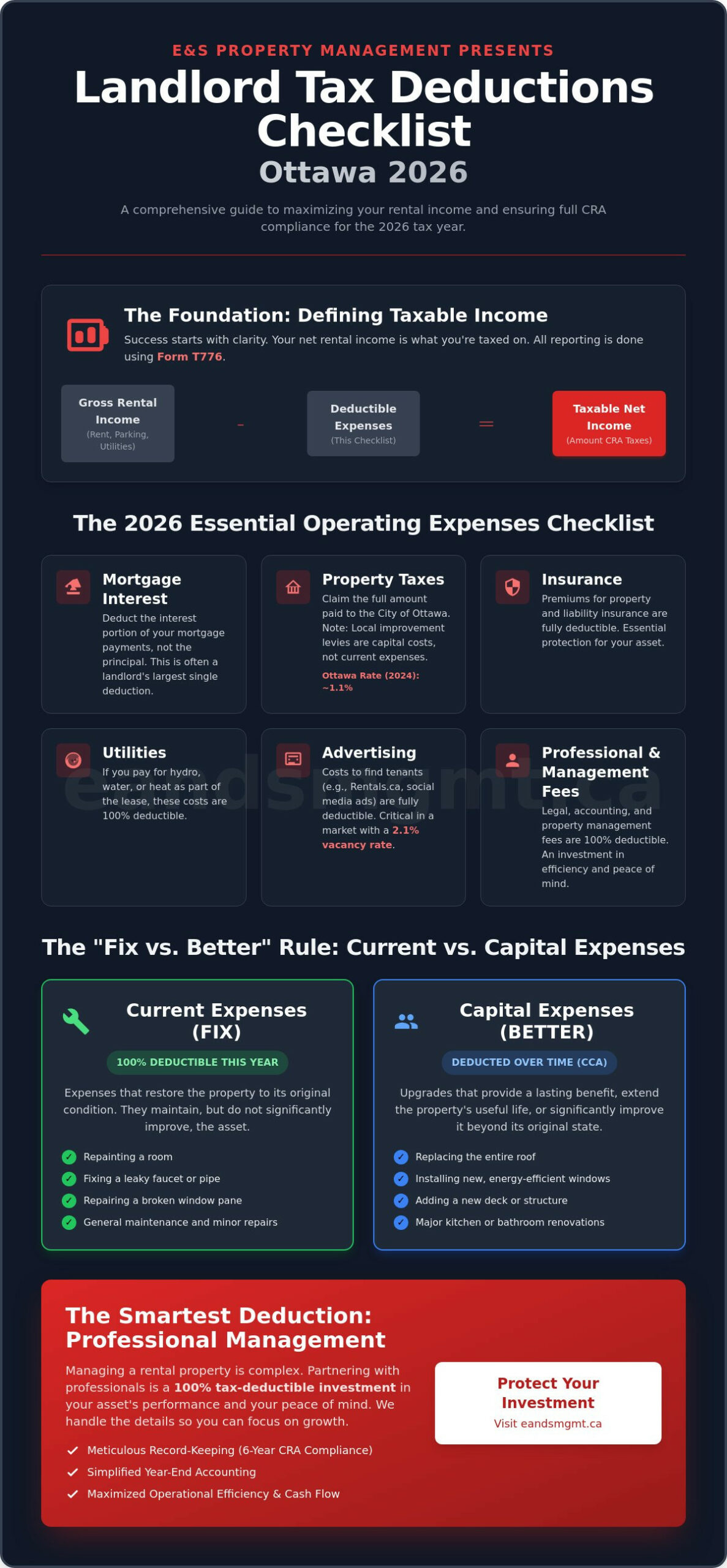
Success in the Canadian Income Tax System starts with clarity. For the 2026 tax year, the Canada Revenue Agency (CRA) defines taxable rental income as any payment received for the use or occupation of a property. This includes base rent plus additional charges for utilities, parking, or storage facilities. Ottawa’s rental market health directly impacts your investment valuation. With a 2.1% vacancy rate recorded in late 2025, landlords should focus on maximizing their net income through strategic tax planning. Asset preservation depends on your ability to track every dollar that enters and leaves your rental business.
Landlords must choose between accrual and cash accounting methods. The accrual method tracks income when it’s earned and expenses when they’re incurred. The cash method tracks them only when the money arrives or leaves your account. Most sophisticated investors in Ontario utilize the accrual method to maintain operational efficiency and a clearer long-term financial picture. Form T776, the Statement of Real Estate Rentals, is the central document for your 2026 filing. Recent revisions to this form require more granular detail regarding capital cost allowance (CCA) classes. Using a professional landlord tax deductions checklist Ottawa 2026 helps ensure no eligible expense is overlooked during this transition.
The 2026 Ottawa Property Tax Landscape
Property taxes are a primary deduction for Ottawa owners. You can deduct the total amount paid to the City of Ottawa for the 2026 calendar year. It’s vital to distinguish between standard property taxes and municipal levies for local improvements, such as new sewer lines or street lighting. These levies are often treated as capital costs rather than immediate deductions. Ottawa typically sends final tax assessments in June. Your 2026 filing must match these records precisely to maintain integrity with the CRA and avoid unnecessary audits.
Record Keeping Solutions for Busy Landlords
The CRA requires digital or paper receipt retention for six years. Digital systems are the preferred standard for 2026 due to their searchability and durability. A methodical document management system creates the “peace of mind” needed to handle potential audits with confidence. Professional management Solutions provide the steady hand required to organize these records throughout the year. By delegating the tracking of maintenance, repairs, and utility costs, you ensure your year-end reporting is accurate. This foresight protects your investment and simplifies the entire tax process for the 2026 filing season.
The 2026 Essential Operating Expenses Checklist
Operating expenses are the backbone of your tax strategy. These current expenses provide immediate relief because you deduct them in the same year you pay them. This landlord tax deductions checklist Ottawa 2026 prioritizes the “Big Three” costs that impact your bottom line. First, mortgage interest remains a primary deduction. You can’t deduct the principal repayment; only the interest portion is the eligible part. Second, property insurance protects your asset against Ottawa’s volatile weather. Third, municipal taxes are a significant recurring cost. In 2024, Ottawa’s residential tax rate sat at approximately 1.1%, and these payments remain fully deductible against your gross rental income.
Filling vacancies requires a strategic approach in a competitive market. You can deduct 100% of advertising costs on digital platforms like Rentals.ca or through targeted social media marketing. If your lease agreements include utilities, you can deduct the costs for heat, hydro, and water. This is common in older Ottawa multi-unit buildings where sub-metering isn’t present. The CRA provides a detailed list of Deductible Rental Expenses to help you track these operational outlays accurately.
Professional and Management Fee Solutions
Managing a property involves complex paperwork and legal compliance. You can deduct 100% of your property management fees to lower your taxable rental income. Legal fees are deductible when used to collect late rent or prepare leases. Accounting fees for tax preparation and bookkeeping also qualify. Professional property management solutions include tenant screening and background checks. These costs are fully deductible. They ensure you secure reliable residents for your investment while reducing your tax liability through professional oversight.
Maintenance and Routine Repair Deductions
Routine maintenance keeps your property competitive and compliant. In Ottawa, snow removal and lawn care are non-negotiable expenses. You should deduct the cost of annual HVAC servicing to ensure system longevity and tenant comfort. Using licensed contractors provides a clear paper trail for the CRA. It’s a safer deduction than unverified labour. Emergency 24/7 maintenance response costs are also deductible. These expenses maintain the property’s current condition without adding permanent value. They represent immediate tax wins for the 2026 tax year.
Current vs. Capital Expenses: Navigating the ‘Fix vs. Better’ Rule
Landlords in Ottawa must distinguish between maintenance and improvements to ensure compliance with the Canada Revenue Agency (CRA). The fundamental question is whether an expense restores a property to its original condition or provides a lasting benefit that increases its value. Capital expenses represent investments in the property’s long-term value. According to the CRA guidelines on Current vs. Capital Expenses, current expenses are recurring costs for maintenance. This includes tasks like fixing a single leaky faucet or replacing a few shingles on a roof after a windstorm. These costs are fully deductible in the year they occur.
In contrast, replacing the entire roof structure is a capital expense because it improves the asset beyond its initial state. These capital costs aren’t deducted fully in the year they’re paid. Instead, they’re added to the property’s adjusted cost base (ACB). A higher ACB reduces potential capital gains taxes when you eventually sell the property. For your landlord tax deductions checklist Ottawa 2026, timing is a critical factor. Completing minor repairs before December 31, 2026, allows for an immediate deduction against that year’s rental income, which improves your short-term cash flow and operational efficiency.
Capital Cost Allowance (CCA) for Ottawa Properties
Claiming CCA allows you to deduct the cost of your building over several years through depreciation. While this reduces your 2026 taxable income, it triggers a “recapture” trap if you sell the property for more than its undepreciated capital cost. The CRA adds previously claimed depreciation back to your income in the year of sale, which can lead to a significant tax bill. Accurate asset preservation requires correct categorization. Class 1 assets, such as the building structure, typically have a 4% depreciation rate. Class 8 assets, including appliances like refrigerators or stoves, carry a 20% rate. Categorizing these correctly ensures you maximize your 2026 position without inviting audit risks.
Special Considerations for Foreign Service Members
Ottawa’s large population of foreign service members requires a specific approach to property stewardship. If you’re posted abroad in 2026, a trusted steward or property manager is vital for managing capital improvements. They ensure all work meets the Ontario Building Code to qualify for legitimate deductions. Maintaining detailed records of these improvements is essential for verifying your landlord tax deductions checklist Ottawa 2026 when you’re out of the country. Strategic consulting with a management professional helps navigate these complexities, providing the peace of mind that your investment remains compliant and profitable while you serve overseas.
Motor Vehicle, Travel, and Office Expenses for Landlords
Managing Ottawa rental properties requires reliable transportation and administrative oversight. The CRA applies strict rules for vehicle deductions based on the size of your portfolio. If you manage only one property, you can’t deduct motor vehicle expenses for rent collection. You can only claim these costs if you personally transport tools and materials to the site for maintenance. Landlords who manage two or more properties have more flexibility. They can deduct vehicle expenses to collect rent, supervise repairs, and manage the properties. This distinction is a vital part of your landlord tax deductions checklist Ottawa 2026.
A meticulous logbook is mandatory for the 2026 tax year. You must record the date, destination, purpose, and total kilometers driven for every business trip. If your vehicle travels 12,000 km annually and 2,000 km are for property inspections, you can claim 16.6% of your fuel, insurance, and maintenance costs. Travel expenses for landlords living outside the National Capital Region are restricted. You can’t deduct travel costs for one property if you live elsewhere. If you own multiple properties, travel to visit them is deductible, but the costs must be reasonable and documented with receipts.
The Home Office Deduction for Real Estate Investors
Landlords can deduct a portion of their home expenses if they use a dedicated workspace for property management. Calculate this by dividing the office square footage by the total finished area of your home. You can then deduct that percentage of your C$145 monthly internet bill, heating, and home insurance. Specific office supplies like stationery, property management software, and telecommunications are also deductible. Many owners find that the administrative burden of tracking these small receipts is high. Professional management Solutions often provide better operational efficiency and eliminate the need for complex personal office claims.
Landscaping and Lease Cancellation Costs
Curb appeal is essential for asset preservation in the Ottawa market. Landscaping is a deductible current expense if it maintains the property’s standard. This includes costs for lawn care, planting annuals, and snow removal during the winter months. If a tenant leaves early and you pay them a settlement, these lease cancellation costs are fully deductible in the year you pay them. These payments are often necessary to regain control of a unit for renovations or to secure a higher-paying tenant. Refining your landlord tax deductions checklist Ottawa 2026 ensures you don’t overlook these frequent costs.
Strategic Tax Advantages of Professional Property Management Solutions
Engaging E&S Management Solutions transforms a standard operating expense into a strategic tax advantage. Every dollar you pay in management fees is 100% deductible from your rental income under CRA guidelines. This effectively lowers your taxable net income while providing professional oversight of your asset. Our transparent reporting also reduces your annual accounting costs. By providing clean, categorized ledgers, we eliminate the need for your CPA to spend billable hours sorting through disorganized receipts. This level of operational efficiency can save Ottawa landlords significant sums in professional fees every tax season.
Asset preservation is a core component of our management philosophy. We perform documented property inspections that serve two purposes. They identify minor repairs before they become major capital expenditures. They also provide a clear paper trail for the CRA to justify maintenance deductions. Ottawa’s specific climate demands proactive care to prevent structural degradation. Our local expertise ensures your property stays compliant with Ontario’s Residential Tenancies Act. This prevents legal errors that often result in costly fines or lost rental revenue.
Non-Resident Tax Administration and NR6 Compliance
Landlords living outside Canada face strict CRA requirements, including a 25% withholding tax on gross rental income. This requirement can severely impact your monthly cash flow. E&S Management Solutions helps non-resident owners navigate this by facilitating the NR6 form application. This process allows you to withhold tax based on your estimated net income instead of gross revenue, keeping more capital in your pocket. We manage the monthly remittances and issue the required NR4 slips by the end of February each year. Our team ensures your compliance is seamless and your investment remains profitable despite your location.
Final Checklist for the 2026 Tax Season
Use this final landlord tax deductions checklist Ottawa 2026 to ensure your filings are accurate and your ROI is protected.
- Review your 2026 ledger to ensure all professional management and consulting fees are recorded as deductible expenses.
- Cross-reference all maintenance receipts with your bank statements to catch any missing deductions from the previous four quarters.
- Verify that all property-related travel expenses are documented with mileage logs and purpose-of-trip notes.
- Confirm that your NR4 slips have been issued if you’re a non-resident landlord.
- Contact E&S Management Solutions for a 2026 rental assessment to optimize your future management plan and tax position.
Professional management is about more than just collecting rent. It’s a disciplined approach to protecting your equity and maximizing your bottom line. By leveraging our local expertise and rigorous financial reporting, you gain the peace of mind that your Ottawa investment is operating at peak efficiency.
Secure Your Ottawa Rental Investment Growth
Navigating the 2026 tax landscape requires more than just keeping receipts. It demands a clear understanding of how to distinguish between immediate repairs and long-term capital improvements to protect your cash flow. By utilizing this landlord tax deductions checklist Ottawa 2026, you’re positioning your portfolio for maximum ROI while staying firmly within CRA guidelines. Efficiently tracking motor vehicle and office costs ensures you aren’t leaving money on the table when filing your returns.
Managing these complexities doesn’t have to be a solo effort. E&S Management Solutions provides the operational oversight needed to turn these tax rules into strategic advantages. With over 40 years of local Ottawa expertise, our team handles the heavy lifting. This includes specialized NR6 and NR4 tax support for expats and comprehensive monthly financial reporting included with our services. We focus on asset preservation and transparency so you can enjoy the stability of your investment.
Get a Free Rental Assessment and Tax-Deductible Management Plan for Your Ottawa Property
Your property deserves a disciplined management approach that yields measurable results every year.
Frequently Asked Questions
Are property management fees tax deductible in Ontario for 2026?
Yes, you can deduct the full cost of professional property management fees from your gross rental income. These fees are considered a current expense because they’re necessary for the daily operation and administration of your investment. E&S Management Solutions provides detailed monthly statements to ensure your landlord tax deductions checklist Ottawa 2026 is accurate and ready for tax season. This helps maintain high operational efficiency for your portfolio.
Can I deduct the cost of travelling to my rental property in Ottawa if I live in another province?
You can deduct reasonable travel expenses incurred to collect rents, supervise repairs, or manage the property. If you own one rental property, you can’t deduct travel costs to simply inspect it. However, if you own two or more properties, the CRA allows more flexibility. Ensure you maintain a logbook recording the date, destination, and C$ cost of every trip to justify these claims to the authorities.
What is the difference between a current expense and a capital expense for tax purposes?
Current expenses are recurring costs that restore a property to its original condition, such as painting or minor repairs. Capital expenses provide a lasting benefit or improve the property beyond its initial state, like replacing a roof or installing new windows. You deduct current expenses in the year they occur. Capital expenses are depreciated over several years through Capital Cost Allowance (CCA) schedules provided by the government.
How do I manage tax deductions if I am a non-resident landlord or Foreign Service officer?
Non-resident landlords must typically have 25% of their gross rent withheld and remitted to the CRA by their agent. You can reduce this burden by filing an NR6 form to pay tax on net income instead of gross. This strategy allows you to claim the same landlord tax deductions checklist Ottawa 2026 items available to residents. It ensures your cash flow remains stable while you’re serving abroad or living internationally.
Is mortgage interest fully deductible on a rental property in Canada?
You can deduct the interest portion of your mortgage payments, but you cannot deduct the principal amount. This deduction applies only to the period the property was available for rent. If you use a portion of the property for personal use, you must pro-rate the interest based on the square footage dedicated to the rental unit. Keep your annual mortgage interest statement from your bank to verify the exact C$ amount.
Can I deduct my own labour if I do the repairs on my Ottawa rental property?
No, the CRA does not allow landlords to deduct the value of their own time or labour. You can only deduct the actual cost of materials and supplies purchased for the repair. To maximize your deductions, hiring professional contractors is often more tax-efficient since their full invoice amount, including labour, is 100% deductible. This approach also ensures asset preservation through high-quality workmanship and professional standards.
What happens if my rental expenses are higher than my rental income in 2026?
If your total eligible expenses exceed your gross rental income, you’ll report a rental loss. You can usually use this loss to offset other sources of income, such as your salary, to reduce your overall tax bill for the 2026 tax year. If your loss exceeds your total income, it becomes a non-capital loss. You can carry these losses back 3 years or forward 20 years to offset future profits.
Do I need to keep physical receipts for my rental property deductions?
You don’t need to keep physical paper receipts as long as you have legible digital copies that meet CRA standards. You must retain these records for at least 6 years after the end of the tax year they relate to. Our management solutions include digital record-keeping tools that organize your invoices and proof of payment. This methodical approach protects you during a potential audit and provides peace of mind throughout the year.


