An eviction in the current Ontario rental market isn’t just an administrative task; it’s a high-stakes legal surgery where a single clerical error can cost you ten months of rental income. You likely feel the weight of these stakes as you manage property overhead while waiting for the Landlord and Tenant Board (LTB) to process a claim. It’s stressful to face non-payment of rent or property damage when the system feels like a maze of complex N-forms and shifting timelines. Mastering the specific legal reasons to evict a tenant in Ontario is the first step toward regaining control of your asset and securing a professional resolution.
This guide provides the clarity you need to handle the Residential Tenancies Act without fear of bad faith claims or procedural delays. We’ll examine the valid grounds for ending a tenancy, from persistent late payments to personal use requirements. You’ll also find a structured roadmap of the LTB process, including current 6 to 10 month wait times and 2026 compensation rules. By the end of this article, you’ll have a professional strategy to resolve tenant issues and protect your property’s long-term stability through disciplined oversight.
Key Takeaways
- Identify the specific legal reasons to evict a tenant Ontario landlords can utilize under the Residential Tenancies Act to ensure compliance and avoid bad faith penalties.
- Distinguish between for-cause evictions, such as non-payment of rent, and no-fault evictions like personal use, including the mandatory compensation requirements for each.
- Learn to navigate the Landlord and Tenant Board process by correctly utilizing N-forms for notices and L-forms for official applications.
- Understand the importance of precise documentation and notice periods to minimize delays within the current LTB hearing timelines.
- Discover how professional tenant placement serves as a primary defense to protect your investment and maintain the long-term stability of your rental portfolio.
Understanding the Ontario Residential Tenancies Act (RTA) in 2026
The Residential Tenancies Act (RTA) serves as the definitive framework for all residential rental agreements in Ontario. It establishes a concept known as security of tenure, which provides tenants the right to occupy a unit until they choose to leave or the landlord provides a valid reason under the Act. You can’t simply end a lease because the initial term has expired; the contract automatically converts to a month-to-month arrangement. To end the tenancy, you must identify specific legal reasons to evict a tenant Ontario law recognizes, such as non-payment or personal use requirements.
Attempting to bypass the legal process through self-help methods is a severe operational risk that undermines your asset security. Changing locks, seizing belongings, or interfering with vital services like heat and water are strictly prohibited. The financial consequences for these actions are substantial. As of June 2026, individuals face fines up to $50,000, while corporations can be fined up to $250,000 for offences under the RTA. Professional property oversight focuses on administrative precision to avoid these liabilities and ensure a stable resolution.
The Role of the Landlord and Tenant Board (LTB)
The Landlord and Tenant Board (LTB) acts as the quasi-judicial body responsible for resolving disputes and issuing eviction orders. It’s the only entity with the authority to legally end a tenancy. Procedural fairness is the LTB’s cornerstone. This means even minor clerical errors on an N-form can lead to a dismissed case at the hearing. The board handles two primary categories of applications. For-cause applications address tenant breaches like rent arrears, while no-fault applications cover situations where the owner requires the unit for personal use or major renovations. Each category requires distinct evidence and specific notice periods.
The 2026 Legal Climate for Ottawa Landlords
In 2026, Ottawa landlords face a complex regulatory environment characterized by significant hearing delays. Most cases currently take 6 to 10 months from the filing date to reach a hearing. Using the Ontario Standard Lease is mandatory for all new tenancies to ensure transparency and legal compliance. For Foreign Service officers or out-of-province owners, maintaining RTA compliance is particularly challenging due to these timelines and the physical distance from the property. Success in this climate requires proactive communication and a disciplined approach to paperwork. Digitalization has improved some aspects of the process; for instance, you can now serve eviction-related forms by email if the tenant has provided written consent. Meticulous record-keeping is no longer optional; it’s a fundamental requirement for protecting your investment.
For-Cause Eviction: When a Tenant Breaches the Agreement
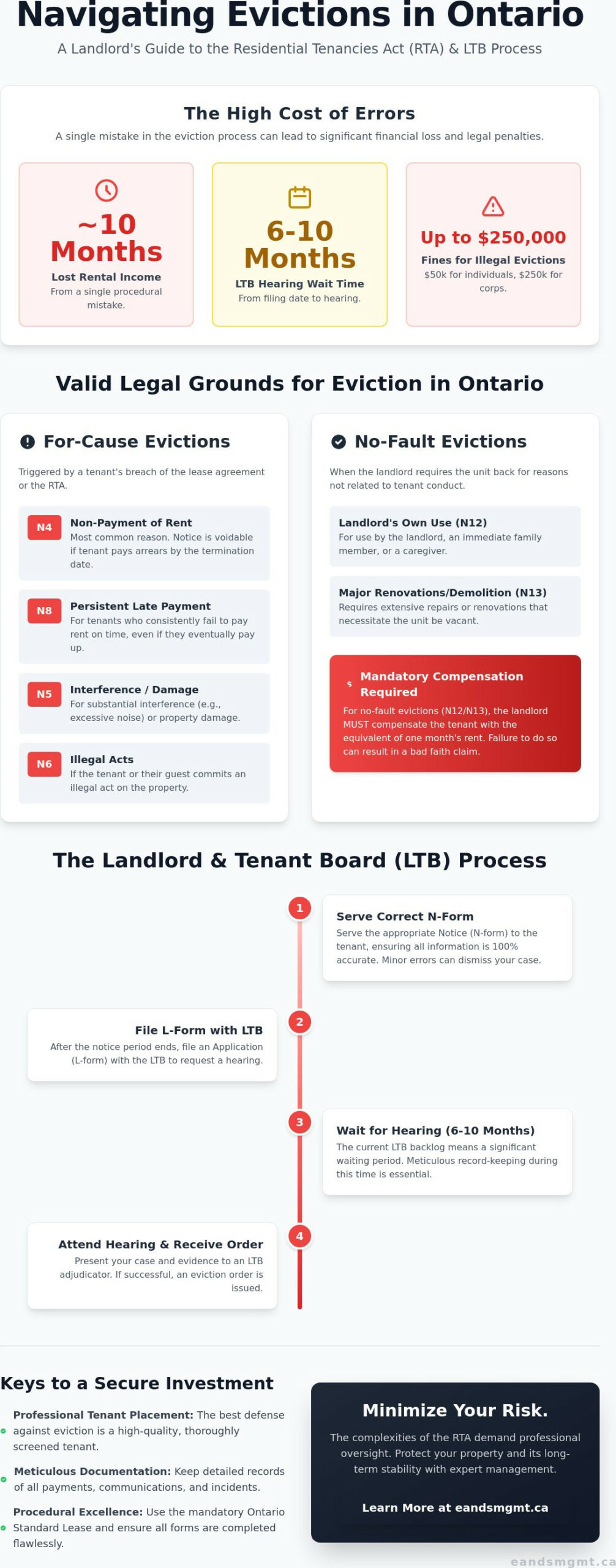
A for-cause eviction is triggered when a tenant violates their contractual obligations or the standards set by the RTA. Non-payment of rent remains the most frequent of the legal reasons to evict a tenant Ontario property owners encounter. When rent is missed, the process begins with an N4 notice. It’s vital to recognize that an N4 is a voidable notice; the legal action terminates if the tenant pays the arrears in full before the specified termination date. For situations where a tenant eventually pays but does so consistently after the due date, an N8 notice for persistent late payment provides a more structured resolution. Following these official guidelines from Tribunals Ontario ensures your documentation stands up to LTB scrutiny.
Beyond financial breaches, behavioral issues often require intervention. An N5 notice addresses substantial interference with the reasonable enjoyment of the premises by the landlord or other tenants. This typically includes excessive noise or repeated disturbances. If the tenant or their guest commits an illegal act on the property, an N6 notice is the correct instrument. These cases often involve complex evidentiary requirements, making it essential to maintain a detailed log of incidents and communications. Proactive Full-Service Property Management helps mitigate these risks by establishing clear expectations from the first day of the tenancy and maintaining professional distance.
Damage and Safety Concerns
Distinguishing between normal wear and tear and undue damage is a common point of friction at the LTB. Undue damage refers to destruction caused willfully or through negligence, which warrants an N5 or N7 notice. Serious impairment of safety, such as blocking fire exits or tampering with smoke alarms, allows for a more direct legal response. Regular property inspections are your best defense here. Documenting the unit’s condition through photos and written reports creates a chronological record that’s difficult to dispute during a hearing. This foresight protects the longevity of your asset and provides the necessary proof if a claim for damages is required.
Overcrowding and Health Standards
Eviction due to overcrowding occurs when the number of occupants exceeds what’s permitted by health, safety, or housing standards. In Ottawa, municipal bylaws set specific occupancy limits that interact directly with RTA rules. Winning an overcrowding case at the LTB carries a high burden of proof. You must demonstrate that the occupancy level isn’t just a lease violation, but a genuine breach of safety or provincial standards. Because the LTB currently faces wait times of 6 to 10 months, ensuring your initial application is flawless is the only way to avoid resetting a very long clock.
No-Fault Eviction: Landlord’s Use and Renovations
A no-fault eviction occurs when a landlord requires possession of a rental unit for reasons unrelated to the tenant’s conduct. These are strictly regulated legal reasons to evict a tenant Ontario property owners must execute with procedural precision. The most common instrument is the N12 notice. This form is utilized when the landlord, an immediate family member, or a person providing care services intends to occupy the unit for at least one year. To validate this notice, you must provide the tenant with compensation equal to one month’s rent or offer them another acceptable unit before the termination date listed on the notice.
Major renovations, demolition, or conversion to non-residential use fall under the N13 notice. This applies only when the work is so extensive that it requires a building permit and the unit must be vacant. It’s vital to respect the tenant’s right of first refusal. This legal provision allows the tenant to move back into the unit once renovations are complete at the same rent they were paying before the work began. Failing to offer this right can lead to significant legal complications at the LTB. You can find further practical advice on these specific scenarios through the Landlord’s Self-Help Centre, which provides resources for navigating these administrative hurdles.
Avoiding the ‘Bad Faith’ Trap
The Landlord and Tenant Board takes ‘bad faith’ claims very seriously. A bad faith eviction occurs if a landlord serves an N12 or N13 without a genuine intent to follow through, often to re-rent the unit at a higher price. In 2026, the rent increase guideline is set at 2.1%, which sometimes tempts owners to bypass legal limits. However, the penalties are severe. If the LTB determines an eviction was in bad faith, they can order the landlord to pay the tenant’s moving expenses, the difference in rent at their new home for one year, and general compensation. Fines for such offences can reach $50,000 for individuals. The board often verifies intent by checking if the unit was listed for rent or sale shortly after the tenant vacated.
Purchaser’s Own Use
When a property is sold, the new owner may wish to occupy the unit. In this case, the seller serves an N12 on behalf of the purchaser once a specialized agreement of purchase and sale is in place. This notice requires at least 60 days’ notice, ending on the last day of a rental period. Clear communication between the buyer, seller, and tenant is critical to ensure a smooth transition. If the tenant refuses to vacate, the purchaser must wait for an LTB hearing, which currently takes 6 to 10 months. Planning for these timelines during the closing process is essential for a successful asset transfer and long-term investment stability.
Once you have established the legal reasons to evict a tenant Ontario law permits, you must follow a rigid procedural sequence. Failure to adhere to these steps often results in the Landlord and Tenant Board (LTB) dismissing your application, forcing a restart of the entire timeline. The process begins with the service of the correct Notice to End Tenancy (N-form). It’s essential that this notice aligns with the terms of the Ontario Standard Lease; inconsistencies between the lease and the notice can undermine your legal standing. If the tenant remains in the unit past the termination date, the next step is filing an application (L-form) with the LTB. For non-payment cases, this involves an L1 application and a $201 filing fee.
The hearing phase is where your evidence is tested before an adjudicator. In 2026, these are primarily conducted via video. If the adjudicator rules in your favor, they will issue an Eviction Order. This document specifies the date by which the tenant must vacate. If they still refuse to leave, you cannot take physical action yourself. You must file the order with the Court Enforcement Office, where a Sheriff will schedule the legal removal of the tenant.
Proper Service of Notices
Delivering the notice correctly is as important as the content itself. Permitted methods include hand-delivery, placing it under the door, or using regular mail. If you choose mail, you must add five days to the notice period to account for delivery. Email service is only valid if the tenant provided written consent, typically within the Standard Lease or a separate agreement. The day of service does not count toward the notice period. Calculating these dates with precision prevents technicality dismissals that can delay a resolution by months.
Evidence Preparation for Hearings
A successful hearing depends on an objective and comprehensive paper trail. You should maintain an organized rent ledger, copies of all written communications, and detailed property inspection reports. These documents provide the adjudicator with a clear, factual history of the tenancy and the breach. In the Ottawa LTB office, 2026 wait times currently range from 6 to 10 months from filing to hearing. This significant delay makes the accuracy of your initial filing paramount. Utilizing Full-Service Property Management ensures your documentation is professionally maintained and ready for scrutiny, reducing the administrative burden on your shoulders.
Minimizing Legal Risk through Professional Property Management
While identifying the legal reasons to evict a tenant Ontario law supports is vital for any property owner, the most effective strategy is to render the eviction process unnecessary. Professional management serves as a preventative resolution. By implementing a high-level tenant placement service, you establish a foundation of reliability from the start. This proactive approach focuses on asset longevity and the removal of operational burdens before they escalate into costly legal disputes. It’s about creating a stable environment where both the owner and the resident understand their obligations clearly.
A disciplined screening process is your primary defense against future LTB applications. This includes thorough credit checks, employment verification, and detailed references from past landlords. When these steps are performed with meticulous detail, the likelihood of facing non-payment or behavioral breaches decreases significantly. Additionally, regular property inspections provide the oversight needed to identify minor issues before they become catastrophic. These inspections act as a tool for early conflict resolution, allowing for professional intervention that protects the physical and financial health of your investment. Documenting these visits also ensures that if you ever need to present a case for damage, your evidence is objective and chronological.
Proactive Compliance Resolution
Addressing minor lease violations early prevents them from maturing into valid legal reasons to evict a tenant Ontario adjudicators must review. Professional rent collection systems ensure consistent cash flow and provide an immediate alert if a payment is missed. This allows for prompt, professional communication that often resolves the issue without needing to file an N4 notice. Foreign service members and institutional investors frequently trust E&S to manage these complexities. When you’re posted abroad, having a steady hand on the ground ensures that RTA requirements, emergency maintenance, and financial reporting are handled with administrative efficiency, regardless of your physical location.
The E&S Advantage: 40 Years of Stewardship
Leveraging 40 years of localized expertise in the Ottawa market provides a level of security that individual owners often struggle to maintain. Our role as a dependable steward means we understand the nuances of the Landlord and Tenant Board rules inside out. This deep knowledge allows us to navigate the system with foresight, ensuring every action taken is legally sound and strategically viable. We provide the predictability and order essential in a sector often defined by uncertainty. This professional oversight doesn’t just manage a property; it enhances the value of the asset while removing the chaos of day-to-day administration. Discover how E&S Property Management protects your investment and provides the professional resolution you require for long-term success.
Securing Your Investment Through Procedural Excellence
Navigating the Landlord and Tenant Board requires a disciplined approach to documentation and a deep understanding of the Residential Tenancies Act. Whether you’re addressing rent arrears or preparing for a no-fault possession, the margin for error remains razor-thin in 2026. Successfully managing the legal reasons to evict a tenant Ontario law recognizes is about more than just filing forms; it’s about protecting the long-term viability of your real estate assets. Meticulous record-keeping and proactive communication are your strongest tools for maintaining order and minimizing the stress of current LTB timelines.
For over 40 years, E&S Property Management has served as a steady hand for Ottawa property owners, providing specialized support for Foreign Service members and institutional investors alike. Our comprehensive tenant screening and placement services ensure that your portfolio is built on a foundation of reliability from the outset. You don’t have to face the complexities of property oversight alone. Protect your rental property with E&S Property Management’s expert oversight and regain the peace of mind that comes from professional stewardship. With the right partner, you can turn operational challenges into predictable, high-value results.
Frequently Asked Questions
Can I evict a tenant for no reason in Ontario?
No, you cannot evict a tenant for no reason in Ontario. The Residential Tenancies Act provides security of tenure, meaning a tenancy only ends if the tenant chooses to leave or you have one of the specific legal reasons to evict a tenant Ontario law recognizes. Even if a fixed-term lease expires, it automatically converts to a month-to-month agreement unless a valid legal ground for termination is established and proven at the Landlord and Tenant Board.
How long does the eviction process take in Ontario in 2026?
The total timeline for an eviction in 2026 typically ranges between 5 and 12 months. This includes the initial notice period, the current LTB hearing wait times of 6 to 10 months, and the subsequent time required for the Sheriff to enforce the order. Because of these lengthy delays, ensuring your initial paperwork is error-free is essential to avoid resetting the process and losing additional months of rental income.
What happens if a tenant refuses to leave after an eviction order?
If a tenant remains in the unit after the LTB’s eviction date, you must file the order with the Court Enforcement Office. Only a Court Enforcement Officer, commonly known as a Sheriff, has the legal authority to physically remove a tenant and their belongings. Landlords are strictly prohibited from changing locks or using self-help methods, as these actions lead to substantial fines of up to $50,000 for individuals under the RTA.
Can a landlord evict a tenant to sell the house in Ottawa?
Selling a property is not a direct reason for eviction. You can only serve an N12 notice if the purchaser, or their immediate family, genuinely intends to occupy the unit themselves. If the buyer intends to keep the property as a rental, the existing tenant remains with the property under their current lease terms. Clear communication between all parties is required to manage these transitions and avoid bad faith claims.
Is it legal to evict a tenant in the winter in Ontario?
Yes, it’s legal to evict a tenant during the winter months. Ontario law does not have a “winter moratorium” on evictions. While the process remains the same regardless of the season, the actual physical removal by the Sheriff can sometimes be delayed by extreme weather conditions or holiday schedules. The legal grounds and LTB procedures for securing an eviction order remain consistent throughout the entire year.
What is the most common reason the LTB denies an eviction request?
The most frequent reason for denial is a technical or clerical error on the notice or application. Small mistakes, such as an incorrect termination date, a misspelled name, or failing to include the full address, can cause an adjudicator to dismiss the case. This procedural strictness emphasizes why professional oversight and meticulous documentation are necessary to protect your rental income and ensure your legal reasons to evict a tenant Ontario are upheld.
Do I need a lawyer for a Landlord and Tenant Board hearing?
You aren’t required to have a lawyer or paralegal for an LTB hearing. Many individual landlords represent themselves; however, the complexity of the legal requirements can make professional representation a wise investment. A licensed paralegal or a property management partner with LTB expertise can help ensure your evidence is presented logically and that all procedural requirements are met to avoid costly dismissals.
How much notice must a landlord give for an N12 eviction?
You must provide at least 60 days’ notice when serving an N12 for personal or purchaser use. This notice period must end on the last day of a rental period, which is typically the day before the rent is due. Additionally, you must pay the tenant one month’s rent as compensation or offer another acceptable unit by the termination date specified in the notice to ensure the application is valid.