
Imagine receiving a Landlord and Tenant Board hearing date scheduled eight months from today while your property sits vacant during a -30°C January deep freeze. You understand that managing Ottawa rentals in 2026 requires more than just finding a tenant; it demands a proactive strategy to handle shifting regulations and the city’s unforgiving climate. It’s frustrating when administrative delays or unexpected furnace failures eat into your margins, especially when you’re managing the property from a different time zone.
We’ve developed this guide to provide the management solutions you need to achieve stable income and complete compliance with the Ontario Standard Lease. You’ll learn how to implement asset preservation strategies that protect your investment from seasonal damage and navigate complex tax obligations for non-resident owners. We will analyze the 2026 market trends, including the impact of the 2.5% rent increase guideline, to ensure your property remains a reliable source of peace of mind and long term value.
Key Takeaways
- Understand how Ottawa’s government-stabilized economy and institutional demand from GAC and DND create unique, predictable leasing cycles for property owners.
- Evaluate the strategic advantages of purpose-built rentals compared to individual condo investments to determine which asset class best supports your long-term financial goals.
- Navigate the complexities of the Landlord and Tenant Board (LTB) to protect your investment from the legal pitfalls and backlogs common in the Ontario market.
- Implement a proactive property preparation and multichannel marketing strategy designed to attract high-calibre tenants while preserving your asset through harsh Ottawa winters.
- Discover how professional management solutions provide peace of mind and operational efficiency through established maintenance networks and expert local oversight.
The Ottawa Rental Market Landscape in 2026
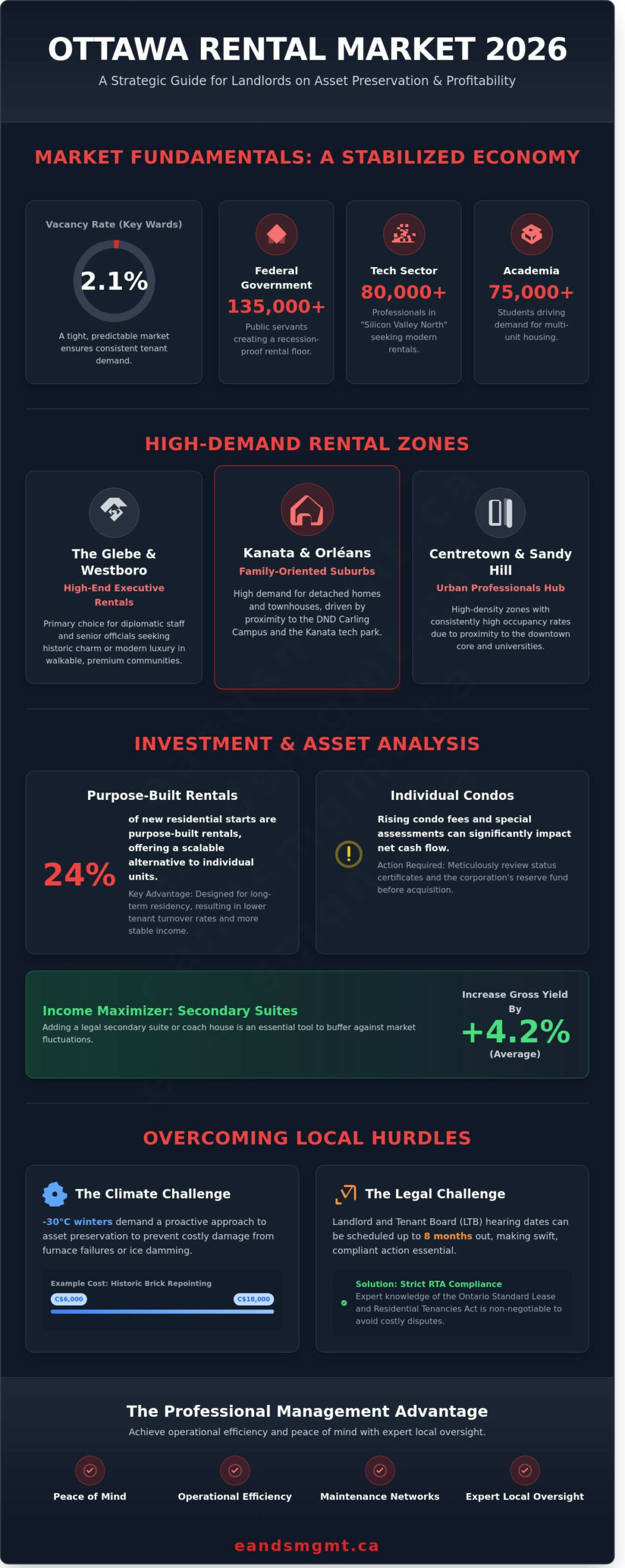
Ottawa’s rental market remains a government-stabilized economy that offers a level of predictability rarely seen in Toronto or Vancouver. This stability is rooted in the city’s unique workforce composition. By 2026, the vacancy rate in key wards like Somerset and Kitchissippi has remained tight, hovering near 2.1%. Property owners benefit from a market that doesn’t experience the volatile price swings found in other major Canadian hubs. Instead, Ottawa provides a steady environment for long-term asset preservation.
The rhythm of the city is dictated by the federal government. Agencies like Global Affairs Canada (GAC) and the Department of National Defence (DND) influence the annual rental cycle through regular staff rotations. Most diplomatic and military postings occur during the summer months. Owners who align their lease turnovers with this window often find high-quality tenants quickly. Managing these high-stakes rentals requires strict adherence to the Residential Tenancies Act, which serves as the legal framework for all landlord-tenant relationships in Ontario. Understanding these regulations is vital for maintaining operational efficiency and avoiding costly disputes at the Landlord and Tenant Board.
Key Neighbourhoods for Rental Demand
- The Glebe and Westboro: These areas are the primary choice for high-end executive rentals. Diplomatic staff and senior officials look for historic charm or modern luxury in these walkable communities.
- Kanata and Orléans: These suburban markets cater to family-oriented tenants. Kanata’s proximity to the DND Carling Campus and the tech park keeps demand for detached homes and townhouses high.
- Centretown and Sandy Hill: These high-density urban zones are essential for young professionals. The proximity to the downtown core ensures that occupancy rates stay high throughout the year.
Economic Drivers of the National Capital Region
The federal workforce provides a recession-proof foundation for the local economy. With over 135,000 public servants in the region, the demand for stable housing remains constant. This presence creates a “floor” for rental prices that protects investors during broader economic downturns. It’s a reliable system that rewards property owners who prioritize well-maintained units.
Ottawa’s tech sector, known as Silicon Valley North, adds another layer of demand. Over 1,700 companies in Kanata and beyond employ upwards of 80,000 workers. These professionals often seek modern executive suites with high-speed connectivity. Additionally, the student populations at Carleton University and uOttawa, totaling over 75,000 individuals, drive the consistent need for multi-unit housing in the city’s east and south ends. This diverse economic base ensures that your investment remains a productive asset year after year.
Types of Residential Rentals in Ottawa
Ottawa’s housing market in 2026 shows a clear shift toward high-density living. Purpose-built rentals now represent approximately 24% of all new residential starts, offering investors a more scalable alternative to individual condo units. These buildings are designed specifically for long-term residency, which often results in lower turnover rates. While individual condo investments remain a popular entry point, the rising cost of monthly condo fees can impact your net cash flow if you don’t calculate them accurately during the acquisition phase.
Maintaining Ottawa’s historic red-brick inventory requires a proactive approach to asset preservation. Properties in neighborhoods like the Glebe or Sandy Hill demand specific masonry care. Repointing historic brickwork typically costs between C$6,000 and C$18,000 depending on the building’s size. Beyond aesthetics, secondary suites and coach houses have become essential tools for maximizing income. These additions can increase a property’s gross yield by an average of 4.2%, providing a reliable buffer against fluctuating interest rates.
Condominiums vs. Freehold Homes
Condo management requires a meticulous review of status certificates and building bylaws. You must ensure the corporation’s reserve fund is healthy to avoid unexpected special assessments that can erase annual profits. Freehold rentals shift the total responsibility for structural care, roof maintenance, and snow removal directly to the landlord. Foreign Service officers stationed in the capital frequently choose to rent their primary residences during their 3 year postings abroad. This strategy keeps their foot in the Ottawa market while ensuring the home is cared for by disciplined stewards.
Multi-Unit Residential Buildings (MURBs)
Investing in duplexes or triplexes allows for faster portfolio growth and improved operational efficiency. Older conversions often feature complex shared utility setups that can lead to tenant disputes. Separating hydro meters, which usually costs about C$2,500 per unit, provides better transparency and reduces overhead. You must also ensure full compliance with Ontario rental regulations regarding fire safety and standard lease requirements. Larger portfolios require a steady hand to maintain order and mitigate risks. Implementing specialized management solutions helps stabilize your long-term returns and protects your investment equity.
The Lifecycle of a Successful Ottawa Rental
Managing rentals in the nation’s capital requires a methodical approach that begins long before a tenant signs a lease. Strategic preparation involves a deep dive into local market trends to ensure the property appeals to high-calibre professionals. We move beyond simple portal listings by implementing multichannel marketing strategies. This approach uses targeted social media placement and high-traffic local networks to reach a wider, more qualified demographic. Every step in this lifecycle is designed to maximize operational efficiency and provide peace of mind for the owner.
Tenant Placement and Screening
The screening process is your first line of defense in a high-interest rate environment. With debt-servicing costs remaining a factor in 2026, we prioritize rigorous credit checks and direct employment verification. It’s not just about the ability to pay; it’s about a history of financial reliability. According to Ottawa rental market data, vacancy rates remain low, yet tenants are more discerning about quality. Professional photography and 3D virtual tours are now the baseline standard for Ottawa rentals. These tools provide transparency and attract serious inquiries while filtering out casual browsers. We finalize every placement using the Ontario Standard Lease, ensuring all custom clauses remain fully enforceable under the Residential Tenancies Act.
Routine Inspections and Asset Preservation
Asset preservation is a core pillar of our management solutions. We view semi-annual inspections as a non-negotiable task for protecting your property value. These visits allow our team to identify hidden issues, such as minor plumbing leaks or early HVAC wear, before they escalate into C$2,000 emergency repairs. Proactive maintenance typically reduces long-term repair costs by approximately 30% compared to reactive fixes. Detailed digital documentation of the property condition serves as a critical asset. This record-keeping is essential for mitigating potential Landlord and Tenant Board (LTB) disputes and ensuring a smooth transition during move-out.
Ongoing retention is the next phase of the cycle. We maintain a steady hand through proactive communication and rapid maintenance responses, which keeps reliable tenants in place longer. The final, critical step involves comprehensive financial reporting. We provide transparent monthly statements that simplify tax compliance and offer a clear view of your investment’s performance. Our structured approach ensures that every aspect of the rental lifecycle is handled with discipline and foresight.
Navigating Local Challenges: Winter, Law, and the LTB
Owning rentals in Ottawa requires a clear-eyed approach to the Landlord and Tenant Board (LTB). Current data shows that wait times for L1 and L2 applications often average seven to nine months. A single non-paying tenant can result in a loss exceeding C$15,000 in lost revenue and legal costs before an eviction order is issued. DIY management often magnifies these risks. Most self-managed owners make technical errors on N4 or N12 forms. These small mistakes cause cases to be dismissed after months of waiting, forcing the owner to restart the entire process.
Liability is another significant hurdle. The Occupiers’ Liability Act places the burden of snow and ice removal squarely on the owner. You can’t simply delegate this to a tenant through a standard lease clause. It requires a separate, paid service agreement to hold up in court if a slip-and-fall claim occurs. Additionally, Ontario’s rent control remains a factor for properties first occupied before November 15, 2018. With the 2025 rent increase guideline set at 2.5%, your strategy must prioritize operational efficiency to maintain a positive ROI against rising property taxes and insurance premiums.
The “Ottawa Winter” Maintenance Strategy
Ottawa’s climate demands a proactive asset preservation plan. Frozen pipes are a primary threat during January cold snaps where temperatures drop below -25°C. We recommend installing smart leak detectors and keeping thermostats at a minimum of 17°C in vacant units. Furnaces and Heat Recovery Ventilator (HRV) systems need professional inspections every October to ensure they handle the heavy load of mid-winter. During the spring thaw, especially for properties near the Ottawa River, sump pump testing is mandatory. A failed pump during the March freshet can cause C$20,000 in basement damage within hours.
Legal Compliance and the Ontario Standard Lease
The Ontario Standard Lease is mandatory. Many owners still try to insert illegal “no pets” or “no guests” clauses. These are void under the Residential Tenancies Act and often damage the landlord-tenant relationship from day one. Proper documentation is your best defense. Using the correct N-forms for late rent or maintenance issues provides the legal paper trail that the LTB requires for a successful hearing. Our team provides Management Solutions that act as a buffer. This professional distance ensures all communication remains compliant and protects owners from the direct legal friction that leads to burnout.
The Professional Management Advantage for Ottawa Owners
Owning property in Ottawa while stationed overseas requires more than a simple caretaker. It demands a strategic partner to manage the nuances of the local market. E&S Management Solutions provides the operational framework needed to protect your investment during global postings. We leverage a vetted network of local contractors to ensure maintenance costs remain manageable through volume pricing. This approach often results in a 10% to 15% reduction in repair expenses compared to individual retail rates. By maintaining these high standards, we position your property as a preferred choice for the diplomatic and military communities, ensuring your rentals attract high-quality, reliable occupants who value asset preservation.
Solutions for Foreign Service and DND Members
Transitioning a family home into a rental property involves complex logistics and emotional weight. Our team coordinates every detail, from initial safety inspections to the eventual return of your keys. We specialize in CRA compliance for non-residents, a critical area where errors are costly. This includes managing the mandatory 25% non-resident tax withholding and filing NR6 and NR4 forms on your behalf. You won’t have to navigate the bureaucracy of the Canadian tax system alone. Our process ensures you remain in good standing with the government while you’re out of the country. When your posting concludes, we manage the transition back, ensuring the property is professionally cleaned and fully prepared for your family to move back in.
Maximizing ROI Through Strategic Oversight
Long-term profitability in the Ottawa market depends on minimizing vacancy and maximizing tenant retention. We use real-time market data to set competitive rates that reflect 2026 demand levels. Our tenant retention programs focus on building positive relationships, which significantly reduces the high costs associated with turnover. You’ll receive transparent financial reports every month. These documents allow you to view your property as a structured business asset rather than a source of stress. We handle the day-to-day friction so you can focus on your professional duties abroad. Our commitment to reliability means your rentals remain profitable and well-maintained regardless of your physical location.
Take the next step in securing your investment. Schedule a rental assessment for your Ottawa property with E&S Management Solutions today.
Secure Your Ottawa Investment for 2026 and Beyond
Success in the capital’s property market requires more than just listing a unit. Managing Ottawa rentals in 2026 demands a proactive approach to asset preservation and a deep understanding of Landlord and Tenant Board regulations. Owners must balance operational efficiency with the unique seasonal demands of the region to ensure long term stability. For non-resident owners, staying compliant with NR6 and NR4 tax requirements is a non-negotiable part of protecting your financial interests.
E&S Management Solutions offers the discipline and foresight needed to navigate these complexities. We bring over 40 years of experience to every property we manage, providing the same high level of reliability that has earned us a proven track record with GAC and DND clients. Our team focuses on transparent communication and strategic consulting to turn management challenges into predictable results. It’s time to move past passive administration and embrace a professional management solution that prioritizes your peace of mind.
Protect your investment with Ottawa’s rental experts; Contact E&S Management Solutions
Your property is a significant asset, and with the right partner, it’ll continue to thrive in any market condition.
Frequently Asked Questions
How much can I realistically rent my house for in Ottawa?
Rental rates depend on the neighborhood and property type. According to the CMHC Rental Market Report released in January 2024, the average rent for a three-bedroom house in Ottawa reached C$2,100, though luxury detached homes in areas like Westboro often command over C$4,000. We conduct a detailed comparative market analysis to ensure your rentals align with current demand and maximize your ROI while maintaining a low vacancy rate.
What is the Ontario Standard Lease and is it mandatory for all rentals?
The Ontario Standard Lease is a mandatory template for most private residential tenancies signed on or after April 30, 2018. It ensures consistency and protects both parties by outlining essential terms clearly. If you don’t use this specific form, tenants can demand one and potentially withhold one month’s rent until it’s provided. Our team ensures all agreements comply with the Residential Tenancies Act to prevent legal disputes and administrative errors.
Do I need a property manager if I live in Ottawa?
You aren’t legally required to hire a manager, but professional oversight provides operational efficiency and asset preservation. Managing rentals involves 24/7 availability for maintenance and strict adherence to the Landlord and Tenant Board (LTB) protocols. Owners who value their time often choose our management solutions to handle tenant screening and day-to-day logistics, ensuring the property remains a passive investment. This approach provides a steady hand to navigate the complexities of local regulations.
How does the LTB backlog affect my ability to evict a non-paying tenant?
The Landlord and Tenant Board (LTB) currently faces a backlog that can delay eviction hearings by seven to nine months. This delay means you could face nearly a year of lost income if a tenant stops paying rent. We mitigate this risk through rigorous front-end screening and proactive communication. Our strategic consulting helps you navigate these delays by ensuring all filings are error-free to avoid further administrative setbacks and financial loss.
What are the tax implications if I rent out my Ottawa home while living abroad?
Non-resident owners must typically have 25% of their gross rental income withheld and remitted to the Canada Revenue Agency (CRA) monthly. You can reduce this by filing an NR6 form to pay tax on net income instead of gross. We provide transparent reporting to assist your accountant in meeting these federal obligations. This ensures your investment remains compliant with Canadian tax laws while you reside outside the country, providing total peace of mind.
Who is responsible for snow removal at a rental property in Ontario?
Landlords are legally responsible for snow removal and property maintenance under the Residential Tenancies Act. You can’t simply shift this burden to the tenant in the lease agreement without a separate, valid contract for services. Failure to clear snow within 24 hours of a storm can result in municipal fines or liability claims. Our maintenance solutions include scheduled clearing to keep your property safe and compliant, protecting you from potential legal action or injury claims.
What is the difference between tenant placement and full-service management?
Tenant placement is a one-time service focused on marketing, screening, and lease execution for your property. Full-service management provides ongoing oversight, including rent collection, maintenance coordination, and annual inspections. Most of our clients prefer the full-service model because it offers long-term asset preservation and professional communication. We act as the primary point of contact, shielding you from the daily stresses of property ownership and ensuring your investment grows steadily over time.
How do I handle emergency repairs if I am posted outside of Canada?
You must appoint a local representative or management firm to handle urgent issues like burst pipes or furnace failures while you’re away. Ontario law requires tenants to have a way to reach someone who can authorize immediate repairs. We provide a 24-hour emergency response system that protects your property from catastrophic damage. This reliable oversight gives you peace of mind while you’re stationed abroad or traveling for work, ensuring your asset is always protected.


