
Imagine waiting four months for a hearing, only to have the Landlord and Tenant Board dismiss your case because of a single clerical error on a notice. For many property owners, handling difficult tenants ottawa feels like walking through a legal minefield where one wrong step resets an agonizingly long clock. With an active backlog of over 53,000 cases currently sitting at the LTB, you don’t have the luxury of trial and error while your rental income and property value are at stake.
We understand that behind every eviction notice is a person who simply wants their investment protected and their sleep restored. It’s incredibly stressful to manage these disputes, especially if you’re coordinating from another city or a different country. This guide provides the clarity you need by outlining the 2026 legal requirements, from the updated N4 notice periods to the specific forms required for a successful L1 or L2 application. You’ll gain a clear roadmap of the current four to six month eviction timeline and the exact steps to ensure your property is protected with total compliance and professional confidence.
Key Takeaways
- Gain a clear understanding of the Residential Tenancies Act and how the Landlord and Tenant Board serves as the essential framework for protecting your property rights.
- Learn to identify and serve the correct notices, such as the N4 or N12, to avoid technical errors that can derail the process of handling difficult tenants ottawa.
- Master the Tribunals Ontario Portal to file L1 and L2 applications accurately, ensuring you stay on track with the current 2026 eviction timelines.
- Understand the transition from a hearing to a final order, including how to navigate mediated agreements and the enforcement role of the Sheriff.
- Discover how proactive tenant screening and professional management act as a shield to prevent legal disputes before they ever reach the LTB.
The Foundation of the LTB Eviction Process in Ontario
The Residential Tenancies Act (RTA) serves as the essential rulebook for every rental relationship in the province. It’s a piece of consumer protection legislation designed to balance the rights of property owners with the security of residents. For those unfamiliar, the Landlord and Tenant Board (LTB) acts as the adjudicative tribunal that interprets these rules and settles disputes. Effectively handling difficult tenants in Ottawa starts with recognizing that you aren’t just managing a person; you’re operating within a strict legal hierarchy that demands precision and patience.
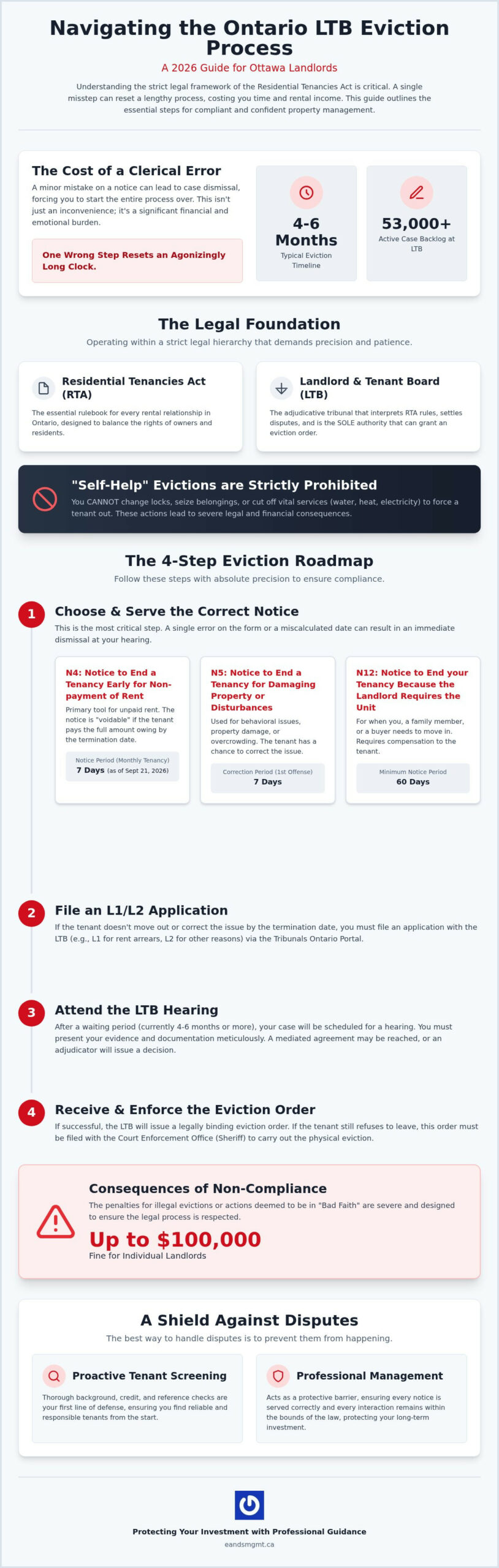
Ontario law upholds a concept known as “security of tenancy.” This principle means a tenant has a legal right to occupy their unit until they choose to move out or the board orders them to leave. You cannot change the locks, seize personal belongings, or cut off vital services like water, heat, or electricity to force a tenant’s hand. These “self-help” evictions are strictly prohibited and often lead to legal consequences that far outweigh the cost of unpaid rent. As of 2026, the Landlord and Tenant Board remains the sole authority legally permitted to grant an eviction order in Ontario.
Who is Covered by the LTB Rules?
Most residential rental situations in Ontario fall under the jurisdiction of the RTA. This includes standard apartments, basement suites, and single-family homes. However, exemptions exist; for instance, if a tenant shares a kitchen or bathroom with the property owner, the RTA typically doesn’t apply. Since 2018, the Ontario Standard Lease has been mandatory for most private tenancies to create consistency. Even without a signed document, an “implied tenancy” exists once you accept rent and provide a key. These verbal agreements carry the same legal weight as a written contract, meaning you still must follow the formal board process to end the arrangement.
The Consequences of Illegal Evictions
The stakes for non-compliance have never been higher for property owners. In 2026, individual landlords can face fines of up to C$100,000 for illegal evictions or conduct deemed to be in “Bad Faith.” These penalties are designed to discourage shortcuts and ensure the legal process is respected. Beyond the financial loss, a history of board violations can permanently damage your standing in future hearings. Successfully handling difficult tenants in Ottawa requires a level of emotional detachment and administrative rigour that can be exhausting for an individual. Professional stewardship acts as a protective shield, ensuring that every notice is served correctly and every interaction remains within the bounds of the law, ultimately protecting your long-term investment.
Choosing and Serving the Right Notice to End Tenancy
Selecting the correct form is the most critical step in the eviction process. A single typo or a miscalculated date can lead to an immediate dismissal at a hearing, forcing you to start the months-long wait all over again. When official LTB eviction forms are used correctly, they provide a structured legal pathway to resolve disputes. The Board is notoriously strict about technicalities. If you name the tenant incorrectly or fail to provide a specific enough reason for the notice, your application will likely fail before it even begins.
Calculating termination dates requires absolute precision under the 2026 rules. You must account for the method of delivery; for example, if you send a notice by mail, you must add five days to the notice period to account for postage time. Handling difficult tenants ottawa is significantly easier when you treat these documents as the foundation of your legal case rather than just a formality. Mistakes here are the most common reason for reset clocks and lost revenue.
Most Common LTB Notices for Landlords
The N4 notice is the primary tool for non-payment of rent. It’s important to remember that as of September 21, 2026, the notice period for monthly tenancies has been reduced to 7 days, though it remains 14 days for notices served before that date. This notice is “voidable,” meaning if the tenant pays the full amount owing before the deadline, the notice becomes invalid. For behavioral issues or property damage, landlords use the N5 notice, which provides a 7-day correction period for the first offense. If you need the unit for personal use, the N12 requires 60 days’ notice. Under the new 2026 regulations, if you provide at least 120 days’ notice for an N12 served after September 21, the requirement to pay one month’s rent in compensation may not apply.
The Art of Meticulous Documentation
Serving the notice is only half the battle; you must prove it was delivered. The LTB accepts several methods of service, including hand delivery or placing it in the mailbox. Email is only valid if the tenant has previously agreed to it in writing. You must complete a Certificate of Service (Form 215) immediately after delivery to document exactly how and when the notice reached the tenant. At E&S Property Management, we maintain audit-ready records and detailed rent ledgers for every property. Having a seasoned hand manage these administrative burdens provides essential protection for your investment, ensuring that your evidence is indisputable if a hearing is required.
Filing the Application and Preparing for the LTB Hearing
Once the notice period expires and the tenant remains in the unit, the formal legal process moves to the Tribunals Ontario Portal. Handling difficult tenants ottawa during this phase requires a shift from interpersonal communication to strict administrative filing. You must select the application that matches your served notice; an L1 application is used for non-payment of rent, while an L2 application covers most other grounds like behavioral issues or personal use. Filing online is the most efficient route, costing C$186 compared to the C$201 fee for paper applications. This official brochure on How a Landlord Can End a Tenancy provides a helpful secondary reference for these specific procedural requirements.
In early 2026, patience is just as important as precision. The LTB is currently working through a backlog of over 53,000 cases, which impacts how quickly your matter will be heard. For an L1 application, you should expect a wait time of approximately three months for a hearing date. If you’ve filed an L2 application, the timeline typically extends to between five and seven months. These delays mean any error in your initial filing isn’t just a minor hurdle; it’s a multi-month setback that keeps your property and your finances in limbo. Handling difficult tenants ottawa is a marathon, and ensuring your “file quality” is perfect from day one is the only way to reach the finish line.
The Digital Hearing Experience
Most LTB hearings in 2026 are conducted virtually via platforms like Zoom. You’ll need a stable internet connection and a quiet space to present your evidence to the adjudicator. Before the formal hearing begins, you may be offered the opportunity to speak with an LTB mediator. These professionals help parties reach a voluntary agreement, which can often lead to a faster resolution than waiting for a contested decision. Having a professional representative manage this digital environment helps lower the emotional temperature, allowing for a logical, evidence-based discussion that protects your interests.
Common Landlord Defences and Pitfalls
Under Section 83 of the RTA, adjudicators have the power to delay or even refuse an eviction based on equitable grounds, even if you’ve proven the tenant is in the wrong. Tenants often counter eviction proceedings by claiming the landlord has neglected essential maintenance. This is why keeping a meticulous record of property inspections and maintenance responses is vital. A clean record serves as your best defense, proving that you’ve acted as a responsible steward of the property while the tenant failed to meet their legal obligations under the lease.
The Eviction Order and Enforcement: What Happens Next?
Receiving a decision from the LTB is a significant milestone that marks the transition from legal dispute to property recovery. Tribunals Ontario generally issues an order within 30 days of your hearing, providing the legal authority needed to move forward. You’ll likely receive either a “Standard Order,” which sets a specific termination date, or a “Mediated Agreement” if a settlement was reached. If a tenant fails to follow the terms of a mediated settlement, you can often apply for an eviction order without a second hearing. However, you should be prepared for a potential “Stay of Proceedings.” If a tenant files an appeal with the Divisional Court, the eviction is usually paused until the appeal is heard, which can add significant time to the process.
Handling difficult tenants ottawa requires a firm understanding that your legal authority ends at the front door. Even with a valid order in hand, you’re strictly prohibited from changing locks or removing belongings yourself. If the tenant hasn’t vacated by the date specified in the order, you must move to the formal enforcement phase. This is a methodical process that ensures the transition of the property back to your care is handled with total legal compliance.
Working with the Court Enforcement Office
To execute an eviction in Ottawa, you must take your LTB order to the Sheriff’s office and pay the required enforcement fees. In 2026, the timeline for the Sheriff to arrive can vary based on local volume, but it typically adds several weeks to the overall process. On the day of enforcement, the landlord or their representative must be present to meet the officer. We recommend having a professional locksmith scheduled to arrive at the same time as the Sheriff. Once the Sheriff confirms the unit is vacant, changing the locks is your first priority to ensure the property is protected. You must then respect the 72-hour rule, which legally requires you to allow the tenant to retrieve their belongings between 8:00 AM and 8:00 PM during the three days following the eviction.
Post-Eviction: Recovering Arrears and Moving Forward
The physical end of a tenancy is often just the beginning of the financial recovery phase. If the tenant left behind significant arrears, you may need to pursue the debt through Small Claims Court or a professional collection agency. Conducting a thorough move-out inspection is also essential to document any damages that exceed normal wear and tear. This is the moment to reflect on the value of professional oversight. By delegating your Full-Service Property Management to a seasoned team, you ensure that the next tenant is screened with meticulous care, effectively preventing this stressful cycle from repeating.
Minimizing Eviction Risks with Professional Property Management
While understanding the legal mechanics of the Landlord and Tenant Board is essential, the most successful property owners focus on prevention rather than just cure. Handling difficult tenants ottawa becomes a significantly lighter burden when you have a rigorous screening process acting as your first line of defense. Since 1981, we’ve seen that a meticulous vetting process serves as a filter; it identifies high-risk patterns before a lease is ever signed. By prioritizing high-quality placements, you effectively shield your investment from the multi-month delays and financial losses associated with the current LTB backlog.
Professional management also creates a necessary “buffer zone” between you and your residents. When communications remain professional and detached, it’s much harder for a dispute to escalate into a personal conflict. This distance is particularly vital when handling difficult tenants ottawa, as it allows for logical, policy-driven resolutions rather than emotional confrontations. A professional manager acts as a protective guardian, ensuring that every interaction is documented and every regulation is met, providing you with a sense of order and clarity.
The E&S Approach to Conflict Resolution
Our philosophy centers on early intervention. We don’t wait for a situation to reach a breaking point; we resolve rent delays or behavioral concerns before they ever require a formal N4 or N5 notice. This proactive stance is supported by meticulous record-keeping that serves as a powerful deterrent to tenant non-compliance. When a tenant knows that every inspection is documented and every payment is tracked in a professional rent ledger, they’re much more likely to respect the terms of their agreement. This approach offers Ottawa landlords the best of both worlds: the freedom of passive ownership and the security of active, expert protection of their assets.
Peace of Mind for Global Landlords
Managing property requirements is complex enough when you live in the same neighborhood, but it’s a massive undertaking for those living abroad. We specialize in supporting Foreign Service members and expatriates who need a reliable partner on the ground in Ottawa. Beyond LTB compliance, we manage the administrative heavy lifting that comes with non-resident status, including NR6 filings and CRA tax compliance. Our 24/7 emergency response and established network of local contractors ensure that your property standards remain high, regardless of where you are in the world. The cost of professional management is often offset by the savings of avoiding just one bad eviction or legal pitfall. You deserve to focus on your career and family while knowing your home is in seasoned, supportive hands. Delegate the stress of property management to E&S today.
Regaining Control and Restoring Your Peace of Mind
The journey to resolving a tenancy dispute in Ontario is often long, but it doesn’t have to be overwhelming. Success at the Landlord and Tenant Board requires a blend of administrative precision and a steady, patient approach to the current legal landscape. By mastering the correct notice forms and ensuring your evidence is audit-ready, you protect yourself from the technicalities that often reset the clock for many property owners. Handling difficult tenants ottawa is about more than just legal filings; it’s about reclaiming the stability of your investment and your daily life.
You don’t need to navigate these complexities alone. With over 40 years of property management expertise in Ottawa, we act as a protective guardian for your home. We specialize in supporting Foreign Service members and non-resident landlords, providing comprehensive maintenance coordination and meticulous oversight that shields you from the stress of LTB hearings. Protect your investment and your peace of mind-contact E&S Property Management. Your property is a significant asset, and it deserves the care of a seasoned partner who understands both the logistical and emotional weight of management. We’re here to help you move forward with confidence.
Frequently Asked Questions
How long does the LTB eviction process take in Ontario in 2026?
The entire eviction process for non-payment of rent typically takes four to six months from the initial notice to the final enforcement by the Sheriff. For more complex cases, such as those involving behavioral issues or personal use, the timeline often extends to six or nine months. These durations are largely driven by a significant backlog at the Board, which currently exceeds 53,000 active cases.
Can I evict a tenant in Ontario for personal use of the property?
You can legally end a tenancy if you, a family member, or a caregiver intend to move into the unit for at least one year. This requires serving an N12 notice with a minimum 60-day notice period. Starting September 21, 2026, if you provide at least 120 days’ notice, you may be exempt from the requirement to pay the tenant one month’s rent in compensation.
What happens if a tenant refuses to leave after the LTB termination date?
If a tenant remains in the unit past the date specified in an LTB order, you must file that order with the Court Enforcement Office to have a Sheriff physically remove them. Landlords are strictly prohibited from taking matters into their own hands by changing locks or removing belongings. Only the Sheriff has the legal authority to enforce the eviction and restore possession of the property to you.
How much does it cost to file an eviction application with the LTB?
Filing a standard eviction application, such as an L1 or L2, costs C$186 when you submit it electronically through the Tribunals Ontario Portal. If you prefer to file a paper application by mail or in person, the fee is C$201. These fees are generally non-refundable, though you can request that the Board order the tenant to reimburse you for these costs if your application is successful.
Can I evict a tenant in Ontario if I do not have a written lease?
You can still evict a tenant without a written lease because the Residential Tenancies Act covers verbal and implied agreements once rent is accepted. Handling difficult tenants ottawa follows the same legal framework and notice requirements regardless of whether a formal contract exists. However, having a written Ontario Standard Lease is always recommended to provide a clear record of the agreed-upon terms and responsibilities.
What is the ‘Right to Void’ an eviction notice for non-payment?
The ‘Right to Void’ is a legal provision that allows a tenant to cancel an eviction for non-payment by paying all outstanding rent and filing fees before the LTB order becomes final. This means that if the tenant brings their account into good standing within the notice period or before the eviction is executed, the notice or order is no longer enforceable. It is designed to prioritize the payment of arrears over the loss of housing.
Do I need a lawyer for an LTB hearing in Ottawa?
You aren’t legally required to hire a lawyer or paralegal for an LTB hearing, but professional representation is often the best way to avoid costly technical errors. Many landlords find that delegating the process to a seasoned property manager provides the stabilizing force they need. A professional hand ensures that all evidence is meticulously prepared and that the hearing is managed with a calm, authoritative presence.
What should I do if my tenant stops paying rent but remains in the unit?
You should serve an N4 notice for non-payment of rent immediately to start the legal clock. As of September 21, 2026, the notice period for monthly tenancies is 7 days. Taking swift action is essential for handling difficult tenants ottawa effectively, as it ensures your application enters the Board’s queue as early as possible. This steady, methodical approach is the most reliable way to protect your rental income and regain control of your property.


