
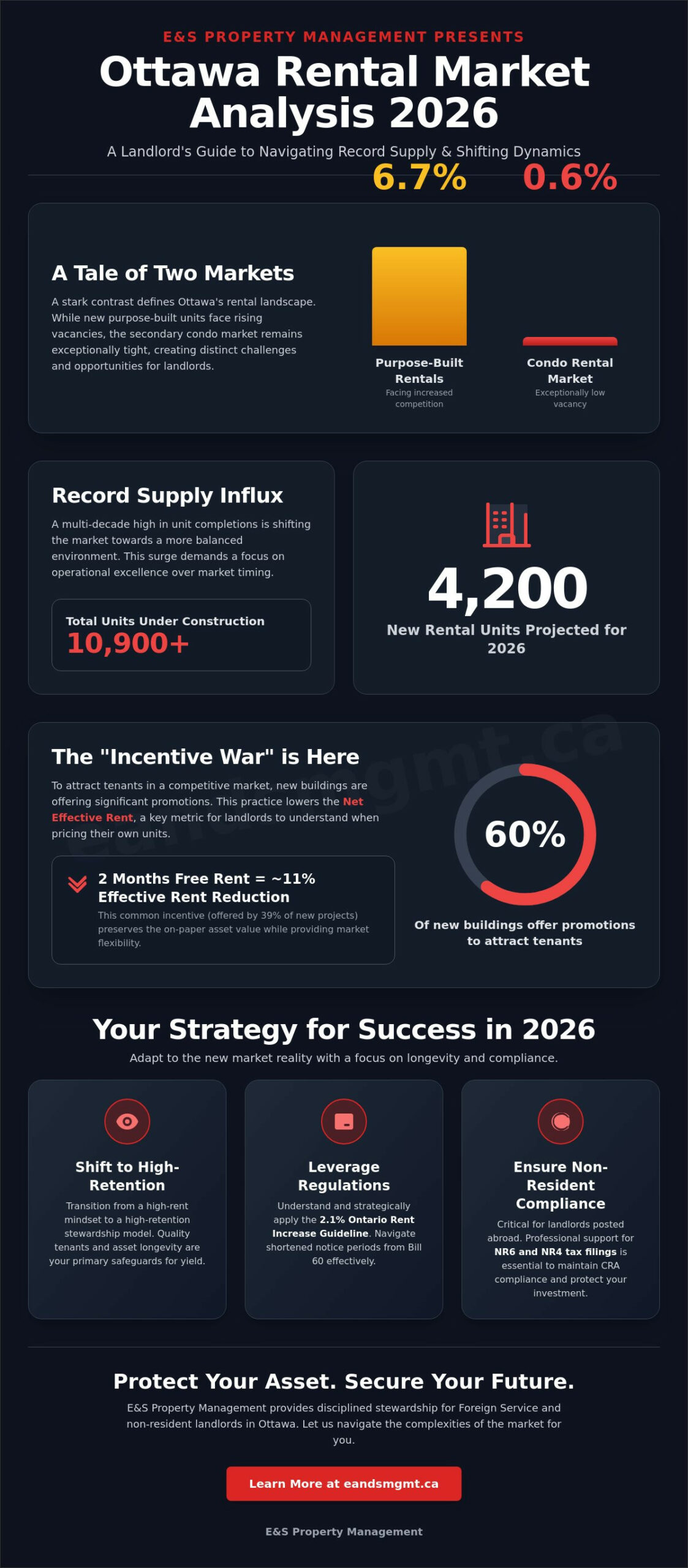
Did you know that while newer purpose-built rentals in Ottawa face a 6.7% vacancy rate, the condo rental market remains exceptionally tight at just 0.6%? This stark contrast highlights a shifting landscape where a record supply of 4,200 new units is scheduled for completion this year. It’s natural to feel concerned about long-term vacancies or whether you should offer incentives like the two months of free rent now common in 39% of new projects. This Ottawa rental market analysis 2026 provides the data-driven clarity you need to protect your assets and maintain high occupancy.
We understand that managing a property, especially while posted outside of Canada, requires more than just finding a tenant; it requires a disciplined strategy for asset longevity. You’ll learn how to leverage the 2.1% Ontario rent increase guideline, navigate the shortened notice periods introduced by Bill 60, and ensure CRA compliance through proper NR6 and NR4 tax filings. This guide previews the tangible steps necessary to transition from a high-rent mindset to a high-retention stewardship model that secures your financial future.
Key Takeaways
- Learn how to maintain high occupancy rates by shifting from a high-rent mindset to a high-retention stewardship strategy as record supply enters the city.
- Use this Ottawa rental market analysis 2026 to evaluate the “Incentive War” and determine if offering promotions is necessary to remain competitive against newer projects.
- Identify the performance gap between purpose-built rentals and the secondary condo market, where lease transactions have grown by 14%.
- Understand the critical steps for non-resident landlords to ensure CRA compliance through professional NR6 and NR4 tax filing support while posted abroad.
The 2026 Ottawa Rental Landscape: Record Supply and Rising Vacancy
The Ottawa rental market has entered a transformative phase defined by a multi-decade high in unit completions. Our Ottawa rental market analysis 2026 reveals that the city is currently absorbing a record influx of supply. There are 4,187 new rental units projected for completion throughout 2026, a surge that’s the direct result of high construction starts recorded over the previous four years. While this expansion offers more choice for residents, it’s pushed the city-wide vacancy rate to approximately 3.5%. This shift represents a move toward a more balanced environment, requiring landlords to focus on operational excellence rather than just market timing.
This stabilization of the vacancy rate doesn’t signal a lack of demand. Instead, it reflects the market’s attempt to catch up with years of chronic undersupply. The primary drivers of this landscape are the completions of major projects initiated during the low-interest-rate environment of the early 2020s. For property owners, this means the days of automatic year-over-year rent hikes have transitioned into a period where tenant retention and asset quality are the primary safeguards for investment yields.
Understanding the Supply Surge: Purpose-Built vs. Secondary Markets
There are currently over 10,900 purpose-built rental units under construction across the city. This massive pipeline creates a competitive environment where institutional-grade buildings compete directly with individual condo owners for the same tenant pool. Interestingly, stabilized buildings; those completed before the recent construction boom; often see higher vacancy rates than new lease-ups. This occurs because new developments frequently offer modern amenities and aggressive move-in incentives that older stock struggles to match without strategic upgrades or professional tenant placement services.
The Impact of Interest Rates and Migration on 2026 Demand
Rental demand remains remarkably sticky despite the supply increase. Several factors influence this stability. Federal public service return-to-office mandates have reinvigorated demand for downtown housing, as employees seek to minimize commutes. However, certain neighborhoods like Sandy Hill and the areas surrounding Carleton University face new pressures due to international student caps. These local shifts are deeply tied to Ottawa’s economy and demographics, which rely heavily on a mix of government stability and institutional growth.
High interest rates also keep many would-be buyers in the rental pool. The cost of mortgage qualification remains prohibitive for many households, ensuring a steady stream of high-income professionals remains in the rental market. For landlords, the challenge isn’t a lack of renters, it’s the increased competition for the most reliable ones. Success in 2026 depends on understanding these localized micro-trends and adjusting your management strategy to meet the expectations of a more discerning tenant base.
Rent Dynamics: Analyzing Price Softening and Tenant Incentives
The “Incentive War” has reached a peak in the capital. Our Ottawa rental market analysis 2026 shows that over 60% of new purpose-built buildings now offer promotions to attract residents. While median asking rents remain at C$1,950 for a one-bedroom and C$2,395 for a two-bedroom unit, these “face rents” are often deceptive. The price per square foot (psf) metric is now the most reliable way to gauge true market value. By offering two months of free rent, a common practice in 39% of new projects, landlords are effectively lowering monthly costs by about 11%. This strategy preserves the asset’s valuation on paper while providing the flexibility needed in a more balanced market.
In 2025, condo rent growth sat at a modest 1.1%. Projections for 2026 suggest a similar trend of stabilization rather than aggressive growth. For individual property owners, the challenge lies in competing with institutional developers who have deeper pockets for marketing. You don’t necessarily need to match every corporate promotion. Instead, focus on the net effective rent. If a nearby building offers a “one month free” deal or a significant signing bonus, you must determine if your property’s unique features or a slightly lower base rent provides a better long-term value proposition for a stable tenant.
Geographic Price Variance: Downtown vs. Suburban Ottawa
Suburban hubs like Kanata and Stittsville remain popular for families and tech professionals. However, Centretown and the ByWard Market are seeing the most significant supply-side pressure. The “LRT effect” continues to influence the East End, where proximity to reliable transit supports higher price floors. Resilient neighborhoods like Westboro or the Glebe remain high-performing because their supply remains naturally constrained by zoning and heritage protections.
The Rise of Tenant Incentives: Should You Offer Them?
Choosing between a rent reduction and a one-time incentive requires careful calculation. A lower base rent can hurt your long-term revenue, particularly since the 2026 Ontario rent increase guideline is set at 2.1%. A one-time incentive, such as free parking or a move-in gift card, protects your “face rent” for future years. Utilizing a professional tenant placement service allows you to structure these offers effectively without devaluing your investment.
Common incentives in the current market include:
- Two months of free rent on a one-year lease.
- Bundled high-speed internet or utility credits for the first 12 months.
- Complimentary parking or storage lockers for the duration of the lease.
- Cash-equivalent signing bonuses or local business gift cards to encourage immediate move-ins.
Strategic Adjustments: Shifting from Acquisition to Tenant Retention
Tenant turnover has emerged as the most significant threat to landlord profitability this year. As our Ottawa rental market analysis 2026 suggests, the influx of new supply gives tenants unprecedented mobility. When a renter decides to leave, the financial impact is immediate. A single 30-day vacancy for a median two-bedroom unit at C$2,395 represents more than just lost revenue. It includes the costs of marketing, utility carrying charges, and the labor required for a new tenant placement. In a softening market, these expenses can quickly erode an entire year’s worth of rental growth.
Successful property owners are pivoting toward a stewardship model. This approach prioritizes asset longevity and stable cash flow over aggressive rent hikes. Regular property inspections play a critical role here. By identifying minor maintenance needs before they escalate, you demonstrate a commitment to the property that encourages tenants to renew. This proactive oversight creates a sense of security and value that discourages residents from exploring the 4,200 new units entering the market. It’s a methodical way to ensure your investment remains competitive without constantly lowering your asking price.
Enhancing the Tenant Experience through Professional Oversight
Renters today expect high-level administrative efficiency. Providing an emergency 24/7 maintenance response isn’t just a luxury; it’s a critical retention tool. When a tenant knows that a plumbing issue or heating failure will be met with immediate resolution, their loyalty to the property increases. Modern digital portals that allow for seamless communication and financial reporting further reduce the friction of daily life. Our observations show that routine inspections, when handled with professionalism, serve as a touchpoint that reinforces the landlord-tenant relationship and significantly improves long-term lease renewals.
Advanced Tenant Screening in a High-Supply Environment
A softening market often leads to landlord desperation, but accepting the wrong resident is far costlier than a short-term vacancy. Income and credit verification have become more complex due to sophisticated digital fraud. A professional tenant placement service utilizes rigorous screening protocols to ensure your property is occupied by stable, long-term residents. We focus on finding individuals who value the quality of the home and the reliability of the management. In 2026, the goal is to secure a tenant who views your property as a residence rather than a temporary stopgap. This disciplined approach to screening is the first line of defense against the chaos of high turnover.
Sector Specifics: Purpose-Built Rentals vs. Secondary Condo Markets
The Ottawa rental market analysis 2026 highlights a distinct divergence between asset classes. While purpose-built supply is rising as discussed in earlier sections, the secondary condo market has seen a 14% increase in lease transactions. This growth indicates that many Ottawa renters still prefer the individualized finishes and central locations typically found in the condo sector. Even with the influx of corporate-managed towers, condos maintain a “Luxury Gap” in pricing. For instance, the average two-bedroom condo rent sits at C$2,503, which is significantly higher than the C$1,926 average for purpose-built units. This premium reflects a tenant base that prioritizes modern amenities and professional-grade residential environments.
For investors, the 2026 outlook is primarily a “hold” strategy. With rent growth for condos stabilizing at approximately 1.1%, current owners benefit most from long-term appreciation and debt paydown rather than rapid cash flow expansion. If you’re considering an acquisition, success depends on identifying units with a competitive price-per-square-foot in neighborhoods where new construction is physically limited. The secondary market remains resilient because it offers a variety of housing types that institutional developers often overlook, creating a stable niche for individual property owners.
Navigating Condo Bylaws and Rental Restrictions
Condo boards in Ottawa are increasingly active in regulating rental activity to preserve building standards. Changes to bylaws regarding move-in fees, short-term stay prohibitions, and pet policies can directly impact your unit’s viability. Managing the relationship between your tenant and the condo corporation requires a disciplined approach to communication. Our Full-Service Property Management ensures that all residents remain compliant with specific building rules, protecting you from potential fines and administrative friction.
The Detached Home Market: Ottawa’s Most Resilient Rental Sector
Families and Department of National Defence (DND) members continue to drive demand for detached homes, particularly in suburban hubs like Barrhaven and Orleans. This sector is arguably the most resilient because supply remains naturally constrained; developers are building up, not out. While apartment tenants might be swayed by move-in incentives, families prioritize school catchments, private yards, and square footage. Pricing strategies for single-family homes in these areas should focus on the scarcity of three-bedroom and four-bedroom options, which often command a premium even when the broader apartment market softens.
Professional Stewardship for Foreign Service and Non-Resident Landlords
Managing a property while posted in a different time zone presents operational risks that go beyond simple maintenance. Our Ottawa rental market analysis 2026 highlights that while the market is shifting toward a tenant-favored environment, the administrative burden on landlords has increased. For members of the Canadian Foreign Service and the Department of National Defence, a rental property isn’t just an investment; it’s the home they’ll eventually return to. Protecting that asset requires a steady hand and a disciplined approach to oversight that can’t be managed via email from a global posting.
The complexities of 2026 require more than just finding a tenant. You need a system that ensures your property maintains its value and remains compliant with evolving Canadian regulations. By prioritizing asset longevity, you ensure that your home remains in peak condition for your eventual return to the capital. This long-term vision is what separates a passive administrator from a dedicated steward who values order and foresight.
Non-Resident Tax Administration: Beyond Rent Collection
Legislative amendments that took effect on August 12, 2024, shifted the primary compliance responsibility for the 25% withholding tax on rental income directly to non-resident landlords. This change makes professional financial reporting and accounting indispensable for those living abroad. We provide comprehensive NR6 and NR4 tax filing support to help you navigate these requirements. Filing an NR6 form is a critical step; it allows the CRA to approve withholding tax based on your net rental income rather than the gross amount, which significantly improves your monthly cash flow.
The E&S Advantage: 40+ Years of Local Expertise
We’ve served the unique needs of the Canadian Foreign Service community since 1981. This long-standing commitment has allowed us to build a robust network of reliable contractors who understand the high standards required for property maintenance in Ottawa. In a market defined by rising supply and increased competition, the quality of your property’s upkeep is a primary driver of tenant retention. Professional stewardship is the key to navigating the results of this Ottawa rental market analysis 2026 with confidence. It removes the operational burden from your shoulders, allowing you to focus on your posting while we protect your investment.
Securing Your Ottawa Investment in a Shifting Market
The data from this Ottawa rental market analysis 2026 confirms that the local landscape has reached a new level of maturity. Success in this balanced market requires a transition from a focus on rapid rent growth to a commitment to high-retention stewardship. By prioritizing asset longevity and professional tenant placement, you can navigate the record supply surge while maintaining stable cash flow. Protecting your investment now depends on administrative efficiency and the ability to offer a superior residential experience that discourages turnover.
We’ve been managing Ottawa properties since 1981, acting as the steady hand for local owners and non-resident landlords alike. Our team provides the resolution of operational burdens through specialized NR6 and NR4 tax compliance and 24/7 emergency maintenance coordination. We invite you to leverage our localized expertise to ensure your property remains a high-performing asset regardless of city-wide vacancy trends. Request a Professional Rental Market Assessment for Your Ottawa Property to begin your tailored resolution. Your portfolio deserves the security of seasoned, professional oversight.
Frequently Asked Questions
What is the current rental vacancy rate in Ottawa for 2026?
The overall purpose-built rental vacancy rate in Ottawa has stabilized at approximately 3.0% to 3.5% in 2026. However, this figure varies significantly by building age; newer developments completed after 2015 face a higher vacancy rate of 6.7%. Conversely, the secondary condominium market remains exceptionally tight with a vacancy rate of just 0.6%, reflecting a strong preference for high-end finishes and central locations.
Are rents in Ottawa going down in 2026?
While asking rents haven’t seen a dramatic city-wide decrease, the market is experiencing a softening in net effective rents. Our Ottawa rental market analysis 2026 shows that condo rent growth has slowed to about 1.1%. Landlords are increasingly using incentives to attract residents, which effectively lowers the tenant’s total cost without officially reducing the base rent recorded on the lease agreement.
Should I offer a free month of rent to attract tenants in Ottawa?
Offering one or two months of free rent is a strategic way to remain competitive, especially since 39% of newer projects now utilize this incentive. This approach allows you to maintain a higher “face rent” for future years while reducing the immediate cost of vacancy. It’s often a more effective long-term strategy than a permanent rent reduction, as it preserves the overall valuation of your property asset.
How does the new rental supply in Ottawa affect my property value?
The record supply of over 4,200 new units completing this year puts pressure on older properties to match modern standards. While this doesn’t necessarily lower your property’s market value, it does increase the importance of asset longevity and professional oversight. Regular property inspections and modernizing your tenant experience are now essential steps to ensure your investment remains a preferred choice for high-quality renters.
What are the tax obligations for non-resident landlords in Canada?
Non-resident landlords are generally required to remit a 25% withholding tax on the gross rental income to the Canada Revenue Agency. Recent legislative changes have shifted more of this compliance burden directly onto the landlord. You can elect to pay tax on your net rental income by filing an NR6 form, which often results in a lower monthly tax burden and significantly improved cash flow for your investment.
Is Centretown still the best place to own a rental property in Ottawa?
Centretown remains a high-demand hub, but it’s also the area facing the most direct competition from new institutional-grade towers. A comprehensive Ottawa rental market analysis 2026 suggests that suburban tech hubs like Kanata or supply-constrained areas like Westboro offer more resilience. The “best” location depends on whether your strategy prioritizes the high turnover of urban professionals or the long-term stability of suburban families.
How much does professional property management cost in Ottawa?
Property management fees typically consist of a monthly percentage of the gross rent along with specific charges for tenant placement or administrative services. These costs vary depending on the complexity of the property and the level of oversight required. You should request a tailored proposal to see how these services remove operational burdens and protect your asset’s long-term financial performance.
Can a property manager help with NR6 and NR4 forms?
Yes, a professional property manager provides critical support for NR6 and NR4 tax filing to ensure CRA compliance for non-residents. This service is a core part of professional financial reporting and accounting for owners living abroad. Having a steady hand to manage these filings ensures that your tax obligations are met accurately, allowing you to focus on your global posting without administrative anxiety.


