Would you rather spend your weekend managing a tense confrontation over unpaid rent, or trust a disciplined steward to implement a legally sound resolution on your behalf? Professional property management for difficult tenants Ottawa provides more than just administrative oversight; it offers a necessary buffer between your peace of mind and the complexities of the Residential Tenancies Act. It’s exhausting to feel like the system is stacked against you, especially when facing the current LTB backlog where L2 applications for tenant conduct can take up to eight months to resolve. You don’t have to shoulder the burden of aggressive communication or financial uncertainty alone.
This guide will show you how to handle these challenges using professional, LTB-compliant strategies that protect your investment and restore your monthly cash flow. We’ll explore the latest July and September 2026 regulatory updates, the importance of precise documentation, and how professional oversight creates a structured path toward a stress-free tenancy resolution. By moving from reactive stress to proactive asset protection, you can secure your property’s longevity and your own mental well-being.
Key Takeaways
- Understand how the 2026 Residential Tenancies Act updates and current LTB timelines dictate the necessary speed and accuracy of your legal filings.
- Discover how property management for difficult tenants Ottawa serves as a disciplined, professional buffer to de-escalate conflict and protect your mental well-being.
- Learn to implement a holistic tenant placement strategy that prioritizes asset longevity through rigorous verification of employment and rental history.
- Explore mediation-oriented resolutions that aim to restore consistent monthly cash flow while avoiding the significant delays of the provincial tribunal system.
- Navigate the specific administrative requirements for non-resident owners, including NR6 and NR4 tax filing support, to maintain CRA compliance from abroad.
Defining the Challenge: What Makes a Tenant ‘Difficult’ in Ottawa?
Ottawa’s rental market in 2026 presents a unique paradox. While a multi-decade high of new rental completions has increased supply, the complexity of managing an investment has never been higher. A “difficult” tenant isn’t just someone who misses a payment; they are individuals whose actions threaten the three pillars of your investment: financial stability, asset longevity, and community reputation. For landlords, especially those in the Foreign Service or living abroad, these challenges are magnified by distance and the rigid requirements of Navigating the Ontario Landlord and Tenant Board (LTB) Framework.
DIY management often turns minor friction into a legal crisis. Small-scale owners frequently rely on emotional appeals or informal agreements, but in a regulated environment, these gestures offer zero protection. When you lack professional property management for difficult tenants Ottawa, you risk entering a cycle of stress that can lead to significant financial loss. With the 2026 rent increase guideline set at 2.1%, every month of unpaid rent represents a compounding loss that is difficult to recover in a softening market.
Common Signs of a High-Risk Tenancy
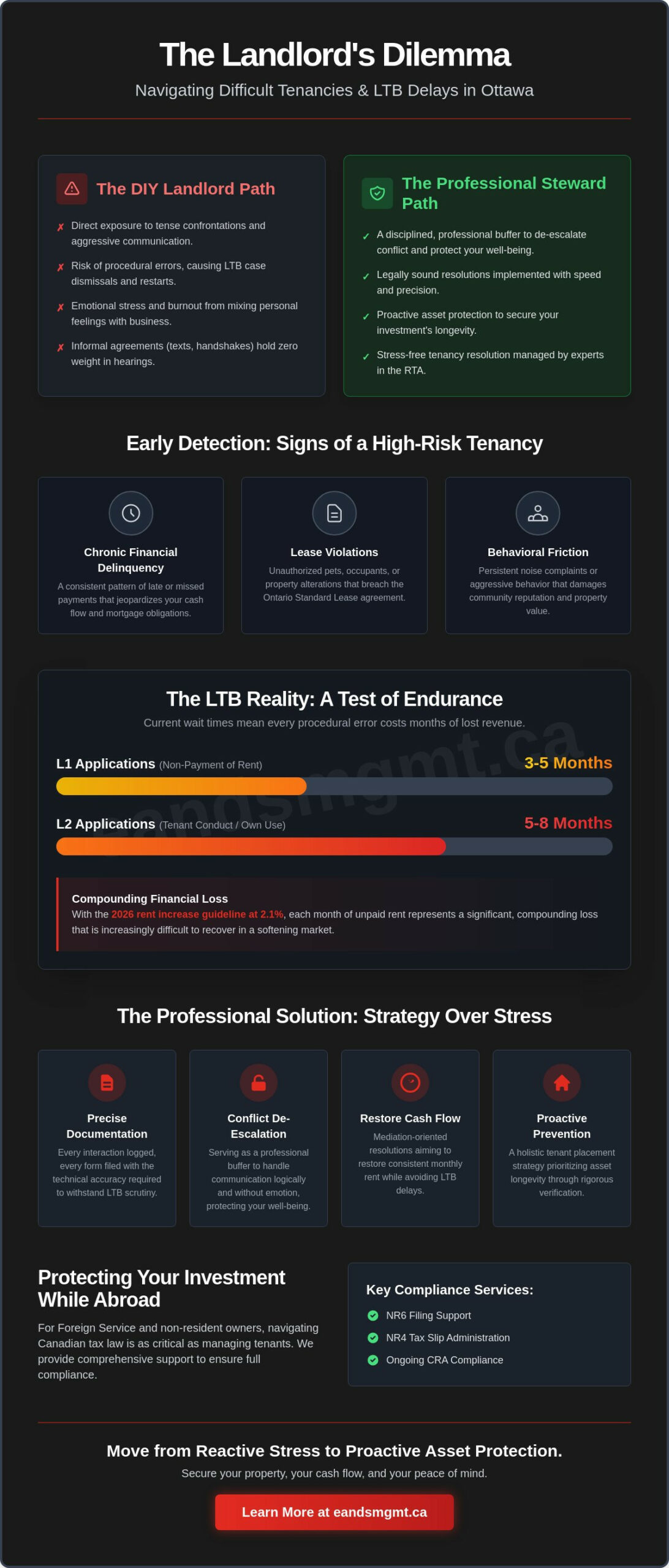
Early detection is the hallmark of a disciplined steward. High-risk tenancies often begin with subtle boundary-testing before escalating into full-scale delinquency. Professional oversight identifies these red flags before they become catastrophic.
- Chronic Financial Delinquency: This isn’t a one-time mishap. It’s a pattern of late payments that forces you to chase rent every month, impacting your own mortgage obligations.
- Lease Violations: Unauthorized guests or pets that violate the Ontario Standard Lease are common issues. These aren’t just house rules; they’re legal breaches that require formal documentation to address.
- Behavioral Friction: Persistent noise complaints or aggressive interactions with neighbours can ruin your reputation in an Ottawa community, potentially leading to municipal interventions or decreased property value.
The Escalation Cycle: Why Landlords Get Stuck
Many landlords find themselves trapped because they prioritize being “nice” over being professional. Handshake agreements and warnings sent via text message carry no weight during an LTB hearing. In fact, inconsistent enforcement of rules often encourages a difficult tenant to push further, knowing there are no immediate consequences. This is where the emotional toll peaks, as landlords feel personally disrespected in their own property.
Professional distance is your most valuable asset. By removing the emotional component from the interaction, you can maintain a high degree of professionalism while following the strict timelines required by the RTA. Without this buffer, the stress of direct confrontation often leads to burnout. Specialized property management for difficult tenants Ottawa is a necessity for those who value their time and long-term investment security.
Navigating the Ontario Landlord and Tenant Board (LTB) Framework
The Residential Tenancies Act (RTA) is designed with significant protections for tenants, often leaving landlords feeling at a disadvantage. In the current 2026 landscape, the reality of the Landlord and Tenant Board (LTB) is defined by persistent backlogs. While timelines have improved since their peak, you can still expect a wait of three to five months for L1 applications regarding non-payment of rent. Matters involving tenant conduct or “own use” evictions (L2 applications) currently face a five to eight month delay. In this environment, speed and administrative precision are your only defenses against mounting financial loss.
Documentation is the only currency that carries value in a hearing. The LTB is a formal tribunal where hearsay is dismissed and procedural errors lead to immediate case dismissal. If you miss a single deadline or miscalculate a notice period, you’re forced to restart the process from day one. Utilizing professional property management for difficult tenants Ottawa ensures that every interaction is logged and every form is filed with the technical accuracy required to withstand legal scrutiny. A disciplined steward doesn’t just manage the property; they manage the legal timeline to minimize your vacancy periods.
Essential Notices: N4, N5, and N7 Explained
Understanding which notice to serve is the foundation of a successful resolution. As of September 21, 2026, the notice period for an N4 (non-payment of rent) has been reduced from 14 days to 7 days. This change allows for faster filing, but the “day after” rule remains critical. If rent is due on the first, the notice cannot be served until the second. An N5 notice addresses damage or interference with reasonable enjoyment, requiring specific dates and times of incidents. For the most serious violations, such as illegal acts or safety threats, an N7 notice provides a shorter window for termination, though the evidentiary bar is exceptionally high.
The Importance of Flawless Administrative Filing
A single typo on a notice of termination can set your case back months and leave you vulnerable to the LTB’s increased fines, which doubled in 2026 to $100,000 for individuals. Professional managers act as your authorized representative, ensuring that payment plans are documented on official LTB forms as required by July 2026 regulations. We maintain a meticulous paper trail of every communication, inspection report, and warning. This structured approach removes the uncertainty of “he-said, she-said” disputes. If you’re struggling with a non-compliant tenancy, choosing a partner for full-service property management provides the administrative expertise needed to navigate these hurdles successfully.
Tactical Resolution: How Professional Managers Handle Conflict
Conflict resolution in property management requires a steady hand and a disciplined process. When a landlord manages their own property, interactions with a difficult tenant often become personal and emotionally charged. This emotional friction is where most legal mistakes occur. Professional property management for difficult tenants Ottawa replaces emotion with a structured communication protocol. By acting as a buffer, we transform volatile situations into objective administrative tasks, moving toward a resolution without the need for aggressive confrontation.
Mediation is our primary tool for resolving disputes before they escalate to the LTB. We work within the framework of Renting in Ontario: Your rights to ensure both parties understand their legal obligations. If a tenant is struggling with behavioral issues or property neglect, we provide a clear path to compliance through written expectations and follow-up. Our local network of Ottawa contractors allows us to assess damages rapidly, providing the objective evidence needed to hold a tenant accountable. We don’t just report problems; we apply a “resolution suffix” to every service, ensuring that a repair or a payment issue is tracked until it is fully resolved.
Professional Distance as a De-escalation Tool
A third-party presence fundamentally changes the tenant-landlord dynamic. Aggressive behavior that might be directed at an individual owner often dissipates when dealing with a professional firm. We implement standardized communication protocols that discourage hostility. Every interaction is recorded, and responses are delivered with clinical professionalism. This distance allows for firm rule enforcement without the risk of personal retaliation, which is essential for protecting your investment and your reputation in the community.
Regular Property Inspections: Catching Problems Early
Proactive stewardship relies on visibility. Regular property inspections are not just about finding damage; they are a signal to the tenant that the asset is being actively monitored. Quarterly walkthroughs allow us to identify signs of property neglect or unauthorized occupants before they become systemic issues. We use digital inspection reports to create a chronological record of the property’s condition. This documentation is invaluable if a dispute ever reaches the tribunal. It provides undeniable proof of the property’s state, making it much harder for a tenant to contest claims of damage or neglect. Effective property management for difficult tenants Ottawa focuses on prevention, ensuring that small issues don’t evolve into expensive legal battles.
Prevention as the Best Cure: The E&S Tenant Placement Strategy
While some agencies highlight high occupancy rates as their primary metric for success, a seasoned steward knows that a bad tenant is far more costly than a temporary vacancy. High occupancy doesn’t guarantee asset protection or financial security. Effective property management for difficult tenants Ottawa begins long before a lease is ever signed. It starts with a disciplined, data-driven approach to tenant selection that prioritizes reliability over speed. By leveraging over 40 years of local market knowledge, we identify subtle red flags that automated screening systems often miss.
Professional marketing serves as the first filter in this preventative process. By presenting a property with high-level photography and transparent, detailed descriptions, we attract a higher tier of applicants who value order and professional oversight. This proactive stewardship ensures that your property is occupied by individuals who respect both the physical asset and the legal framework governing their stay. We don’t just fill units; we place residents who contribute to the longevity of your investment.
The Multi-Step Screening Protocol
Our screening protocol is designed to be exhaustive and methodical. We look past the raw credit score to analyze the underlying financial health of every applicant. This includes verifying income stability through official documentation and calculating debt-to-rent ratios to ensure the tenancy is sustainable. Previous landlord verification is a non-negotiable step in our process. We speak directly with prior owners to confirm an applicant’s history regarding property care and payment consistency. The “interview” phase is equally critical. We assess how an applicant interacts during the showing and application stages, as a history of aggressive or evasive communication is a primary indicator of future friction.
The Ontario Standard Lease: Your Primary Defense
The Ontario Standard Lease is more than a formality. It is your primary legal defense. We ensure that every lease includes all mandatory legal disclosures and specific, LTB-compliant terms from day one. By setting clear expectations for maintenance responsibilities and communication protocols, we eliminate the ambiguity that difficult tenants often exploit. Professional execution of this document prevents “accidental” violations and establishes a baseline of accountability. If you want to secure your investment with high-quality residents and avoid the stress of poor placements, our Tenant Placement Service provides the meticulous oversight needed to build a stable rental portfolio.
Protecting Your Ottawa Investment While Living Abroad
Foreign Service and Department of National Defence members face a unique vulnerability when posted abroad. Managing a rental property from a different time zone is difficult under the best circumstances, but it becomes nearly impossible when a tenant becomes non-compliant. You cannot effectively oversee a legal dispute or conduct emergency inspections from a different continent. Professional property management for difficult tenants Ottawa acts as your local proxy, providing the physical presence required to enforce lease terms and protect your interests. We serve as the steady hand on the ground, ensuring that your investment remains secure even when you are thousands of kilometers away.
Distance often emboldens difficult tenants to push boundaries, assuming that an absent owner cannot respond quickly. Our team removes this operational burden by implementing disciplined communication and oversight. We provide the high-level consulting needed to navigate the complexities of the Ottawa market, ensuring that your property is not just occupied, but professionally stewarded. This localized expertise is a signature of our commitment to the specific needs of the National Capital Region, offering a level of security that DIY management simply cannot match.
CRA Compliance for Non-Resident Landlords
Non-resident owners are subject to strict Canadian Revenue Agency (CRA) requirements that demand meticulous administrative efficiency. Handling monthly tax withholdings and annual filings is a significant burden for expat landlords. We provide comprehensive NR6 and NR4 tax filing support, acting as your local agent for CRA accountability. By managing these filings, we help ensure you are taxed on net rental income rather than gross, which is essential for maintaining consistent monthly cash flow. This structured approach to financial reporting and accounting removes the risk of costly penalties and keeps your investment in good standing with federal authorities.
The Peace of Mind Guarantee
The transition from a stressed landlord to a passive investor is only possible when you have a dependable steward in place. Our emergency 24/7 maintenance response ensures that your asset is protected at all hours, regardless of your location. We provide a tailored resolution for every challenge, from urgent repairs to complex tenant mediation. This reliability is why we remain a preferred choice for Global Affairs and DND clients who require a high degree of professionalism. If you are ready to secure your property’s longevity and eliminate the chaos of remote management, contact E&S Property Management for a consultation to learn how our oversight can protect your Ottawa investment.
Restoring Stability to Your Ottawa Rental Portfolio
Managing a rental property shouldn’t be a source of constant friction. By implementing a disciplined approach to LTB compliance and maintaining professional distance, you can resolve tenant conflicts without the emotional toll of direct confrontation. Professional property management for difficult tenants Ottawa transforms your role from a reactive troubleshooter into a strategic investor. You’ve seen how rigorous screening and proactive stewardship prevent delinquency before it starts, ensuring your asset remains protected through every market cycle.
With over 40 years of localized expertise, E&S Management provides the steady hand needed to navigate complex tenancies and shifting regulations. We have a proven track record with Foreign Service and DND clients, offering specialized NR6 and NR4 tax filing support to maintain CRA compliance while you’re posted abroad. You don’t have to shoulder the administrative and legal burdens of property oversight alone. Our team is ready to apply the foresight and meticulous detail your investment requires.
Request a Professional Property Assessment from E&S Management to secure your asset’s longevity and restore your peace of mind. Your investment deserves the protection of a seasoned professional who values order, reliability, and long-term results.
Frequently Asked Questions
How do I legally evict a tenant for non-payment of rent in Ottawa?
To legally evict a tenant for non-payment, you must first serve an N4 notice. As of September 21, 2026, the notice period for rent arrears has been reduced to seven days. If the tenant doesn’t pay or move out within this timeframe, you can file an L1 application with the Landlord and Tenant Board. Utilizing professional property management for difficult tenants Ottawa ensures that these forms are filed with the technical accuracy required to avoid a dismissal due to administrative errors.
What should I do if my tenant is damaging my property?
You should immediately serve an N5 notice to address property damage or interference with the reasonable enjoyment of other residents. It’s vital to document the damage with high-resolution photos and obtain professional repair quotes from local contractors. If the tenant fails to remedy the damage or if the behavior continues, you can proceed with an L2 application. Regular property inspections are a key part of proactive stewardship, as they identify these issues before they escalate into major financial liabilities.
How long does the LTB process take in 2026?
Landlord and Tenant Board wait times in 2026 vary based on the specific nature of your application. L1 applications for non-payment of rent currently take between three and five months to reach a hearing. Matters involving tenant conduct or “own use” evictions, filed via an L2 application, typically face a longer delay of five to eight months. Because of these timelines, filing your paperwork correctly on the first attempt is essential to prevent losing additional months of rental income.
Can I manage a difficult tenant myself while living outside of Canada?
While it’s technically possible to manage a property from abroad, it carries significant legal and financial risks. Managing difficult tenancies requires a local presence for emergency maintenance, regular inspections, and representation at LTB hearings. Most non-resident owners, especially those in the Foreign Service, choose professional property management for difficult tenants Ottawa to provide a necessary buffer. Having a local steward ensures that rules are enforced and your asset is protected without the stress of remote confrontation.
What are the most common red flags during tenant screening?
Common red flags include inconsistent employment history, a refusal to provide previous landlord references, and evasive communication during the application process. We also look for applicants whose debt-to-rent ratio indicates future financial instability. A holistic screening process goes beyond a simple credit score to assess an applicant’s history of property care. Identifying these behavioral and financial markers early is the most effective way to secure the long-term health of your investment.
How much does property management cost for a single-family home in Ottawa?
Property management fees in Ottawa generally range from 8% to 12% of the monthly rent for full-service oversight. Some firms utilize flat-fee structures that range from $165 to $260 per month. Tenant placement services are typically a separate fee, often equivalent to 75% to 100% of one month’s rent. While these costs vary by provider, they represent a strategic investment in asset protection and the removal of the operational burdens associated with being a landlord.
Does a property manager handle CRA tax filings for non-residents?
Yes, a full-service manager handles the specific administrative requirements for owners living outside of Canada. This includes providing NR6 and NR4 tax filing support to ensure you remain compliant with CRA regulations. By managing monthly withholdings and annual reporting, we help you avoid penalties and ensure you are taxed on net income rather than gross. This level of financial reporting and accounting is essential for maintaining consistent, reliable cash flow while you are posted abroad.
What happens if a tenant refuses to leave after their lease expires?
In Ontario, a tenancy automatically converts to a month-to-month arrangement once the fixed term expires. You can’t force a tenant to leave simply because the lease has ended; you must have a valid legal reason under the Residential Tenancies Act, such as persistent non-payment or personal use of the unit. If a tenant refuses to leave after a valid notice of termination is served, you must file an application with the LTB to obtain a formal eviction order and wait for a scheduled hearing.