If your Ottawa tenant calls to say they’re moving out six months before the lease ends, is your first instinct to check your contract for a penalty fee? Many landlords feel a sense of panic when faced with an unexpected vacancy, especially when considering the current Landlord and Tenant Board hearing wait times that often range from six to ten months. It’s completely natural to worry about how you’ll cover the mortgage or if you’ll be left chasing unpaid rent for years. We understand that your property is more than just an asset; it’s a significant part of your financial security and your future.
This article clarifies the tenant breaking lease early Ottawa consequences so you can navigate this transition with confidence. You’ll discover why “lease break fees” are actually illegal under the Residential Tenancies Act and how the Duty to Mitigate works in a market where the vacancy rate has recently shifted to 3.0 percent. We’ll walk you through the essential differences between Form N11 and N9, ensuring you have a clear path to protect your income and maintain the value of your investment without the weight of unnecessary stress. By the end, you’ll have a professional roadmap for turning a potential legal headache into a manageable, orderly process.
Key Takeaways
- Learn why the Ontario Standard Lease terms take precedence over custom clauses, helping you avoid the stress of unenforceable penalty agreements.
- Gain clarity on tenant breaking lease early Ottawa consequences, including your right to recover actual out-of-pocket costs while the unit is vacant.
- Understand your legal Duty to Mitigate and the specific steps needed to demonstrate you’ve made a reasonable effort to find a new resident.
- Discover how professional management handles complex LTB forms and rapid re-marketing to transition your property back to a stable, income-generating state.
Understanding the Ontario Residential Tenancies Act (RTA) Framework
Managing a rental property in the capital requires a clear grasp of the provincial rules that govern every interaction between you and your residents. The Ontario Residential Tenancies Act (RTA) serves as the primary legal foundation for all residential tenancies in our province. It’s designed to provide a balanced framework, though many landlords often feel the system leans toward protecting the tenant. While this can feel overwhelming, especially when a resident suddenly decides to move, understanding these rules is the first step toward finding relief. The Landlord and Tenant Board (LTB) acts as the adjudicator for these matters, though current wait times for hearings often stretch between six and ten months. This delay highlights why it’s so vital to get your paperwork right from the very beginning.
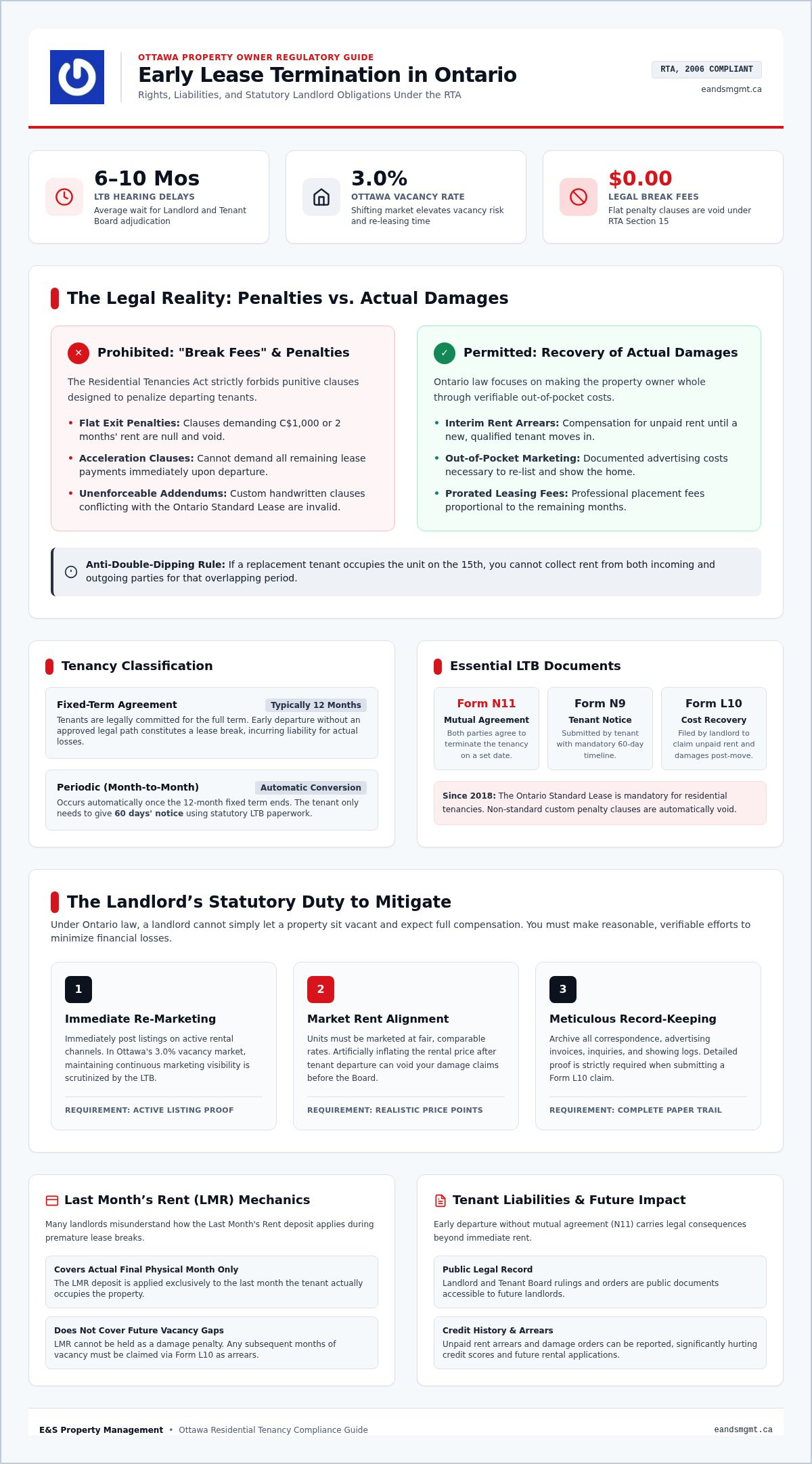
One common point of confusion involves the Ontario Standard Lease. Since 2018, almost all private residential tenancies must use this specific document. You might be tempted to add custom, handwritten clauses to protect yourself, but you should be cautious. If a custom term conflicts with the RTA, it’s generally considered void and unenforceable. This is particularly relevant when discussing tenant breaking lease early Ottawa consequences, as your rights are strictly defined by the Act rather than by a unique paragraph added to the end of a contract.
Fixed-Term vs. Periodic Tenancies
In Ontario, most tenancies begin as a fixed-term agreement, typically lasting 12 months. A common surprise for new landlords is that once this term ends, the lease doesn’t just expire. Instead, it automatically converts to a month-to-month, or periodic, tenancy under the same terms. During the fixed term, a tenant is technically committed to the full duration. Once it becomes periodic, they only need to provide 60 days’ notice using the correct LTB forms. Breaking a fixed term early is a more complex legal event than simply ending a monthly arrangement, and it requires a specific set of steps to ensure you aren’t left with a financial shortfall.
The Myth of the ‘Lease Break Fee’
We often see landlords try to include a flat penalty, such as C$1,000 or two months’ rent, to allow a tenant to walk away early. It’s a logical attempt to find certainty, but these charges are illegal in Ontario. Section 15 of the RTA makes most “exit fees” or acceleration clauses void. You cannot charge a penalty just for the act of leaving. However, you can seek “damages” for actual losses, such as unpaid rent while you search for a replacement or specific out-of-pocket marketing costs. The law focuses on making you whole again, rather than punishing the tenant for their transition.
Financial Consequences and Potential Liabilities for Tenants
When a resident decides to leave before their term is up, the financial ripples can be significant for both parties. In the eyes of the Ontario Residential Tenancies Act, 2006, a lease is a binding financial commitment. While you cannot charge a penalty fee, a tenant remains responsible for the rent until the day a new, qualified resident takes over the unit. This often means the Last Month’s Rent (LMR) deposit is applied to the final month they actually live in the home, but it doesn’t necessarily cover the gap if the property sits empty for several months afterward. In a market where the vacancy rate is currently 3.0 percent, finding a replacement may take longer than it did a few years ago, making the risk of a rental shortfall very real.
Calculating ‘Actual Damages’ for Landlords
Landlords can seek compensation for specific out-of-pocket expenses incurred due to the early departure. This includes the cost of advertising the vacancy and even prorated portions of professional leasing fees. However, it’s vital to remember that you cannot ‘double-dip.’ If a new tenant moves in on the 15th of the month, you cannot collect rent from both the outgoing and incoming parties for that same period. Keeping meticulous records of every receipt and communication is your best defense if you ever need to file an L10 application to recover these costs. These records serve as the proof required by the Landlord and Tenant Board to show that your losses were real and documented.
The Impact on Tenant Credit and Future Rentals
The tenant breaking lease early Ottawa consequences extend far beyond the immediate bank balance. If the LTB issues an order for rent arrears or damages, that record becomes a public document. Future property managers and landlords often use specialized databases to screen for these orders. An unpaid judgement can also be sent to collections agencies, which may severely impact a tenant’s credit score for years. We always advocate for a mutual agreement, such as an N11 form, rather than a ‘midnight move.’ It provides a clean break and protects everyone’s long-term interests. If you’re feeling overwhelmed by the logistics of re-renting, our tenant placement service can step in to handle the screening and transition for you. Taking a collaborative approach often yields the fastest relief and ensures your property value remains protected throughout the changeover.
Legal Paths for Breaking a Lease: Assignment vs. Subletting
When a resident’s circumstances change, they often look for legal options for ending a rental agreement before the fixed term expires. Understanding the difference between assignment and subletting is crucial for protecting your interests. An assignment is a permanent transfer of the lease to a new person, effectively releasing the original tenant from their obligations once the deal is done. Subletting, conversely, is a temporary bridge. The original tenant moves out for a set period but intends to return before the lease ends. In a sublet, the original tenant remains your primary legal and financial contact; if the subtenant misses a payment, you still look to the original tenant for the funds.
The Assignment Process in Ontario
The assignment process is the most common “clean break” for tenants in the Ottawa market. It begins when a tenant asks for your general permission to assign the unit. Under the RTA, if you refuse the idea of assignment generally, or if you fail to respond to the request within seven calendar days, the tenant gains the right to end the tenancy with only 30 days’ notice using a Form N9. This “7-day rule” is a common pitfall for unrepresented landlords. However, if you agree in principle, you still maintain the right to screen the specific “assignee.” You can, and should, apply your professional standards for credit, income, and references. While you cannot “unreasonably” refuse a candidate, you are entitled to ensure the new resident is as qualified as the one leaving. You may also charge the outgoing tenant for reasonable out-of-pocket expenses, such as the cost of a credit check, to process the application.
Form N11: The Power of Mutual Agreement
If you want to avoid the technicalities of assignment, the Form N11 is the gold standard for a stress-free transition. This is a mutual agreement to end the tenancy on a specific date. It represents a “meeting of the minds” and provides a level of legal finality that a one-sided notice like an N9 cannot offer. In the context of tenant breaking lease early Ottawa consequences, a signed N11 is often the best way to move from stress to relief. Landlords often agree to an N11 if the tenant helps find a high-quality replacement or if the market allows for a seamless handover. It allows both parties to part ways amicably, ensuring the property remains cared for until the very last day. This collaborative approach often prevents the need for future LTB hearings and keeps your rental history clean and professional.
The Landlord’s Duty to Mitigate Loss in the Ottawa Market
The moment a tenant hands back the keys prematurely, the clock starts ticking on your legal obligation to minimize the financial impact. Under Section 16 of the RTA, landlords have an affirmative duty to mitigate their losses. This means you cannot simply leave the unit vacant and expect the Landlord and Tenant Board to award you rent for the entire remaining term. Instead, you must act with reasonable diligence to find a new resident. When navigating the tenant breaking lease early Ottawa consequences, the LTB will closely examine whether you treated the vacancy with the same urgency as any other turnover. If the board finds you didn’t make a genuine effort, they may deny your claim for rent arrears from the date the tenant vacated.
Documenting Your Search for a New Tenant
To protect your claim, you need to treat your re-renting process like a professional audit. Mitigation is the active pursuit of a replacement tenant to stop financial bleeding. You should maintain a detailed log that includes the dates you posted advertisements, the platforms used, and a record of every inquiry or showing. It’s a common mistake to try and increase the rent significantly during this period; however, the LTB often views this as a failure to mitigate. To satisfy the “reasonable” standard, you should list the property at its current lawful rent. If the market has softened, you might even need to lower the price slightly to attract a qualified applicant quickly. Keeping every receipt for marketing costs and screening fees is essential for your eventual L10 filing.
Ottawa Market Realities in 2026
The speed of your mitigation efforts will be judged against the current local climate. With Ottawa’s overall vacancy rate rising to 3.0 percent, and nearly 7 percent for newer construction, units are staying on the market longer than in previous years. In high-demand suburban hubs like Kanata, where average rents have reached C$2,551, the pool of qualified applicants may be smaller than in central areas like Westboro or the Glebe. Seasonal trends also play a role; a vacancy in the middle of a January cold snap is much harder to fill than one in the spring. Leveraging professional networks and syndicated listing sites is often the most effective way to reach a broad audience fast. If you need support finding a reliable replacement, our Full-Service Property Management team handles the entire marketing and screening cycle to ensure your duty to mitigate is fully satisfied.
How Professional Management Protects Ottawa Property Owners
When a resident decides to leave, the administrative burden can feel like a second job. Between drafting legal notices and managing the Tribunals Ontario portal, the process is fraught with potential for technical errors that could delay your recovery of lost rent. Since 1981, we’ve acted as a stabilizing force for Ottawa landlords, turning these complex transitions into orderly, documented shifts. We handle the paperwork so you don’t have to face the 6 to 10 month LTB backlog alone. Our experience allows us to identify high-risk lease breakers during the initial screening, significantly reducing the likelihood of a mid-term exit before it ever begins.
Minimizing Vacancy Through Proactive Leasing
Re-marketing a property requires more than just a generic listing. We use professional photography and wide syndication across major platforms to ensure your home reaches the widest possible audience. Our approach is designed to satisfy the duty to mitigate by providing clear, evidentiary logs of active efforts to find a replacement. We often maintain a pre-vetted waitlist of qualified tenants ready to move into Ottawa’s most desirable neighborhoods. This proactive stance significantly reduces the financial impact of tenant breaking lease early Ottawa consequences. Learn about our Tenant Placement Service to see how we minimize your exposure to long vacancies through meticulous care and thoroughness.
Legal Compliance and Stress Reduction
For Foreign Service officers posted abroad, a lease break in Ottawa can feel like a crisis managed from across the globe. We act as your dedicated steward on the ground. Our team serves as a professional buffer, handling all negotiations and ensuring move-out inspections are conducted with the same thoroughness we apply to our own assets. We reconcile last month’s rent deposits and ensure every legal requirement of the RTA is met, providing you with the peace of mind that your investment is being shielded from similar pitfalls. By delegating these logistical burdens to a seasoned hand, you move from a state of anxiety to one of relief. Contact E&S Property Management to protect your Ottawa investment and ensure your property remains a stable, income-generating asset regardless of market shifts.
Securing Your Investment Through Every Transition
Facing a sudden vacancy is undoubtedly stressful, but you now have the tools to manage the transition with clarity and order. By understanding the legal framework of the RTA and your mandatory duty to mitigate, you can protect your financial interests while maintaining a professional relationship with your departing residents. Whether you choose a mutual N11 agreement or navigate the assignment process, remember that the goal is always a clean break that preserves your property’s value. Managing the tenant breaking lease early Ottawa consequences doesn’t have to be a solo burden; having a clear roadmap is the first step from anxiety toward total relief.
Since 1981, we’ve specialized in shielding landlords from these exact complexities. From our meticulous tenant screening that prevents mid-lease exits to our dedicated support for Foreign Service members posted abroad, we act as a protective guardian for your assets. You deserve a partner who handles the logistical cycles with seasoned authority and neighborly care. Protect your rental income with Ottawa’s seasoned property experts at E&S Property Management. We’re here to ensure your rental journey remains steady, predictable, and rewarding, no matter what changes come your way.
Frequently Asked Questions
Can a tenant break a lease early in Ontario without penalty?
While “lease break fees” are illegal in Ontario, tenants aren’t always off the hook. A tenant can legally leave early if you refuse an assignment request or if they use Form N15 for safety reasons. In most other cases, they remain liable for your actual financial losses until a replacement is found. We help you understand these tenant breaking lease early Ottawa consequences so you can distinguish between a legal exit and a breach of contract.
What happens if a tenant just moves out and stops paying rent in Ottawa?
This is considered abandonment of the unit. You must immediately take steps to “mitigate your losses” by advertising the property at a fair market rate. Once you’ve found a new resident, you can file an L10 application with the Landlord and Tenant Board to recover the unpaid rent and advertising costs. Our team often handles these stressful transitions for Foreign Service members, ensuring all evidence of your mitigation efforts is meticulously documented for the board.
Is a landlord required to accept an assignment of a lease?
You aren’t forced to accept a specific person, but your refusal has consequences. If you refuse the idea of assignment entirely, the tenant can end the lease with just 30 days’ notice. If you agree in principle, you can still screen the specific applicant. You may only refuse a candidate for valid, “reasonable” reasons, such as a poor credit history or insufficient income. We provide professional screening to ensure any new resident meets your high standards.
Can I charge my tenant for the cost of finding a new tenant if they leave early?
Yes, you can recover actual, reasonable out-of-pocket expenses. This includes the cost of credit checks for applicants or specific advertising fees required to fill the vacancy. You cannot, however, charge an arbitrary “administration fee” or a flat penalty for the inconvenience. Keeping detailed receipts is vital because the Landlord and Tenant Board requires proof of these damages before they will award you compensation during a hearing.
How long does it take to get an LTB hearing for a lease-break dispute in Ottawa?
Current wait times for a hearing at the Landlord and Tenant Board in Ottawa typically range from 6 to 10 months. This significant backlog is why many property owners prefer to reach a mutual agreement rather than waiting for a formal judgement. Because these delays can be financially draining, we focus on proactive tenant placement and clear communication to resolve disputes quickly and keep your rental income flowing without unnecessary interruptions.
What is an N11 form, and when should I use it?
An N11 is an “Agreement to End the Tenancy” that both you and your resident sign voluntarily. It is the most reliable way to ensure a tenant moves out on a specific date without the need for a hearing. You should use it when both parties agree to part ways, such as when a tenant needs to leave early and you’ve already found a qualified replacement. It provides a clean, certain break for everyone involved.
Does a tenant have to pay rent if the landlord hasn’t found a replacement yet?
Yes, a tenant is generally responsible for the rent until a new resident moves in or the fixed term expires. However, this liability only continues if you are actively and reasonably trying to re-rent the unit. If you don’t advertise the property or if you reject qualified applicants without cause, the tenant may not be required to pay for that period. We act as your steward to ensure your mitigation efforts are airtight.
Can a landlord refuse a sublet in Ontario?
You cannot “unreasonably” refuse a sublet request, but the rules are different than an assignment. In a sublet, the original tenant intends to return and remains fully responsible for the rent and any damages caused by the subtenant. You have the right to screen the subtenant just as you would any other resident. If the candidate doesn’t meet your standard screening criteria, you have a valid reason to decline that specific individual.