
Could a single administrative oversight in your tenant screening process jeopardize the long-term value of your entire investment? For many property owners, the reality of DIY landlord mistakes to avoid Ontario becomes clear only after a “professional tenant” exploits a loophole in the Ontario Standard Lease or a human rights violation leads to a costly LTB hearing. With Ontario apartment rents dropping 5.2% year-over-year as of April 2026, the margin for error has never been thinner.
We understand that managing your own rental can feel like a constant battle against evolving regulations and the fear of financial loss. You’re looking for a way to be a fair provider while ensuring your property remains a stable, profitable asset. This guide provides a clear framework to help you navigate the 2026 landscape with confidence and precision. You’ll learn how to master the new Bill 97 rent payment agreements, comply with the 2.1% rent increase guideline, and manage NR6 tax obligations if you’re living abroad. We’ll break down the ten most critical errors that lead to legal disputes so you can maintain order and protect your equity.
Key Takeaways
- Identify unenforceable clauses within the mandatory Ontario Standard Lease to prevent your rental agreement from being ruled void by the Landlord and Tenant Board.
- Navigate the specific service requirements for N1 notices and the “New Build” exemption to maximize your rental income within legal limits.
- Protect your investment from high-risk applicants by recognizing common DIY landlord mistakes to avoid Ontario during the tenant screening and Human Rights Code compliance process.
- Ensure your property meets Ottawa Municipal Code Chapter 629 standards to avoid fines related to vital services and asset maintenance.
- Evaluate the operational benefits of professional oversight for NR6 tax filing and emergency maintenance response versus the hidden costs of self-management.
The Ontario Standard Lease and the ‘Illegal Clause’ Trap
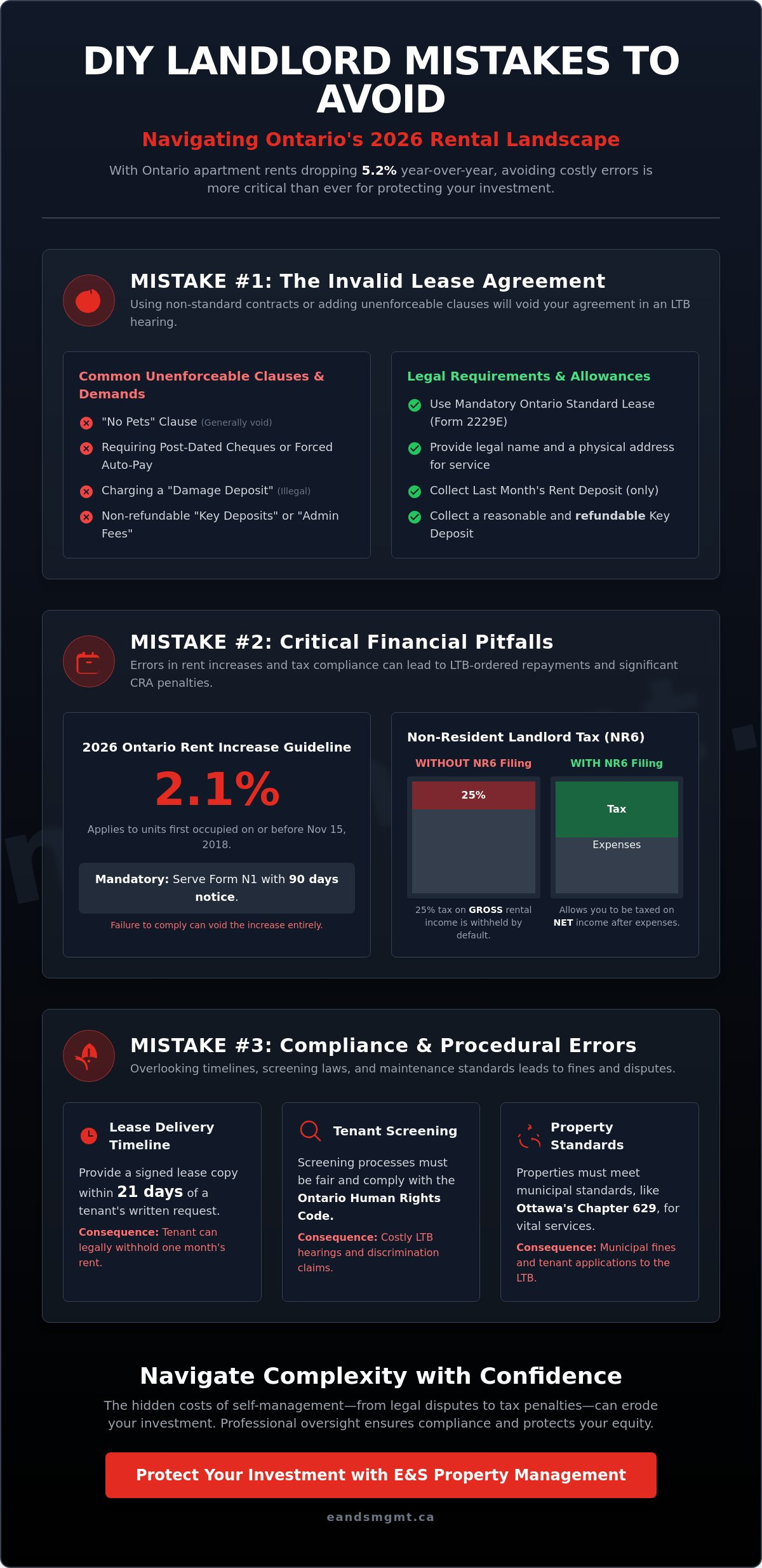
The Residential Tenancy Agreement (Standard Form of Lease) is the only legal framework for residential tenancies since 2018. Using a custom or outdated contract is one of the most significant DIY landlord mistakes to avoid Ontario. This document, officially known as Form 2229E, was designed to create a consistent standard across the province and protect both parties from predatory or confusing terms. By failing to use this specific form, you immediately put your investment at risk. In 2026, the Landlord and Tenant Board (LTB) continues to view non-standard agreements with high scrutiny, often allowing tenants to withhold rent or terminate a lease early if the landlord refuses to provide the mandatory form upon request.
Many property owners believe they can add “house rules” to protect their assets. However, Ontario’s Residential Tenancies Act, 2006 explicitly states that any clause contradicting the Act is void and unenforceable. For example, common “no pets” or “no guests” rules have no legal standing in most residential settings. If you attempt to evict a tenant based on these void clauses, the LTB will likely dismiss your application. This administrative friction creates unnecessary stress and financial loss. Achieving a stable lease-compliance resolution requires a strict adherence to the provincial standard without the clutter of illegal addendums.
Identifying and Removing Unenforceable Clauses
Financial demands are a frequent source of legal liability for DIY landlords. You cannot legally demand post-dated cheques or require a tenant to set up automatic rent withdrawals as a condition of the lease. While Bill 97, which takes effect on July 1, 2026, introduces new LTB-approved forms for rent payment agreements, it doesn’t permit landlords to force specific payment methods. Furthermore, “damage deposits” are strictly prohibited. You may only collect a rent deposit for the last month of the tenancy and a small, refundable key deposit. Any other fees, such as “administration charges” for moving in, are illegal and can be clawed back through the LTB at your expense.
The Mandatory Disclosure Requirement
Transparency is a core requirement of Ontario law. You must provide your legal name and a physical address for service within the lease. This ensures the tenant has a reliable way to deliver legal notices or maintenance requests. If you fail to provide a signed copy of the lease within 21 days of the tenant’s written request, the law allows the tenant to withhold one month’s rent. Professional oversight ensures these timelines are met, protecting your cash flow from preventable interruptions. In a market where Toronto one-bedroom rents have fallen 8.3% annually as of April 2026, maintaining a seamless relationship with your tenant is essential for asset longevity.
Financial Pitfalls: Rent Increases, Taxes, and NR6 Compliance
Maintaining the financial health of a rental property requires more than just collecting a cheque. In 2026, the Ontario rent increase guideline is set at 2.1%. Failing to adhere to this limit for units first occupied on or before November 15, 2018, is a frequent error. If you own a newer property, you may be exempt from this cap, but you must still provide the full 90-day notice using the correct Form N1. Miscalculating this notice period or serving the form incorrectly are common DIY landlord mistakes to avoid Ontario. These errors often result in the Landlord and Tenant Board (LTB) ordering a full repayment of the increased rent to the tenant, which can disrupt your annual budget.
For landlords living abroad, such as members of the Foreign Service or expats, the financial complexity increases significantly. The Canada Revenue Agency (CRA) requires a 25% withholding tax on gross rental income by default. This high percentage can severely impact your monthly cash flow if you’re paying a mortgage and maintenance costs. Implementing a dedicated tax resolution involves the proactive filing of an NR6 form. This document allows you to be taxed on net rental income after expenses, rather than the gross amount. Without professional Financial Reporting and Accounting, you risk significant penalties and interest from the CRA for non-compliance.
Navigating the Ontario Rent Increase Guidelines
Precision is essential when managing rent adjustments. You must serve the N1 notice at least 90 days before the increase takes effect. A single day’s error in the calculation can lead to a dismissal of your case at the LTB. It’s helpful to consult the official LTB Guide to the Residential Tenancies Act to ensure your service methods, such as mail or hand delivery, align with legal requirements. If you’ve completed major capital expenditures, you might consider an Above Guideline Increase (AGI). This process is rigorous and requires detailed evidence of costs and necessity to succeed in a professional consultation with the board.
The Non-Resident Landlord Tax Resolution
The role of a Canadian agent is vital for administrative efficiency when you are out of the country. This agent is responsible for withholding the correct tax and remitting it to the CRA on your behalf. The deadline to file a 2025 T1159 tax return for non-residents with an approved NR6 undertaking is June 30, 2026. Managing these filings while balancing a career abroad creates a heavy operational burden. By securing support for NR6 and NR4 tax filing, you ensure that your investment remains a source of steady income rather than a source of legal anxiety. This structured approach protects your assets and maintains your standing with federal tax authorities.
Screening Failures: Navigating the Ontario Human Rights Code
Relying on a “gut feeling” during the tenant selection process is a significant legal liability for property owners. In Ontario’s strict regulatory environment, personal intuition does not serve as a valid defense against discrimination claims. One of the most dangerous DIY landlord mistakes to avoid Ontario is failing to implement a standardized, objective screening protocol. This oversight often leaves owners vulnerable to the “professional tenant” profile. These individuals understand how to navigate the LTB system and may present polished credit reports that mask a history of non-payment or fraudulent documentation. A disciplined screening resolution requires looking beyond surface-level data to protect the long-term value of your asset.
The initial interview is where many landlords inadvertently cross legal boundaries. Asking about an applicant’s family plans, religious practices, or ethnic background can trigger a human rights complaint even if there was no intent to discriminate. You must focus strictly on the applicant’s ability to fulfill the terms of the lease. Maintaining a consistent set of questions for every candidate ensures that your process is transparent and defensible. This methodical approach is essential in a market where the national rental vacancy rate rose to 3.1% in 2025, increasing the pressure to fill units quickly without compromising on tenant quality.
Verification Beyond the Credit Score
Credit scores are an important metric, but they are not infallible. A professional-grade verification process involves cross-referencing employment letters with independent corporate searches to confirm the legitimacy of the employer. When checking references, you should distinguish between a “friend” posing as a landlord and a genuine property owner. Social media screening can provide factual context, but it must be handled with caution. You can use it to verify professional history, yet using it to judge lifestyle choices often leads to legal friction. Reliability is best confirmed through hard data and verified history rather than subjective online personas.
Compliance with Fair Housing Standards
The Ontario Human Rights Commission’s policy on rental housing prohibits discrimination based on source of income. This means you cannot reject an applicant simply because they receive Ontario Disability Support Program (ODSP) or Ontario Works (OW) benefits. While you are permitted to ask for income information, you cannot use a strict rent-to-income ratio as your sole screening criterion. The Ontario Human Rights Code takes precedence over a landlord’s personal preference in tenant selection. By adopting a Tenant Placement Service, owners can ensure their screening process meets all ethical and legal standards, effectively removing the operational burden of compliance while securing stable tenancies.
Maintenance Mismanagement and Ottawa Property Standards
Ottawa landlords must adhere to specific local bylaws that go beyond provincial mandates. Ottawa Municipal Code Chapter 629 dictates the minimum standards for property maintenance, ranging from structural integrity to the functionality of essential appliances. A common error among property owners is the failure to distinguish between “vital services” and general maintenance. In Ottawa, you’re legally obligated to ensure a continuous supply of heat, water, and electricity. Attempting to leverage these services during a tenant dispute is one of the most severe DIY landlord mistakes to avoid Ontario. Cutting off utilities or changing locks without an LTB order constitutes an illegal “self-help” eviction, which often leads to heavy administrative fines.
Confusion also persists regarding exterior upkeep. While many DIY leases include clauses requiring tenants to shovel snow or mow the lawn, the LTB typically views these as void unless they’re part of a separate, compensated service agreement. The primary responsibility for maintaining safe walkways remains with the owner. Neglecting these duties doesn’t just invite LTB friction; it creates significant liability for slip-and-fall accidents on your property.
Proactive Oversight vs. Reactive Repair
Maintaining a property requires a disciplined schedule of entry and review. Legal entry for non-emergencies requires a 24-hour written notice that specifies the date, time, and purpose of the visit. This process respects tenant privacy while allowing you to document the property condition. We recommend conducting thorough move-in and move-out inspections to establish a baseline for asset longevity. You must also understand the “Emergency Repair” threshold. If a vital service fails and you’re unavailable to provide a resolution, a tenant may be legally permitted to hire their own contractor and seek reimbursement through the board.
Ottawa-Specific Winter Obligations
Ottawa winters demand a specific maintenance strategy to ensure compliance with municipal standards. Local bylaws require landlords to maintain a minimum temperature of 21°C in all residential units from September 15 to May 31. Failure to meet this requirement can trigger inspections by municipal officers and subsequent work orders. Coordinating with local contractors who understand the unique demands of the capital region is essential for protecting your investment. To ensure your property remains compliant and safe throughout the season, consider securing an Emergency 24/7 Maintenance Response to handle urgent repairs before they escalate into legal liabilities.
The Management Gap: When to Move from DIY to Professional Resolution
Transitioning from a self-managed property to a professional management model is a strategic decision that prioritizes asset longevity. Many owners initially choose the DIY path to minimize overhead, yet they often overlook the true hourly cost of their own labor. Between managing LTB filings, coordinating with contractors, and staying current on the 2026 rent increase guidelines, the administrative burden is substantial. Identifying DIY landlord mistakes to avoid Ontario requires constant vigilance and specialized knowledge that most individual owners simply don’t have the capacity to maintain while balancing a separate career.
For landlords posted outside of Ottawa, the “Management Gap” becomes a matter of security. Relying on friends or family to handle emergency repairs or tenant disputes often leads to inconsistent results and legal friction. A professional resolution ensures that your property is managed with the same level of discipline as a commercial asset. This steady hand is essential for maintaining tenant retention in a market where Toronto one-bedroom rents have fallen 8.3% annually as of April 2026. A stable, well-managed property remains competitive even during periods of increased supply and declining market rents.
The ROI of Professional Property Management
Professional oversight delivers a measurable return on investment by reducing vacancy loss and preventing expensive emergency repairs. With the national rental vacancy rate rising to 3.1% in 2025, the speed and accuracy of a Tenant Placement Service are vital for maintaining cash flow. Furthermore, a 24/7 maintenance network ensures that minor issues are addressed before they escalate into structural damage. Moving your records from scattered spreadsheets to a professional client portal provides the administrative efficiency needed for accurate Financial Reporting and Accounting. This transition removes the chaos of uncertainty and replaces it with a predictable, logical framework for growth.
Partnering with E&S Property Management
E&S Property Management has a 40-year history of serving the specific needs of local Ottawa landlords and those serving in the Foreign Service abroad. We specialize in the complex NR6 and NR4 tax administration required for non-resident owners, ensuring all filings meet the June 30, 2026, deadline for net-basis taxation. Our approach is grounded in localized expertise and a commitment to protecting the ethical and financial standing of our clients. We act as the disciplined steward of your portfolio, providing regular property inspections and a methodical response to every operational challenge. Protect your investment with professional Ottawa property management and regain the peace of mind that comes from expert oversight.
Securing Your Rental Investment’s Future in Ontario
Successful property ownership in 2026 depends on a disciplined approach to legal and financial compliance. By mastering the mandatory Ontario Standard Lease and adhering to strict Human Rights Code screening protocols, you eliminate the most common DIY landlord mistakes to avoid Ontario. Protecting your asset also requires precise tax administration, especially for non-residents who must balance NR6 obligations with the daily demands of property oversight. These proactive steps ensure your investment remains a source of security rather than a liability while protecting the long-term value of your equity.
Since 1981, E&S Property Management has provided the steady hand needed to navigate these capital-region complexities. With over 40 years of local Ottawa expertise, our team provides specialized NR6 and NR4 tax compliance alongside a 24/7 emergency maintenance response network. This professional-grade oversight ensures your property remains a stable and profitable asset regardless of market fluctuations. Don’t let administrative burdens or legal uncertainty compromise your hard-earned investment. Request a Professional Rental Assessment for Your Ottawa Property today to secure a tailored resolution for your portfolio. We look forward to partnering with you to enhance the reliability and performance of your investment.
Frequently Asked Questions
Can I charge a security deposit for damages in Ontario?
No, you cannot legally charge a security deposit for damages in Ontario. The Residential Tenancies Act strictly limits deposits to the last month’s rent and a small, refundable key deposit. Any additional “damage” or “pet” deposits are considered illegal charges and can be recovered by the tenant through an LTB application. Avoiding these unauthorized fees is a key step in preventing DIY landlord mistakes to avoid Ontario that lead to administrative penalties.
How much notice do I need to give a tenant to move in myself?
You must provide at least 60 days’ written notice using an N12 form if you or a close family member intend to occupy the unit. This notice must coincide with the end of a rental term or the last day of a fixed-term lease. Additionally, you’re required to pay the tenant one month’s rent as compensation or offer them another acceptable unit before the termination date on the notice.
What happens if my tenant stops paying rent and the LTB is backed up?
You should serve an N4 notice for non-payment of rent immediately after the payment is missed. Under Bill 60 changes implemented in 2026, the notice period for non-payment has been reduced from 14 to 7 days. Even with backlogs, filing your L1 application through the Tribunals Ontario Portal as soon as the notice period expires ensures you’re in the queue for a hearing as early as possible.
Is it legal to ask for a tenant’s SIN during the application process?
You can ask for a Social Insurance Number for credit screening, but an applicant isn’t legally required to provide it. If they refuse, you must allow them to provide other forms of identification or credit history. Refusing to rent to someone solely because they won’t disclose their SIN could lead to a human rights complaint, so it’s best to use alternative verification methods whenever possible.
Am I responsible for shovelling snow at my single-family rental home?
The landlord is legally responsible for snow removal and lawn maintenance under provincial health and safety standards. While you can enter into a separate, compensated service agreement with the tenant to handle these tasks, you can’t make it a mandatory condition of the Residential Tenancy Agreement. In the capital region, Ottawa property standards require all exits and walkways to be kept clear of ice and snow at all times.
How do I legally evict a tenant for persistent late payment of rent?
You should serve an N8 notice for persistent late payment if a tenant consistently fails to pay on time. This process requires you to document a clear pattern of late payments over a period of several months. Unlike a non-payment eviction, an N8 focuses on the habitual breach of the lease terms, and you’ll need to provide a detailed ledger of payment dates during your LTB hearing.
What are the rules for entering a rental unit for an inspection?
You must provide at least 24 hours’ written notice before entering a unit for a non-emergency inspection. The notice must specify the date and a time window between 8:00 a.m. and 8:00 p.m., along with a valid reason for entry. Conducting Regular Property Inspections is a methodical way to protect your asset’s condition while ensuring you remain compliant with the tenant’s right to privacy.
Do I need to file an NR6 form every year if I live abroad?
Yes, you must submit a new NR6 undertaking to the CRA every year before the first rent payment is due or by January 1st. This annual filing allows your Canadian agent to withhold tax on your net rental income rather than the standard 25% of gross rent. Consistent filing is essential for non-residents to maintain cash flow and ensure administrative efficiency throughout the tax year.


