
What if the time you spend managing your own rental is actually devaluing your investment more than any professional fee ever could? Many Ontario property owners choose the DIY route to maximize their margins, yet they often find themselves losing weekends to tenant disputes and paying full retail prices for emergency repairs. These immediate burdens are just the surface of the hidden costs of self-managing a rental property in 2026. It’s a common trap where the pursuit of short-term savings leads to long-term capital erosion and unnecessary operational stress.
You deserve a passive ownership experience that prioritizes asset longevity and administrative efficiency. This guide demonstrates why professional oversight often secures a higher net rental income than self-management while protecting you from the financial risks of Ontario Landlord and Tenant Board delays, where a single L1 application now costs $186 to file online. We will analyze the impact of the 2.1% rent increase guideline, the complexities of the June 30, 2026, T1159 tax filing deadline for non-residents, and how a structured maintenance resolution strategy preserves your capital in a shifting market.
Key Takeaways
- Identify the “un-invoiced liabilities” that diminish your ROI beyond obvious out-of-pocket expenses.
- Calculate the true daily impact of vacancy in the Ottawa market and learn to bypass the retail pricing premiums common in emergency maintenance.
- Evaluate the financial risks associated with LTB backlogs and discover how to mitigate the hidden costs of self-managing a rental property through professional tenant placement.
- Navigate complex CRA compliance requirements for non-resident landlords, including the strategic use of NR6 and NR4 filings.
- Transition from active administration to passive stewardship by leveraging professional oversight to maximize your net rental returns.
The False Economy of DIY Property Management
Many investors view property management fees as a simple deduction from their monthly bottom line. This perspective often ignores the False Economy of DIY Property Management. There’s a fundamental difference between out-of-pocket expenses, such as a physical repair invoice, and economic costs, which include your lost time and the gradual devaluation of your asset through reactive oversight. In the current landscape, the hidden costs of self-managing a rental property usually manifest as un-invoiced liabilities. These are risks you carry silently until they crystallize into a significant financial loss, such as a prolonged vacancy or a complex legal dispute.
Transitioning from a hobbyist mindset to a professional asset manager requires a shift in how you value your own labor. If you spend ten hours a month handling administrative tasks, you’re effectively paying yourself a high wage to perform clerical work that could be handled more efficiently by a specialized partner. A disciplined steward treats the property as a high-performing asset that requires foresight and methodical oversight to maintain its market value and net yield.
The Anatomy of a Hidden Cost
Direct costs are visible and easy to track. Opportunity costs are the invisible leaks in your investment portfolio. When you lack a professional network, you pay a “convenience premium” for emergency repairs, often at full retail rates. Small errors in tenant selection also compound over time. A single month of vacancy or a tenant who fails to report minor leaks can cost thousands in lost revenue and capital repairs over a five-year period. Professional management mitigates these risks through regular property inspections and established vendor relationships that prioritize asset longevity.
Ottawa Market Dynamics in 2026
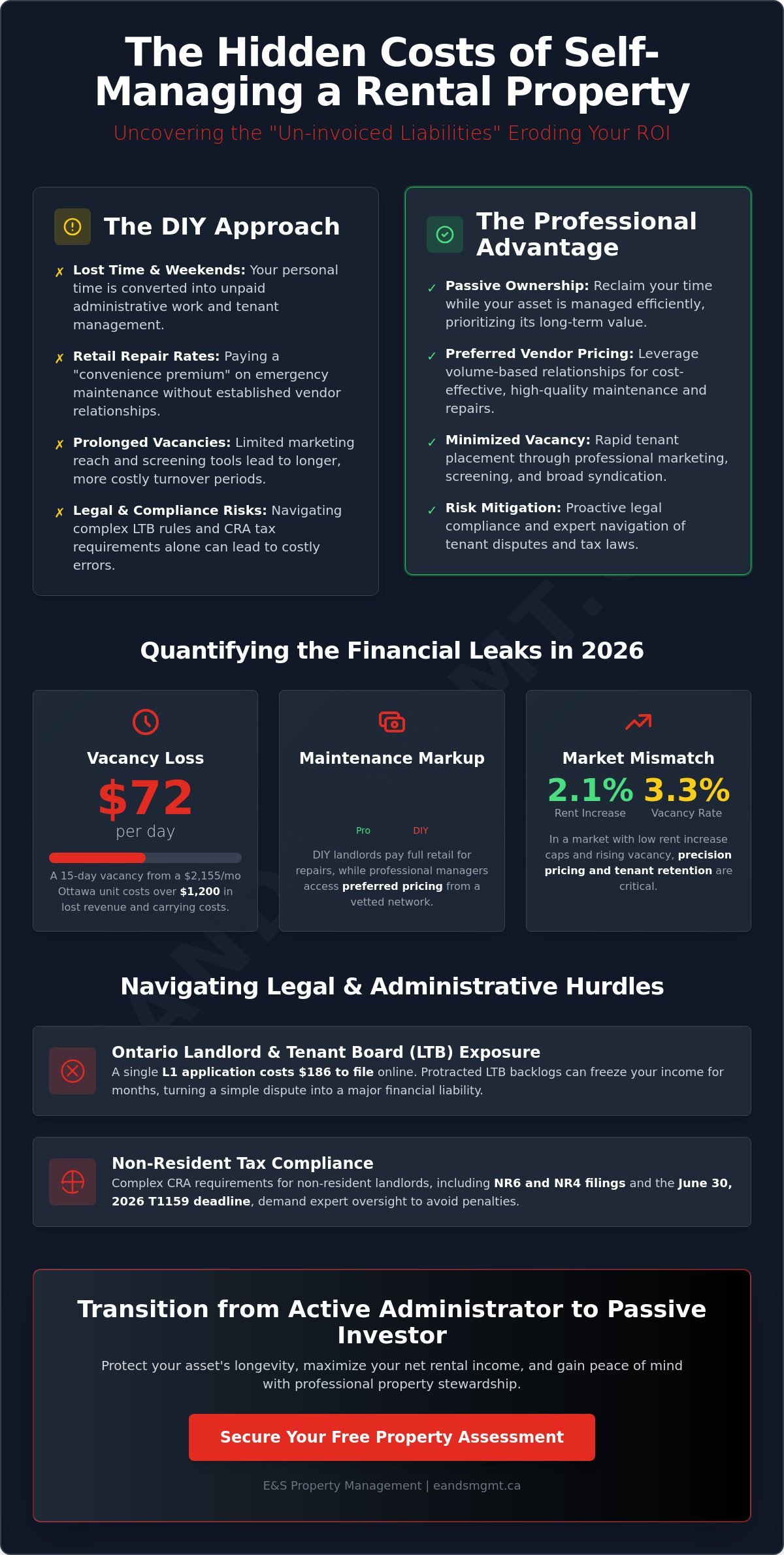
The 2026 Ottawa market presents specific challenges that make DIY management riskier than in previous years. With the Ontario rent increase guideline set at 2.1% and regional vacancy rates trending near 3.3%, precision in pricing and tenant retention is vital. You can’t afford to miscalculate the market rate during a turnover. Modern tenants in the capital region also expect a high level of professional communication and rapid maintenance resolution. Meeting these expectations is difficult for a solo landlord but remains essential for maintaining a stable, passive income stream and protecting your ROI.
Quantifying Vacancy Leaks and Maintenance Premiums
Every day a rental unit sits empty in Ottawa, the owner loses more than just potential income. Based on 2025 data, a two-bedroom apartment in Ottawa commands an average turnover rent of $2,155. This translates to a daily loss of approximately $72 in gross revenue. When you add carrying costs such as property taxes, insurance, and utility base rates, a 15-day delay in tenant placement can easily cost an owner over $1,200. These are the sharpest hidden costs of self-managing a rental property. DIY marketing often relies on amateur photography and limited listing visibility, which extends these vacancy windows compared to professional multi-platform syndication.
Property owners who manage their own assets often fall into the trap of reactive maintenance. This approach usually results in “band-aid” fixes that mask underlying issues rather than resolving them. Over time, these temporary solutions lead to significant capital expenditures that could have been avoided. A disciplined approach to asset stewardship involves moving away from emergency coordination and toward a structured maintenance resolution that preserves the building’s envelope and internal systems.
The High Cost of an Empty Unit
The 2026 forecast for Ottawa suggests a vacancy rate of roughly 3.3%. While demand remains present, tenants have become more selective about the quality of their housing. DIY landlords often lose 15 to 30 days of rent because they lack the tools to screen and place tenants rapidly. Professional placement services use high-resolution imagery and broad listing distribution to ensure the property reaches the widest possible audience. This efficiency doesn’t just save time; it directly protects your net annual yield by minimizing the time the unit remains non-productive.
The Maintenance “Markup” for DIY Landlords
DIY landlords frequently pay a “maintenance markup” because they lack the volume-based relationships held by professional firms. Contractors typically charge retail rates for one-off service calls. In contrast, a professional manager leverages a vetted network of licensed trades who provide preferred pricing due to the consistent volume of work. Using unvetted or unlicensed handymen to save money often backfires, creating liabilities if the work isn’t to code or if an injury occurs on-site.
Maintaining a property also requires strict adherence to the Legal Exposure and the Ontario Landlord and Tenant Board rules regarding maintenance standards. Failure to provide timely repairs can result in rent abatements or legal penalties. For owners who want to stabilize their operational expenses, a full-service property management strategy provides regular property inspections that identify $100 problems before they turn into $10,000 disasters. This proactive oversight is the most effective way to eliminate the emergency surcharges associated with after-hours DIY repair coordination.
Legal Exposure and the Ontario Landlord and Tenant Board
The legal landscape for Ontario landlords is increasingly complex, making the hidden costs of self-managing a rental property a significant risk for the unprepared. As of May 2026, the Landlord and Tenant Board (LTB) continues to struggle with backlogs that can result in six-month delays for standard eviction hearings. A single L1 application to evict for non-payment costs $186 when filed online, but the true expense is the lost rent during the waiting period. If your monthly rent is $2,155, a half-year delay translates to over $12,900 in gross revenue loss, excluding the $1,500 to $3,000 typically required for professional LTB representation.
Navigating the Residential Tenancies Act (RTA) without a specialized background is a high-stakes gamble. Many owners believe that using the Ontario Standard Lease is enough to ensure compliance, but this document is only the baseline. Improperly served notices of entry or illegal rent increases, even if accidental, can lead to costly rent abatements and administrative fines. The financial impact of a “Professional Tenant” is one of the most significant hidden costs of self-managing a rental property today. These individuals exploit procedural loopholes to live rent-free while the legal system slowly grinds toward a resolution.
The “Bad Tenant” Price Tag
A problematic tenancy costs much more than just unpaid rent. By the time an eviction is executed, owners often face legal fees and significant property damage that exceeds the initial security deposit. DIY screening processes that rely solely on basic credit checks are no longer sufficient to identify sophisticated risks. A rigorous Tenant Placement Service provides a layer of defense by verifying employment, conducting deep-dive reference checks, and analyzing rental history. This proactive oversight is essential for maintaining a stable, passive income stream and avoiding the chaos of the LTB system.
Regulatory Compliance and Liability
Regulatory compliance extends far beyond the lease agreement. Self-managing landlords often fall into “hidden legal traps” in their advertising, accidentally violating the Human Rights Code through restrictive language. In Ottawa, strict fire code and safety standards require consistent monitoring and documentation. Failure to keep accurate records of smoke detector tests or carbon monoxide alarm maintenance can result in severe liability if an incident occurs. Professional management ensures that every notice, inspection, and interaction follows a methodical, logical framework that protects the owner from litigation and ensures full legal compliance.
The Administrative Burden and Non-Resident Tax Compliance
The “paperwork tax” is a silent drain on a landlord’s productivity. It encompasses the cumulative hours spent on accounting, receipt management, and year-end reporting. These administrative tasks represent a significant portion of the hidden costs of self-managing a rental property, especially when errors lead to audit risks. For non-resident landlords, the stakes are even higher. The Canada Revenue Agency (CRA) requires a 25% withholding tax on gross monthly rental income, which must be remitted by the 15th of the following month.
Without professional intervention, this 25% gross withholding can cripple your monthly cash flow. A disciplined administrator utilizes the NR6 election, which allows the withholding to be calculated based on net rental income instead. This process requires precise monthly tracking and the issuance of NR4 slips. For the 2025 tax year, the deadline to file the T1159 return is June 30, 2026. Missing this date or failing to remit withholdings correctly results in compounding interest and penalties that far exceed the cost of professional oversight.
Managing from a Distance: The Expat Challenge
Foreign Service officers and expats often face the temptation to let a friend or family member oversee their property. This approach is a liability. Personal contacts lack the professional distance required to enforce lease terms or coordinate emergency maintenance resolution effectively. A three-hour delay in responding to a burst pipe because of time-zone differences can turn a minor repair into a major insurance claim. Professional oversight ensures your home remains a stable asset rather than a source of international stress. If you are posted abroad and require specialized assistance, our team provides comprehensive NR6 and NR4 tax filing support to ensure your investment remains fully compliant.
Financial Reporting as a Profit Tool
Precise financial reporting and accounting do more than just satisfy the CRA; they serve as a tool for asset optimization. Monthly statements provide a clear digital paper trail of all property interactions and deductible expenses. This transparency simplifies your annual filing and ensures you maximize your net income by capturing every eligible deduction. Instead of searching through emails for repair receipts, you receive a structured report that reflects the true performance of your investment. This methodical approach removes the chaos of tax season and provides the stability institutional investors expect.
Strategic Asset Stewardship with E&S Property Management
Professional oversight isn’t a simple expense; it’s a strategic investment in asset longevity. E&S Property Management has spent 40 years protecting rental investments in the Ottawa region, providing the steady hand necessary to navigate a shifting market. By neutralizing the hidden costs of self-managing a rental property, we ensure that your investment remains a source of passive income rather than a full-time operational burden. Our approach focuses on maximizing your net rental income through disciplined administration and rigorous cost control.
We provide specialized support for Foreign Service and DND members who face the unique challenge of managing Canadian assets from abroad. These owners require more than just a passive administrator; they need a disciplined steward capable of maintaining full legal and tax compliance in their absence. Transitioning from a DIY approach to professional oversight is a methodical and seamless process. We handle the intake of existing documentation, coordinate with current tenants, and implement a structured resolution framework designed to stabilize your property from day one.
The E&S Resolution Framework
Our operational model is built on foresight and results. We provide a comprehensive suite of services that addresses the specific pain points of modern landlords:
- Proactive Maintenance Resolution: We conduct regular property inspections to identify and resolve minor issues before they escalate into major capital expenditures.
- Rigorous Tenant Placement: Our screening process goes beyond basic credit checks to ensure consistent cash flow and protect the physical integrity of your asset.
- Full-Service Compliance: We provide transparent financial reporting and accounting, including essential NR6 and NR4 tax filing support for non-resident owners.
- Emergency Response: Our 24/7 maintenance response ensures that your property is protected at all times, removing the need for you to coordinate repairs during evenings or weekends.
Next Steps for the Savvy Landlord
The first step toward professional stewardship is a realistic assessment of your current operational efficiency. We invite you to request a professional rental assessment of your Ottawa property to determine its true market yield. Compare your current DIY time-log and out-of-pocket repair costs against a professional management fee. You’ll likely find that the economic cost of your personal labor and the retail premiums you pay for maintenance far exceed the cost of expert oversight. If you’re ready to secure your ROI and enjoy a truly passive ownership experience, Contact E&S today for a tailored management proposal. Our team is ready to provide the reliability and order your investment deserves.
Securing Your Rental Investment ROI
Choosing to oversee your own assets often feels like a cost-saving measure until the un-invoiced liabilities of vacancy and legal exposure materialize. We’ve analyzed how the hidden costs of self-managing a rental property can erode your net income through retail maintenance premiums and complex CRA tax penalties. Shifting from a reactive DIY mindset to a structured stewardship model protects both your time and your capital.
E&S Property Management brings over 40 years of residential expertise to the Ottawa region. Our team provides the stability of specialized NR6 and NR4 tax administration and the security of 24/7 emergency maintenance coordination. This methodical approach ensures your property remains a high-performing asset while you enjoy a truly passive ownership experience. You don’t have to navigate the complexities of the rental market alone.
Protect Your Investment – Get a Free Management Quote
Your path to a stress-free investment begins with a professional partnership built on order and foresight. We look forward to helping you maximize your property’s potential.
Frequently Asked Questions
Is property management tax deductible in Ontario?
Yes, professional property management fees are a fully deductible business expense for rental property owners in Ontario. These costs are subtracted from your gross rental income on your annual tax return, which effectively lowers your net taxable income. By leveraging professional oversight, you reduce your tax liability while ensuring your asset receives disciplined, expert care that preserves its long-term market value and operational efficiency.
How much do property management companies in Ottawa typically charge?
Industry averages for property management in Ontario typically range from 6% to 12% of the monthly rental income. For a unit commanding $2,500 per month, this represents a monthly fee between $150 and $300. Additionally, tenant placement services often involve a separate fee ranging from 50% to 100% of one month’s rent. These costs provide a structured resolution for marketing, screening, and ongoing administrative tasks.
What is the cost of a bad tenant in 2026?
A problematic tenancy can result in a total financial loss exceeding $15,000. This includes approximately $12,900 in lost rent during a standard six-month LTB delay, the $186 L1 application fee, and potential legal representation costs between $1,500 and $3,000. These figures don’t include the expense of physical property damage, which often exceeds the initial deposit, making rigorous tenant placement a critical safeguard for your ROI.
Can I manage my rental property while living outside of Canada?
While technically possible, managing from abroad introduces significant hidden costs of self-managing a rental property. Time-zone differences delay emergency maintenance response, and non-resident landlords face strict CRA withholding requirements. Without a local representative to conduct regular property inspections and handle NR6 or NR4 filings, you risk both physical asset deterioration and severe tax penalties. Professional stewardship ensures your investment remains passive and fully compliant with Canadian regulations.
What are the penalties for not filing an NR6 form as a non-resident landlord?
Failure to file an approved NR6 form requires you to remit 25% of your gross rental income to the CRA by the 15th of every month. If you miss this deadline or fail to remit the correct amount, the CRA applies compounding interest and penalties. Filing the NR6 allows you to withhold 25% of your net income instead, significantly improving your monthly cash flow and ensuring you meet the June 30, 2026, T1159 filing deadline.
How does a property manager reduce vacancy rates in Ottawa?
Professional managers utilize multi-platform listing syndication and high-resolution photography to reach a broader audience than DIY landlords. With Ottawa vacancy rates projected near 3.3% in 2026, rapid placement is essential to minimize revenue leaks. A structured tenant placement service identifies qualified applicants quickly, reducing the standard 15 to 30 days of unnecessary vacancy often seen in self-managed properties and ensuring your unit remains a productive asset.
Do I need a property manager if I only have one rental unit?
Owners of single units often face the highest risks because they lack the portfolio diversity to absorb a major loss. The hidden costs of self-managing a rental property, such as a single LTB dispute or an emergency after-hours repair, can eliminate several years of net profit. Professional oversight provides the same level of administrative efficiency and legal protection enjoyed by institutional investors, making it a vital tool for individual owners.
What happens if my tenant stops paying rent and I am self-managing?
You must immediately serve the appropriate legal notice and file an L1 application with the Landlord and Tenant Board. In 2026, wait times for hearings remain significant, often extending to six months. During this period, you remain responsible for all carrying costs, including taxes and utilities. Professional management mitigates this burden by ensuring all paperwork is filed with methodical precision, preventing procedural errors that could cause further delays in the eviction process.


