
What if the conversation about hiring a property manager isn’t about who’s right, but about what works for both of you? If you’re asking, “how to convince my spouse we need a property manager,” you may be handling most of the tenant calls, maintenance coordination, or paperwork while your spouse is concerned about cost or losing control. Those concerns can coexist, and neither partner needs to be blamed for the strain.
Managing an Ottawa rental yourselves gives you direct oversight, but it also takes time and attention. Professional management has a fee, while taking routine responsibilities off your household’s plate. The right choice depends on your shared priorities, available time, and comfort with handling the day-to-day work together.
This article will help you make a calm, practical case without pressuring your spouse. You’ll compare self-management with professional support, identify the responsibilities causing the most stress, and weigh the trade-offs against your goals. Then you can agree on a clear next step, whether that’s exploring management or setting a date to revisit the decision.
Key Takeaways
- Start with your shared goal of protecting the property and keeping ownership manageable, rather than assigning blame.
- Track tenant messages, rent follow-up, inspections, and repair coordination to understand how the workload is divided.
- Compare self-management and professional support using the priorities that matter to both of you, including time, oversight, and communication.
- Make your case through a calm discussion about actual responsibilities, not pressure or assumptions.
- Consider whether distance, limited availability, or recurring tasks make professional support practical for your Ottawa rental.
How to Convince Your Spouse You Need a Property Manager: Start With Their Concern
Begin with what you both want: to protect the property and make ownership manageable. That shared goal can keep the conversation from becoming a debate about who does more or who understands rental ownership best. The question isn’t whether one partner is right; it’s whether your current approach still works for your household.
Before making a case for professional help, ask what gives your spouse pause. Is it the management fee, a concern about losing control, uncertainty about how the work would be handled, or a preference for dealing with tenants personally? Each concern calls for a different discussion. If cost is the issue, compare the fees with the actual tasks and time involved. If control is the concern, talk about which decisions you would retain and how you would receive updates.
Property management generally involves coordinating responsibilities such as tenant relations, rent collection, maintenance, and oversight. The Wikipedia article on Property Management offers a broader overview of the field. In practice, hiring a manager means delegating agreed day-to-day work, not giving up ownership or every decision about the property.
What might make your spouse hesitant about hiring a manager?
Invite your spouse to name their main concern before you present reasons to hire someone. Listen for whether it’s about cost, control, or confidence in how the work will be handled. Self-management can make sense when both partners have time, are comfortable with tenant communication and repairs, and agree on how to divide the responsibilities. Acknowledging that keeps the discussion focused on fit, not on selling one outcome.
You might ask, “What part of bringing in a manager feels like the biggest downside to you?” Reflect their answer before responding. If they’re worried about cost, take that seriously. If they value direct tenant contact, ask which parts they want to keep handling. The goal is to understand the concern accurately, not find a quick way around it.
How to set a shared goal for the rental
Agree on what you want the rental to support. For example, you may both want the property kept in good condition and tenant issues handled reliably, while protecting time for work or family. Make those priorities specific enough to guide a decision, while recognizing that each partner may weigh them differently.
Next, list the recurring responsibilities and who currently handles them. Include tenant messages, rent follow-up, inspections, repair coordination, and administrative tasks. Note how often each comes up and whether the work is predictable or interrupts other plans. This is not a scorecard; it’s a clear picture of your current arrangement.
Finally, define what a good outcome would look like for both of you. One partner might want fewer interruptions, while the other wants visibility into property decisions. You could agree that the next step is simply to compare options against those priorities, not to commit to hiring immediately. That shared process is a practical starting point for how to convince my spouse we need a property manager without blame or pressure.
Build a Property-Management Case From Your Actual Workload
A fair discussion is easier when it’s based on what managing the rental actually involves, rather than what either partner remembers from a stressful moment. Keep a shared log for a set period. Record the task, who handled it, how long it took, and whether it was planned or interrupted something else. The goal isn’t to prove one person works harder. It’s to make the workload visible enough to assess.
Make invisible landlord tasks visible
Include routine administration as well as repair calls. Note tenant questions, rent follow-up, inspection arrangements, vacancy tasks, maintenance scheduling, and record keeping. Use real examples from your recent experience, even if each entry is brief. A single message may take only minutes, but repeated messages and repair coordination can add up or interrupt a workday.
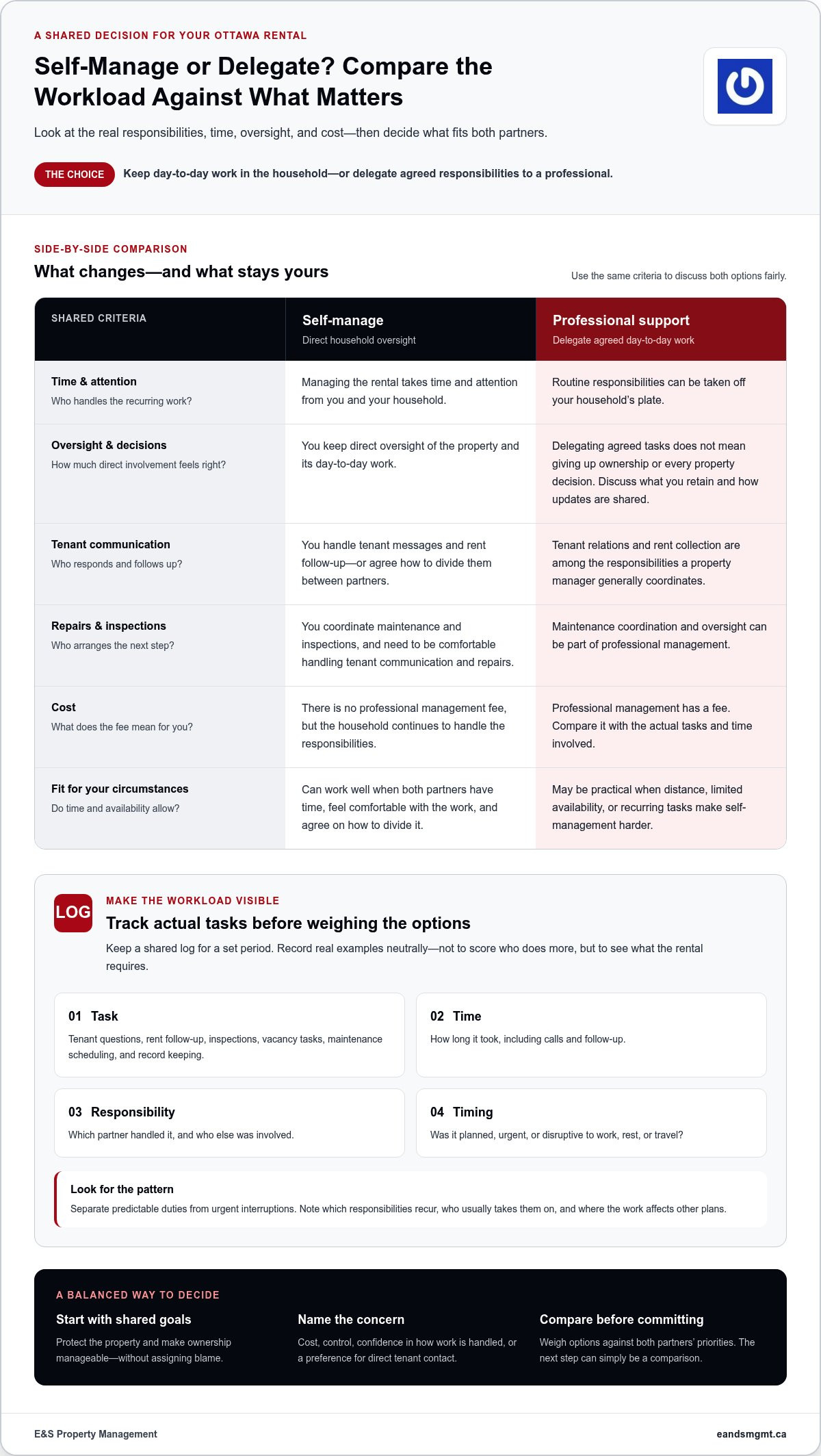
- Task: What needed to be done?
- Time: How long did the work take, including calls or follow-up?
- Responsibility: Which partner handled it, and who else was involved?
- Timing: Was it planned, urgent, or disruptive to work, rest, or travel?
Separate predictable duties, such as organizing records or arranging an inspection, from urgent matters that arrive without warning. This shows not only the hours involved, but also how much flexibility your current arrangement requires. At the end of the tracking period, summarize the pattern in a few neutral sentences: which responsibilities recur, who usually takes them on, and where interruptions create friction.
Consider distance, availability, and Ottawa property needs
Time and location can change how manageable the same workload feels. Note when work travel, an overseas posting, or limited availability affects who can respond or coordinate the next step. Canadian Foreign Service members serving abroad, for example, may have different day-to-day needs from owners living near their Ottawa rental. Record your circumstances rather than assuming every property has the same demands.
Include seasonal or urgent property matters when they apply to your home, and distinguish tasks you’ve actually handled from issues you’re concerned might arise. For legal or compliance questions, verify the requirements that apply to your Ontario rental before treating them as part of the workload. A U.S. government document such as the IRS guidelines on Personal Property Management describes an internal federal context, not Canadian landlord requirements, so it isn’t a compliance guide for an Ottawa property.
This record gives you a grounded starting point for how to convince my spouse we need a property manager: discuss the actual time, interruptions, and division of responsibilities, then decide together whether your current system is sustainable. If your notes point toward needing more structured day-to-day support, explore how Ottawa residential property management can coordinate landlord responsibilities.
Compare Self-Managing With a Property Manager Using Shared Criteria
Use your workload log to compare both approaches against the same priorities. A property manager doesn’t automatically take every decision off your hands, and self-management doesn’t require splitting every task equally. Talk through what each of you would still handle, what you would delegate, and how you’d stay informed. The aim is to compare practical arrangements, not an idealized version of either option.
Time
Self-managing: You and your spouse set aside time for tenant communication, rent follow-up, inspections, and repairs. Decide who is available when tasks arise.
With a manager: Day-to-day coordination is delegated according to the agreed service scope. You’ll still need time to review updates and make owner-level decisions.
Responsibility
Self-managing: You organize each task between you, including record keeping and follow-up.
With a manager: Services can include tenant placement, rent collection, inspections, and maintenance coordination. Review the agreement to understand what’s included and what remains your responsibility.
Oversight
Self-managing: You have direct involvement, but need your own process for tracking activity and sharing information.
With a manager: Discuss how reporting and communication will work and which decisions you want to retain as owners.
Communication
Self-managing: Tenants contact the partner or partners handling the rental, so agree on how messages will be shared.
With a manager: Tenant communication and coordination can be handled through the management arrangement, while you decide how you want to receive updates.
Match the service scope to your actual needs
Compare your task log with the responsibilities a manager would take on. If finding and placing tenants is the main challenge, tenant placement may be especially relevant. If inspections, rent collection, or repair coordination create friction, see how those responsibilities fit the service scope. Emergency maintenance response may matter if it’s difficult for your household to coordinate urgent issues. For non-resident owners, NR6 and NR4 tax filing support may also be relevant. Needs differ, so review the specific services rather than assuming every management arrangement covers the same work.
Write down what each partner would continue doing under either approach. One spouse might want to review financial reports; the other might prefer to stay involved in larger property decisions. Agreeing on those roles can make professional support feel like a defined working arrangement rather than a loss of ownership control.
Discuss fees alongside time and involvement
Review the service agreement and fee structure together. Rather than relying on general averages, compare the actual fees with your documented workload, the responsibilities included, and the level of oversight you want. Consider what the fee would change for your household, not only what it costs. A helpful summary is: the right choice depends on your workload, priorities, and the support you need.
That comparison gives you a practical basis for how to convince my spouse we need a property manager, or for deciding that self-management still suits you both.
How to Talk Through Hiring a Property Manager Without Turning It Into an Argument
A good conversation doesn’t need to end with an immediate yes or no. Its purpose is to understand what each of you needs, then decide what information or next step would make the choice clearer. Pick a time when you’re not dealing with an active tenant issue or repair. If either person feels rushed or frustrated, pause and choose another time.
Use a calm, collaborative conversation sequence
Start with the shared goal of protecting the rental while keeping ownership manageable. Then bring out your workload log as a starting point, not evidence against your spouse. You might say, “Here’s what I’ve recorded. What have I missed, or what would you describe differently?” Neutral examples, such as time spent coordinating a repair, are easier to discuss than claims about who always does more. Ask which concerns need an answer before either of you considers a change.
Listen for the specific support your spouse might accept. Perhaps they’re open to delegating tenant placement but want to stay involved in larger decisions. Or they may want clearer communication before considering outside help. Describe what you hope would change in practical terms, such as fewer interruptions during work or a more organized maintenance process. Avoid presenting hiring a manager as the only acceptable outcome.
Agree on a low-pressure way to evaluate the decision
Give the conversation a useful next step without forcing a commitment. Agree on a date to revisit the question after reviewing a management service scope and your household priorities. Decide what you’ll assess: which tasks could be delegated, what each partner would retain or review, and what would make the arrangement worthwhile to both of you. If you need a broader framework, include whether hiring a property manager is worthwhile in your discussion.
Before you wrap up, write down the points you’ve agreed on. A short record can prevent the same concerns from resurfacing without resolution and gives you a fair basis for your follow-up conversation.
- Shared priorities: What matters most for the property and your household?
- Responsibilities: Which tasks would you keep, delegate, or review together?
- Decision criteria: What would show that professional support addresses a real need?
- Review date: When will you return to the discussion?
For example, you might agree to review the service scope together and revisit the choice on a set date, with no obligation to decide before then. That keeps the discussion focused on evidence and fit rather than pressure. It also offers a practical answer to how to convince my spouse we need a property manager: make the case collaboratively and give both partners room to shape the decision.
If you’re ready to explore how day-to-day rental responsibilities could be handled, learn about Ottawa property management support.
When an Ottawa Property Manager Could Be the Practical Next Step
Delegated support may be worth discussing if the rental regularly competes with work or family time, one partner handles most tenant and maintenance tasks, or distance makes it harder to stay involved. A need for clearer records and organized oversight can also signal that your current arrangement no longer fits. These aren’t proof that self-management has failed. They’re reasons to consider whether another approach better supports both owners and the property.
For Ottawa landlords, local residential management can bring recurring responsibilities into a coordinated process. E&S Property Management has focused on Ottawa residential properties since 1981. Its services include tenant placement, rent collection, regular inspections, maintenance coordination, and financial reporting. These services can address specific pressure points, such as coordinating a new tenant, tracking property condition, arranging repairs, or keeping rental finances organized. Discuss the service scope and how it fits your needs.
What local management can look like for Ottawa rental owners
For a couple, the practical difference may be having tenant and property matters coordinated through a management relationship instead of divided informally between partners. Owners can agree on what to delegate and what they prefer to continue reviewing themselves. This can be especially relevant when one or both owners live far from the property. E&S supports Canadian Foreign Service members managing Ottawa homes while serving abroad, when distance makes local coordination more difficult.
Professional oversight doesn’t remove your role as an owner or guarantee a particular result. It provides a defined structure for responsibilities such as placing tenants, collecting rent, conducting inspections, coordinating maintenance, and sharing financial information. Be clear about what you want the manager to handle, which decisions you’ll retain, and how updates should reach both partners.
Turn your shared decision into a useful next step
If you and your spouse agree that a conversation would help, bring your workload notes and priorities. Ask focused questions about:
- Service scope: Which day-to-day responsibilities would be coordinated?
- Communication: How would you receive updates and share decisions?
- Reporting: What financial and property information would be provided?
- Maintenance: How would repair coordination and urgent issues be managed?
Then compare the answers with the needs you both named. If one partner still feels unsure, agree on what information is missing and when you’ll revisit the decision. That keeps the process measured and gives each person a meaningful role in deciding how to handle how to convince my spouse we need a property manager.
If you’re ready to discuss your Ottawa rental’s management needs, reach out to E&S Property Management for a calm conversation about the responsibilities you’d like support with.
Take the Next Step Together
You don’t have to settle every detail in one conversation. A useful decision begins with a shared understanding of what feels manageable now, what you’d like to change, and which responsibilities you want to keep close. If you and your spouse aren’t ready to decide, agree on what information would help and when you’ll revisit the question. That keeps the choice open without leaving the concern unaddressed.
If you’re still considering how to convince my spouse we need a property manager, shift the focus from persuasion to fit. A conversation with E&S Property Management can help you discuss how full-service support, tenant placement, inspections, rent collection, maintenance coordination, and financial reporting relate to the needs you’ve identified together.
Talk with E&S Property Management about your Ottawa rental and take the next step at a pace that feels right for both of you. A clear, considered conversation is progress, whatever you decide.
Frequently Asked Questions
How do I talk to my spouse about hiring a property manager?
Talk about hiring a manager as a joint decision about how you want to own the rental, not a criticism of how either partner handles it now. If you’re wondering how to convince my spouse we need a property manager, ask, “What would you need to know to feel comfortable considering this?” Then listen without rushing to rebut. You can agree to gather answers together and decide later, rather than asking for an immediate commitment.
Is hiring a property manager worth it for one rental property?
Can we hire a property manager but still stay involved?
What should I compare before choosing between self-management and a property manager?
Compare the actual responsibilities involved, not just the label of each option. Consider how tenant questions are handled, who coordinates repairs, how property information is recorded, and what happens when the usual contact person is unavailable. For professional management, read the service agreement closely so you understand what’s included and what remains your responsibility. For self-management, agree on a backup plan and a shared record-keeping method, especially if one partner is away.
How can we decide if property management fees are justified?
Review the proposed fees alongside the specific services, responsibilities, and reporting included in the agreement. Then compare that scope with the hours and interruptions your household currently handles, as well as the tasks you would still retain. Consider whether the arrangement fits your rental budget and priorities without assuming every fee covers the same work. A fee is easier to assess when you know what it pays for and what remains outside the agreement.
What does a property manager do for an Ottawa rental home?
For an Ottawa residential rental, property management can include placing tenants, collecting rent, conducting inspections, coordinating maintenance, and providing financial reporting. E&S Property Management provides these services, along with emergency 24/7 maintenance response and NR6 and NR4 tax filing support. Reviewing the responsibilities together can help you identify which tasks address your household’s current needs and which you prefer to manage yourselves.
Can an Ottawa property manager help if one spouse lives abroad?
Yes. Local management can help coordinate an Ottawa home when one owner is outside Canada, including when a Canadian Foreign Service member is posted abroad. Tenant placement, rent collection, inspections, maintenance coordination, and financial reporting support oversight from a distance. E&S Property Management also provides NR6 and NR4 tax filing support. You and your spouse can agree on how updates should be shared so the owner abroad stays informed about the property.


