Imagine waking up at 3 AM in mid-January to a frantic call about a burst pipe flooding your investment property while you are out of the country. With 32% of all rental units in Ottawa currently requiring repairs according to CMHC data, these high-stakes scenarios are a reality for many owners. Managing emergency maintenance for rental properties Ottawa requires more than just a toolkit; it demands a deep understanding of local by-laws and a reliable system for immediate action.
You likely feel the constant pressure of staying compliant with Ontario’s Residential Tenancies Act and the City of Ottawa’s Property Standards By-law. It’s stressful to manage the 24-hour response window required for vital services like heat and water, especially when your own schedule is already full. This guide provides a clear roadmap for handling these urgent situations with professional precision. You’ll learn how to establish a 24/7 response framework that protects your asset, ensures tenant safety, and keeps your operations fully aligned with current provincial regulations.
Key Takeaways
- Identify the specific legal requirements of the 2021 Property Management By-law to ensure you’re meeting mandatory 24-hour response timelines for urgent requests.
- Differentiate between urgent and standard repairs to focus your resources on issues that pose an immediate threat to your property’s safety or structural integrity.
- Develop a robust protocol for emergency maintenance for rental properties Ottawa to handle critical failures without the stress of 3 AM phone calls.
- Learn the essential vetting steps for contractors to guarantee that every repair is performed by licensed, insured, and WSIB-compliant professionals.
- Explore how professional management solutions offer a steady hand for landlords living abroad, providing total asset oversight and regulatory compliance.
Understanding the Ottawa Rental Housing Property Management By-law
Operating a rental property in Ottawa involves more than just collecting rent; it requires strict adherence to local and provincial standards. The City of Ottawa’s Rental Housing Property Management By-law (No. 2020-255), which became effective on August 31, 2021, transformed the landscape for local landlords. This regulation mandates that every landlord establishes a clear, written procedure for handling “Tenant Service Requests.” Under this framework, emergency maintenance for rental properties Ottawa isn’t just a best practice. It’s a legal requirement that demands a documented response system. You must provide tenants with an information package that outlines how to report issues and what timelines they should expect for resolution.
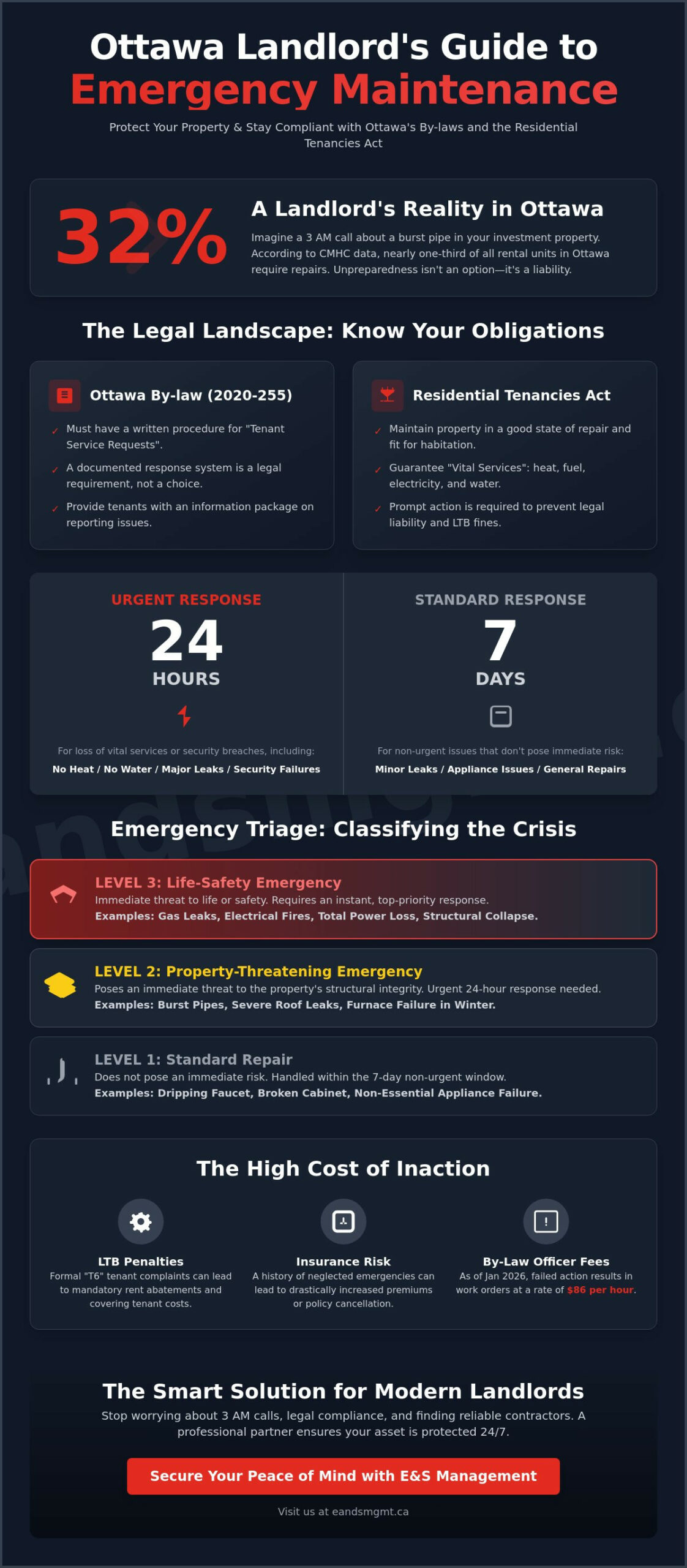
The by-law defines a service request as any notification regarding maintenance or property standards. For urgent matters, such as the loss of vital services or security breaches, the city expects a response within 24 hours. Non-urgent items allow for a seven-day window. If you don’t have a structured plan in place, you risk failing a city audit or facing direct intervention from municipal officers. A documented plan ensures that when a crisis occurs, you have a repeatable process to follow, which protects both your tenant and your investment.
Legal Obligations Under the Residential Tenancies Act
Your primary responsibilities are anchored in Ontario’s Residential Tenancies Act. This provincial law dictates that landlords must maintain the residential complex in a good state of repair and fit for habitation. A critical component of this duty is the “Vital Services” regulation. This requires you to ensure a consistent supply of heat, fuel, electricity, and water. During Ottawa’s harsh winters, a furnace failure is a high-stakes emergency that requires immediate action to prevent property damage and legal liability. Failing to restore these services promptly can lead to significant fines or mandatory rent abatements ordered by the Landlord and Tenant Board (LTB).
The Consequences of Improper Emergency Handling
Neglecting a maintenance emergency often leads to a “T6” application at the LTB. This is a formal tenant complaint about maintenance that can result in you paying back a portion of the rent or covering the tenant’s out-of-pocket costs. Beyond legal fees, your property insurance is also at risk. Insurers often view a history of neglected emergency repairs as a sign of high risk, which can lead to increased premiums or even policy cancellation. Additionally, Ottawa by-law officers have the authority to issue work orders if a landlord fails to act. As of January 1, 2026, the hourly rate for a property standards officer has increased to $86. These costs add up quickly, making a proactive approach to emergency maintenance for rental properties Ottawa the most cost-effective strategy for long-term asset protection.
Defining a Maintenance Emergency in the Ottawa Climate
A maintenance emergency is defined as any situation posing an immediate threat to life, safety, or the structural integrity of the property. In the context of emergency maintenance for rental properties Ottawa, the local climate dictates the level of urgency. While a leaky faucet is a nuisance, a burst pipe or a total loss of heat requires a 24-hour response under municipal guidelines. Standard repairs, which don’t pose immediate risks, generally allow for a seven-day window. Proper classification is the first step in protecting your investment and staying compliant with local laws.
Ottawa’s extreme temperatures create unique challenges that landlords in milder climates don’t face. From October to April, a furnace failure isn’t just a comfort issue; it’s a critical emergency. If indoor temperatures drop below freezing, pipes can burst, leading to catastrophic water damage and the displacement of tenants. This makes heating systems a “vital service” that landlords must prioritize. While homeowners in Ottawa spend an average of $3,200 annually on emergency AC repairs, the financial and legal stakes of a winter heating failure are significantly higher. Professional property management solutions help owners mitigate these risks through proactive oversight and reliable response systems.
Life-Safety vs. Property-Threatening Emergencies
Distinguishing between these categories helps landlords prioritize resources and response times. Life-safety emergencies include gas leaks, electrical fires, total power loss, or structural collapses. These situations require immediate evacuation and the involvement of emergency services. Property-threatening events involve issues like sewer backups, major roof leaks, or failed sump pumps. The Ottawa Property Standards By-law outlines the minimum maintenance requirements to ensure these systems function correctly. If these issues aren’t addressed within 24 hours, the damage to the asset can become irreversible and costly to remediate.
What Does NOT Constitute an Emergency?
Clear communication with tenants is essential to prevent unnecessary after-hours calls. Issues that don’t qualify as emergencies include dripping faucets, slow-moving drains, or cosmetic damage like peeling paint or burnt-out light bulbs in non-common areas. Appliance failures, such as a broken dishwasher or a burnt-out stove element, are usually non-urgent unless the lease specifically defines them as vital. By establishing these boundaries in the tenant information package, you ensure that your emergency maintenance for rental properties Ottawa protocol remains reserved for true crises, preserving both your budget and your professional relationships.
Professional Management vs. DIY Emergency Response
Choosing between managing a crisis yourself or delegating to a professional is a decision that impacts your property’s long-term health. The “3 AM reality check” is often the moment landlords realize that DIY emergency management carries hidden costs. When a pipe bursts or a furnace fails, the time spent searching for a reliable technician in the middle of the night leads to exhaustion and potentially thousands in preventable damage. Managing emergency maintenance for rental properties Ottawa effectively requires a pre-established network of professionals who respond immediately. Beyond the immediate repair, a professional manager acts as a vital buffer. They de-escalate high-stress interactions with tenants who may be frustrated by a loss of heat or water, ensuring the relationship remains professional and compliant with the Landlord and Tenant Board maintenance guidelines.
A significant advantage of professional oversight is the priority service secured through volume pricing. During city-wide crises, such as the severe ice storms Ottawa occasionally experiences, individual landlords often find themselves at the bottom of a contractor’s waiting list. Professional managers maintain deep relationships with vetted vendors, ensuring their clients’ properties receive attention first. This priority status is not just a convenience; it is an essential component of asset protection that prevents minor issues from escalating into structural failures.
The Non-Resident Landlord Dilemma
For Foreign Service and DND members serving abroad, managing a property from a different time zone is nearly impossible. A six-hour time difference means a midnight flood in Ottawa happens while you are in a morning briefing. Relying on a local friend or family member often creates legal and insurance gaps, as these individuals lack the professional standing to authorize major repairs or navigate by-law inspections. Without a local steward, “out of sight, out of mind” can quickly turn into a catastrophic loss.
Contractor Accountability and Quality Control
The distinction between a general handyman and a licensed trade is critical during an emergency. Professional management ensures that every technician is licensed, insured, and WSIB-compliant. This protects you from liability if a worker is injured on your property. All emergency maintenance for rental properties Ottawa must meet the Ontario Building Code and Electrical Safety Code. Meticulous documentation of these repairs is essential for future insurance claims or property appraisals, providing a clear paper trail of diligent stewardship.
Building a Robust Emergency Response Protocol
Developing a structured response framework is the only way to ensure emergency maintenance for rental properties Ottawa remains manageable. The first step involves establishing a dedicated 24/7 communication channel. Relying on a personal phone line often leads to missed alerts or delayed responses, which can be costly. This channel should be paired with a comprehensive “Preferred Vendor List.” By pre-negotiating rates and response expectations with licensed trades, you eliminate the friction of searching for help during a crisis. This foresight ensures that your property receives priority service even during peak demand periods.
Financial readiness is equally critical. You should maintain a dedicated repair fund to authorize immediate action without approval delays. When a boiler fails in February, every hour of indecision increases the risk of frozen pipes. Finally, document every interaction and repair meticulously. This log serves as your primary defense in the event of an LTB hearing or insurance inquiry. If you’re looking for a partner to manage these complexities, our Emergency 24/7 Maintenance Response service provides the professional oversight needed to protect your investment.
Preventative Maintenance: The Best Emergency is the One That Never Happens
Proactive stewardship reduces the frequency of urgent calls. Annual HVAC servicing and filter changes must occur before the Ottawa heating season begins in October. As the spring thaw approaches, test sump pumps and install battery backups to prevent basement flooding. Regular roof and gutter inspections are also essential to mitigate ice damming, a common cause of interior water damage in the capital region. Catching these “pre-emergencies” during regular property inspections is significantly more cost-effective than reactive repairs.
Tenant Education and Onboarding
Empowering your tenants is a strategic move that limits property damage. During the onboarding process, walk tenants through the unit to show them the location of the main water shut-off valve. Provide a clear “Who to Call” guide that distinguishes between true emergencies and standard service requests. Setting these expectations early ensures tenants know exactly how to act when a crisis occurs. Clear communication regarding access requirements for emergency repairs also helps maintain compliance with provincial laws while ensuring the safety of the residential complex.
E&S Property Management: Your 24/7 Ottawa Maintenance Partner
With a 40-year legacy of protecting residential assets in the capital, E&S Property Management provides the stability landlords need to thrive. We understand that emergency maintenance for rental properties Ottawa requires immediate, expert intervention to prevent asset devaluation. Our team manages the entire resolution process, from the initial tenant call to the final inspection of the repair. This comprehensive oversight ensures that every action taken aligns with both municipal by-laws and your long-term financial goals. We provide a transparent bridge between the property’s needs and your investment strategy, removing the operational burdens that often lead to landlord burnout.
Our rigorous contractor vetting process ensures that only licensed, insured, and WSIB-compliant professionals enter your home. We maintain a high-level consulting relationship with our vendor network, which grants our clients priority access during city-wide emergencies. You’ll receive real-time updates and detailed financial reporting on all maintenance costs. This level of transparency ensures you’re never left wondering about the status of your property or the cost of a repair. By acting as a disciplined steward, we ensure your residential complex remains in peak condition while you focus on your broader objectives.
The E&S “Steady Hand” Approach
We specialize in providing specialized support for Foreign Service and DND members serving abroad. For these owners, a significant time difference makes direct management of emergency maintenance for rental properties Ottawa an impossible task. We act as your local representative, handling the chaos of a mid-winter furnace failure or a sudden flood with professional composure. Our history includes managing high-stakes structural failures while owners were stationed overseas, ensuring the property remained compliant and the tenants stayed safe. This localized expertise serves as a signature of our commitment to the specific needs of the Ottawa community and its unique housing standards.
Seamless Integration with Your Investment Strategy
Effective maintenance coordination is a cornerstone of asset longevity. By providing responsive, professional service through our Emergency 24/7 Maintenance Response, we significantly reduce tenant turnover and maintain the market value of your property. Our proactive approach ensures that minor issues are resolved before they escalate into structural failures or legal disputes. This disciplined oversight protects your ROI and provides a sense of security that DIY management cannot match. Contact E&S today for a free rental assessment to learn how our stewardship can protect and enhance your Ottawa investment portfolio.
Securing Your Ottawa Investment Through Professional Stewardship
Managing a rental property in the capital requires more than just oversight; it demands a disciplined approach to risk mitigation and legal compliance. You now understand the critical 24-hour response window required by municipal by-laws and how the extreme local climate makes proactive heating maintenance essential. Establishing a robust protocol for emergency maintenance for rental properties Ottawa isn’t just about answering the phone at 3 AM. It’s about having a vetted network of professionals ready to act before a minor failure becomes a catastrophic loss.
E&S Property Management offers over 40 years of local experience and a trusted network of more than 100 licensed and insured contractors. We provide specialized NR6 and NR4 tax support alongside 24/7 maintenance coordination for expats and non-resident owners. Secure your property with Ottawa’s most reliable emergency maintenance team and remove the operational burdens from your daily life. Your property is a significant asset, and with the right steward, you can ensure its longevity and success for years to come.
Frequently Asked Questions
What is legally considered an emergency repair in Ontario?
An emergency repair is legally defined as any situation that poses an immediate risk to the safety of the occupants or the structural integrity of the residential complex. This includes gas leaks, total electrical failure, major water ingress, or a lack of heat during winter months. Landlords must act immediately to mitigate these hazards. Proper documentation of these events is essential for insurance purposes and to demonstrate compliance with provincial safety standards.
How long does an Ottawa landlord have to fix a broken furnace?
Landlords in Ottawa must respond to urgent maintenance requests, including a broken furnace, within 24 hours. Heat is a vital service, and its restoration is a legal priority. According to the Property Standards By-law, landlords must ensure units can maintain adequate temperatures. Failing to act quickly can lead to city by-law officers issuing work orders at an hourly rate of $86, reflecting the high cost of non-compliance.
Can a tenant withhold rent if an emergency repair is not handled?
No, a tenant cannot legally withhold rent in Ontario, even if an emergency repair remains unresolved. Withholding rent puts the tenant at risk of eviction for non-payment. Instead, the tenant should contact the City of Ottawa’s By-law services or file a T6 application with the Landlord and Tenant Board. This legal process allows the board to determine if a rent abatement or reimbursement for repair costs is appropriate.
What should I do if my tenant causes a maintenance emergency?
You must address the immediate emergency to protect your asset regardless of who caused the damage. Once the property is stable, you can investigate the cause. If the tenant is found to be negligent or willful in causing the damage, you can seek compensation through the LTB or issue an N5 notice. Maintaining a professional emergency maintenance for rental properties Ottawa protocol ensures the repair is handled correctly while you pursue a resolution for the costs.
Does property insurance cover emergency maintenance costs in Ottawa?
Property insurance typically covers the resulting damage from a sudden emergency, such as a burst pipe, rather than the maintenance of the system itself. For instance, your policy might cover the cost of drying a basement after a flood but won’t pay for the plumbing repair that caused it. Landlords should review their specific policy with an advisor to understand their coverage limits for high-stakes environmental events common in the capital region.
Is a property manager required to be on-call 24/7 in Ottawa?
While the law doesn’t explicitly state a property manager must be on-call 24/7, it does mandate a 24-hour response time for urgent issues. This requirement makes a round-the-clock response system practically necessary for compliance. Efficiently managing emergency maintenance for rental properties Ottawa involves having a reliable point of contact who can authorize repairs and dispatch contractors at any hour to meet these strict municipal and provincial timelines.
What are “Vital Services” under the Ontario Residential Tenancies Act?
Vital services under the Residential Tenancies Act include fuel, electricity, gas, hot or cold water, and heat. Landlords cannot legally cut off or interfere with these services, even if the tenant is in arrears. In Ottawa, providing heat is mandatory during the colder months to ensure units remain habitable. If a mechanical failure disrupts these services, it is classified as an urgent matter requiring a response within the 24-hour legal window.
How do I handle a maintenance emergency if I live outside of Canada?
Non-resident landlords should appoint a local property manager to act as their primary steward and point of contact. Managing a crisis from a different time zone often leads to delays that exacerbate property damage and legal liability. A professional management firm provides the necessary local presence to coordinate with contractors and by-law officers. This ensures your investment is protected and your legal obligations are met while you’re living abroad.