Did you know that as of July 1, 2026, an administrative oversight in managing a tenant dispute could result in personal fines of up to $100,000? Learning how to handle tenant complaints effectively is now a critical financial safeguard rather than a simple courtesy. With the Landlord and Tenant Board (LTB) currently facing wait times of up to twelve months for certain applications, the cost of a poorly managed conflict is substantial. Most property owners feel the mounting pressure of these delays and the stress of dealing with difficult personalities while trying to protect their rental income.
It’s a heavy burden to carry, but you don’t have to manage these complexities without a plan. This guide provides a professional roadmap to resolving disputes while ensuring you remain in full compliance with Ontario’s Residential Tenancies Act and the latest Bill 97 requirements. We’ll explore a structured approach to communication and documentation that protects your property’s revenue and minimizes administrative friction. Mastering these steps will help you maintain stable, paying tenants and secure your reputation as a disciplined steward of your real estate assets.
Key Takeaways
- Learn how to align your dispute resolution with the Residential Tenancies Act to avoid escalating fines and lengthy LTB delays.
- Discover a 5-step professional framework for how to handle tenant complaints effectively, beginning with a critical 24-hour acknowledgment window.
- Identify strategies to streamline maintenance and noise disputes by replacing informal communication with standardized, professional record-keeping.
- Understand the “paper trail” philosophy and why comprehensive documentation is your most effective tool for long-term risk management.
- Explore how professional property management serves as a buffer to depersonalize conflict and maintain the operational stability of your investment.
The Legal and Financial Stakes of Tenant Complaints in Ontario
In the context of professional property oversight, tenant complaints are defined as formal or informal expressions of dissatisfaction regarding property conditions, lease terms, or the conduct of others on the premises. While some owners view these interactions as a nuisance, learning how to handle tenant complaints effectively is a core component of risk mitigation. In Ontario, the relationship between owner and occupant is strictly governed by the Residential Tenancies Act (RTA). This legislation sets the baseline for your responsibilities, ensuring that your property remains a safe, habitable environment while protecting the rights of all parties involved.
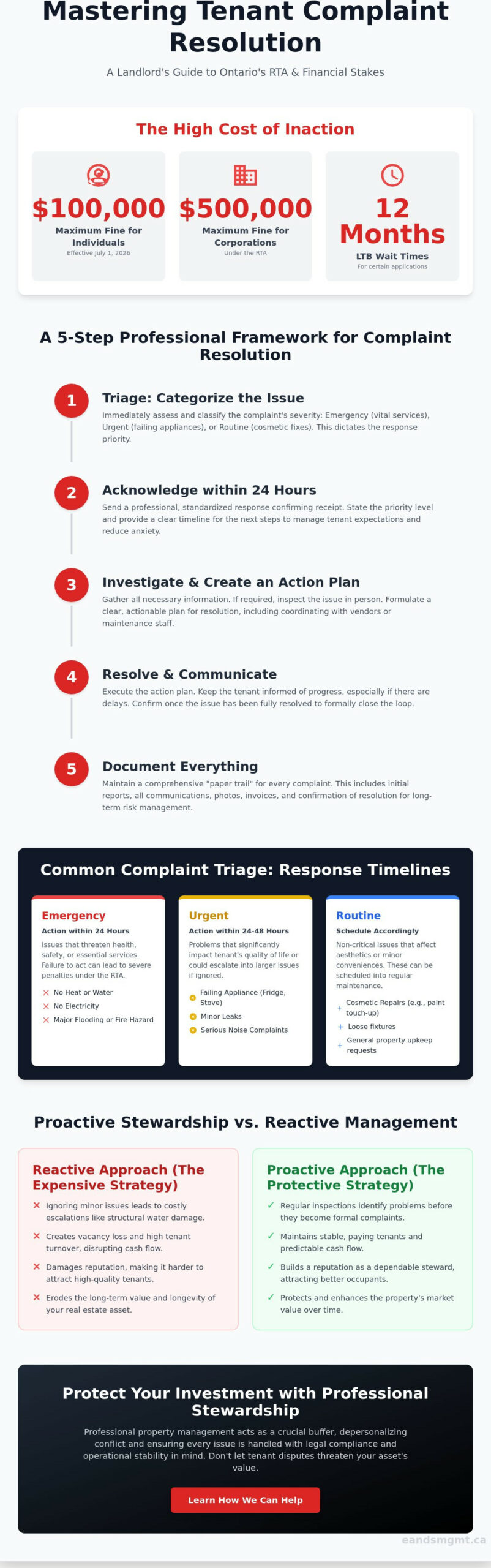
The financial stakes of mismanaging these disputes have reached unprecedented levels. As of July 1, 2026, the maximum fines for offences under the RTA have doubled. Individual landlords now face penalties of up to $100,000, while corporations can be fined up to $500,000. These figures reflect a provincial shift toward much stricter enforcement. Beyond direct fines, the “hidden cost” of unresolved complaints lies in the current Landlord and Tenant Board (LTB) backlog. With tenant-led applications for maintenance issues (T6) or harassment (T2) often taking between 9 and 12 months to reach a hearing, early resolution isn’t just good service; it’s a financial necessity.
Understanding Your Obligations Under the RTA
Effective management requires a clear understanding of landlord-tenant law and the distinction between essential services and aesthetic concerns. Essential services, such as heat, water, and electricity, require immediate action. Aesthetic issues, while important for tenant retention, carry less legal weight. Ontario law mandates that landlords address maintenance issues within a “reasonable” timeframe. While the RTA doesn’t define “reasonable” as a specific number of hours, the Rental Housing Enforcement Unit (RHEU) typically expects action on vital services within a 24-hour window. Failing to meet these benchmarks can lead to rent abatement orders or costly legal interventions that drain your administrative resources.
Why ‘Ignoring it’ is the Most Expensive Strategy
A reactive approach almost always leads to repair escalation. A minor plumbing complaint that’s ignored can quickly evolve into structural water damage, requiring extensive remediation and potentially displacing tenants. This transition from a simple fix to a major project creates vacancy loss and erodes the longevity of your asset. In a competitive market like Ottawa, your reputation as a dependable steward is a tangible asset. High tenant turnover and negative reviews make it difficult to secure high-quality occupants, eventually impacting your property’s market value. Proactive oversight, including regular property inspections, allows you to identify these issues before they become formal complaints, keeping your investment stable and your cash flow predictable.
A 5-Step Professional Framework for Complaint Resolution
Managing a rental property requires a methodical approach to conflict. Without a standardized workflow, minor grievances can quickly escalate into formal legal disputes that threaten your cash flow. Implementing a structured framework is the most reliable way to maintain order and protect your investment. This process ensures that every issue is addressed with the same level of professional scrutiny, regardless of its perceived severity. Learning how to handle tenant complaints effectively starts with removing emotion from the equation and replacing it with a logical, five-step resolution cycle that prioritizes asset protection and legal compliance.
Step 1 & 2: Triage and Professional Acknowledgment
The triage phase is where you determine the legal and operational weight of a complaint. You must categorize issues into three tiers: Emergency, Urgent, and Routine. Emergencies involving vital services like heat or water require immediate intervention to prevent RTA violations. Urgent issues, such as a failing appliance or a minor leak, demand action within 24 to 48 hours. Routine matters, such as cosmetic repairs, can be integrated into your standard maintenance schedule. A professional acknowledgment must be sent within 24 hours of receipt. This response should use a neutral, solution-oriented template that confirms receipt, assigns a priority level, and provides a clear timeline for the next steps. Setting these expectations early reduces tenant anxiety and prevents the risk of rent withholding, which often stems from a feeling of being ignored.
Step 3 to 5: Investigation, Action, and Verification
Once acknowledged, you must gather objective evidence to support your resolution plan. For non-resident landlords, digital tools like time-stamped photos or video walkthroughs are essential for remote investigation. This documentation serves as your primary defense if the case ever reaches Ontario’s Landlord and Tenant Board. When action is required, always coordinate with licensed contractors who ensure all repairs meet Ontario building codes. This guarantees that the resolution is a long-term fix rather than a temporary patch. The final step is verification. Never consider a file closed until you have a ‘Verification Receipt’ or written confirmation from the tenant that the work is satisfactory. This closing of the loop is a hallmark of full-service property management, ensuring that small issues don’t re-emerge as major liabilities. By following this disciplined cycle, you demonstrate a commitment to asset longevity and professional stewardship.
Resolving Frequent Issues: Maintenance, Noise, and Safety
Applying a structured framework to specific grievances requires a deep understanding of local regulations and property standards. While the general process remains the same, the technical requirements for a plumbing leak differ significantly from a noise dispute between neighbors. Understanding these nuances is the only way to determine how to handle tenant complaints effectively while protecting your asset’s long-term value. Most friction in the landlord-tenant relationship stems from three core areas: maintenance, quiet enjoyment, and physical security. Addressing these proactively prevents minor frustrations from evolving into costly legal challenges at the Landlord and Tenant Board.
Maintenance and the ‘Vital Services’ Rule
Maintenance requests are the most frequent source of administrative burden for property owners. In Ontario, landlords are legally required to maintain the complex in a good state of repair and fit for habitation. This includes managing “vital services” like heat, water, and electricity. For those operating in the Ottawa region, specific municipal bylaws dictate that landlords must maintain a minimum temperature of 20°C from September 1 to May 31. Failing to meet these seasonal deadlines or ignoring a failing furnace can result in immediate intervention from the Rental Housing Enforcement Unit. Beyond heating, plumbing issues require a rapid response to prevent catastrophic water damage. Implementing a system for 24/7 emergency maintenance response ensures that leaks are contained before they impact the building’s structural integrity or lead to mold remediation costs.
Navigating Inter-Tenant Conflicts and Noise
Noise complaints fall under the category of “reasonable enjoyment,” a right guaranteed to every tenant under the Ontario Standard Lease. Establishing a professional framework for complaint resolution in these cases involves acting as a neutral mediator rather than an emotional participant. When disputes arise between occupants, your role is to verify the disturbance and determine if it constitutes a substantial interference with the rights of others. If a tenant’s behavior consistently violates these terms, you must document every instance to support an N5 notice. This documentation should include dates, times, and impact statements from affected parties. By maintaining a disciplined record, you create the legal foundation necessary to resolve the issue through formal channels if mediation fails.
Safety and security concerns, such as broken locks or inadequate lighting in common areas, should be treated with the same urgency as vital services. These issues aren’t just tenant complaints; they’re liability risks. Regular property inspections allow you to identify these vulnerabilities before they’re reported, demonstrating foresight and a commitment to professional stewardship. Proactive oversight reduces the volume of incoming complaints and reinforces your reputation as a dependable owner who values the safety of their residents and the longevity of their property.
Documentation and Risk Management: Protecting Your Assets
The ‘Paper Trail’ philosophy is simple: if it isn’t in writing, it didn’t happen in the eyes of the law. Transitioning from informal text messages to professional email or dedicated portals is the first step in how to handle tenant complaints effectively. Text messages are difficult to archive. They often lack the professional context required for legal proceedings. A centralized communication system ensures every interaction is time-stamped and searchable. This level of organization is vital. The Landlord and Tenant Board (LTB) received approximately 87,600 new applications in the 2024-2025 fiscal year. When you are one of tens of thousands of cases, clarity is your best defense. Organization prevents chaos.
The Anatomy of a Perfect Record
The ‘Documentation Gold Standard’ includes precise dates of all interactions, high-resolution photos of the issue, and detailed contractor invoices. Beyond the physical repair, you must record the ‘reasonableness’ of your response. This involves tracking response times and the specific efforts made to coordinate repairs. For landlords living abroad, cloud-based storage solutions are indispensable. These digital folders should be organized by tenant and incident. This allows you to produce a complete history of any dispute at a moment’s notice. Meticulous records reflect a commitment to asset longevity and administrative efficiency. They remove the burden of memory during high-stress conflicts.
Legal Shielding: Preparing for Potential LTB Hearings
A robust record-keeping system serves as a deterrent against ‘Bad Faith’ claims. It discourages frivolous tenant applications. When a tenant sees that every request is met with a professional, documented response, the likelihood of them filing a T6 application for maintenance decreases. Regular property inspections provide an objective baseline. They prove that the property met provincial standards before and after a complaint was filed. If a resolution cannot be reached, these records allow for a seamless transition to formal legal notices, such as N5 or N7 forms. With fines for individual landlords reaching $100,000 as of July 1, 2026, administrative diligence is your strongest shield. Protect your reputation. Protect your income.
The Value of Professional Stewardship for Ottawa Landlords
Professional stewardship transforms a high-stress rental property into a stable investment asset. One of the most significant advantages is the “buffer effect.” A property manager acts as a neutral third party, depersonalizing conflict and ensuring that all interactions remain strictly professional. This distance is essential for owners who find direct negotiations with difficult personalities emotionally draining. By delegating the resolution process, you ensure that every dispute is handled with a focus on RTA compliance and asset protection rather than personal sentiment. This methodical approach reduces the risk of administrative errors that could lead to costly LTB hearings.
Local expertise is equally critical in the Ottawa market. Navigating municipal requirements, such as the specific heating bylaws that mandate minimum temperatures from September to May, requires a steady hand and a reliable contractor network. We provide an Emergency 24/7 Maintenance Response, removing the burden of midnight calls and ensuring that vital services are restored before they become legal liabilities. For non-resident owners, we also provide specialized NR6 and NR4 Tax Filing Support. This ensures your CRA obligations are met with the same precision as your property maintenance, providing a comprehensive resolution for all administrative burdens.
Removing the Burden for Foreign Service and Expat Owners
Managing a property across different time zones presents unique logistical hurdles. When a furnace fails or a neighbor reports a noise disturbance, an absentee landlord cannot personally verify the issue. This is where a local partner becomes indispensable. Learning how to handle tenant complaints effectively from a distance requires more than just an email; it requires a physical presence to conduct regular property inspections and verify that repairs meet provincial standards. Our team acts as your disciplined steward on the ground, coordinating with licensed professionals to maintain the integrity of your Ottawa home. Professional tenant placement services also act as a proactive defense, reducing the volume of future complaints by securing high-quality, reliable residents from the start.
Transitioning to a Stress-Free Investment
The return on investment for professional management is found in lower turnover rates and enhanced asset longevity. When tenants feel their concerns are heard and resolved promptly, they’re more likely to remain in the unit. This reduces the significant costs associated with vacancy and re-leasing. Evaluate your current workload and the time you spend managing administrative friction. If the stress of potential LTB delays or the complexity of current regulations is impacting your investment strategy, it’s time to shift to a more structured oversight model. You can contact E&S Property Management for a seamless oversight solution that protects your capital and restores your peace of mind.
Secure Your Investment Through Professional Oversight
Managing a rental property in Ontario requires a disciplined approach to legal compliance and administrative order. You’ve learned that a structured resolution framework, backed by meticulous documentation, is the only way to navigate current regulatory pressures. Mastering how to handle tenant complaints effectively is the difference between a volatile liability and a predictable income stream. It’s about moving from a reactive stance to a proactive strategy that prioritizes asset longevity and tenant stability.
With over 40 years of residential expertise in the Ottawa market, E&S Property Management provides the steady hand required to oversee these complexities. We specialize in supporting Foreign Service and DND members; we offer comprehensive NR6 and NR4 tax administration to ensure your investment remains compliant from anywhere in the world. Let E&S Property Management handle the complexities of tenant relations for you. Your property should be a source of financial security, not a constant administrative burden. We’re here to provide the professional stewardship your assets deserve.
Frequently Asked Questions
Can a tenant in Ontario withhold rent if they have a complaint about repairs?
No, tenants in Ontario are legally required to pay rent in full even if they have outstanding maintenance concerns. Withholding rent is a serious breach that allows a landlord to file an L1 application for eviction. The proper procedure is for the tenant to pay rent and then file a T6 application for a hearing. This highlights why learning how to handle tenant complaints effectively is vital for maintaining steady cash flow and legal leverage.
What is a ‘reasonable amount of time’ for a landlord to fix something in Ontario?
The Residential Tenancies Act doesn’t provide a specific hourly definition for “reasonable,” but industry standards dictate urgency based on the issue’s severity. Vital services like heat, water, and electricity should be addressed within 24 hours. For non-essential repairs, a window of one to seven days is generally considered professional. Clear communication regarding these timelines prevents tenants from escalating the matter to the Landlord and Tenant Board, which currently faces significant processing backlogs.
How should I handle a tenant who constantly complains about minor issues?
Address frequent minor complaints by standardizing your communication through a professional portal or email. This creates a documented history and prevents emotional fatigue from constant phone calls. Categorize these requests as “routine” during your triage process and schedule them for a single maintenance visit. This structured approach maintains the property’s condition without allowing administrative tasks to consume your schedule or disrupt your investment’s operational stability.
Do I need to provide 24 hours’ notice to inspect a complaint inside the unit?
Yes, you must provide a written notice at least 24 hours in advance for any non-emergency inspection or repair. The notice must specify the reason for entry and a time window between 8:00 AM and 8:00 PM. In the case of a true emergency, such as a burst pipe or fire, you may enter without notice. Always document the reason for emergency entry to protect against future claims of illegal entry or privacy violations.
What can I do if a tenant complains about noise from a neighboring unit?
Act as a neutral mediator by investigating the complaint and determining if the noise constitutes a “substantial interference” with reasonable enjoyment. If the noise violates local bylaws or lease terms, issue a formal warning to the offending party. If the behavior persists, you may need to serve an N5 notice. Maintaining detailed logs of these complaints is a key part of how to handle tenant complaints effectively when legal escalation becomes necessary to protect the property.
How do I handle tenant complaints if I am living outside of Canada?
Non-resident landlords should utilize a local property management partner to provide a physical presence for inspections and repairs. Managing disputes across time zones is logistically difficult and risks violating RTA timelines for vital services. A local manager provides 24/7 emergency response and ensures all resolutions comply with Ontario law. This removes the operational burden from the owner while protecting the asset from damage or legal penalties, which is essential for those in the Foreign Service.
What is the Rental Housing Enforcement Unit (RHEU) and when do they get involved?
The Rental Housing Enforcement Unit (RHEU) is a provincial body that investigates reported offences under the Residential Tenancies Act. They typically get involved in high-severity cases, such as the illegal shut-off of vital services or unlawful lockouts. While the LTB handles civil disputes, the RHEU can issue fines that have doubled as of July 1, 2026. Maintaining professional documentation of all resolutions is the best way to demonstrate compliance if the RHEU ever contacts you.
Can a tenant file a T2 application for ‘harassment’ if I respond to their complaints too frequently?
A tenant can file a T2 application if they believe your conduct interferes with their reasonable enjoyment, but professional, solution-oriented communication rarely qualifies as harassment. Harassment typically involves threats, coercion, or frequent unannounced entries. To avoid this risk, keep all communication focused on the resolution of the specific issue. Using standardized templates and sticking to agreed-upon timelines ensures your interactions remain professional and legally defensible, protecting you from frivolous claims.